
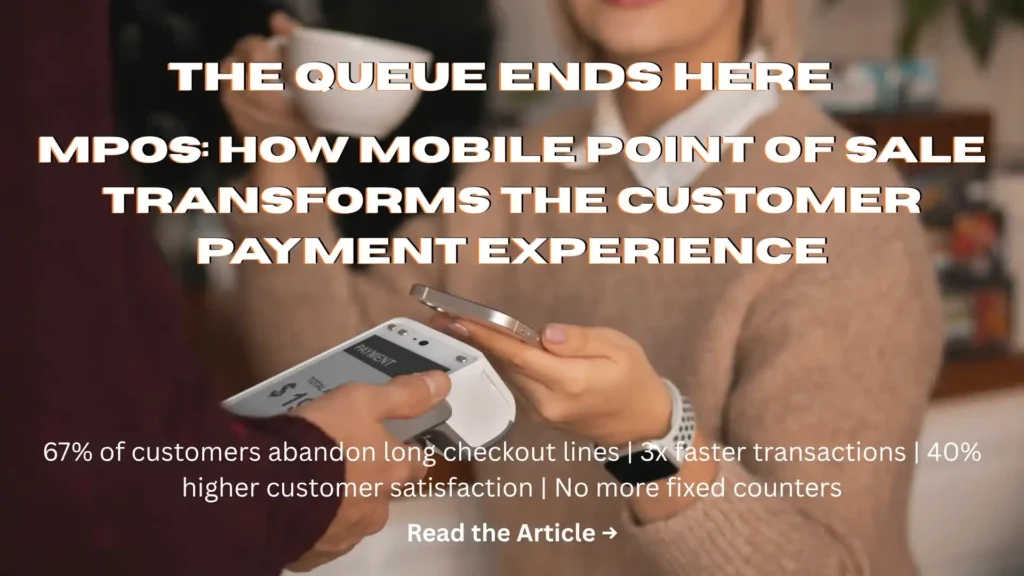
A customer walks up to your counter, picks up exactly what they want — and then puts it back down and walks out because you do not accept card payments. That lost sale happens thousands of times every day across India. And with the explosion of UPI, digital wallets, and contactless payments, it is happening more frequently — not less. The solution is not complicated. It is mPOS — mobile Point of Sale — and it is changing the way retailers and merchants across India do business.
What Is mPOS and Why Does It Matter?
mPOS (Mobile Point of Sale) is a compact payment acceptance solution that turns a smartphone or tablet into a fully functional payment terminal. Using a small card reader connected to your device, you can accept credit cards, debit cards, UPI payments, digital wallets, and contactless transactions — anywhere, instantly.
For small and mid-size retailers, restaurants, delivery businesses, and service providers, mPOS removes the biggest barrier to completing a sale: payment inflexibility.
India’s payment landscape is uniquely diverse. Different customers prefer different payment modes — and those preferences vary by region, age group, and transaction size. Some customers only carry cards. Others exclusively use UPI. Many prefer digital wallets like Paytm or PhonePe. A traditional cash-only or single-mode payment setup means turning away every customer whose preferred method you do not support.
mPOS accepts them all. That single capability alone justifies the investment.
mPOS vs Traditional POS: The Key Difference
Traditional POS systems are fixed, expensive, and require significant infrastructure. You need a dedicated terminal, a broadband connection, and a fixed checkout counter. They work well for established retail locations — but they offer zero flexibility for businesses that operate on the move, across multiple locations, or in environments where a fixed terminal is impractical.
mPOS is the opposite:
- No fixed infrastructure required — any smartphone or tablet becomes a payment terminal
- Works anywhere with a mobile connection — trade shows, pop-up events, delivery routes, customer premises
- Fraction of the cost — significantly lower setup investment than traditional POS hardware
- Set up in minutes — not days of installation and configuration
For growing businesses that need payment flexibility before they are ready for a full POS infrastructure, mPOS is the practical, cost-effective bridge.
5 Reasons Your Business Needs mPOS Right Now
1. Grow Your Sales by Accepting Every Payment Mode
The most direct benefit of mPOS is also the most commercially significant: you stop turning away customers.
Today’s Indian consumer is comfortable with multiple payment modes — UPI via BHIM, Google Pay, or PhonePe; contactless card payments; digital wallets; EMI options; and cash. Their preference at any given moment depends on the transaction size, their current balance, and simply what is most convenient.
When you can accept every mode, you remove friction from the purchase decision. Research consistently shows that payment flexibility increases both the frequency of purchase and the average transaction value. Customers who are not limited to cash tend to spend more freely — because digital payment feels less immediate than handing over physical notes.
Fewer payment declines. Fewer abandoned purchases. Higher revenue per customer visit.
2. Track Customer Data and Drive Repeat Business
Every mPOS transaction is a data point. And those data points — when captured and used well — are the foundation of customer retention.
A connected mPOS solution captures customer mobile numbers and transaction histories, which you can use to:
- Send targeted offers and discount campaigns to customers who have already bought from you
- Build loyalty programmes that reward repeat visits
- Identify your highest-value customers and give them preferential treatment
- Reach out during slow periods with time-limited promotions
This is marketing intelligence that traditional cash-only businesses simply do not have. Every digital transaction your customer makes builds a profile you can use to serve them better — and bring them back more often.
3. Go Digital With Instant, Automated Receipts
Paper receipts are slow, unreliable, and increasingly unwanted. Digital receipts — sent instantly to a customer’s phone or email — are faster, more professional, and more convenient for everyone.
With mPOS, the moment a payment is processed:
- A digital receipt is automatically sent to the customer
- The transaction is recorded in your payment system
- Your accounts are updated in real time
No manual entry. No reconciliation errors. No paper trail to manage. It is faster for your staff, cleaner for your records, and better for your customer experience.
4. Accept Payments Anywhere, Anytime
The traditional payment counter creates a bottleneck. Customers queue. Service slows. The experience deteriorates — particularly during peak periods.
mPOS eliminates the bottleneck entirely. Your team can accept payment at the table in a restaurant, at the customer’s doorstep for a delivery, on the shop floor during a sale event, or at an outdoor market stall. Payment happens where the customer is — not where your fixed terminal is.
This flexibility is transformative for:
- Restaurants and cafés — tableside payment removes the queue at the till
- Delivery businesses — accept payment on delivery without cash handling
- Field service teams — collect payment on site when the job is complete
- Pop-up retailers and events — trade anywhere without fixed infrastructure
Convenience at the point of payment directly improves the customer experience — and a better experience drives better reviews, referrals, and repeat visits.
5. A Complete, Hassle-Free Payment Solution
The best mPOS solutions do not just process payments. They connect payment acceptance to your broader business operations — inventory, customer management, sales reporting, and financial reconciliation.
When your mPOS is integrated with your retail management or ERP platform, every transaction updates your records automatically. Stock levels adjust. Revenue is captured. Customer data is stored. End-of-day reconciliation takes minutes instead of hours.
This end-to-end connectivity is what separates a true business solution from a simple payment tool — and it is what makes mPOS genuinely transformative rather than merely convenient.
How Trident’s Retail Technology Supports mPOS Integration
Trident Information Systems provides retail and hospitality management solutions — including LS Central on Microsoft Dynamics 365 Business Central — that integrate mPOS capabilities with full inventory management, customer loyalty, financial reporting, and multi-location management.
Whether you operate a single outlet or a growing retail chain, our solutions connect your payment acceptance directly to your business operations — giving you the complete picture of performance in real time.
Ready to upgrade your payment experience and grow your business? Book a free retail technology assessment with Trident today. For more insightful content and industry updates, follow our LinkedIn page.

