
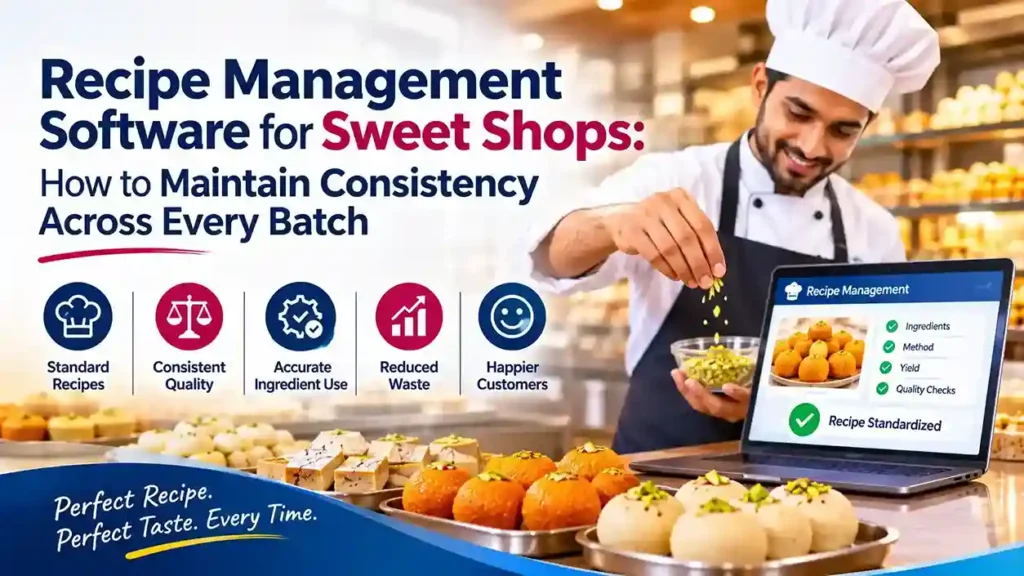
Sweet shops face a challenge that general food manufacturers do not: recipes are not just formulas—they are the brand. A slightly denser barfi, a less glossy jalebi, or a subtly different kaju katli texture erodes customer trust built over decades. Consistency is not a quality metric; it is the product itself.
Recipe management software solves this by digitizing the formulation, controlling ingredient variance, and enforcing production discipline across every batch. This guide explains how sweet shops can use recipe management systems to achieve batch-to-batch consistency at scale.
Why Sweet Shop Consistency Is Harder Than It Looks
Sweet manufacturing involves variables that general ERP systems ignore: sugar-to-glucose ratios, cooking temperatures, humidity during cooling, and the freshness of perishable ingredients like milk solids and khoya. A 2023 study found that optimizing sugar ratios alone can improve production efficiency by up to 15%, reducing waste and enhancing product consistency .
Manual recipe management fails because:
- Recipes live in notebooks or the head chef’s memory
- Ingredient substitutions happen without documentation
- Batch sizes vary, but scaling calculations are manual and error-prone
- Quality checks depend on individual judgment, not recorded parameters
Software addresses these gaps by making the recipe the single source of truth—not a suggestion.
Core Features of Recipe Management for Sweet Shops
Recipe-Based Bill of Materials (BOM)
Every product is tied to a structured BOM listing each ingredient, its quantity, unit, and cost. RealSoft ERP, built for sweets and chocolate producers, tracks every ingredient’s weight, cost, and shelf-life, ensuring each batch meets quality and cost standards . When ingredient prices change, the system recalculates costs automatically, preventing margin erosion.
Batch Scaling with Precision
Sweet shops rarely make the same quantity twice. A recipe for 100 pieces must scale reliably to 250 or 1,000 without compromising texture or taste. Software handles the math, but more importantly, it enforces proportional scaling rules that account for evaporation, yield loss, and equipment capacity limits.
Automated Cost Calculation
Recipe management is inseparable from costing. Systems like FoodCore calculate cost price automatically from ingredient prices and recipe quantities, so sweet shop owners know the true margin per product without manual spreadsheets . This also exposes when a recipe has drifted from its profitable formulation.
Traceability and Recall Readiness
Food safety regulations require forward and backward traceability. If a batch of khoya is contaminated, the shop must know which finished sweets used it. LS Central for sweet manufacturers provides full traceability from raw materials to final products sold, supporting faster recall resolution .
How Software Enforces Consistency
Ingredient Control
The system flags when an ingredient is outside specification—for example, if sugar grade differs from the standard grade used in prior batches. RealSoft ERP’s expiry tracking and FEFO (First Expired, First Out) stock movement prevent stale ingredients from entering production . Consistency starts with consistent inputs.
Production Discipline
Job cards or production orders generated from the recipe dictate exact quantities and sequence. Workers cannot substitute or approximate without documented approval. This reduces the “a little extra” culture that introduces variance.
Quality Checkpoints
LS Central automates quality checks at each production stage, ensuring compliance with standards and recording results against the batch . Over time, this data reveals which parameters correlate with customer complaints or product returns.
Seasonal Demand Management
Sweet shops face extreme seasonal spikes—Diwali, Eid, wedding seasons. Production scheduling optimized for demand while maintaining recipe discipline is essential. LS Central’s production scheduling and management modules help optimize workflows to meet retailer demands on time without sacrificing quality .
Microsoft-Based Solutions for Sweet Shops
For organizations in the Microsoft ecosystem, two paths exist:
LS Central for Sweets and Namkeen extends Dynamics 365 Business Central with recipe and batch management, production scheduling, quality control, and omnichannel retail capabilities. Trident Information Systems offers fixed-fee implementation plans for sweet manufacturers, with recipe management included in Retail + Finance + SCM configurations and go-live timelines of 18 weeks .
Business Central with ISV extensions provides a more configurable starting point. Sweet shops can adopt standard BC manufacturing and inventory modules, then add recipe and batch functionality through AppSource solutions or partner-built extensions. This suits operations planning to integrate finance, production, and retail in a single platform without full LS Retail specialization.
Implementation Considerations for Sweet Shops
Document before digitizing. Clean up existing recipes before loading them into software. Inconsistent measurements, outdated ingredient lists, and undocumented substitutions will transfer directly into the new system.
Standardize units and yields. Define standard batch yields, expected loss percentages, and unit conversions. The system enforces what you define—define it correctly.
Train production staff, not just management. The system only enforces consistency if the people making sweets use it. Job cards and ingredient issue processes must be followed on the floor, not bypassed.
Start with high-volume products. Pilot the software on your best-selling items where consistency failures are most visible and costly. Expand to the full range once workflows stabilize.
Final Thoughts
Recipe management software does not make sweets taste better—it makes them taste the same every time. For sweet shops, that consistency is the foundation of brand trust and repeat business.
Whether you choose LS Central for its purpose-built sweet manufacturing capabilities or configure Business Central with recipe extensions, the essential step is treating the recipe as controlled data rather than oral tradition. The shops that do this will scale without losing the quality that built them.
Evaluating recipe management software for your sweet shop? Start by documenting your top ten recipes, ingredient specifications, and quality parameters. Then assess whether LS Central’s industry-specific modules or a configured Business Central approach better fits your production and retail model.