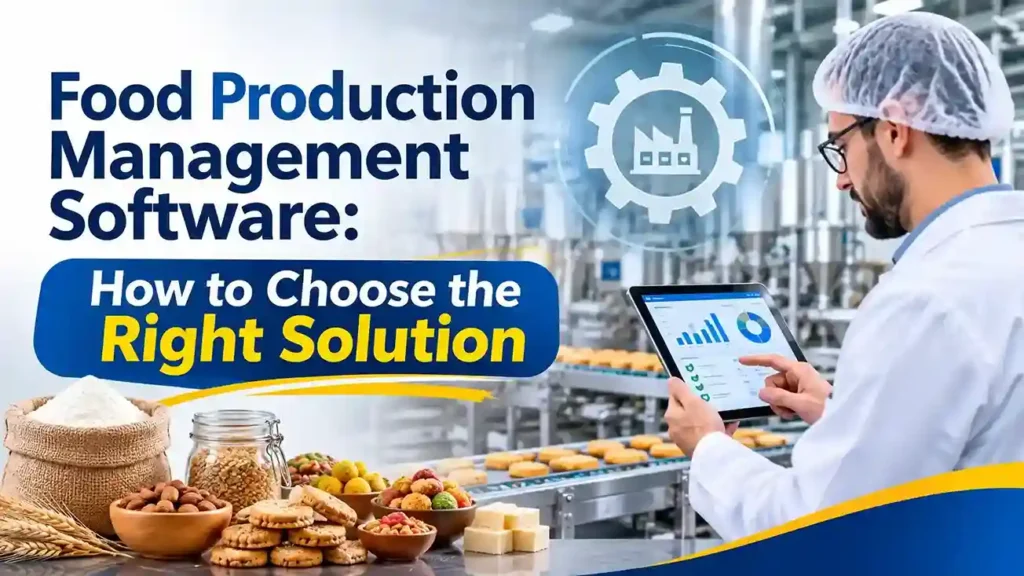
Choosing food production management software in 2026 comes down to one question: does the platform handle your operational reality—batch traceability, allergen control, shelf-life enforcement, and recipe precision—without forcing your team into workarounds? For mid-market food manufacturers on Microsoft, the realistic choice sits between Dynamics 365 Business Central (with embedded food extensions) for single-site or simpler multi-site operations, and Dynamics 365 Finance & Operations for complex, multi-entity production networks. Trident’s implementation experience shows that the platform decision matters less than data readiness and process discipline before go-live.
The Uncomfortable Truth About Food ERP Selection
Most food manufacturers don’t pick the wrong software. They pick the right software too late—after years of spreadsheet patching, manual lot tracking, and recipe knowledge living in individual operators’ heads.
The cost of that delay is measurable. Food manufacturers implementing smart ERP systems consistently report 30–35% waste reduction within the first year, driven primarily by enforced recipe precision, automated FIFO enforcement, and demand forecasting that prevents overproduction . On a mid-scale operation, recovering even 3% in ingredient yield translates directly into recovered margin every year.
The selection question, then, is not “which system has the most features.” It is “which system can we actually implement—with our data quality, our team capacity, and our regulatory obligations—before the next audit season.”
What Food Production Software Must Do (That Generic ERP Cannot)
Food manufacturing is not discrete manufacturing with expiration dates bolted on. The operational requirements are fundamentally different, and any platform evaluation should start here.
Batch and lot traceability from receipt to shipment. Forward and backward tracing must be executable in minutes, not days—critical during a recall event or mock audit. In USDA-regulated environments, mock recalls are expected to complete in under four hours . If your current system requires a team to manually reconstruct lot lineage from paper records, that gap is a liability.
Recipe and formula management with version control. Ingredients have substitutions, yield factors fluctuate, and allergen declarations must stay synchronized with every recipe change. A recipe entered once should propagate to costing, labeling, production orders, and compliance documentation automatically—not through a separate spreadsheet update .
Shelf-life enforcement and FEFO picking. First Expired, First Out must be a system rule, not a warehouse convention. The platform should track remaining shelf life at every stage and enforce expiry-based allocation without manual intervention .
Allergen data embedded in master data. Allergen information cannot live in a label template or a quality binder. It must be attached to ingredients, roll up through multi-level BOMs, and flag risks before a production order releases .
Quality checks tied to production stages. HACCP critical control points, pre-shipment reviews, and sanitation logs need to be system-enforced workflow steps—not paperwork completed after the fact .
Business Central vs. Finance & Operations: The Real Decision
For organizations already committed to the Microsoft ecosystem, the platform decision typically narrows to two paths. The choice is not about which is “better”—it is about which fits your operational complexity today and for the next five years.
When Business Central (with food extensions) Fits
Business Central serves single-site or small multi-site food manufacturers, typically up to a few hundred users, with straightforward formula structures and limited co-product complexity .
The critical caveat: standard Business Central was not built for food production. It handles finance, inventory, and general manufacturing well, but lot traceability depth, allergen rollup, catch-weight pricing, and batch-level recipe control require embedded extensions . On the Microsoft Marketplace, solutions like Harvest bundle production batching, item specifications, lot traceability, and allergen management directly into Business Central . Trident’s own work with food manufacturers on Business Central follows the same pattern: start with process manufacturing and product specification modules, then add segment-specific functionality for fresh, beverage, or confectionery operations .
Business Central licensing runs approximately $70–$100 per user per month, making it accessible for mid-market operations that need food-specific functionality without enterprise ERP overhead .
When Finance & Operations Is the Right Call
F&O becomes the correct choice when the operation has multiple legal entities, multi-country production, complex co-product and by-product accounting, or high transaction volumes that strain Business Central’s architecture .
The rule of thumb from implementation practitioners is straightforward: one or two plants with simple formulas and a need to go live fast → Business Central. Several legal entities, complex formulas with co-products, high volume → Finance & Operations . F&O’s native advanced warehouse management, catch-weight variable-measure item support, and lot traceability from purchase order through sales shipment justify the higher licensing cost ($180–$210 per user per month) and longer implementation timeline for organizations that genuinely need that depth .
What Actually Determines Implementation Success
Trident’s food manufacturing implementation experience, consistent with broader industry data, points to the same conclusion: projects fail on data and decisions, not on software features.
Master data quality is the silent project killer. Recipes, allergen declarations, supplier records, and item specifications accumulated over years in spreadsheets contain inconsistencies that surface only during migration. The implementation phase that covers data migration takes longer than planned in almost every food ERP project . Budget for cleansing, not just migration.
Customization discipline protects your release cadence. Every bespoke extension is paid for once to build and forever to maintain, test, and revalidate through Microsoft’s twice-yearly release waves. The food manufacturers who achieve stable operations fastest are those who adapt their processes to the platform’s built-in food-industry logic rather than recreating legacy workarounds in code .
UAT scenarios must reflect actual production conditions. A user acceptance test that runs through ideal-state transactions while ignoring allergen changeover, partial batch consumption, or co-product reporting is not a test. It is a formality that pushes discovery into hypercare—when fixing problems costs three times as much.
A Practical Selection Framework
Before signing any contract, verify these capabilities against your actual operations:
Traceability depth. Ask the vendor to demonstrate a forward trace from a finished lot to all ingredient lots consumed, and a backward trace from an ingredient lot to every finished product it touched. If either takes more than a few clicks, the traceability is not production-grade.
Allergen rollup logic. Request a walkthrough of how allergen data flows from ingredient master through BOM to production order to label. Manual steps in that chain are failure points.
Catch-weight and variable-measure handling. If you process meat, seafood, or any product where case count and weight diverge, confirm native support—not a customization .
Regulatory alignment for your market. FSSAI for India, USDA/FSIS for US meat and poultry, Natasha’s Law for UK allergen labeling, FSMA 204 for US traceability—the platform’s compliance features must match your actual regulatory exposure, not a generic “food industry” claim .
Partner food-industry experience. Ask how many food production implementations the partner has completed, and request references from projects with similar batch complexity and regulatory scope. A partner learning food manufacturing on your budget is an expensive education.
Final Thoughts
Food production management software is not a feature checklist. It is the operating system for how your facility handles recipes, batches, allergens, and compliance—every shift, every batch, every audit. The right platform for your business depends less on which logo appears on the box and more on whether your team can execute the implementation with clean data, disciplined scope, and a partner who has done this before in a food plant.
For mid-market manufacturers on Microsoft, Business Central with embedded food extensions delivers the fastest path to traceability and batch control. For complex, multi-entity operations, F&O provides the depth that scale demands. Either way, the work that determines success starts before the software is configured: knowing your processes, cleaning your data, and deciding what “done” actually means.
FAQ
Q: What is the difference between Business Central and Finance & Operations for food manufacturing?
A: Business Central with embedded food extensions fits single-site or small multi-site manufacturers with straightforward formulas and up to a few hundred users. Finance & Operations is built for multi-entity, multi-country operations with complex co-product accounting, high transaction volumes, and deeper warehouse management requirements.
Q: How long does food production software implementation take?
A: Business Central food implementations typically run 4–8 months for a single site, depending on data quality and module scope. Finance & Operations projects commonly take 9–18 months for multi-site deployments. Master data readiness—especially recipe, allergen, and supplier records—is the most common factor in timeline variance.
Q: What features are non-negotiable for food production software?
A: Lot-level forward and backward traceability, version-controlled recipe management with allergen rollup, FEFO shelf-life enforcement, and production-stage quality checks. Catch-weight handling is essential if you process meat, seafood, or variable-weight products. Regulatory features must align with your specific market requirements (FSSAI, USDA, FSMA 204, or Natasha’s Law).