
INTRODUCTION
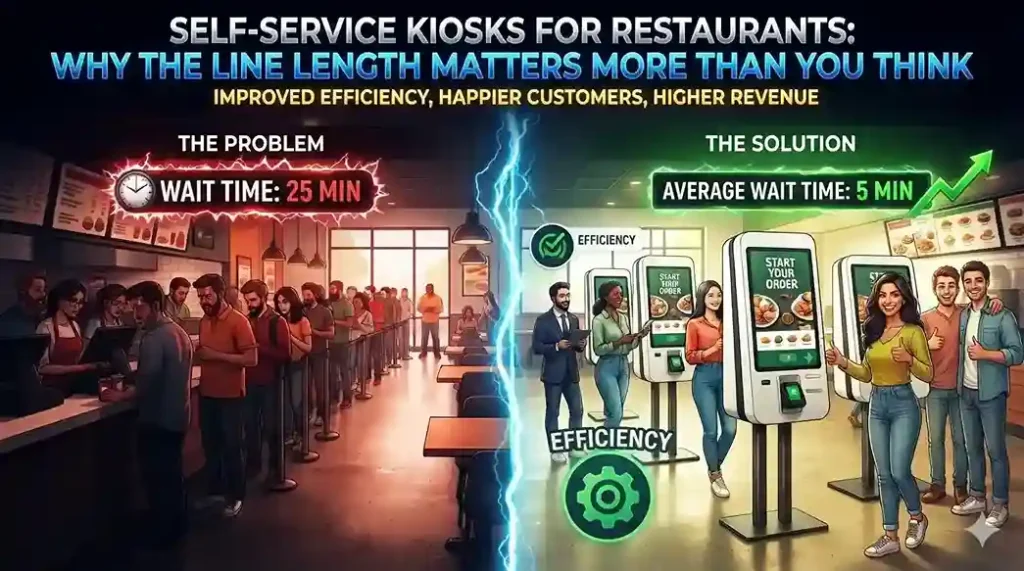
Almost three out of four customers at quick-service establishments say they would leave the line if seven people were waiting ahead of them; that figure rises to more than nine out of ten when the queue reaches ten people. This is not merely a minor loss of conversions, but actual revenue vanishing before an order is even placed. Restaurant self-service kiosks exist precisely to eliminate this friction point, and adoption data confirms their effectiveness: McDonald’s rolled out kiosks across its 14,000 U.S. locations and has recorded measurable sales increases directly linked to their use.
Kiosks do more than reduce wait times—they also change order size
The most interesting effect of self-service ordering isn’t speed. What really matters is that customers order differently when they don’t have someone standing behind them or a cashier waiting for them to make a decision. Concession stands at Dodger Stadium saw a 20% increase in average order size after introducing self-service kiosks; meanwhile, Subway has reported that customers using kiosks are more likely to add extras and spend more per visit than those ordering at the counter.
The key lies in removing social pressure from the ordering process: customers can explore options at their own pace, notice add-on items, try new combinations, and avoid rushing to choose their usual or “safe” order simply to avoid holding up the line.
The integration choice that determines whether the system truly works
Many restaurants add kiosks as a standalone system running its own software, linked to their existing point-of-sale (POS) system. This approach entails managing two systems that require constant integration, updates, and maintenance: every menu change, price update, and new promotion must be implemented twice. A unified restaurant management platform, such as LS Central, avoids this issue by running kiosks on the same POS system already used by cashiers. This is crucial, as most restaurant management systems are too complex to implement on a self-service kiosk without specific staff training—which would defeat the very purpose of self-service.
Menu customization becomes a sales tool, not just a display option
Since kiosk menus operate on the same system as the POS, changes are applied instantly across all locations, eliminating the need to configure each kiosk individually. This opens up real tactical possibilities: A/B testing menu item presentations to see what actually drives upselling, highlighting high-margin items at the top of the screen, or simplifying options during peak hours to speed up ordering when time is of the essence.
It also solves a practical inventory issue. If stock for a specific product runs low, the kiosk menu can update in real time to promote what is actually available—prioritizing chicken over beef or offering milkshakes when the smoothie machine goes down—instead of having to manually cross out items on a physical menu board.
The kitchen benefits just as much as the front counter
Orders placed at kiosks are automatically sent to a kitchen display system and organized by preparation station, ensuring that items from the same order are ready simultaneously rather than arriving piecemeal. The system can alert staff to orders that have been pending for too long, and front-of-house staff can view order status in real time; this allows customers to know exactly when they will receive their food, so they don’t have to linger near the counter.
Is it a passing fad or a permanent shift?
Self-service kiosks in quick-service restaurants are not a new idea; For over a decade, the industry has questioned the slow pace of its adoption. What has changed is that the technology has matured enough for major brands to commit to it on a large scale, and customer expectations have evolved accordingly: diners increasingly expect self-service as a standard option, and a significant number clearly prefer it over ordering with a cashier.
Are you considering installing self-service kiosks in your restaurant? Talk to Trident about implementing LS Central at your locations.

