Welcome to Trident Information Systems!
Write us to - info@tridentinfo.com
Let's Socialize

business central india

Manufacturer unifies data and gains agility in finance and supply chain with Dynamics 365

Bel Fuse designs, manufactures, and markets electronic circuits products at 24 manufacturing locations across North America, Europe, and Asia. The company’s existing enterprise resource planning solution was highly customized and expensive to maintain, so it decided to deploy Microsoft Dynamics 365 Finance and Dynamics 365 Supply Chain Management. Bel Fuse unified data and can now more easily manage its supply chain operations and finance processes, gaining more agility to respond quickly to changes in the market or its suppliers. “With Dynamics 365, we save nearly USD2 million per year in IT service and support fees compared to our previous, highly customized solution.” Mark Hodkinson: Vice President of Finance for the Bel Power Solutions Group Essential step in the supply chain A typical consumer might interact with Bel Fuse products and not even know it. The manufacturer makes the components that power, protect, and connect electronic circuits in products we use every day. Bel Fuse is usually in the middle of the supply chain, relying on smaller parts from its suppliers before passing components on to the manufacturers that create finished products. Founded in 1949, the company has grown significantly in the last 20 years through acquisitions. It has seven business groups, including Bel Power Solutions, which it acquired in 2014. Bel Power Solutions makes the power conversion products for server and storage networks at large server farms and in industrial products like the power sources in hybrid electric vehicles and trains. To manage its enterprise resource planning (ERP) processes, Bel Power Solutions used a legacy version of Oracle that was highly customized and difficult to update. The version was outdated and the month-to-month costs and support for the solution were expensive. With different business units using different ERP systems, Bel Fuse wanted to find an affordable solution to unify the company’s finance and operations processes, starting with Bel Power Solutions. Bel Fuse also needed a solution that would support its material requirements planning (MRP) process, a production planning, scheduling, and inventory control system to manage its manufacturing processes. “Our MRP processing goes in both directions—we require a full dataset and forecasting of what’s coming to us and what’s going out,” says Scott Hasterlik, Director Global IT at Bel Fuse. “We have power assets with 500 components and 65,000 SKUs, so we needed a robust solution to share nonstandard information quickly.” An integrated solution for finance and operations After careful evaluation, Bel Fuse found that Microsoft Dynamics 365 had the right capabilities at the right price for the company’s needs. With Dynamics 365, Bel Fuse had a single system for the first time, the ability to report globally, and a solution that was intuitive to use and easy to add users. Bel Fuse uses Dynamics 365 Finance to automate its financial operations, monitor performance in real time, predict future outcomes, and make data-driven decisions. For operations, the company deployed Dynamics 365 Supply Chain Management, which includes an MRP function and AI to improve visibility across its global supply chain and to improve manufacturing productivity. To aid the quick, seamless deployment process, Bel Fuse worked with Flintfox, a Gold competency member of the Microsoft Partner Network. “Flintfox jumped in, understood what we wanted to accomplish, and helped us move forward on budget,” says Hasterlik. “Flintfox has been a fantastic partner and is still our partner of record.” A wide range of Bel Power Solutions employees now rely on the Finance and Supply Chain Management business applications. Users include staff in customer service, quality assurance, demand and product returns, manufacturing and supply chain ordering, accounts payable, accounts receivable, and engineering. “From decision makers to factory floor managers, everyone is working in Dynamics 365, staying connected and accessing valuable data,” says Stefan Naude, General Manager, Slovakia, at Bel Fuse. Reduced costs, disparate systems eliminated Bel Fuse accomplished its central goal—to reduce the high costs of its previous ERP system while bringing data together in one solution. The company built the capacity it needed without a lot of customizations, helping ensure that the solution would stay flexible in the future. “With Dynamics 365, we save nearly USD2 million per year in IT service and support fees compared to our previous, highly customized solution,” says Mark Hodkinson, Vice President of Finance for the Bel Power Solutions Group at Bel Fuse. Bel Fuse also reduced costs because it now has the tools to fulfill more of its own finance needs internally. For example, a Bel Fuse engineering and distribution site in Italy previously paid an outside firm to do its accounting. “It was easy to move the Italy site into Dynamics 365 and transfer all that work internally to our team in Slovakia,” says Hodkinson. “Now our own team manages the facility’s day-to-day finances even though they aren’t located in Italy. With a common system, we have better access to our own internal talent.” Increased visibility and agility With Dynamics 365, Bel Fuse gained a more global view of financial data and can perform more accurate forecasting. “I always view orders and revenue from a global perspective because the locations are all connected and have so many intercompany transactions,” says Hodkinson. “I rely on Dynamics 365 to help me make sense of complex financial histories to stay on top of complicated billing and payment processes at multiple sites.” With ERP data now centralized and easy to access in the cloud, Bel Fuse can respond with more agility to complex, changing circumstances. When employees in Italy, China, and other countries needed to work from home during the COVID-19 crisis, the company was able to effectively run remote finance and supply chain operations. “We kept all our finance functions moving forward even though we don’t have anyone physically in the office,” says Hodkinson. “We were impressed that our team was able to get everything done while working from home for the first time, and I think that speaks to how intuitive Dynamics 365 Finance was for our team.” As a mid-chain supplier, Bel Fuse is committed to continuing its operations on time and not
Manufacturer unifies data and gains agility in finance and supply chain with Dynamics 365 Read More »

Why Business Central – Migrating to Dynamics 365 Business Central

The launch of BC has posed this question to all the users of Navision as ERP what is the future?  Should they upgrade or stay on the current version? Upgrading brings up thoughts of cost, pain, business disruption, and maybe even limited reward for all the effort. But it’s still something that one will have to evaluate as currently  NAV solution might be still meeting the needs now, however eventually support for the version will end, there will be more challenges around integrating with other applications and systems as they advance, and one can  fall behind the competition because they’re taking advantage of the latest technology has to offer. Stability, Performance and Security Data security is top-of-mind for most IT professionals. The Microsoft Cloud is synonymous with security and stability. With over 3,500 cyber-security professionals on staff, Microsoft is an industry leader when it comes to protecting, detecting, and responding to cyber threats. With so many IT experts in your corner, your IT staff can become more productive without having to worry about managing servers and ever-changing security regulations. Cost Effective Essentially, moving to the cloud is a financial shift that reallocates ERP spend from infrastructure, costly servers, and upgrades to licensing fees. In fact, transitioning from Dynamics NAV to Dynamics 365 is the final ‘upgrade’ you’ll ever have to pay for. Once you have implemented Dynamics 365, updates happen frequently, and at no cost, ensuring you’re always on the most recent version. Integrated Modern Platform Dynamics 365 Business Central features an intuitive look and feel that will help reduce training and ramp-up time for users because it’s easy to use and similar to other Microsoft solutions. Additionally, Business Central can be accessed anywhere, at any time – giving users the flexibility to work no matter where they are. The deep integration with the Business Central Cloud solution and O365 is the best starting point on your journey to consider the move from NAV to Business Central Cloud creating best work from Home Solution. Digital Transformation With Dynamics 365, businesses can easily embrace the benefits of Machine Learning and Artificial Intelligence to become more efficient and reduce manual processes. Machine Learning can help with equipment monitoring, spam filtering, ad targeting, image detection, forecasting, and much more. Microsoft’s Power Platform, made up of Power BI, Flow, and Power Apps, gives you better data that is more accurate and timely to help you make better business decisions.

Why Business Central – Migrating to Dynamics 365 Business Central Read More »

Enterprise ERP software dashboard managing retail, hospitality, and manufacturing operations.

Enterprise ERP Software for Retail, Hospitality & Manufacturing: 6 Benefits That Transform Your Business

Running a business in retail, hospitality, or manufacturing means managing a constant flow of moving parts — staff schedules, customer orders, inventory levels, supplier deliveries, and financial transactions — all happening simultaneously, every single day. When those moving parts are managed through disconnected systems — a spreadsheet here, a separate POS there, a standalone HR tool — the gaps between them create errors, delays, and blind spots that cost real money. Enterprise ERP software brings everything together. One platform. One source of truth. Every department — finance, operations, HR, sales, and customer service — working from the same real-time data. Here is how ERP transforms operations specifically in retail, hospitality, and manufacturing — and why Microsoft Dynamics 365 Business Central is the platform Trident recommends. Why Retail, Hospitality, and Manufacturing Need ERP Most These three industries share a common challenge: high operational complexity at every level. A retail chain manages hundreds of SKUs across multiple locations. A hotel or restaurant balances reservations, kitchen operations, staff rotas, and customer satisfaction simultaneously. A manufacturer coordinates raw material procurement, production scheduling, quality control, and order fulfilment — often across multiple sites. Without a unified system connecting all these functions, management is reactive. With the right ERP, it becomes proactive — with real-time visibility that enables better decisions at every level of the organisation. 6 Key Benefits of ERP for Retail, Hospitality and Manufacturing 1. Real-Time Data Across Every Department Business data changes constantly. Inventory levels shift with every sale. Staff schedules update daily. Customer orders flow in around the clock. Financial positions move with every transaction. Without real-time visibility, managers make decisions based on yesterday’s data — and the gaps between systems mean different departments often work from different numbers. ERP solves this fundamentally. Every transaction updates the central system instantly — so whether you are checking stock levels, reviewing sales performance, or approving a purchase order, you are always working from current, accurate information. No delays. No discrepancies. No guesswork. 2. Integrated Point of Sale In retail and hospitality, the POS system is the heartbeat of the operation. Every sale, every order, every payment flows through it — and what happens to that data after the transaction determines how well the rest of the business functions. A standalone POS that does not connect to inventory, finance, and customer management creates manual work and data silos. An ERP-integrated POS changes everything: For retail chains and multi-outlet hospitality businesses, this integration is particularly powerful — giving head office a live view of every location’s performance without waiting for manual reports. 3. Smarter Customer Management Your customers are your most valuable asset — and your ERP should help you treat them that way. An ERP system captures complete customer profiles: purchase history, preferences, communication records, loyalty points, and service interactions. This data enables: In hospitality especially, knowing your guest’s preferences before they arrive is a powerful differentiator. In retail, personalised offers based on real purchase data consistently outperform generic promotions. ERP makes both possible at scale. 4. Efficient Employee Management Managing staff across retail stores, restaurant shifts, or manufacturing shifts — potentially across multiple locations — is one of the most operationally demanding functions in any of these industries. ERP centralises employee management in one system: When employee data is connected to operational data, managers can make faster and fairer staffing decisions — and compliance documentation is always complete and current. 5. Streamlined Inventory Management Inventory management is the operational function where ERP delivers the most immediate and visible impact — particularly in retail and manufacturing. Without a connected inventory system, businesses either over-order (tying up cash in excess stock) or under-order (losing sales to stockouts). Neither is acceptable in competitive markets. ERP provides: For manufacturers, ERP takes this further — connecting inventory management directly to production planning and supplier procurement, ensuring materials are always available when production needs them. 6. Unified Financial Management Every operational decision has a financial consequence — and ERP connects the two in real time. Rather than waiting for month-end reports compiled manually from multiple systems, ERP gives finance teams live visibility into revenue, costs, margins, and cash flow across every business unit. Invoices are matched automatically. Budget variances are flagged immediately. Financial close processes that once took days are completed in hours. For multi-entity businesses — retail chains, hospitality groups, or multi-site manufacturers — ERP consolidates financial data across all locations into a single, accurate picture that leadership can act on immediately. Why Microsoft Dynamics 365 Business Central Microsoft Dynamics 365 Business Central is the modern, cloud-native evolution of Dynamics NAV — one of the most widely deployed ERP platforms in retail, hospitality, and manufacturing globally. It delivers all six benefits above in a single, integrated platform — with the added advantage of: Whether you are running a single restaurant, a retail chain, or a manufacturing facility, Business Central scales with your operation — without platform replacement as you grow. Why Trident Is India’s Trusted ERP Partner As a certified Microsoft Dynamics 365 Business Central partner, Trident Information Systems has helped businesses across retail, hospitality, and manufacturing in India implement ERP solutions that deliver measurable results — from initial assessment through go-live and ongoing optimisation. Ready to unify your business on one intelligent platform? Book a free ERP assessment with Trident today.

Enterprise ERP Software for Retail, Hospitality & Manufacturing: 6 Benefits That Transform Your Business Read More »

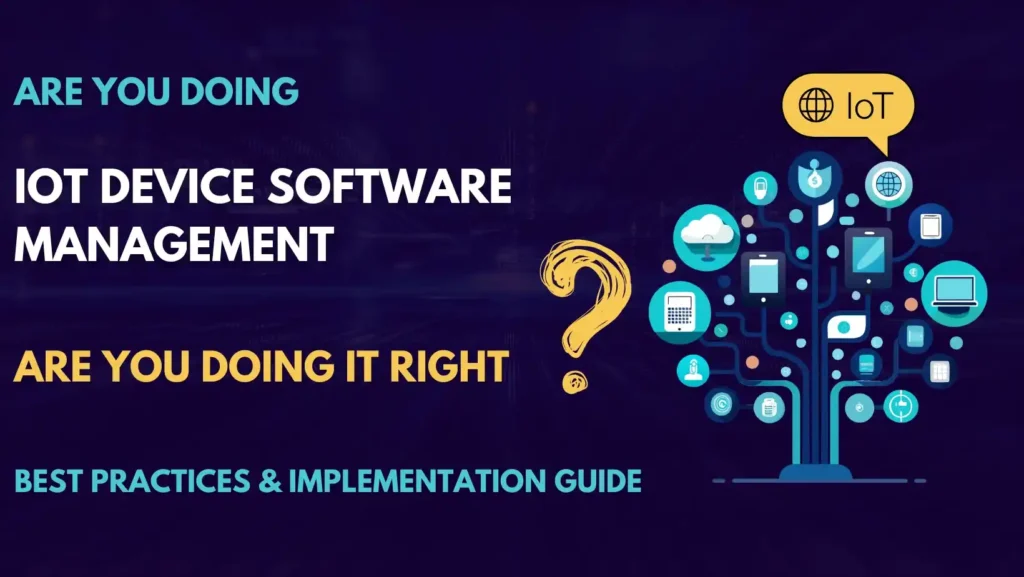
IoT device management dashboard monitoring software updates, device status, and security in real time.

IoT Device Software Management: Are You Doing It Right?

Every enterprise today runs on software – and nowhere is that pressure more intense than in IoT device software management. As connected devices multiply across factories, hospitals, logistics networks, and smart infrastructure, the stakes for getting software delivery right have never been higher. Yet most organizations are still managing IoT device software the way they managed desktop applications a decade ago – slow release cycles, siloed teams, reactive testing, and little visibility across the device lifecycle. That approach no longer works. Industry disruptors are not waiting. They are shipping faster, patching smarter, and scaling IoT fleets without proportional cost increases. Meanwhile, enterprises clinging to outdated development practices face a widening gap – in speed, in quality, and in customer satisfaction. The choice is now binary: modernize your IoT device software management strategy, or watch competitors who already have pull further ahead. Organizations that embrace lean, agile, and DevOps-driven approaches to IoT software delivery are not just keeping up – they are setting the new benchmark. What Is IoT Device Software Management? IoT device software management refers to the processes, tools, and strategies used to deploy, monitor, update, and maintain software across a fleet of connected devices – from sensors and edge nodes to industrial controllers. Unlike traditional software environments, IoT ecosystems introduce unique challenges: devices operate in remote locations, run on constrained hardware, and require Over-the-Air (OTA) update capabilities to stay secure and functional. Without a structured management approach, enterprises risk firmware drift, security vulnerabilities, and costly manual interventions at scale. As it pertains to the “new normal” DevOps standards, organizations now face many challenges such as cost overruns, software development projects that don’t scale in line with the enterprise growth, and increased market demands for speed. On top of that, the available outdated testing tools don’t offer visibility to ensure the right specifications get tested in the right time. How Lean and Agile Principles Transform IoT Software Delivery So, how can you make sure your organization is ready to manage unexpected changes, and deal with any dependencies that you already have under the hood? How do you ensure a strong balance between the existing business and the new development? Many of you may already be familiar with lean and agile principles and have probably even tried applying them in smaller teams. But what we’ve seen so far in the market is that many of you struggle to apply these principles across the entire organization. Lean and agile principles can help you reach your goals in today’s hyper-competitive world of digital product delivery. By becoming a lean and agile enterprise your organization will be able to adapt faster to the needs of the market by improving internal collaboration and communication. You will be able to learn in real-time from your clients to ensure that you are producing the prioritized set of features that drive economic value. By managing test labs, test planning, and ensuring the tight linkage between product demand and delivery, your organization will be able to reduce waste (time, effort, resources), while ensuring that your business strategy is aligned with the investment and development goals. The Numbers Don’t Lie: Agile IoT Transformation Results Let’s have a look at a few examples of what some of the industry leaders have achieved, using lean and agile processes. Nationwide achieved 50 percent improvement in code quality and 70 percent reduction in system downtime by applying lean principles to transform the software delivery lifecycle. Diagnostic Grifols, a world-leading healthcare enterprise headquartered in Barcelona Spain, increased the efficiency of development documentation by 30 percent-facilitating compliance, ensuring consistency of records across all product lines, and reducing operational costs. IoT Software Security: The Risk You Can’t Ignore A lean and agile development lifecycle isn’t just about speed – it’s about building security into every release cycle. According to industry research, over 57% of IoT devices are vulnerable to medium- or high-severity attacks due to unpatched firmware. Integrating automated security testing within your DevOps pipeline ensures vulnerabilities are caught before deployment, not after a breach. If your current IoT software management process doesn’t include continuous security validation, it’s time to close that gap. Start Managing IoT Software the Right Way — Here’s How It’s time to transform your organization into a lean and agile enterprise. It’s time to ensure that your firm can adjust to any market change, predict the unpredictable, keep costs low, deliver new features and offerings faster, and never lose a beat with your customers. If you would like to learn more, let’s get connected! Our IBM solution enables companies to improve visibility and transparency across the product delivery lifecycle by providing a single source of truth. It also enables enterprises to define a process custom to each organization, and it ensures quality and compliance. All using lean and agile processes.

IoT Device Software Management: Are You Doing It Right? Read More »