Welcome to Trident Information Systems!
Write us to - info@tridentinfo.com
Let's Socialize

software solution for hospitality

The Importance of Omni Channel Management in Restaurant and Foodservice.

Ensure a seamless journey to your customers and let them place orders from the channel of their choice. Integrate every channel and manage them centrally with an ERP for Hospitality, such as LS Retail: one of the best Hospitality ERP Software. Omnichannel was once believed to be used by only retailers focusing on consistent customer experience throughout various channels: Brick and mortar, direct and wholesale. However, many people overlook its importance in the restaurant industry since it operates quite differently than retail. Nevertheless, restaurants and other foodservice providers operate on different channels and can tremendously benefit from it.   Why an Omni Channel Restaurant Strategy?  The Restaurant industry is transforming, and so are their needs, a good Restaurant Management Software can help keeping-up with the transformation. Today’s consumers want to order their fast food from anywhere and at any time. It is imperative, and not optional that the customer experience is seamless and connected. Those consumer needs are driving the omnichannel trend. For restaurants, that means providing their customers with multiple ways to order, pay, and receive their meals.  Restaurant operators are now recognizing its importance in their industry. They are acknowledging the importance of being visible to new customers while embracing multiple channels and hence adopt a wise multi-channel management system i.e., Omni Channel. This is the same reason an eCommerce retailer decides to have a concrete shop to reach more customers. Be it via enhanced delivery options, a non-traditional and pop-up unit, food trucks, or any other medium, restaurants are reaching more customers through different channels.   How does Omni Channel Management Help the Restaurant and Foodservice Business?  Customers demand more convenience as soon as they get in touch with your restaurant. It is up to you to offer a continuous brand image and customer experience both online and offline for pick-ups, dine-in, takeout throughout devices. With such efforts, the customer feels looked after and gets a consistent experience. Given below are the few benefits of proper Omni-channel management for your restaurant business:  Central Control for Multiple Locations  With LS Retail Hospitality’s Omni Channel Management, control all your food channels centrally from the head office. Set up menu items, recipes, meal deals, and modifiers. The system replicates data and transmits it throughout the Restaurants, automatically allowing you to manage POS (point of sale) terminals and staff from headquarters. Being one of the Best Software for Restaurant, it offers multiple tools within the same platform which many of the other Restaurant Management Software fail to offer.   A Greater Reach   The more channels your restaurant has, the bigger the audience you can reach. Consider how many additional consumers you could reach if you started offering delivery, takeout, or a drive through.   In the delivery space, you can choose to collaborate with a third-party service provider, already having a large customer base such as Uber Eats, Takeaway.com, Deliveroo, etc. Restaurant Management Software such as LS Retail itself can manage your delivery and online ordering operation more efficiently.  Free Flow of Information   Integrate omnichannel the correct way among all the tech platforms you have: POS or food delivery apps. As soon as you are onboard new customers on your POS, you can simply collect their data and optimize it to generate loyalty programs.   As you integrate more channels you start collecting new data from new sources. If used correctly, you can understand your customers’ behavior and identify new methods to serve them better.   Improving data flow also enhances your efficiency from the front office to the back office. When you have efficient technology and clean data, you might as well take care of your staff better. Hence, encouraging them to become more efficient.   Improved Customer Experience   Providing a consistent Brand Image and streamlining customer experience is what Omnichannel experience is all about. The main objective of this approach is to create a seamless customer experience throughout all the channels and touchpoints, treating them the same irrespective of the location they placed an order. This fosters brand loyalty and repeated business.   Aligning all your channels not only streamlines the user experience but is also an asset to customer service and support. Your support team can extract your customer’s records on interactions, issues, and orders in real-time. Hence, turning the buyer’s journey a lot easier and satisfactory.   CRM Data Optimization   You can use CRM to gather direct feedback from your customers. Similarly, you may respond swiftly to all reviews and build a personal connection with them. The best way to get repeat business is to nurture your customers. You can optimize omnichannel strategies such as email and SMS campaigns to maintain and strengthen customer relationships.   Through the right targeting and segmentation, you can access the right set of customers. Adding personalized messages such as greeting cards on their birthday, offering exclusive rewards for being a valued customer, or offering their preferred dish as an incentive. Use automated workflows to ensure you deliver these campaigns at a precise time.   Greater Flexibility   Omnichannel management helps maintain and keep track of everything throughout multiple platforms. A customer should be able to order food from any chain available near him as well as return it if not satisfied. These flexible options boost customer satisfaction and sales.   Studies show a customer is most likely to purchase from a business if their omnichannel works seamlessly and empowers them to make flexible choices.   With LS Retail – the Best ERP for Restaurant, you can simplify your omnichannel management and provide better flexibility to your customers.   Why Trident?  After winning multiple awards, Trident Information Systems has been recognized as a Gold Microsoft Dynamics 365 and LS retail partner since 2004 and services many restaurants and foodservice businesses so far. With our ERP for Hospitality services, 150+ resources, and technical tools, many successful restaurants have been our clients. For further queries contact us.  

The Importance of Omni Channel Management in Restaurant and Foodservice. Read More »
How To Boost Revenue and Goodwill with Cloud-Based Restaurant Management Software?

An ideal restaurant experiences a good customer in-flow, filled tables, orders rushing in, and so on. Restaurant businesses face a neck to neck-to-neck competition, and usually, the ones with the latest Restaurant Management Software thrive on it. It is rewarding to see happy customers’ faces, and genuine appreciation becomes a great motivation to level up. This generally happens during regular days. However, as soon as weekdays hit, the business catches at a slower pace. Restaurants need to use their technology optimally and smartly to avoid slow-paced business, boost profit and brand name.   We will share some strategies to optimize your Cloud-based ERP For Restaurant Industry to increase your business revenue and goodwill, through this blog’s medium.  Strategies to Grow Revenue and Goodwill Hand in Hand with Restaurant Management Technology  Adopting suitable Restaurant Management Software can be a game-changer. Having smart technology compiled with suitable strategies will not only help you cut costs and boost profit but contribute to your brand growth also.  Utilize Smart POS Systems Old fashioned POS systems running on their internal system can no longer benefit your business. Since cloud-based restaurant POS systems are replacing the old ones, they can easily help in boosting sales with quick data access on everything from the menu to inventory. Therefore, you always have your profitability insights.  Launch Meal Deals and Discounts    Loyalty programs are a great way to boost sales and goodwill. Your cloud-based Restaurant Management Software uses the current market data to strategize deals, offers, discounts, meal plans, and so on. It is an ideal measure to track customer behavior and how they respond to your services.   Use Automation to Provide High-Quality Services   Use your restaurant management software will help you create KOTs, prepare bills and serve orders. Automating these tasks will free up your staff to attend to customers. Having everything automated also minimizes the scope of errors. Ideal software will also provide every day, weekly and monthly data on the most preferred dishes so you can plan out your inventory accordingly.   Formulate Targeted Campaigns   Make sure the ERP for Hospitality Industry you use provides real-time data and helps you strategize formulated targeted campaigns during the slow business. You can launch incentive programs and promotional campaigns for your restaurant to boost sales. One such example is ‘No-Cook Wednesdays’ by Pizza Hut.  Look For the Need for Remodeling   Your business must evolve according to the dynamics of the restaurant industry. Studies have shown that remodeling your business can boost sales by 10-30%. Check if your restaurant needs technological or non-technological remodeling. It is suggested to execute this operation during slow business days since it won’t impact your customer business as such.   Choose an Integrated Cloud service   Selecting a Unified Commerce solution that provides all the necessities under the same platform as Microsoft Azure Cloud. It is one of the Best ERP for Restaurant Management for restaurants. It provides analytics, database, computing, networking, and mobile integration under the same platform. This not only saves time but also eliminates unnecessary expenses and complications. Therefore, you end up increasing your profit margin and make better decisions to level up your brand name.   Conclusion  A good Restaurant Management Software is a must-have to survive the neck-to-neck competition in the restaurant industry. We suggest picking up the latest cloud-based ERP software such as LS Central, it is a unified restaurant solution that provides all the necessities under the same platform. Trident Information system is a Gold Partner of Microsoft and has served various restaurants and food chains such as Biryani Blues, Haldirams, Bikanerwala, Chocola, and so on. Contact us for further inquiries or a demo.  

How To Boost Revenue and Goodwill with Cloud-Based Restaurant Management Software? Read More »

Why Hospitality Industry Needs a Future Ready Technology

This Pandemic has brought a massive shift in the Hospitality industry. The tough working parameters have made it quite difficult for restaurants to sustain their services. The juggle between survival and keeping up with government regulations demand a future-ready Restaurant Management Software to be a must-have for all the restaurants.   Such software embraces sophisticated technology which are pushing their limits to evolve into their best vision. One such software includes LS Central for Restaurants; it broadens up to ERP for Restaurant management, and facilities complete business management in the same platform. It is an excellent Restaurant management software, especially when today’s scenarios have shaken the industry from within.   Current Challenges Faced by Restaurants Covid-19 pandemic has constrained this industry to operate differently and adopt suitable solutions in order to survive. Certainly, there are a few things that no one saw coming: Meeting the Break-Even Point: your break-even point can be defined as the sales covering your operating costs. Like all the businesses, where the CEOs wish for huge profits, restaurants are struggling to meet their break-even point. Keeping up with the sanitation and health regulations: covid 19 pandemic has made customers and staff even more aware of their sanitation and health Off-Premise Dining: the enforced lockdown has labored the dine-in restaurants to swear by delivery sales and take always to meet the necessary returns. Good Restaurant management software can be a huge help. A recent techno mic conducted study has revealed, over 80% of restaurants were prevented from shutting down because of take always and food deliveries. This is believed to be the forthcoming scenario for the next few years. Limited offers and innovative menus: to last throughout the forthcoming years, there is an incredible need to adopt more creativity. Offering certain menus, new offers, and out-of-the-world experiences can draw a great deal of draw diners, especially those cutting on their dining out budget. Advance online ordering system: Restaurants are subjected to strict sanitary guidelines and lockdowns and are expected to remain the same way for quite a while. There is a growing need for contactless home deliveries and online food orders. Overcoming the slow pace in 2021 will have restaurants to have examined all business prospects and aspects again. Restaurants need suitable Restaurant Management Software such as LS Retail for food services to cope with the upcoming challenges. How Can LS Central For Restaurants Help You Combat The Challenges In Hospitality?  There are many technological and non-technological challenges in the hospitality industry, such as the need of using multiple restaurant management software to get different features, back office and front office integration issues, lack of real time data tracking, difficulty in retaining customers and so on. LS Central for Restaurant can help you get rid of them. It is an all-in-one Restaurant Management Software that generates a real-time data report and exhibits the bigger picture of cafes, restaurants, and other food services, integrating activities from the back office to the final customer serving, therefore, leading to excellent coordination. Additionally, you can get the following benefits:   Gives The Ultimate Control Over Your Restaurant Since you can monitor each business activity and access real-time data within the same environment, You can eliminate the excessive expenses on multiple software. It carries out the following tasks: This Restaurant Management Software supervises and administers your franchise and location from the headquarters. Controls recipes, prices, offers, menus, and campaigns centrally. Navigate the performances of your staff and carry out effective communication. Computes real-time costs and revenues, and picks up the latest trends and opportunities. Check up on the real-time reports. Uses Artificial Intelligence to read and predict your customer’s or prospects’ behavior. Scales up your business and helps it grow. Centrally Manage Your Restaurant   Since you can monitor each business activity and access real-time data within the same environment, you can eliminate the excessive expenses on multiple software. It carries out the following tasks:    This Restaurant Management Software supervises and administers your franchise and location from the headquarters.   Navigate the performances of your staff and carry out effective communication.   Computes real-time costs and revenues, and picks up the latest trends and opportunities.  Check up on the real-time reports.   Uses Artificial Intelligence to read and predict your customer’s or prospects’ behavior.   Scales up your business and helps it grow.   Cut Costs and Boost Revenue   With proper assist management measures, you can minimize waste and use your resources optimally with this Restaurant Management Software. LS Central does the following jobs for you:      Accurately price your menu and ensure good returns.  Orders and distributes the appropriate quantity of ingredients. .   Plan out your meals and streamline your ingredient orders.   Automates everything and eliminates mistakes.   Allow Customers to Serve Themselves   Get ready to deliver excellent customer services and draw a broad set of customers repeatedly. This is how it helps your business get a customer boost:      Uses mobile POS on the table and takes contactless orders and payments.   Gives your customers a free hand to customize their meal by removing or adding ingredients of their choice.   Exhibits the exact ingredients and information on allergens at the POS on online platforms and also on self-ordering devices.   Adjusts the price and the menu as per the demand.   This Restaurant Management Software allows your customers to order food online or as per their preferred services.    Loyalty Programs     A loyalty program is a great measure to retain your current customers and also to increase the customer base. A customer loyalty program includes the following:      Prepares a personalized promotion and each guest can get an attractive meal deal  Smartly generates loyalty programs to benefit you and your guests in the shape of returns.   Creates happy hours strategy to attract maximum customers.   Launches various deals and offers according to customer preferences and spending behavior data.    Our Final Words LS Central is one of the best Restaurant Management Software which integrates services like Point Of Sale, Supply Chain Management, Operations, Online Channels, Inventory, and customer loyalty within the same environment. Trident is one of the most renowned LS Central Information Partner. For the best support, feel free to contact us. We will be more than happy to serve.

Why Hospitality Industry Needs a Future Ready Technology Read More »

Omnichannel retail strategy connecting POS, eCommerce, inventory, customer data, and analytics across retail channels.

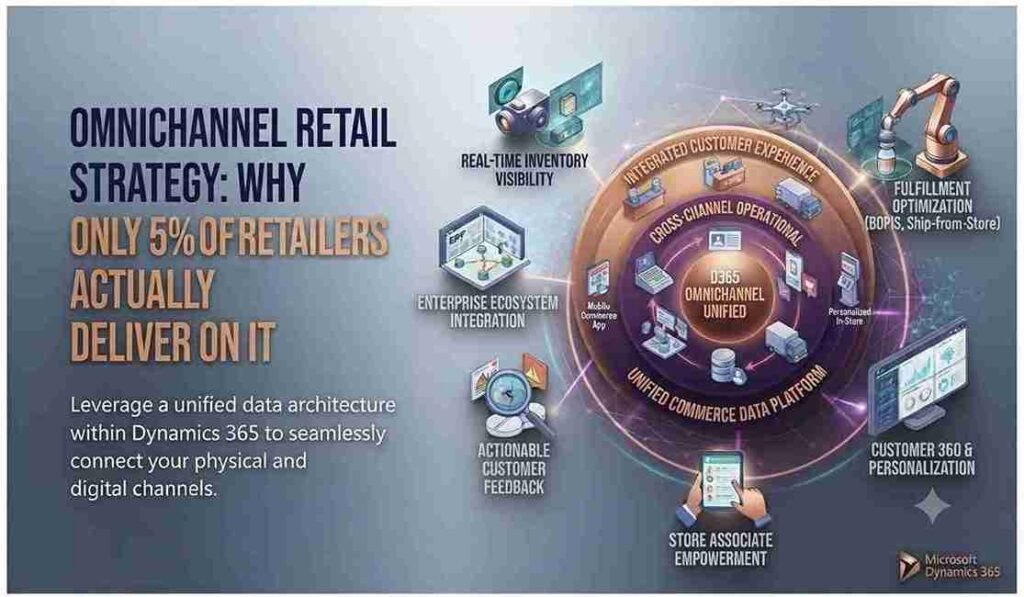
Omnichannel Retail Strategy: Why Only 5% of Retailers Actually Deliver On It

INTRODUCTION Retailers have been talking about omnichannel for more than a decade. However, only about 5% actually allow a customer to initiate a purchase on one channel and complete it on another. Meanwhile, customers aren’t waiting: The vast majority research and select products online before setting foot in a physical store, and half of in-store shoppers check their phone during the visit to check specifications, compare prices or confirm a decision. The gap between what customers expect and what most retail systems can deliver is where sales are lost. Make all channels reflect the same brand A disjointed brand experience—slick in-store, clunky in-app, and slow on social—quietly erodes trust with each inconsistency. Nespresso is a great example of how to do it right: the same visual language is maintained on their e-commerce site, mobile app, order confirmation emails and even on the physical packaging; Thus, the brand is perceived identical at each touch point, instead of reinventing itself channel by channel. Unify your sales channels, not just your brand image Customers expect basic cross-channel functionality: checking if a specific store is in stock, adding an item they saw in person to their online cart, or making a hassle-free return on an in-store purchase. Most retailers cannot yet reliably offer this, as their systems have been assembled from separate, poorly integrated tools rather than being built as a single platform; This often results in the inability to see real-time inventory across locations, difficulty accepting returns across channels, and the risk of selling items that are no longer available. A unified commerce platform like LS Central solves this at the root: centralized inventory and location visibility allows exchanges and returns to work the same way, regardless of the channel where the original purchase was made. Be transparent about shipping costs and conditions Approximately 70% of online shopping carts are abandoned before completing the order, with unclear or unexpectedly high shipping costs being the most common reason. Retailers who clearly list delivery time, shipping cost, and return conditions next to each product—rather than revealing them at the final checkout step—allow customers to make an informed decision from the start, building the kind of trust that reduces cart abandonment. Show real inventory, not just a product catalog Most customers expect to see product availability online before visiting a store; some retailers, like IKEA, even go so far as to display exact stock quantities at each location. At a minimum, product catalogs should be kept up-to-date across all channels (a unified system allows e-commerce, point-of-sale and back-office to use the same data in real time), include detailed product information to compensate for the inability to physically touch or try it, use high-quality images and videos, and display customer reviews; All of these factors directly influence confidence when purchasing and decision-making. Design thinking about what the customer really needs The retailers who succeed are not those who insist most on selling, but those who solve a real problem. CVS’s pharmacy app is a useful example: it helps customers manage complex medication schedules with reminders and notifies them when a prescription is ready for pickup. The value is not promotional, but functional; Precisely because of this, it generates the type of trust that translates into recurring purchases. Turn collected data into actions, not just reports Retailers collect huge amounts of behavioral data (pages viewed, items abandoned in cart, return patterns, top customer preferences), but collecting it is not the same as using it. GameStop’s loyalty program, with tens of millions of members, is a clear example of how to do it right: Analysis of member data revealed that rewards alone don’t drive engagement, but personalized offers do. This change reportedly allowed email open rates to more than double when GameStop moved to using hyper-segmented messages based on purchase history. Turn collected data into action, not just reports Retailers gather vast amounts of behavioral data—pages visited, items abandoned in carts, return patterns, and the preferences of key customers—but collecting data is not the same as using it. GameStop’s loyalty program, with its tens of millions of members, is a prime example of getting this right: analysis of member data revealed that rewards alone do not drive engagement, whereas personalized offers do. This shift more than doubled email open rates when GameStop switched to using hyper-segmented messages based on purchase history. For most retailers, the obstacle isn’t a lack of data, but rather data fragmentation. Having data scattered across disconnected systems means most companies can only meaningfully analyze a small fraction of the information they collect. A unified commerce platform that consolidates data from all channels into a single location is what truly enables a comprehensive view of the customer. Want to see what a unified omnichannel platform would look like for your retail business? Contact the Trident team to discover the possibilities offered by LS Central.

Omnichannel Retail Strategy: Why Only 5% of Retailers Actually Deliver On It Read More »