Welcome to Trident Information Systems!
Write us to - info@tridentinfo.com
Let's Socialize

Food Manufacturing ERP

Comply with Quality Standard & Food Safety Regulations with Food Manufacturing ERP 

The established food services are subjugated to maintain safe food handling practices and behavior, otherwise, they can be subjected to food-borne illnesses and outbreaks. The best way to tackle this issue is to adopt a Food Manufacturing ERP. Since the quality standards and food safety regulations are elevating with time, the CEOs need advanced technological assistance to cope with it.  Maintaining food safety in food service businesses can get on your nerves. Related issues can pop up at any stage like storage, food receipts, services, or preparations. Food Manufacturing ERP Software can be a great help for you to demonstrate consistency in implementation, enforce and monitor food safety-oriented functions and operations.  What Are the Challenges Faced by the Food and Beverages Manufacturing Business?  An outbreak like COVID-19 enforces the evolution of current food safety and quality standards. Therefore, most food and beverages manufacturing businesses are adopting the latest Food Manufacturing ERP. The following challenges have played a great role in the process:  COVID-19 Pandemic   Due to COVID-19 outbreak, issues leading to supply chain disruptions, hiked food prices, increased ingredients, and workforce restriction in the plant that hamper production are perceived to continue. You can opt for the latest Food Manufacturing Protection Software as it can be a total game-changer, especially in current scenarios.  Coping With Safety Standards   Unfortunately, food manufacturing is one of those industries which cannot operate from homes – you cannot price and pack meat on Microsoft Outlook. It is the owner’s responsibility to keep their workforce safe and provide them with a secure work environment.  Keeping Sustainability at The Front   Having vaccinations finally available to the masses, it seems like Covid-19 times may come under control. However, the climate crisis is not leaving our side so easily. Since food sustainability issues have been behind the scenes for obvious reasons, now it is necessary to bring them back to the front as soon as possible. Food manufacturing ERP can be an immense help in the process.  Information Circulation  Foodservice establishments are responsible for declaring allergens in their ingredients. Businesses must keep updating their customers about the allergens irrespective of their location, whether they are at home or at a restaurant.  Waste Management Practices   It is essential for a food manufacturing business to introduce and implement a suitable waste management system to check food security risks and facilitate environmental hygiene. A suitable food manufacturing ERP can do wonders in resolving this issue.  How Can Trident’s Food Manufacturing ERP Help You Combat Food Quality and Safety Challenges?  Trident’s Food Manufacturing ERP is the Best Software for Food and Beverage Industry. You can have all the exact ingredients to beat any quality standards and food safety regulation challenge. You can get our industry rich services delivered at cloud or on-premises and claim agile business growth with the following benefits:   Optimally Utilize Your Inventory   With First Expire, First Out (FEFO) solution, track your raw material shelf life and expiration, so you could utilize your inventory to the fullest. In addition, you can also minimize wastage and avoid unwanted situations like understocking and overstocking. Quality of inventory is met by standards with little to no extra effort.  Two Way Lot Tracking  track your lot from the grocery store to your factory within seconds. Having a transparent supply chain, you can access real-time data on your raw material purchasing and recall identification. With this Food Manufacturing ERP, real-time stock transportation data is in your hand. You can acknowledge where exactly your stock is on its way and when exactly it will reach the store. You can be aware of any damage being done in its way.  Keep Up with The Quality Standards with iOS and Six Sigma:   Manage your food quality with IOS and generate methodologies to improve the process with Six Sigma. It is an excellent platform to keep up with the quality standards. Keeping up with quality standards increases chances of customer retention and attracting new business.  Grants Ultimate Inventory Control  You can have the ultimate control over your inventory with our Food Manufacturing ERP, its batch, and lot. Also, trace them via serial number. Serial Number Tracking ensures a more systematic lot tracking approach, minimizes risks while enabling centralized control over all your stocks.  Helps in Better Decision Making With real-time inventory data and current food quality standards compliance, you can make better decisions and adopt advanced strategies. You can decide what innovation you can make in your current inventory or how you can raise your quality standards.  Balancing operating a Food services establishment and complying with food quality and safety regulations can be quite exhausting. You need a food and beverages software system to keep up with the current market scenario. Trident serves excellent Food Manufacturing ERP across the globe. For one of the finest ERP solutions contact us now. 

Comply with Quality Standard & Food Safety Regulations with Food Manufacturing ERP  Read More »

How to Achieve Optimal FMCG Manufacturing? 

The best way to achieve optimal FMCG manufacturing is to implement Dynamics 365 for Food Manufacturing. FMCG products tend to perish in the shortest time as compared to other manufactured products such as steel, laminate, glass, and so on. If not manufactured and stored properly, they tend to perish even earlier. In this case, a Food Manufacturing ERP becomes crucial. Dynamics 365 for Food Manufacturing is one such software that delivers every tool you need while food manufacturing. It manages raw material sourcing and vendors, manages inventories, logistics, warehouses, and a lot more using the same platform. Therefore, providing a unified view on every aspect and allowing the user to make the best decisions.  With frequently changing customer demands these days, manufacturers may come across certain challenges such as:   Overstocking and understocking due to lack of demand forecasting.   Manufacturers have to rely on guesswork which usually leads to minor errors.   Redundancy issues are quite common due to disparate systems.   Lack of updated stock visibility due to using disparate systems.   Working in silos can lead to financial discrepancies.    How Manufacturing ERP Software Optimize FMCG Manufacturing?  One of the most effective ways to accomplish this is to upgrade your technological approach. Use sophisticated technology like Dynamics 365 for Food Manufacturing. Having your technology upgraded lays an enormous impact on your production process. Given below are some ways in which you can get the best out of your production:    Use Insights During Project Management   Having a shoddy project management strategy can lead to endless frustration. Poor project management is one of the major areas where businesses tend to face losses. With Microsoft Power BI real-time production performance reports, you can monitor all your manufacturing aspects. You can also review and approve every necessary time and cost impacting projects using insightful reports. These reports enable users to quickly respond to potential project risks and sudden changes by managing critical KPIs.    Get Live Visibility into Operations   Accessing real-time visibility into your complete manufacturing operations will drive excellence. If businesses are unable to gather, link and visualize global supply chain data, they can never get visibility into end-to-end operations. Having improved visibility into the supply chain data will improve communication and coordination among supply, production, services, and sales. Integrating different departments will foster collaboration leading to harmonious and smooth operations.   Use Technology to Empower Your Employees   With Manufacturing ERP Software like Dynamics 365 for Manufacturing, you can empower your employees and make them happy with their jobs. According to a survey, 53% of American Workers are unhappy with their jobs. Dynamics 365 delivers role-specific tools and a 365-degree view of the business. This helps them adapt and enhance their working style. By integrating a structured workflow-oriented platform with the unstructured work of collaboration, you can achieve greater productivity. When you bring out the best in people, that is when the production is maximized.    Boost Productivity with the Right Tools   Achieving productivity is much more than doing work, it is about how much value you can extract from that effort. Manufacturing productivity is a byproduct of a unified view of operations and also digital assistance tools to monitor and resolve issues remotely. If your technician can coordinate existing expertise with tasks, greater productivity is bound to be at your court.   One thing that differentiates achievers from non-achievers is the quality of services. Reinforcing your staff with intelligent tools and on-the-go can enable them to boost efficiency and provide exceptional services. Creating customized sales documents by leveraging familiar Office 365 tools, a comprehensive event-driven sales process, viewing relevant data, and working on phones add up to productivity. You can get all this in Dynamics 365 for Food Manufacturing. Offer Customized Services   Microsoft Dynamics is the most effective CRM for Manufacturing Industry, the key factor that contributes to a successful manufacturing business is exceptional customer service. Offering value-added customer services via community, self-service, or social channels is a wonderful way to resolve customer issues without having to speak to a technician.   Consisting of modern problems and complex operations, manufacturing cannot be done the old ways. Technological advancement has become a necessity. Manufacturing ERP Software like Dynamics 365 for Food Manufacturing provides a unified platform that supports all the manufacturing-related activities while enabling better collaboration and staff reinforcement. For Dynamics 365 implementation, you may contact Trident Information Systems.  

How to Achieve Optimal FMCG Manufacturing?  Read More »

Curb Food Manufacturing Wastage and Meet Quality Standards with Microsoft D365 

In an industry where the margin is limited and the final product is perishable, the manufacturer needs to take certain steps to avoid wastage. Food manufacturers waste food every day in a concerning amount. Lack of proper inventory distribution, storage, and management are key drivers of food wastage. An ERP for Food Manufacturing like Dynamics 365 for Food Manufacturing can help manufacturers tackle wastage and comply with quality standards. Statistically, Food wastage is one of the leading causes adding to food costs and depleting revenue. Proper planning and inventory management can save your business from shutting down.   Minimizing waste can save you a fortune, adding considerable value to your profit. However, have you ever wondered about food waste driving factors?   One of the most common factors are overbuying, spoilage, Improper Storage, and improper methods:   Overbuying is the case due to a lack of an efficient demand forecast. With the inability to identify customer demands, manufacturers tend to purchase certain ingredients which are left unused for a long time.   Raw material and final products need proper storage otherwise, they can perish a lot faster than their estimated time.   Unused items left for a long time can end up getting spoiled or become unfit to consume, hence they get wasted.   Another major factor that counts is being unable to practice proper preparation techniques such as failing to get the most fruit off the grind.  Manufacturers can prevent these factors with a suitable Food Manufacturing ERP such as Microsoft Dynamics 365 for Food Manufacturing. They can forecast demand and allocate inventory better. Proper warehouse management is necessary to boost the shelf life of your raw material and finished products. Also, training your staff to adopt certain preparation methods that ensure optimum ingredient utilization can help this process significantly.   How Dynamics 365 Helps Curb Food Wastage and Comply with Quality Standards?  Microsoft Dynamics 365 for Food Manufacturing is one of the leading ERP for Food Manufacturing throughout the globe. It tracks raw material, spillage, and food waste, forecasts demand, manages warehouses, and identifies how you can meet the quality standards with minimum waste.   Demand Forecasting   You can use D365 to predict independent demand orders from sales reports and dependent demand from a decoupling point for customer orders. This upgraded demand forecast is an ideal solution for master planning.  Historical transactions are transmitted to Microsoft Azure Machine Learning hosted on Azure. Since this service is not shared amongst users, it can be customized to fulfill industry-specific requirements. You can optimize the supply chain management to view and adjust forecasts and spot the Key Performance indicators (KPIs) on forecast certainty.   Inventory Management   With real-time visibility, you can manage inventory better, order, and optimize the accurate ingredient ratio. Microsoft Dynamics 365 keeps upgrading its inventory management capacities for more sophisticated supply chain tactics optimization, such as assigning series numbers and locations to different food products, inventory organization for transfer routes, added item carts, and cards creation to classify each product.   Measuring available inventory, categorizing added items, and importing zip files for item images.   Complete Automation   Dynamics 365 for Food Manufacturing ensures Complete manufacturing automation minimizing human efforts as much as possible. Leading to a manufacturing process boost and waste reduction at the same time. For instance, adopting Automatic Visual detection minimizes human efforts and the scope of errors. Or automatic data analysis extracting market demands and production requirements offer quicker reports than your data analysts. sparing you enough time to use it on other productive activities.   Avoids Overproduction   Under Microsoft Dynamics ERP for Food Manufacturing, you can purchase apt equipment and tools your business needs to avoid overproduction. Waste reduction gets easier with proper inventory control, accurate timelines, and efficient management. With manufacturing workflow process integrations and adjusting production schedules can help reduce food wastage to a significant level.   Also, its robust features such as capacity loading, production-driven automation can help you determine the cost of each activity occurring at the factory.   Warehouse Management   The warehouse management module for Microsoft Dynamics 365 finance and operations manages warehouse operations regarding manufacturing, distribution, and retail companies. You can claim a wide range of features baking up warehouse operations optimally at any given time. The warehouse is completely integrated with other business operations in finance and operations such as manufacturing, quality control, transportation, purchase, sales, transfer, and returns, etc.  Lean Manufacturing   Optimize lean manufacturing method to minimize waste. Applying this concept can allow manufacturers to cut costs on every business aspect. From accounting to payroll, there are numerous ways to cut activities that do not add value to the business. Similarly, Microsoft Dynamics 365 for Food Manufacturing, an ERP for Food Manufacturing helps you streamline every aspect of manufacturing. The integrated software generates a factory consisting of an unmatched level of efficiency and eliminates non-value-adding activities.   What is Vision Quality Inspection (VQI) and How Does It Help in FMCG Manufacturing?   Vision Quality Inspection is a technology accompanied by hardware created by our experts to detect defects while manufacturing FMCG products.   It is particularly useful for reign particle detection such as stones, metals, insects, small animals, unwanted vegetables, wood, thorns, and so on.   Confirm the structural dimension and quality with relative dimension monitoring, check if the necessary components are present and unwanted particles are evaded.   Automate color identification and identify if the product is in the right tone of color. Measure and control the product intensity and spectrum of the object’s illustration.   Why Would you Choose Trident?  Trident Information Systems offers one of the best ERP for Food Manufacturing. After winning multiple awards, we are recognized as the Gold Partner of Microsoft Dynamics 365 and LS Retail. We are armed with 150+ technical resources and have come up with unique services such as Vision Quality Inspections. Optimizing food manufacturing and ensuring quality, this innovation of ours has gained significant recognition among manufacturers. Not every implementation partner provides this add-on. Additionally, we are one of the oldest B2B service providers in India, extending our services to South Africa, America, the

Curb Food Manufacturing Wastage and Meet Quality Standards with Microsoft D365  Read More »

Curb Food Manufacturing Wastage and Meet Quality Standards with Microsoft D365

In an industry where the margin is limited and the final product is perishable, the manufacturer needs to take certain steps to avoid wastage. Food manufacturers waste food every day in a concerning amount. Lack of proper inventory distribution, storage, and management are key drivers of food wastage. An ERP for Food Manufacturing can help manufacturers tackle wastage and comply with quality standards. Statistically, Food wastage is one of the leading causes adding to food costs and depleting revenue. Proper planning and inventory management can save your business from shutting down.   Minimizing waste can save you a fortune, adding considerable value to your profit. However, have you ever wondered about the food waste driving factors?   One of the most common factors are overbuying, spoilage, Improper Storage, and improper methods:   Overbuying is the case due to a lack of efficient demand forecast. With the inability to identify customer demands, manufacturers tend to purchase certain ingredients which are left unused for a long time.   Raw material and final products need proper storage otherwise, they can perish a lot faster than their estimated time.   Unused items left for a long time can end up getting spoiled or become unfit to consume, hence they get wasted.   Another major factor that counts is being unable to practice proper preparation techniques such as failing to get the most fruit off the grind.  Manufacturers can prevent these factors with a suitable  ERP for Food Manufacturing such as Microsoft Dynamics 365. They can forecast demand and allocate inventory better. Proper warehouse management is necessary to boost the shelf life of your raw material and finished products. Also, training your staff to adopt certain preparation methods that ensure optimum ingredient utilization can help this process significantly.   How Dynamics 365 ERP For Food Manufacturing Helps Curb Food Wastage and Comply with Quality Standards?  Microsoft Dynamics 365 is one of the leading  ERP for Food Manufacturing throughout the globe. It tracks raw material, spillage, and food waste, forecasts demand, manages warehouses, and identifies how you can meet the quality standards with minimum waste.   Demand Forecasting   You can use this  ERP for Food Manufacturing to predict independent demand orders from sales reports and dependent demand from a decoupling point for customer orders. This upgraded demand forecast is an ideal solution for master planning.  Historical transactions are transmitted to Microsoft Azure Machine Learning hosted on Azure. Since this service is not shared amongst users, it can be customized to fulfill industry-specific requirements. You can optimize the supply chain management to view and adjust forecasts and spot the Key Performance indicators (KPIs) on forecast certainty.   Inventory Management   With real-time visibility, you can manage inventory better, order, and optimize the accurate ingredient ratio. Microsoft Dynamics 365 keeps upgrading its inventory management capacities for more sophisticated supply chain tactics optimization, such as assigning series numbers and locations to different food products, inventory organization for transfer routes, added item carts, and cards creation to classify each product.   Measuring available inventory, categorizing added items, and importing zip files for item images.   Complete Automation   Dynamics 365 for Food Manufacturing ensures the best  ERP for Food Manufacturing. A Complete manufacturing automation minimizing human efforts as much as possible. Leading to a manufacturing process boost and waste reduction at the same time. For instance, adopting Automatic Visual detect detection minimizes human efforts and the scope of errors. Or automatic data analysis extracting market demands and production requirements offer quicker reports than your data analysts. sparing you enough time to use it on other productive activities.   Avoids Overproduction   Under Microsoft Dynamics  ERP for Food Manufacturing, you can purchase apt equipment and tools your business needs to avoid overproduction. Waste reduction gets easier with proper inventory control, accurate timelines, and efficient management. With manufacturing workflow process integrations and adjusting production schedules can help reduce food wastage to a significant level.   Also, its robust features such as capacity loading, production-driven automation can help you determine the cost of each activity occurring at the factory.   Warehouse Management   The warehouse management module for Microsoft Dynamics 365 finance and operations manages warehouse operations regarding manufacturing, distribution, and retail companies. You can claim a wide range of features baking up warehouse operations optimally at any given time. The warehouse is completely integrated with other business operations in finance and operations such as manufacturing, quality control, transportation, purchase, sales, transfer, and returns, etc.  Lean Manufacturing   Optimize lean manufacturing method to minimize waste. Applying this concept can allow manufacturers to cut costs on every business aspect. From accounting to payroll, there are numerous ways to cut activities that do not add value to the business. Similarly, Microsoft Dynamics 365 helps you streamline every aspect of manufacturing. The integrated software generates a factory consisting of an unmatched level of efficiency and eliminates non-value-adding activities.   What is Vision Quality Inspection (VQI) and How Does It Help in FMCG Manufacturing?   Vision Quality Inspection is a technology accompanied by hardware created by our experts to detect defects while manufacturing FMCG products.   It is particularly useful for reign particle detection such as stones, metals, insects, small animals, unwanted vegetables, wood, thorns, and so on.   Confirm the structural dimension and quality with relative dimension monitoring, check if the necessary components are present and unwanted particles are evaded.   Automate color identification and identify if the product is in the right tone of color. Measure and control the product intensity and spectrum of the object’s illustration.   Why would you choose Trident?  Trident Information Systems offers one of the best ERP for Food Manufacturing. After winning multiple awards, we are recognized as the Gold Partner of Microsoft Dynamics 365 and LS Retail, we are armed with 150+ technical resources and have come up with unique services such as Vision Quality Inspections. Optimizing food manufacturing and ensuring quality, this innovation of ours has gained significant recognition among manufacturers. Not every implementation partner provides this add-on. Additionally, we are one of the oldest B2B service providers in India, extending our services to South Africa, America, the UK, and GCC countries.  

Curb Food Manufacturing Wastage and Meet Quality Standards with Microsoft D365 Read More »

Does Your Food & Beverages Manufacturing Business Comply With Quality Standard & Food Safety Regulations

The established food services are subjugated to maintain safe food handling practices and behavior, otherwise, they can be subjected to food-borne illnesses and outbreaks. The best way to tackle this issue is to adopt a Food Manufacturing ERP. Since the quality standards and food safety regulations are elevating with time, the CEOs need advanced technological assistance to cope with it. Maintaining food safety in food service businesses can get on your nerves. Related issues can pop up at any stage like storage, food receipts, services, or preparations. A Food ERP Software can be a great help for you to demonstrate consistency in implementation, enforce and monitor food safety-oriented functions and operations. What Are The Challenges Faced By The Food And Beverages Manufacturing Business? An outbreak like Covid 19 enforces the evolution of current food safety and quality standards. Therefore, most food and beverages manufacturing businesses are adopting the latest Food Manufacturing ERP. The following challenges have played a great role in the process: Covid 19 Pandemic Due to Covid 19 outbreak, issues leading to supply chain disruptions, hiked food prices, increased ingredients, and workforce restriction in the plant that hampers the production are perceived to continue. You can opt for the latest Food Manufacturing Protection Software as it can be a total game-changer, especially in current scenarios. Coping With Safety Standards Unfortunately, food manufacturing is one of those industries which can not operate from homes – you can not price and pack meat on Microsoft Outlook. It is the owner’s responsibility to keep their workforce safe and provide them a secure work environment. Keeping Sustainability At The Front Having vaccinations finally available to the masses, it seems like the Covid-19 times may come under control. However, the climate crisis is not leaving our side so easily. Since the food sustainability issues have been behind the scenes for obvious reasons, now it is necessary to bring them back to the front as soon as possible. Food manufacturing ERP can be a great help in the process. Information Circulation Food service establishments are responsible to declare allergens in their ingredients. Businesses must keep updating their customers about the allergens irrespective of their location; whether they are at home or a restaurant. Waste Management Practices It is essential for a food manufacturing business to introduce and implement a suitable waste management system to check on food security risks and facilitate environmental hygiene. A suitable food manufacturing ERP can do wonders in resolving this issue. How Can Trident Food Manufacturing ERP Help You Combat Food Quality And Safety Challenges? Trident’s Food Manufacturing ERP is the Best Software For Food And Beverage Industry. You can have all the exact ingredients to beat any quality standards and food safety regulation challenge. You can get our industry rich services delivered at cloud or on-premise and claim an agile business growth with the following benefits: Optimally Utilize Your Inventory With First Expire, First Out (FEFO) solution, track your raw material shelf life and expiration, so you could utilize your inventory to the fullest. Two Way Lot Tracking track your lot from the grocery store to your factory within seconds. having a transparent supply chain, you can access real-time data on your raw material purchasing and recall identification. Keep Up With The Quality Standards With IOS And Six Sigma: Manage your food quality with IOS and generate methodologies to improve the process with Six Sigma. It is an excellent platform to keep up with the quality standards. Grants The Ultimate Inventory Control You can have the ultimate control over your inventory, its batch, and lot. Also, trace them via serial number. Helps In Better Decision Making With real-time inventory data and current food quality standards compliance, you can make better decisions and adopt advanced strategies. Our Final Words Balancing operating a Food services establishment and complying with food quality and safety regulations can be quite exhausting. You need a food and beverages software system to keep up with the current market scenario. Trident serves excellent Food Manufacturing ERP all across the globe. For one of t

Does Your Food & Beverages Manufacturing Business Comply With Quality Standard & Food Safety Regulations Read More »

What Considerations Should be taken into Account when Implementing the New ERP for Food Manufacturing?

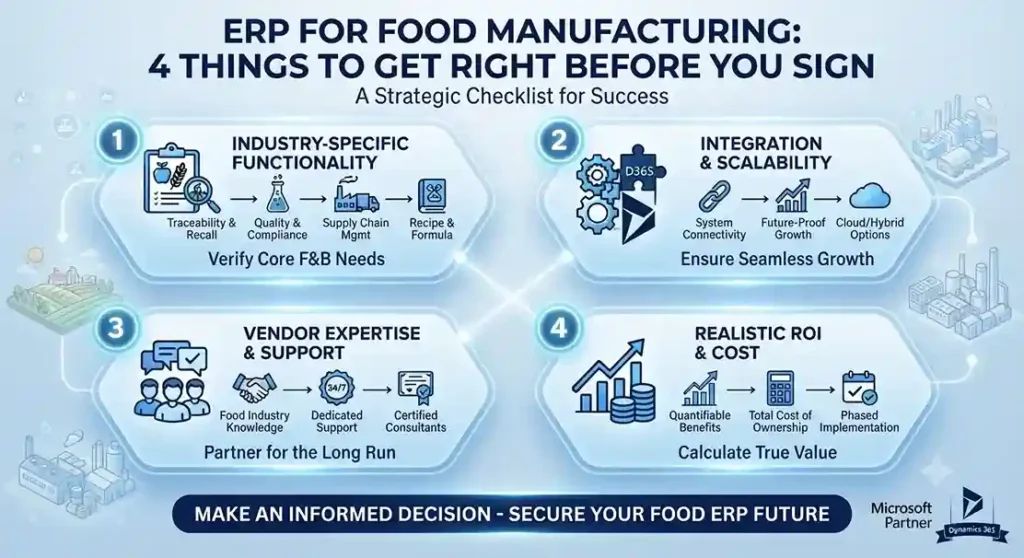
[vc_row][vc_column][vc_column_text]Usually, the decision-making process for ERP for Food Manufacturing is long and complex. From deciding which functionality is most vital to your business, to choosing a system that will make rapid and meaningful changes, it may seem daunting to decide on the appropriate ERP solution for your organization. But don’t worry, Microsoft gold partner Trident got you covered. As we have 20+ years’ experience and  implemented ERP food manufacturing various satisfied customers like Haldirams, Nik Bakers, etc. Through sharing tips on how to pick and incorporate the right food production ERP solution for your food company, we will make the decision-making process of implementing an appropriate ERP for food manufacturing a bit easier for your organization. 1) – Food Specific Approaches Tons of ERPs and business solutions are available to choose from. But as a food manufacturer or supplier, you should understand that it is complex to manage a food business effectively and comes with its own set of unique complexities. Many of the integrated software systems in the marketplace for small to medium-sized enterprises provide the functionality you would expect for sales, acquisitions, operations, accounting and inventory management only. But what about the extra features distinctive to food manufacturing? Once you settle on a standardized ERP solution, ask yourselves how much modification and flexibility a food-specific system will have to go into implementing the following characteristics: Food safety and compliance Manufacturing and quality Recipe development and management Food recall and trace-ability 2) – Functionality Recalling that not all food businesses run in the same manner is also relevant. A supermarket bakery operates much differently than a manufacturing frozen food, and a meat processor will have a completely different set of software specifications than a broad line dealer. So where are you going to start? Try to address the features and functions that your existing system currently lacks. Create a “wish list” of elements that would make operations run better if you had them in the spot. From there, you can filter a lot of ERP providers and can concentrate on only those solutions that are suitable for your organization. 3) –  Easy to Use Suppose: at your job you’re a warehouse worker or a machine technician. Now your management team has decided to introduce a new software platform throughout the organization, and you are responsible for learning it as soon as possible (and as precisely as possible). Too much load, right? Moving from manually managing stuff or from a legacy system to a fully integrated ERP solution can be terrifying for everyone in the company. The accounting department now needs to learn how to use a new system to enter figures and run calculations. The QA department now has a new way to set up quality controls and audits. If a new process is too complex, your staff might feel frustrated, disheartened, and underappreciated. Look for an ERP running on a system that is probably already familiar with most of your workforce (such as, for example, Microsoft Dynamics) 4) – Customer Support Working with a vendor of an ERP solution is so much more than just buying and using the product to run your business. The ERP solution is implemented, which usually takes five to nine months, and then continued support and facilities will proceed across your software’s life cycle. It is therefore essential to ensure that the ERP you choose is assisted by a team of people who are committed to ensuring that you are successful. This means for the food industry you need experts who are not only professionals in software but also food specialists. You wouldn’t recruit somebody to work in your warehouse that wasn’t a good choice, correct? Think the same way about the people who are working for your ERP provider. Because they are also responsible for your business ‘ success. It is easy to get confused as there are too many ERP for food manufacturing service providers, so remember to remain vigilant and consistent with what you want to get out of your solution. Selecting the right ERP means choosing software to help you enhance food security, simplify efficiency or productivity and handle the progress of the enterprise. If you still have any doubts left in your mind then you can contact to Trident’s ERP for food manufacturing providers on https://tridentinfo.com/contact/[/vc_column_text][/vc_column][/vc_row]

What Considerations Should be taken into Account when Implementing the New ERP for Food Manufacturing? Read More »

Enterprise’s secret flavor to success- Microsoft Dynamics 365

As Fourth Industrialization spreads throughout the world, it ultimately reshapes the way enterprises operate and their staff work and food manufacturing is a key example. Digitization at the root of this revolution — supported and driven by cloud computing and likewise technologies such as artificial intelligence (AI), the Internet of Things, and machine learning — is enabling food manufacturers to always use information-driven intelligence to change their business operations and expand their business offerings by integrating innovative products with value-added services. Trustworthy Microsoft’s cloud offerings as Microsoft Dynamics 365—provide manufacturers new and better ways of growing, innovating, and boosting operational efficiencies. For Food & Beverage, Microsoft Dynamics 365 has all the spices you need to handle your complex tasks, financial and compliance needs. Industry-rich features are provided in the cloud & on-premise, which makes an enterprise more agile. Food safety provisions, traceability of ingredients, shelf-life monitoring, recipe management and seasonal demand predicting are some of the challenges faced daily by food and beverage manufacturers. With the industry-specific Microsoft Dynamics 365, whether you are dealing in foods, drinks, frozen entrees or canned goods, food manufacturers are acquiring the resources required for success and prosper. Microsoft Dynamics 365 provides a complete solution, ensuring that every part of your enterprise is fully connected, from human resources and financial management to warehouse operations and quality control. Add in industry-specific food and beverage manufacturing apps, then add a touch of advanced digital and shop floor technologies, and Microsoft Dynamics 365 will provide you with a formula for success. The benefits of Microsoft Dynamics 365 for food manufacturing industry include: The flexibility of recipes with batch processing technologies and industry-specific BOMs to help reformulation Supports multiple Units of measure (volume, weight, pounds, cases, etc.) Seasonal demand forecast for individual and multi-plant Precise and clear consumer inventory management, including batch, lot and serial number traceability to automate turns and monitor expiry or best-in-time dates The functionality of private labelling Strong scheduling engine for planning volumes, advanced sequencing, waiting times and other dynamic scheduling criteria. Conquering of the laws of the food and beverage industries Two-way lot monitoring (from fields to grocery stores and back) for a clear and precise supply chain, including the purchase of raw materials and rapid identification of recall Expiry, cross-contamination and shelf-life monitoring, first-OUT (FEFO) logic to reduce waste and streamline your stock Strong labelling options to avoid unnecessary error labelling and regulatory fines Microsoft Dynamics 365 provides some clear business advantages for the food industry, whether you need to boost your teamwork skills, improve productivity or protect your data, it will be there for you. Now the question is out of too many Microsoft Dynamics 365 service providers, which service providers to opt for?? For that, you can blindly trust dynamics 365 partner Trident Information Pvt Ltd. It is one of the renowned names in the market. For more information, you can go to https://tridentinfo.com/contact/[/vc_column_text][/vc_column][/vc_row]

Enterprise’s secret flavor to success- Microsoft Dynamics 365 Read More »

ERP software dashboard managing food manufacturing production, inventory, and compliance.

ERP for Food Manufacturing: Why Intelligent Software Is No Longer Optional in 2026

Food manufacturing is one of the most operationally demanding industries on the planet — and one of the least forgiving when things go wrong. A batch produced with the wrong ingredient ratio. A shelf-life date miscalculated by a day. A supplier delivering substandard raw materials that are not caught until they are already in production. A demand forecast that is off by 20 percent — leaving you either short of product during peak season or sitting on months of unsold inventory. In most industries, operational errors are expensive. In food manufacturing, they can also be dangerous — to consumers, to your brand, and to your regulatory standing. A single food safety incident that reaches consumers can damage years of brand equity overnight. This is why ERP for food manufacturing is no longer a technology investment that forward-thinking companies make to gain competitive advantage. It is a baseline operational requirement for any food manufacturer serious about quality, compliance, efficiency, and growth. An intelligent ERP system — purpose-built or deeply configured for the specific requirements of food and beverage production — connects every function of your manufacturing operation on a single platform: from raw material procurement and recipe management through production scheduling, quality control, traceability, warehouse management, and financial reporting. It replaces the patchwork of spreadsheets, paper records, and disconnected systems that most food manufacturers have accumulated over years — and gives every team in your operation the real-time information they need to make better decisions, faster. This guide covers the key challenges driving food manufacturers toward ERP adoption, the six core ways ERP transforms operations, the critical features to look for, and what Microsoft Dynamics 365 delivers for food and beverage manufacturers. The Unique Challenges Facing Food Manufacturers in 2026 The food manufacturing industry faces a confluence of pressures that are making intelligent ERP software not just beneficial but operationally essential. Understanding these challenges is the starting point for understanding what ERP needs to solve. Regulatory Compliance and Food Safety Pressure Food safety regulations are tightening globally — and in India specifically, FSSAI compliance requirements are expanding in scope and enforcement intensity. For manufacturers supplying export markets, compliance with FDA, EU food safety regulations, HACCP requirements, and retailer-specific food safety standards adds further complexity. Meeting these requirements without an integrated system that maintains complete, auditable records throughout production is becoming increasingly difficult — and the consequences of non-compliance range from product recalls and production shutdowns to significant financial penalties and reputational damage. Supply Chain Volatility and Raw Material Costs Food raw material costs are notoriously volatile — subject to seasonal variation, weather events, geopolitical disruption, and commodity market fluctuations that can dramatically change the economics of production within a single quarter. Managing ingredient sourcing, supplier relationships, and procurement timing without real-time visibility into costs and availability means making buying decisions that may look sensible today but prove expensive in three months. Consumer Demand for Transparency and Traceability Today’s consumers — and the retailers and food service operators who serve them — increasingly demand transparency about where food comes from, what ingredients it contains, and how it was produced. This is driven by a combination of food safety awareness, dietary preference and allergy concerns, sustainability requirements, and supply chain ethics expectations. Meeting this demand requires the ability to trace every product back through every stage of production to its source ingredients — a capability that is simply not achievable without a system that tracks batch and lot numbers throughout the entire production and distribution process. Shelf Life, Waste, and Margin Pressure Food manufacturing margins are thin — and food waste is one of the largest controllable cost variables. Overproduction, poor shelf-life management, inaccurate demand forecasting, and sub-optimal raw material usage all contribute to waste that erodes profitability directly. In an industry where competition on price is intense and input costs are rising, reducing waste through better planning, better inventory management, and better production efficiency is not an optional improvement — it is a margin imperative. Why Food Manufacturing Needs a Specialized ERP — Not a Generic One What Generic ERP Systems Miss in Food Production A generic ERP system can manage financial accounts, purchase orders, and inventory records. What it typically cannot handle natively — without expensive customization — are the specific operational requirements that define food manufacturing: A food manufacturing ERP that does not handle these requirements natively forces manufacturers to either build expensive custom solutions or work around them with manual processes — undermining the efficiency gains that ERP is supposed to deliver. What Intelligent Food Manufacturing ERP Actually Delivers An intelligent food manufacturing ERP — like Microsoft Dynamics 365 Supply Chain Management or Business Central with food industry extensions — delivers all of the above natively, within a unified platform that connects production with procurement, quality, warehouse, finance, and sales. The result is a manufacturing operation that is: 6 Ways ERP Transforms Food Manufacturing Operations 1. Single Integrated System: One Source of Truth Across Every Function Let us start with the most fundamental transformation — because everything else flows from this. Most food manufacturers have accumulated technology over the years in the same way most people accumulate tools: buying something for a specific purpose when the need arose, without a clear plan for how everything would eventually work together. The result is a production system talking to a separate quality system, a warehouse system that does not connect to the ERP, a finance system receiving manual exports from production, and a sales system that does not have real-time visibility into manufacturing capacity. Every connection between these systems is a potential point of failure — a data lag, an import error, a version mismatch, or simply a piece of information that never arrives because someone forgot to run the export. An integrated ERP for food manufacturing replaces this patchwork with a single platform where every function — procurement, production, quality, warehousing, finance, and sales — operates from the same real-time data: This real-time, enterprise-wide integration is the foundation from

ERP for Food Manufacturing: Why Intelligent Software Is No Longer Optional in 2026 Read More »