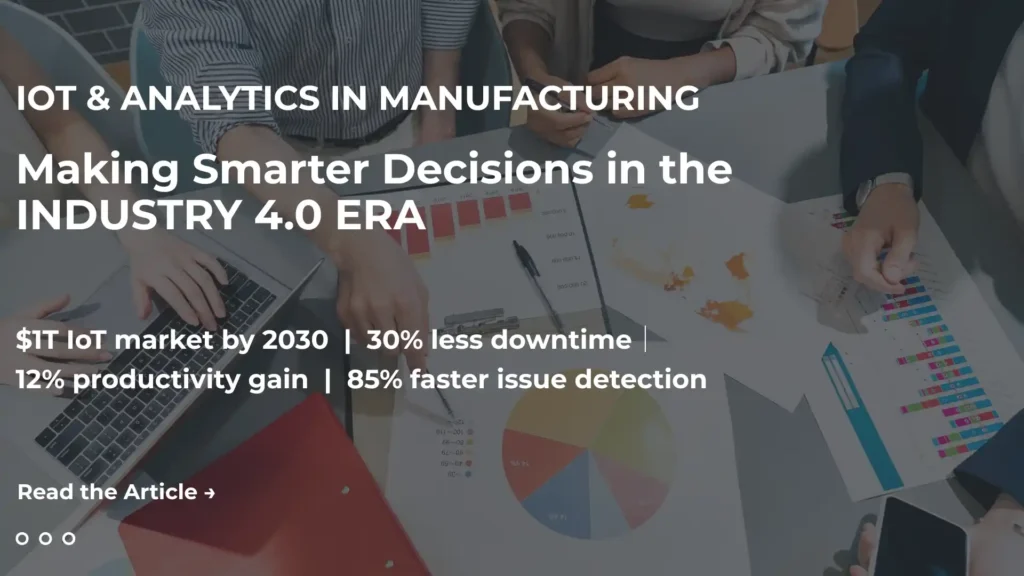
IoT and Analytics in Manufacturing: Making Smarter Decisions in the Industry 4.0 Era
Your factory floor is generating more data than you could ever manually process. The question is — are you actually using any of it? Most manufacturers today are data-rich but insight-poor. Sensors on machines, production line monitors, quality inspection systems, and logistics trackers generate enormous volumes of operational data every single day. Yet the majority of that data either sits unused in a database or gets reviewed days after the moment when acting on it would have made a difference. That gap — between data collection and intelligent decision-making — is exactly what the combination of IoT and advanced analytics is designed to close. And in Industry 4.0, closing it is no longer a competitive advantage. It is a baseline requirement. What Industry 4.0 Actually Means for Manufacturers Industry 4.0 is not a single technology. It is the convergence of several technologies — IoT sensors, cloud computing, artificial intelligence, machine learning, and advanced analytics — working together to create manufacturing operations that are connected, intelligent, and self-optimizing. The central promise is straightforward: connect every asset, capture every data point, and use that data to make faster and better decisions — about maintenance, quality, production planning, and operational efficiency. The manufacturers who are getting this right are called Best-in-Class for a reason. They experience less unplanned downtime, higher product quality, better asset utilization, and lower operational costs than their peers. The difference is not their machines. It is how intelligently they use the data those machines generate. The Three Levels of Manufacturing Analytics To understand what IoT and analytics deliver together, it helps to understand the three levels of analytical insight available to manufacturers. 1. Descriptive Analytics — What Happened? This is the starting point. Descriptive analytics tells you what has already occurred — production volumes, downtime events, quality rejection rates, energy consumption. Most manufacturers have some version of this through their ERP or MES reporting. It is useful for understanding history. But it cannot help you prevent the next problem. 2. Predictive Analytics — What Will Happen? Predictive analytics uses historical data and machine learning models to forecast future events. In manufacturing, the most valuable application is predictive maintenance — identifying equipment that is likely to fail before it actually does. When IoT sensors on a machine detect subtle changes in vibration, temperature, or current draw that historically precede a failure, the system flags it for maintenance intervention. The machine gets serviced during a planned window. Production continues uninterrupted. The difference between a planned maintenance stop and an unplanned breakdown is enormous — in cost, in production loss, and in the cascading impact on every downstream process that depends on that machine. 3. Prescriptive Analytics — What Should We Do? This is the most powerful level — and the one that separates genuinely Best-in-Class manufacturers from the rest. Prescriptive analytics does not just tell you what will happen. It tells you what to do about it. It evaluates multiple possible responses to a predicted situation and recommends the optimal action — factoring in production schedules, parts availability, technician skills, customer delivery commitments, and cost. This is the foundation of what analysts call the virtual factory — a digital model of your production operation that continuously optimizes decisions across every function in real time. How IoT Makes All of This Possible Advanced analytics is only as good as the data it processes. IoT is what makes that data rich, real-time, and continuous. IoT sensors embedded in production equipment capture performance data — vibration, temperature, pressure, speed, current draw, cycle time — at frequencies that humans cannot monitor manually. This continuous stream of operational data feeds directly into analytics platforms. Connected quality systems capture inspection data at every production stage — surface defects, dimensional measurements, weight variations — creating a complete quality record for every batch produced. Production line monitors track throughput, cycle times, and OEE (Overall Equipment Effectiveness) in real time — giving production managers the live visibility they need to identify bottlenecks and respond before the end of shift, not at the next morning’s review meeting. Asset tracking monitors the location and utilization of tools, equipment, and WIP inventory across the factory floor — reducing the time wasted searching for assets and improving the accuracy of production scheduling. The Real Business Impact When IoT and analytics work together effectively in a manufacturing environment, the business outcomes are measurable and significant: Outcome How IoT and Analytics Delivers It Reduced unplanned downtime Predictive maintenance catches failures before they occur Higher product quality Real-time quality monitoring enables immediate corrective action Better OEE Live production visibility identifies and eliminates bottlenecks Lower maintenance costs Planned maintenance replaces emergency breakdowns Improved energy efficiency Usage patterns identified and optimized through analytics Faster decision-making Prescriptive recommendations surface the right action automatically Best-in-Class manufacturers combining IoT with advanced prescriptive analytics consistently report significant reductions in asset downtime and measurable improvements in product quality — not as aspirational projections, but as documented operational outcomes. Microsoft Azure IoT and Dynamics 365: The Enterprise Platform For manufacturers looking to implement IoT and analytics at enterprise scale, Microsoft Azure IoT Hub combined with Microsoft Dynamics 365 Supply Chain Management provides the integrated platform that makes Best-in-Class performance achievable. Azure IoT Hub connects every sensor and asset in your facility — processing real-time telemetry data from thousands of devices simultaneously and feeding it into analytics and business systems. Azure Machine Learning builds and deploys the predictive models that turn raw sensor data into actionable maintenance and quality insights. Microsoft Dynamics 365 integrates IoT alerts directly into business processes — automatically creating work orders when predictive models identify a maintenance requirement, adjusting production schedules when quality anomalies are detected, and providing management dashboards with real-time operational intelligence. Microsoft Copilot in Dynamics 365 adds a natural language layer — allowing production managers and operations leaders to query their operational data conversationally, getting instant answers to questions that previously required an analyst to answer. Where to Start The gap between a factory that collects data and
IoT and Analytics in Manufacturing: Making Smarter Decisions in the Industry 4.0 Era Read More »