
Welcome to Trident Information Systems!
Write us to - info@tridentinfo.com
Let's Socialize

devops tools

Steel Structure Design Software

5 Tips to Conquer Overcapacity Issues, Over-pricing, and Price Volatility in Your Steel Manufacturing Plant

Steel manufacturers often come across unique challenges in their production units with routes, BOMs, and engineer functions deciding product design. The world crude production in 2020, amounted to more than 1.86 billion metric tons. It was a more stable value as compared to 2019’s production. Due to the steel price drop, global leaders such as ArcelorMittal and Nucor faced adverse consequences. Due to international policies, manufacturing plants face overcapacity. Manufacturers need efficient Steel Structure Design Software to help them through similar situations  The key to succeeding in the steel industry and service is to deploy Advance Steel Software. Technology providing real-time updates and transparency through every stage of your supply chain helps in efficient planning, and material scheduling streamlines the supply chain and provides transparency. To ensure consistent and smooth operations, make sure your Metal Fabrication Software comes with after-sales support services.  Ideal Steel Manufacturing Software will provide:   Quality management  Financial management  Shop floor data capture  Attendance and time   Product Configurator  purchase, sales, and order processing  Timesheet management  Purchase requisition  How to Use Steel Structure Design Software to Optimize Manufacturing?  The only way to achieve manufacturing optimization is to complement the latest technology. First, you have to find the most suitable Steel Structure Design Software. Microsoft Dynamics 365 Finance and Operations is one of the best examples. Renowned by every business, D365 has an impression of a robust, agile, flexible, and value-for-money platform. Suitable for SMEs and Enterprises, it allows the development and customization of tools for specific requirements. Given below are five tips to streamline your manufacturing processes.   #1 Thoroughly Analyze and Identify Long Term and Short-Term Solutions  To streamline operations, you must first identify the problems. Thoroughly analyze and spot what your long-term and short-term analysis are. You can pull out your current KPI stats and check out your previous non-conformances. Look at the solutions and how they performed last time. What improvisations can be made? Bring out previous data and analyze the effectiveness of your previous measures. These steps are necessary to control quality. Also, you can identify the areas where you are investing in vain. It is best if your Steel Structure Design Software generates an ultimate product quality certificate so you can ensure the best quality product for your customers.   #2 Try to Get Transparency on the Shop-floor to Manage Costs   The production process involves various steps. Getting transparency on each step helps you identify what exactly is going on and how your staff is performing. Check how much time and resources you can save in the process. With the latest ERP for Steel Industry like Microsoft D365, you can track, schedule, and report progress in production. Make sure you check what each employee does, and how much time he takes in completing a production order, followed by his duties. These steps are crucial to saving investments.   #3 Pay Attention to the Scheduling Process  Scheduling is one of the most painstaking processes in the steel manufacturing industry. Getting visibility into this particular task improves overall production capability. The best way to get visibility in scheduling is to deploy advanced Steel Structure Design Software that allows real-time visibility into the process. MSD 365 provides visibility with material optimization, max OD/ coil breakpoint, interactive graphic planning, cut, slit and melt planning workbenches, etc.   #4 Make Informed plans and Decisions   Data is the foundation of every business. Make sure the source of your foundation provides quick and updated information. It is recommended to use a single Metal Fabrication Software to manage all your business operations instead of hopping back and forth from one software to another. Make sure the data you use is fresh, and no updates are made thereafter. This way you can make better production-boosting strategies. Moreover, you can make effective replenishment decisions to avoid overstocking and understocking.   #5 Keep Up with the Legislation Updates   Overcapacity is one of the global issues in the world. It involves changes in international policies where the government intervenes in your trade. Make sure you keep up with such updates and produce accordingly. Regressive policies and low demands cause a drop in steel prices. The best way to prevent overcapacity is to install unified software that helps you comply with the legislation of a specific area.   You need to deploy the latest technology to deal with the latest problems. MSD 365, renowned by millions of businesses across the globe, allows you to access every functionality your steel manufacturing plant needs to run smoothly. If you wish for implementation or a demonstration, you can contact Trident Information Systems, a Microsoft Dynamics 365 Gold Implementation Partner.  
5 Tips to Conquer Overcapacity Issues, Over-pricing, and Price Volatility in Your Steel Manufacturing Plant Read More »

How does a Vision Intelligence System Outraces Manual Defect Detection While Manufacturing? 

Quality and Productivity are the two key aspects of a manufacturing company. However, bringing them both into equilibrium has become a daunting challenge. Manufacturers desperately need a Vision Intelligence System to restore balance. A Vision Inspection System Manufacturers assist with meeting dynamic customer demands and keeping up with the quality requirements.   Manual Defect Detection in Manufacturing, on the other hand, is insufficient to deal with current market dynamics. It becomes next to impossible to get productivity and quality complementing each other. It is prone to setbacks such as:   The inefficiency of human eyes to detect minute defects.   Inability to identify differences in similar spectrums of colors.   Too much workforce is needed to detect defects manually.   A rather costly approach.   Crowded floor space may cause staff to bump into each other.   Delayed reporting can lead to defective pieces passing through the conveyor.  A Vision Intelligence System is capable of abolishing each of these hindrances and providing a seamless quality inspection. Trident Information Systems has designed a technology called Vision Intelligence System. It is specifically for manufacturers. It digitally detects defects of manufactured items right on the conveyor, demanding low or no human interference.   How Does Trident’s Visual Quality Inspection Work?  Trident’s Machine Vision Inspection is a solution that digitally does everything a human inspection does, but more efficiently.   Identifies Minute Defects  This Visual Defect Detection System catches even minute defects such as small dents, scratches, breaks, burrs, chips, and so on. Human eyes may get tired, and miss these faults sometimes, or due to lack of focus, the outcome could be similar. It is faster and more efficient than a human, hence delivering results with more accuracy.  Presence/ Absence of Components   It can also identify the absence or presence of a component while manufacturing. For Instance, during FMCG production, it can identify small animals, dust, stone, and any other component that is not supposed to be there. In addition, it can also detect missing items. E.g., it can easily identify missing bolts, nuts, screws, etc.   Color Monitoring  Human eyes can sometimes miss judging certain colors, but this Vision Intelligence System does not. It can precisely monitor colors and only lets those pieces pass which has an acceptable color range than what is standardized. Color monitoring ensures uniformity among items produced.   Dimension Quality   Vision Intelligence System also ensures a dimensional uniformity among all the items. In human inspection, the chances for faulty dimension quality are higher. A Visual Quality Inspection, however, precisely monitors the dimensional quality of a product. It checks if all the bottles are properly capped and sealed. It detects any thorns in the packaging too.   Printing Accuracy   Apart from color monitoring, it also identifies if printing is accurate, the colors match the standards, and the logo is professionally printed. It also inspects if the labels are mentioned within the assisted dimensions.  How Does it Work in the Favor of Your Business?  Trident’s Vision Quality Inspection, also known as Vision Intelligence System, outweighs common manual inspection challenges and provides a better, faster, smoother, and optimized defect detection.   Accurate and Faster Defect Detection   With machine handling your defect detection, you can expect a more accurate defect detection. Even little scratches, dents, burns, etc. which are generally missed by human eyes, this Machine Vision System catches them right away. In addition to being accurate, it is also faster than your traditional inspection. It quickly catches the defect and commands to discard it, hence leading only pieces to pass through.   Prompt Reporting   In inspection by man, reporting can be delayed, and surplus time is given for defective pieces to blend with the accurate items. A Machine Vision System flashes it on the associated monitor as soon as a defect is identified.  Boosted Productivity   Faster and more accurate detection with low to no human interference leads to boosted productivity. You will not have to hire new staff as you can use your current staff on other productive tasks which they would get the time for earlier. For instance, assigning packaging work to more staff if you do not have automatic packaging technology.   Empty Floor Space  No human interference leaves floor space empty. With plenty of free space, the chances of staff bumping into one another and getting into clashes diminish.   Trident’s Vision Intelligence System is crafted specifically for manufacturers. We serve glass, steel, laminate, FMCG, automotive, and pharmaceutical manufacturing industries. Contact us for further information. 

How does a Vision Intelligence System Outraces Manual Defect Detection While Manufacturing?  Read More »

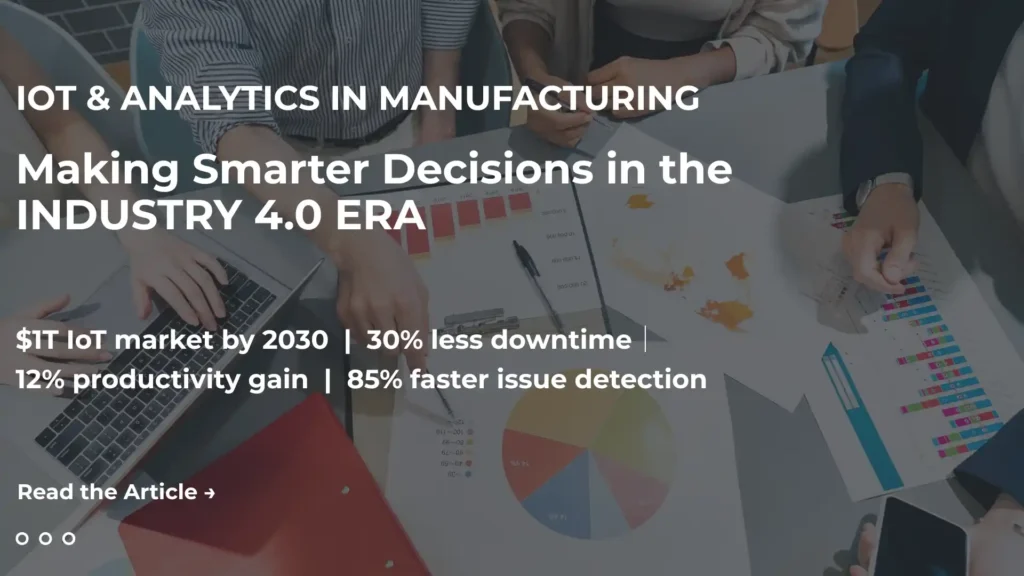
Smart factory using IoT sensors and analytics dashboards for real-time manufacturing insights.

IoT and Analytics in Manufacturing: Making Smarter Decisions in the Industry 4.0 Era

Your factory floor is generating more data than you could ever manually process. The question is — are you actually using any of it? Most manufacturers today are data-rich but insight-poor. Sensors on machines, production line monitors, quality inspection systems, and logistics trackers generate enormous volumes of operational data every single day. Yet the majority of that data either sits unused in a database or gets reviewed days after the moment when acting on it would have made a difference. That gap — between data collection and intelligent decision-making — is exactly what the combination of IoT and advanced analytics is designed to close. And in Industry 4.0, closing it is no longer a competitive advantage. It is a baseline requirement. What Industry 4.0 Actually Means for Manufacturers Industry 4.0 is not a single technology. It is the convergence of several technologies — IoT sensors, cloud computing, artificial intelligence, machine learning, and advanced analytics — working together to create manufacturing operations that are connected, intelligent, and self-optimizing. The central promise is straightforward: connect every asset, capture every data point, and use that data to make faster and better decisions — about maintenance, quality, production planning, and operational efficiency. The manufacturers who are getting this right are called Best-in-Class for a reason. They experience less unplanned downtime, higher product quality, better asset utilization, and lower operational costs than their peers. The difference is not their machines. It is how intelligently they use the data those machines generate. The Three Levels of Manufacturing Analytics To understand what IoT and analytics deliver together, it helps to understand the three levels of analytical insight available to manufacturers. 1. Descriptive Analytics — What Happened? This is the starting point. Descriptive analytics tells you what has already occurred — production volumes, downtime events, quality rejection rates, energy consumption. Most manufacturers have some version of this through their ERP or MES reporting. It is useful for understanding history. But it cannot help you prevent the next problem. 2. Predictive Analytics — What Will Happen? Predictive analytics uses historical data and machine learning models to forecast future events. In manufacturing, the most valuable application is predictive maintenance — identifying equipment that is likely to fail before it actually does. When IoT sensors on a machine detect subtle changes in vibration, temperature, or current draw that historically precede a failure, the system flags it for maintenance intervention. The machine gets serviced during a planned window. Production continues uninterrupted. The difference between a planned maintenance stop and an unplanned breakdown is enormous — in cost, in production loss, and in the cascading impact on every downstream process that depends on that machine. 3. Prescriptive Analytics — What Should We Do? This is the most powerful level — and the one that separates genuinely Best-in-Class manufacturers from the rest. Prescriptive analytics does not just tell you what will happen. It tells you what to do about it. It evaluates multiple possible responses to a predicted situation and recommends the optimal action — factoring in production schedules, parts availability, technician skills, customer delivery commitments, and cost. This is the foundation of what analysts call the virtual factory — a digital model of your production operation that continuously optimizes decisions across every function in real time. How IoT Makes All of This Possible Advanced analytics is only as good as the data it processes. IoT is what makes that data rich, real-time, and continuous. IoT sensors embedded in production equipment capture performance data — vibration, temperature, pressure, speed, current draw, cycle time — at frequencies that humans cannot monitor manually. This continuous stream of operational data feeds directly into analytics platforms. Connected quality systems capture inspection data at every production stage — surface defects, dimensional measurements, weight variations — creating a complete quality record for every batch produced. Production line monitors track throughput, cycle times, and OEE (Overall Equipment Effectiveness) in real time — giving production managers the live visibility they need to identify bottlenecks and respond before the end of shift, not at the next morning’s review meeting. Asset tracking monitors the location and utilization of tools, equipment, and WIP inventory across the factory floor — reducing the time wasted searching for assets and improving the accuracy of production scheduling. The Real Business Impact When IoT and analytics work together effectively in a manufacturing environment, the business outcomes are measurable and significant: Outcome How IoT and Analytics Delivers It Reduced unplanned downtime Predictive maintenance catches failures before they occur Higher product quality Real-time quality monitoring enables immediate corrective action Better OEE Live production visibility identifies and eliminates bottlenecks Lower maintenance costs Planned maintenance replaces emergency breakdowns Improved energy efficiency Usage patterns identified and optimized through analytics Faster decision-making Prescriptive recommendations surface the right action automatically Best-in-Class manufacturers combining IoT with advanced prescriptive analytics consistently report significant reductions in asset downtime and measurable improvements in product quality — not as aspirational projections, but as documented operational outcomes. Microsoft Azure IoT and Dynamics 365: The Enterprise Platform For manufacturers looking to implement IoT and analytics at enterprise scale, Microsoft Azure IoT Hub combined with Microsoft Dynamics 365 Supply Chain Management provides the integrated platform that makes Best-in-Class performance achievable. Azure IoT Hub connects every sensor and asset in your facility — processing real-time telemetry data from thousands of devices simultaneously and feeding it into analytics and business systems. Azure Machine Learning builds and deploys the predictive models that turn raw sensor data into actionable maintenance and quality insights. Microsoft Dynamics 365 integrates IoT alerts directly into business processes — automatically creating work orders when predictive models identify a maintenance requirement, adjusting production schedules when quality anomalies are detected, and providing management dashboards with real-time operational intelligence. Microsoft Copilot in Dynamics 365 adds a natural language layer — allowing production managers and operations leaders to query their operational data conversationally, getting instant answers to questions that previously required an analyst to answer. Where to Start The gap between a factory that collects data and

IoT and Analytics in Manufacturing: Making Smarter Decisions in the Industry 4.0 Era Read More »

Advancing Azure service quality with artificial intelligence: AIOps

We are going to share our vision on the importance of infusing AI into our cloud platform and DevOps process. Gartner referred to something similar as AIOps (pronounced “AI Ops”) and this has become the common term that we use internally, albeit with a larger scope. Today’s post is just the start, as we intend to provide regular updates to share our adoption stories of using AI technologies to support how we build and operate Azure at scale. Why AIOps? There are two unique characteristics of cloud services: The ever-increasing scale and complexity of the cloud platform and systems The ever-changing needs of customers, partners, and their workloads To build and operate reliable cloud services during this constant state of flux, and to do so as efficiently and effectively as possible, our cloud engineers (including thousands of Azure developers, operations engineers, customer support engineers, and program managers) heavily rely on data to make decisions and take actions. Furthermore, many of these decisions and actions need to be executed automatically as an integral part of our cloud services or our DevOps processes. Streamlining the path from data to decisions to actions involves identifying patterns in the data, reasoning, and making predictions based on historical data, then recommending or even taking actions based on the insights derived from all that underlying data.   Figure 1. Infusing AI into cloud platform and DevOps. The AIOps vision AIOps has started to transform the cloud business by improving service quality and customer experience at scale while boosting engineers’ productivity with intelligent tools, driving continuous cost optimization, and ultimately improving the reliability, performance, and efficiency of the platform itself. When we invest in advancing AIOps and related technologies, we see this ultimately provides value in several ways: Higher service quality and efficiency: Cloud services will have built-in capabilities of self-monitoring, self-adapting, and self-healing, all with minimal human intervention. Platform-level automation powered by such intelligence will improve service quality (including reliability, and availability, and performance), and service efficiency to deliver the best possible customer experience. Higher DevOps productivity: With the automation power of AI and ML, engineers are released from the toil of investigating repeated issues, manually operating and supporting their services, and can instead focus on solving new problems, building new functionality, and work that more directly impacts the customer and partner experience. In practice, AIOps empowers developers and engineers with insights to avoid looking at raw data, thereby improving engineer productivity. Higher customer satisfaction: AIOps solutions play a critical role in enabling customers to use, maintain, and troubleshoot their workloads on top of our cloud services as easily as possible. We endeavor to use AIOps to understand customer needs better, in some cases to identify potential pain points and proactively reach out as needed. Data-driven insights into customer workload behavior could flag when Microsoft or the customer needs to take action to prevent issues or apply workarounds. Ultimately, the goal is to improve satisfaction by quickly identifying, mitigating, and fixing issues. Figure 2. AI for Cloud: AIOps and AI-Serving Platform. AIOps Moving beyond our vision, we wanted to start by briefly summarizing our general methodology for building AIOps solutions. A solution in this space always starts with data—measurements of systems, customers, and processes—as the key of any AIOps solution is distilling insights about system behavior, customer behaviors, and DevOps artifacts and processes. The insights could include identifying a problem that is happening now (detect), why it’s happening (diagnose), what will happen in the future (predict), and how to improve (optimize, adjust, and mitigate). Such insights should always be associated with business metrics—customer satisfaction, system quality, and DevOps productivity—and drive actions in line with prioritization determined by the business impact. The actions will also be fed back into the system and process. This feedback could be fully automated (infused into the system) or with humans in the loop (infused into the DevOps process). This overall methodology guided us to build AIOps solutions in three pillars. Figure 3. AIOps methodologies: Data, insights, and actions. AI for systems Today, we’re introducing several AIOps solutions that are already in use and supporting Azure behind the scenes. The goal is to automate system management to reduce human intervention. As a result, this helps to reduce operational costs, improve system efficiency, and increase customer satisfaction. These solutions have already contributed significantly to the Azure platform availability improvements, especially for Azure IaaS virtual machines (VMs). AIOps solutions contributed in several ways including protecting customers’ workload from host failures through hardware failure prediction and proactive actions like live migration and Project Tardigrade and pre-provisioning VMs to shorten VM creation time. Of course, engineering improvements and ongoing system innovation also play important roles in the continuous improvement of platform reliability. Hardware Failure Prediction is to protect cloud customers from interruptions caused by hardware failures.  Microsoft Research and Azure have built a disk failure prediction solution for Azure Compute, triggering the live migration of customer VMs from predicted-to-fail nodes to healthy nodes. We also expanded the prediction to other types of hardware issues including memory and networking router failures. This enables us to perform predictive maintenance for better availability. Pre-Provisioning Service in Azure brings VM deployment reliability and latency benefits by creating pre-provisioned VMs. Pre-provisioned VMs are pre-created and partially configured VMs ahead of customer requests for VMs. As we described in the IJCAI 2020 publication, As we described in the AAAI-20 keynote mentioned above,  the Pre-Provisioning Service leverages a prediction engine to predict VM configurations and the number of VMs per configuration to pre-create. This prediction engine applies dynamic models that are trained based on historical and current deployment behaviors and predicts future deployments. Pre-Provisioning Service uses this prediction to create and manage VM pools per VM configuration. Pre-Provisioning Service resizes the pool of VMs by destroying or adding VMs as prescribed by the latest predictions. Once a VM matching the customer’s request is identified, the VM is assigned from the pre-created pool to the customer’s subscription. AI for DevOps AI can boost engineering productivity and help in shipping

Advancing Azure service quality with artificial intelligence: AIOps Read More »

Microsoft Dynamics 365 Connected Field Service dashboard monitoring predictive maintenance and service operations.

Microsoft Dynamics 365 Connected Field Service: How Industry Leaders Are Moving From Break-Fix to Predictive Service

What if your field technician could fix a problem before the customer even knew it existed? That is not a futuristic scenario. It is what Microsoft Dynamics 365 Connected Field Service — powered by IoT integration through Microsoft Azure — is delivering for industry leaders right now. And organizations that have made the switch are seeing return on investment in as little as four months. Field service has always been the moment of truth in customer relationships. The technician who arrives on time, with the right parts, with full knowledge of the customer’s history — or doesn’t — defines how that customer feels about your brand for years. But the traditional break-fix model of field service is no longer a viable competitive strategy. Customers today expect 100 percent uptime, hyper-speed service delivery, and proactive care that anticipates problems before they escalate. In an environment where competitive pressure is intensifying across every industry — from manufacturing and utilities to telecommunications and retail — field service has become a primary differentiator. The organizations winning are those that have moved from reactive to predictive, from disconnected to connected, and from legacy systems to intelligent, cloud-based field service platforms. This guide covers everything you need to know about Microsoft Dynamics 365 Connected Field Service — what it is, how it works, what real organizations have achieved with it, and how Trident Information Systems can implement it for your operation. The Field Service Revolution: Why the Old Model Is Failing From Break-Fix to Predictive: The New Standard for Field Service The break-fix model of field service — wait for something to fail, dispatch a technician, fix the problem, send the invoice — was the industry standard for decades. It worked adequately in a world where customers had limited alternatives and modest expectations. Neither of those conditions applies today. Modern customers expect continuous uptime, not reactive repairs. They expect service providers to know about potential failures before they occur — and to resolve them without disruption to operations. In industries like utilities, manufacturing, and facilities management, an unplanned outage or equipment failure is not just an inconvenience. It is a financial event, a safety risk, and a potential contract termination. The shift from break-fix to proactive and predictive service is not a trend — it is a market requirement. And it is only possible with the right connected technology infrastructure. Why Customer Experience Has Become the Frontline of Field Service Field service is no longer just an operational function. It is a customer experience function — and in many industries, it is the single most important touchpoint in the entire customer relationship. The field technician who arrives at a customer’s facility is representing your brand at its most direct and personal. What they know, what tools they have, how quickly they resolve the issue, and how well they communicate throughout the process determines whether that customer renews their contract, refers your company to others, or starts evaluating your competitors. This is why leading organizations across retail, telecommunications, manufacturing, utilities, and professional services are investing in connected field service — not just as an operational upgrade, but as a strategic investment in customer retention and competitive differentiation. What Is Microsoft Dynamics 365 Connected Field Service? Microsoft Dynamics 365 Connected Field Service is an intelligent, IoT-powered field service management solution that connects physical assets, field technicians, customer data, and service operations on a single platform — enabling organizations to shift from reactive maintenance to proactive, predictive service delivery. At its core, Connected Field Service integrates three technology layers that traditional field service solutions have always kept separate: When these three layers work together, something fundamental changes: your service operation stops reacting to failures and starts preventing them. IoT Integration: Knowing About Problems Before Customers Do The most powerful capability in Microsoft Dynamics 365 Connected Field Service is the integration with Microsoft Azure IoT Hub — which enables continuous monitoring of connected assets and automatic work order generation when sensor data indicates a potential failure. Here is what that means in practice: The result is not just faster service. It is service that prevents the problem from becoming a crisis — protecting the customer’s operations and your relationship simultaneously. Mobile-Connected Field Teams With a 360-Degree Customer View The value of IoT monitoring is only fully realized when the field technician who responds to it is properly equipped. Microsoft Dynamics 365 Connected Field Service gives every technician a complete, real-time view of the customer and asset before they arrive on site: When a technician arrives fully informed and properly equipped, first-time fix rates increase dramatically — and repeat visits, which are expensive for the service provider and frustrating for the customer, decrease proportionally. H3: Mixed Reality and the Future of Field Service Delivery Microsoft Dynamics 365 Connected Field Service also supports Mixed Reality technologies — including Microsoft HoloLens and Remote Assist — that are reshaping how complex field service challenges are resolved: Mixed Reality in field service is not yet universal — but for organizations managing complex, high-value assets in industries like aerospace, industrial manufacturing, and energy, it is rapidly becoming a standard capability. Real-World Proof: MacDonald Miller Facility Solutions Case Study Theory is valuable. Proof is better. The MacDonald Miller Facility Solutions case study is one of the most compelling demonstrations of what Microsoft Dynamics 365 Connected Field Service delivers in practice — and the speed at which it delivers it. The Challenge: Managing Complex, Interconnected Facility Systems MacDonald Miller Facility Solutions is a professional services company specializing in facilities management — a sector defined by complexity. Managing multiple interlocking, interdependent building systems across a large portfolio of client facilities, with the expectation of continuous uptime and proactive maintenance, requires a technology platform capable of integrating disparate data sources and coordinating rapid field response. Before adopting Connected Field Service, MacDonald Miller’s technicians were working without complete asset history when deployed to service calls. Work order creation and dispatch was reactive. The information needed to diagnose and resolve issues

Microsoft Dynamics 365 Connected Field Service: How Industry Leaders Are Moving From Break-Fix to Predictive Service Read More »