Welcome to Trident Information Systems!
Write us to - info@tridentinfo.com
Let's Socialize

Iot for manufacturing

How can IoT Help in Achieving Excellent Automotive Product Quality in Your Manufacturing Plant? 

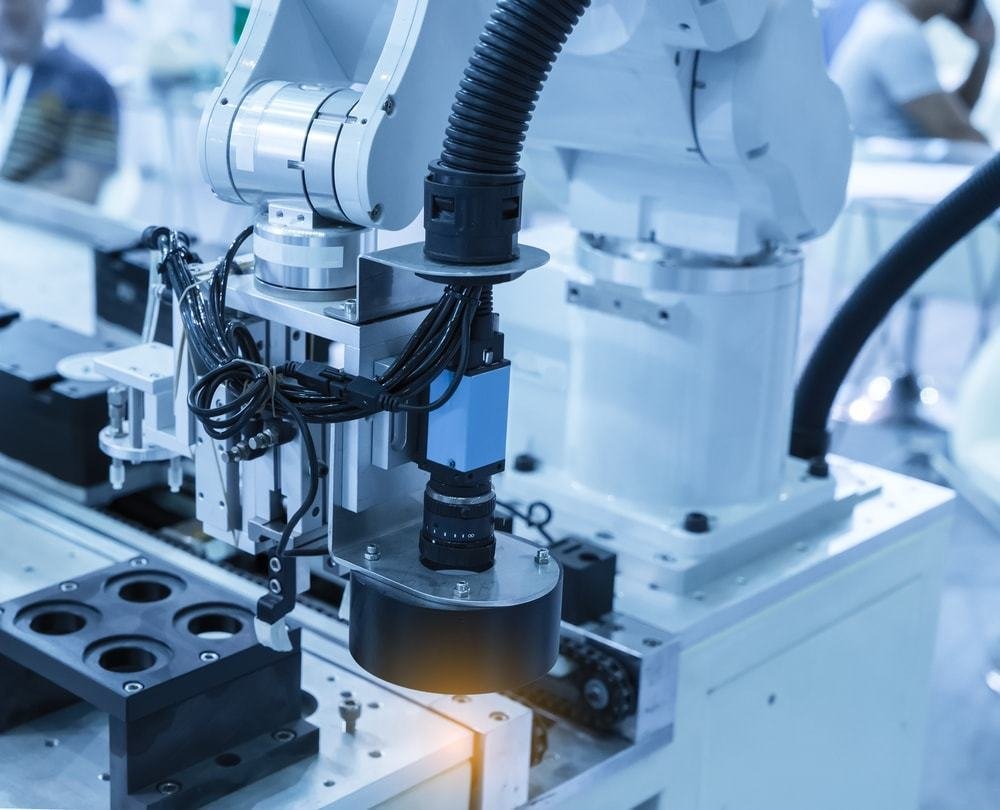
Today’s economies are dramatically changing, triggered by new markets, digital developments, increased automation, and the rise in modern technologies around the world. These factors have revolutionized several industries, and the automotive industry is no exception. People these days have become more quality conscious. Hence, pressuring manufacturers to provide the best quality automotive items at lower costs. Manufacturers seek the best IoT for Manufacturing such as a Machine Vision Application to produce excellent quality products.   The automotive industry can expect consistent growth in the market. According to a report by Mckinsey, the automotive revenue pool will significantly increase and diversify towards on-demand mobility and driven data services. It can generate about 1.5 trillion or 30% more as additional revenue in 2030. This is a massive opportunity for automotive manufacturers. However, this opportunity tags along with various challenges. Among these, the most obvious one is – high competition.   To stay ahead of the competition, you have to offer exceptional services and excellent quality automotive products to the customers. You can easily achieve this with an IoT solution for Manufacturing (preferably Artificial Intelligence based Software). A Machine Vision Inspection helps you achieve exactly what you need; excellent quality products at lower costs. This Smart Manufacturing IoT is designed specifically for you to cut waste and increase your staff’s productivity.   In this article, we will discuss how a Machine Vision Application can help you achieve the desired quality of your products.   How Can Machine Vision Application Help You Achieve First-Class Production Quality?  To ensure the quality of your products, first, you need superior quality raw material and then ensure that the produced items have no scratches, breakage, etc. A Manufacturing Defect Detection Software enables the dimensional gauging of the precision machine components like transmission, fasteners, and other sub-assemblies. The Machine Vision Application ensures only those items pass through the conveyor belt that fulfills the quality standards.    AI-based Manufacturing Inspection Software like Vision Intelligence System by Trident  Allows quality inspection in a similar environment. The best part is you do not even have to make additional changes to this IoT Factory Automation software.   What Can the Vision Intelligence System do? Identify   The Machine Vision Application can read barcode labels, barcodes from the marked parts, direct part marks (DPM), and verify labels.  Inspect   This IoT in Manufacturing Industry detects dents, wrinkles, and cracks in any part of the item. It can further detect piston defects (mishandling and foundry defects).   Measure/ Gauge/ Guide  You can easily measure the outer and inner diameters of the O ring, the angle of the metal tips, and the positions of labels and edges with Machine Vision Application.   Detects Minute Flaws   You can even detect flaws that are not visible to the naked eye such as small dents, scratches, dust, dust, etc.   Quality of the Glass  The Internet of Things Smart Manufacturing software helps detect little flaws on the windshield like cracks, scratches, breakage, discoloration, dust, and so on.   Missing Components   Detect missing bolts, nuts, screws, wires, and so on at one glance.   What Would You Get in the End?  Defect detection is a tiring process, yet the most important thing is to determine the quality of your production. If you employ Machine Vision Application , you can get the following benefits:   No Human Interaction Required  With Defect Detection Computer Vision like Vision Intelligence System, you can leave human dependency behind. The machine does all the work itself demanding no too low human interactions. This is the best way to avoid human errors.  Boosts Productivity   When you employ a robust machine like Machine Vision Application for quality check, you get faster and more accurate detection. Since the process becomes faster, you can cut waste and produce more items in less time.  Quick Reporting   The best part of this technology is its quick reporting facilities. Whenever there is a defect, it flashes the alert on the monitor. Hence, prompting the concerned person to take relevant actions. In human-based defect detection, the same process is more tedious and time-consuming.   The automotive industry has a bright future, and you, as a manufacturer, have a lot of opportunities. However, opportunities come with challenges. To stay ahead in the competition, you need to get AI (Artificial Intelligence) and IoT software working for you that supports you to provide excellent customer service.   Vision Intelligence System is one of the most renowned Machine Vision Application in the market that helps you boost productivity, cut human errors and increase your ROI (Return on Investment) impressively. For further information, you can Contact Trident Information Systems. 

How can IoT Help in Achieving Excellent Automotive Product Quality in Your Manufacturing Plant?  Read More »

Machine Vision Inspection

Get Three times Better Quality FMCG Production with Vision Inspection System  

Are you an FMCG manufacturer? How fast can you produce good quality products? If you need a solution that ensures faster production with enhanced quality and greater ROI (Return on Investment), you must get a Machine Vision Inspection. You must be facing tough competition in the market. Fast Moving Consumer Goods are the fastest-selling and low-profit margin covering goods. Hence, you must stand out in the market.   Manufacturers that are still relying on human efficiency to inspect goods need a serious technological shift, or they will fall back into the line. Traditional Defect Detection System may include low digital involvement and high human dependency, whereas, in the case of Manufacturing Inspection Software, there will be low-to-no human interference.   Traditional methods are prone to a good sum of challenges such as:   Human dependency.   Lack of consistency due to different perceptions of humans.  Time-consuming inspection methodologies.   Often a poor-quality product may pass through the conveyor belt.   The production process may be hampered due to the absence of employees.  Conflicts among workers.   Too much rush on the floor space.   There are so many disadvantages to traditional inspection methods, and you will bid farewell to them once a Visual Defect Detection System is installed.   Find a Machine Vision Inspection for Your Business  There is a ton of Machine Inspection System in the market, but you must choose smartly. Look for the one which offers AI (Artificial Intelligence) integration such as Vision Inspection System by Trident Information Systems. Furthermore, various reasons encourage infusing technology with your production environment:   No Human Interference  In Visual Defect Detection, you do not need human interference, as everything is done using machines. With AI technology, you do not even have to make consistent modifications, the system can work perfectly in a similar environment. With no human interference, you can also expect to witness even fewer conflicts among floor space.   Free Floor Space  Handing over everything to the machine, you can free up a lot of floor space and let your staff roam freely when necessary. Employees won’t bump into one another and cause disturbance in the flow. Shifting goods from one space to another becomes even easier.   Consistency of Work   The machine offers consistency in work and encourages a smooth flow. Even if some staff is missing, the operational flow remains smooth. Humans may miss identifying a different spectrum of color, but Machine Vision Inspection can’t miss it. You get the same inspection quality as it is managed by a single software. However, you cannot expect the same from human Manufacturing Defect Detection.  Increased Profit   Expect an impressive return as a Machine Vision Inspection can help you achieve it. With better quality products in half time, you are going to catch fat clients. Become the leading FMCG producer in the market and enjoy a thick profit margin. Producing faster and excellent quality products will grab the buyer’s attention and you will in no time become their first preference.   Faster Reporting   A worker may delay reporting to you about the defective piece, but the machine won’t. It will flash an error in front of the person concerned. With faster reporting, you will only allow the ideal product to move ahead. This is an essential step in creating goodwill.  Competitive Edge   With an AI-integrated Machine Vision Inspection, the user gets a competitive edge. It spots defects straight on the conveyor belt with no human interference. Flexibility is in the genes of AI; it detects defects in a similar environment with no additional modifications. It gives you a competitive edge and ensures you are way ahead in the competition.   How Does Vision Intelligence System Detect Defects?  The Vision Intelligence System will help you detect even the smallest and hard-to-get-at-once defects such as:   Small unwanted components: such as small animals, insects, stones, dust, weed, leaves, plastic, and so on.   Color spectrum: It ensures the product is in the correct spectrum and doesn’t look odd.   Barcodes: It checks if the barcodes are properly printed and if there are no errors.   Labels and logos: It make sure your labels are printed accurately and the logo is situated in the right place.   Adhesion: It will immediately spot any tearing or breakage in the packaging.   Capping: It makes sure all the bottles are capped properly and none of them are loose.   Trident Information Systems have designed Vision Intelligence System considering manufacturer’s grievances and how we can push them ahead in the market competition. With a dedicated team of experts, we have managed to accomplish a robust track of accomplishments. You too can implement this Machine Vision System and see the results for yourself. Contact us for further information or a demonstration.  

Get Three times Better Quality FMCG Production with Vision Inspection System   Read More »

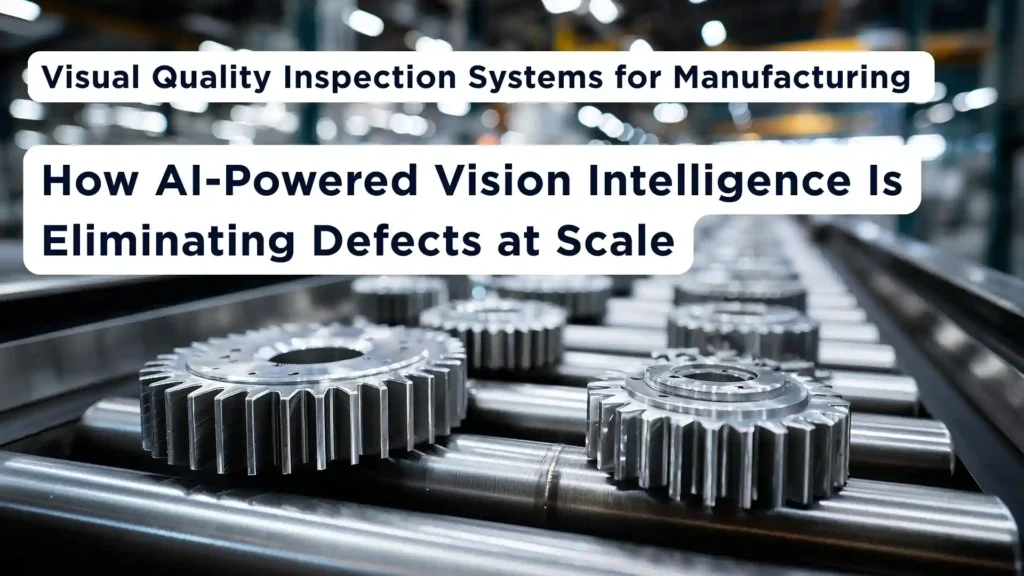
AI-powered visual inspection system detecting product defects on a manufacturing production line.

Visual Quality Inspection Systems for Manufacturing: How AI-Powered Vision Intelligence Is Eliminating Defects at Scale

In manufacturing, quality is not just a standard — it is a commercial obligation. A defective product that reaches the customer costs far more than the product itself: warranty claims, returns, reputation damage, regulatory penalties, and in industries like pharmaceuticals and automotive, potential safety liability. For decades, quality control in manufacturing depended almost entirely on human visual inspection — trained inspectors examining products at the end of the production line, relying on their eyes, experience, and concentration to detect defects before they reached the customer. The problem is that human inspection has fundamental, irreducible limitations. Attention lapses. Fatigue accumulates. Lighting conditions vary. And no matter how experienced the inspector, the error rate in human visual inspection means that some proportion of defective products will always pass through. Visual quality inspection systems — powered by digital imaging, optical sensors, AI, and machine learning — eliminate these limitations entirely. By replacing or augmenting human inspection with automated machine vision, manufacturers across automotive, pharmaceutical, FMCG, tobacco, and consumer goods industries are achieving inspection accuracy and throughput levels that human-only quality control simply cannot match. Trident’s Vision Intelligence System (VIS) platform brings industry-specific visual inspection solutions to manufacturers across India — with dedicated configurations for automotive, pharma, retail and FMCG, tobacco manufacturing, and safety compliance applications including face mask detection. This guide covers everything you need to know about visual quality inspection systems — how they work, what they deliver, and how Trident’s VIS platform addresses the specific inspection requirements of your industry. Why Manual Quality Inspection Is No Longer Enough The Real Cost of Human Error in Manufacturing Quality Control Manual visual inspection has served manufacturing quality control for generations — but its limitations have always been present. The critical question is not whether human inspectors make errors — they do, consistently and predictably — but whether those errors are acceptable given the commercial and safety stakes involved. In most modern manufacturing environments, they are not: What Modern Visual Quality Inspection Systems Replace Visual quality inspection systems do not just make existing inspection processes faster — they replace the fundamental dependency on human judgment for defect detection with objective, measurable, consistently applied machine vision criteria. The result is a quality control function that operates at production speed, maintains consistent accuracy across every shift and every unit, generates quantitative defect data for process improvement, and enables real-time corrective action before defective products progress further down the production line. What Is a Visual Quality Inspection System and How Does It Work? A visual quality inspection system is an automated quality control solution that uses digital cameras, optical sensors, and computer vision software to capture images of products during or after production — and then analyzes those images against defined quality parameters to accept or reject each unit. The Core Components of a Machine Vision Inspection System Every visual quality inspection system — regardless of industry application — consists of four fundamental components working together: 1. Imaging hardware — high-resolution digital cameras, line scan cameras, or 3D imaging systems capture images of every product as it moves through the production or inspection station. The choice of imaging hardware depends on the product type, production speed, and the nature of the defects being detected. Lighting systems — LED ring lights, backlit panels, structured light projectors — are configured to maximize defect visibility for the specific inspection application. 2. Sensor integration — RFID tags, QR codes, barcode readers, and proximity sensors provide product identification and triggering signals — ensuring the imaging system captures each unit at precisely the right moment and associates inspection results with specific product batches and serial numbers. 3. Image processing and AI analysis — captured images are processed in real time by computer vision algorithms — including deep learning models trained on examples of acceptable and defective products. The system measures specific characteristics: dimensions, surface finish, color consistency, label placement, fill levels, seal integrity, and hundreds of other parameters depending on the application. AI-powered systems continuously improve their detection accuracy as they accumulate inspection data. 4. Decision and action layer — based on the analysis results, the system makes an accept or reject decision for each unit — and triggers appropriate actions: pass-through for accepted units, diversion or rejection for non-conforming units, and alert generation for systematic defect patterns that indicate a production process issue requiring investigation. How Visual Inspection Systems Make Decisions Modern visual quality inspection systems make inspection decisions through a combination of traditional machine vision techniques and AI-powered deep learning: 5 Key Benefits of Visual Quality Inspection in Manufacturing 1. Faster Inspection Without Sacrificing Accuracy The most immediate and measurable benefit of automated visual inspection is the combination of inspection speed and accuracy that no human inspection process can match. A machine vision system can inspect hundreds or thousands of units per minute — at full production line speed — without the accuracy degradation that accompanies high-speed human inspection. For high-volume manufacturers, this means quality control no longer constrains production throughput — the inspection system keeps pace with production, not the other way around. The time savings extend beyond the inspection process itself. Automated inspection systems generate instant, quantitative results — eliminating the documentation, reporting, and data compilation time associated with manual inspection processes. 2. Elimination of Human Error From Quality Control Human inspection error is not a management or training problem — it is a physiological reality. The human visual system has limitations in resolution, consistency, and sustained attention that cannot be overcome through training or motivation. Visual quality inspection systems have no such limitations: The practical result is a dramatically lower defect escape rate — the proportion of defective products that pass inspection and reach the customer or the next production stage. 3. Adaptable to Every Production Process and Use Case One of the most commercially significant characteristics of modern visual quality inspection systems is their adaptability. When production parameters change — new product variants, modified specifications, updated packaging, new defect types — the inspection system can be


Visual Quality Inspection Systems for Manufacturing: How AI-Powered Vision Intelligence Is Eliminating Defects at Scale Read More »

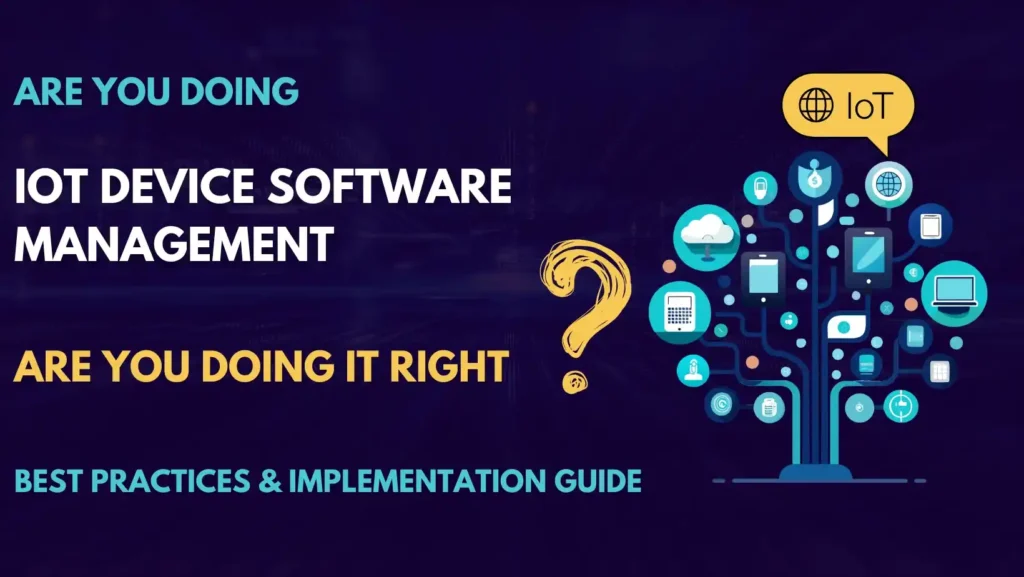
IoT device management dashboard monitoring software updates, device status, and security in real time.

IoT Device Software Management: Are You Doing It Right?

Every enterprise today runs on software – and nowhere is that pressure more intense than in IoT device software management. As connected devices multiply across factories, hospitals, logistics networks, and smart infrastructure, the stakes for getting software delivery right have never been higher. Yet most organizations are still managing IoT device software the way they managed desktop applications a decade ago – slow release cycles, siloed teams, reactive testing, and little visibility across the device lifecycle. That approach no longer works. Industry disruptors are not waiting. They are shipping faster, patching smarter, and scaling IoT fleets without proportional cost increases. Meanwhile, enterprises clinging to outdated development practices face a widening gap – in speed, in quality, and in customer satisfaction. The choice is now binary: modernize your IoT device software management strategy, or watch competitors who already have pull further ahead. Organizations that embrace lean, agile, and DevOps-driven approaches to IoT software delivery are not just keeping up – they are setting the new benchmark. What Is IoT Device Software Management? IoT device software management refers to the processes, tools, and strategies used to deploy, monitor, update, and maintain software across a fleet of connected devices – from sensors and edge nodes to industrial controllers. Unlike traditional software environments, IoT ecosystems introduce unique challenges: devices operate in remote locations, run on constrained hardware, and require Over-the-Air (OTA) update capabilities to stay secure and functional. Without a structured management approach, enterprises risk firmware drift, security vulnerabilities, and costly manual interventions at scale. As it pertains to the “new normal” DevOps standards, organizations now face many challenges such as cost overruns, software development projects that don’t scale in line with the enterprise growth, and increased market demands for speed. On top of that, the available outdated testing tools don’t offer visibility to ensure the right specifications get tested in the right time. How Lean and Agile Principles Transform IoT Software Delivery So, how can you make sure your organization is ready to manage unexpected changes, and deal with any dependencies that you already have under the hood? How do you ensure a strong balance between the existing business and the new development? Many of you may already be familiar with lean and agile principles and have probably even tried applying them in smaller teams. But what we’ve seen so far in the market is that many of you struggle to apply these principles across the entire organization. Lean and agile principles can help you reach your goals in today’s hyper-competitive world of digital product delivery. By becoming a lean and agile enterprise your organization will be able to adapt faster to the needs of the market by improving internal collaboration and communication. You will be able to learn in real-time from your clients to ensure that you are producing the prioritized set of features that drive economic value. By managing test labs, test planning, and ensuring the tight linkage between product demand and delivery, your organization will be able to reduce waste (time, effort, resources), while ensuring that your business strategy is aligned with the investment and development goals. The Numbers Don’t Lie: Agile IoT Transformation Results Let’s have a look at a few examples of what some of the industry leaders have achieved, using lean and agile processes. Nationwide achieved 50 percent improvement in code quality and 70 percent reduction in system downtime by applying lean principles to transform the software delivery lifecycle. Diagnostic Grifols, a world-leading healthcare enterprise headquartered in Barcelona Spain, increased the efficiency of development documentation by 30 percent-facilitating compliance, ensuring consistency of records across all product lines, and reducing operational costs. IoT Software Security: The Risk You Can’t Ignore A lean and agile development lifecycle isn’t just about speed – it’s about building security into every release cycle. According to industry research, over 57% of IoT devices are vulnerable to medium- or high-severity attacks due to unpatched firmware. Integrating automated security testing within your DevOps pipeline ensures vulnerabilities are caught before deployment, not after a breach. If your current IoT software management process doesn’t include continuous security validation, it’s time to close that gap. Start Managing IoT Software the Right Way — Here’s How It’s time to transform your organization into a lean and agile enterprise. It’s time to ensure that your firm can adjust to any market change, predict the unpredictable, keep costs low, deliver new features and offerings faster, and never lose a beat with your customers. If you would like to learn more, let’s get connected! Our IBM solution enables companies to improve visibility and transparency across the product delivery lifecycle by providing a single source of truth. It also enables enterprises to define a process custom to each organization, and it ensures quality and compliance. All using lean and agile processes.

IoT Device Software Management: Are You Doing It Right? Read More »