Welcome to Trident Information Systems!
Write us to - info@tridentinfo.com
Let's Socialize

real estate crm software

DevOps can be One of the Best Investments You Make for Your Restaurant Delivery Services

Are your customers facing difficulties in ordering food online? Is your online delivery app crashing again and again? Is this situation frustrating you and your customers? It signals it’s time to invest in Agile DevOps. During Quarantine, the trend for online food ordering grew at an immense speed. Many restaurants already started online food delivery services, but after the lockdown, the situation got overwhelmed.   The pandemic forced the whole world to stay at home. People stopped going out to eat and rather, ordered and ate their favorite meals at home. Results? Many applications started crashing.   To avoid extreme situations like this, employing robust DevOps Software is a smarter decision. If you are wondering how your online delivery service should behave, given below are some points to clear that out:   It should receive orders from the application, website, and even chatbots.   It should successfully handle various payment gateways.   It should send the ‘forgotten cart’ notifications to the customers to encourage them to finish their orders.   It should be able to store order history to understand customer preferences and create loyalty programs.   These features can be added to the application with either plugins or add-ons. You can also get them customized by a third-party service provider. Moreover, you can provide the smoothest online delivery services with Agile DevOps.   A Ukrainian startup called All Set Now, has added 2500+ restaurants across the 12 states of the United States. This brand helped all its members to grow their delivery revenue immensely and boosted their table turnover by 200% while their customers lived happily and healthily.   This is just the beginning of the endless opportunities to help you grow your restaurant to an unexpected level. Starting with AR/ VR to provide a preview of the custom meals to using voice assistance to place orders.   Do you know the best part of modern technology? It helps you innovate solutions fast and on budget. However, during unexpected events like a pandemic, DevOps Solutions can be a lifesaver. Agile DevOps helps restaurants to develop and operate teams to create robust technologies to cater to frequent customers who cannot cook at home.   What is DevOps and How Does it Work?  DevOps is a strategy for managing cloud infrastructure and software development that enables enterprises to deploy apps and manage them in production quickly and affordably. This is accomplished by automating repetitive procedures and setting up CI/CD pipelines so that the IT systems supporting your operations may function with little assistance from your team and with little oversight.  More importantly, DevOps Service Providers also field specialized teams of software engineers crucial for restaurants as they often don’t have an internal software development team. By doing this, you have immediate access to a team of experts who can create applications for you fast and affordably.  So How Does Agile DevOps Work?  The most common and time-consuming repetitive procedures are provisioning testing environments and creating new app versions while building and operating any program in a production environment. DevOps Tools enable Infrastructure as Code (IaC) utilizing toolchains like Terraform, Kubernetes, Helm, and Docker. It allows you to write down in text files, or “manifests,” all the settings and variables of every computer environment required for creating your application in plain, straightforward terms.  Using CI/CD pipelines, or Continuous Integration and Continuous Delivery procedures is the next stage in the Agile DevOps journey. These are automated scenarios where the results of one operation serve as the input for the following one. If the tests are successful, CI/CD pipelines make sure that new code can be automatically tested, produced, uploaded to the staging server, tested again, and submitted to production with a single code commit. This guarantees quick and inexpensive software delivery, enabling outcomes you need to launch your application in a month rather than a year.  The most significant benefit of a DevOps Platform is that it is a practical application of Agile methodology, allowing you to create an MVP (Minimum Viable Product) for your delivery service application in a week, release it to stay connected with your regular users, and then refine it to attract new users. This might be a crucial step in addressing the unexpected dilemma and moving on effectively.  For end-to-end software delivery services, MVP creation, and continuing Agile DevOps support, get in touch with a reputable DevOps as a service organization like Trident Information Systems. Contact us if you have any questions about adopting DevOps for restaurant delivery services, or Monitoring Tools in DevOps.  

DevOps can be One of the Best Investments You Make for Your Restaurant Delivery Services Read More »


Smart Retail IoT

How Does IoT Help Your Retail Business with More Advanced Customer Service?

Today’s digital transformation has given the Internet of Things a fair playground to establish itself among businesses. IoT has entered our homes and offices, which is why we expect exceptional comfort from the technology. From fast details to instant customer services, it has conquered it all. Due to all these conveniences, customers are becoming less patient and hence their demand changes rapidly. Be it retail, manufacturing, or IT services, IoT is used everywhere. Especially in retail, successful retailers are more inclined to Smart Retail IoT. They allow their customers to view the availability of products in advance, so they don’t waste their time over something that’s not even available.  To keep it even simpler, a few years ago, let’s say your microwave faced issues. You would call the executive of that brand, get in the customer service line, and wait for your turn. Then you will go ahead describing your issues and he may even transfer your call to another executive. You will end up explaining to him all over again. He will tell you ways you can fix it yourself, if you fail, they will send a technician. Would you still do it even today? Probably not. Of course, it will be one of the options, but you can straightaway talk to a bot who has the fix for your issue fed into its system.   It can send you a link to a blog to help yourself or send you common FAQs. It will even assign a technician for your job if you want. That’s how IoT is.    How Smart Retail IoT Helps Coping with Changing Customer Demands?  IoT in Retail Industry is a reliable source if you wish to gain meaningful customer insights into your customers, especially when a specific demand of theirs does not last long. This is how Smart Retail IoT changes the game:   Data-Driven Customer Insights  The user can analyze Smart Retail IoT data to get a better understanding of their customers, products, and marketing strategies. They can figure out what improvement a product needs, along with its potential problems. Based on the insights received from Retail IoT Solutions, companies can personalize their approach such as recommending a complimentary service or product, especially for current customers. They can also offer special incentives for potential customers.   Combining IoT Data   By combining IoT in Supermarket data with other, preferably digital sources, marketers can get maximum advantage. For instance, a runner’s behavior as tracked in his fitness tracker may be combined with his shoe purchase history may give useful insights into when he may need a pair of new shoes. They can then personalize offers for him and send him notifications via text or email.   Connecting with Customers Using Devices   Various Smart Retail IoT devices provide a feature to directly interact with the customer. Such features are embedded to get recommendations to improve the product or services. Customers can also suggest what upgrade they would prefer. Marketers can get these insights by connecting data from IoT Application in Retail to a marketing system to blend it with other data as well and apply certain regulations from the archives of approved content.   Use IoT to Boost Your Reach   Businesses can easily use Smart Retail IoT to boost reach and enhance communication via different channels. It assists in revealing customer needs and interests. This can only happen if this IoT for Retail Industry data is confined to other customer data in a single unified database. They can then leverage it in some marketing approach such as emails or social media campaigns.   How To Create Value for Your Customers?  Just like any other technology, Smart Retail IoT too has some challenges in customer data management. However, if the businesses can unlock the insights found in the data can tap into new opportunities for understanding and interacting with customers. It makes it worth it to put extra effort into decoding Retail IoT Solutions data and formatting it for the marketers to use.    So, how to create value for your customers? You must adjust to the world of IoT. It may include planning how to manage a high volume of streaming data, even extraction, performing parsing, saving data in readable formats, and integrating it with other marketing systems for analysis and implementation.   If you want to integrate Smart Retail IoT with your existing system, you must look for a trusted service provider. Trident Information Systems integrates your IoT Solutions with your existing system so you can leverage its features and maximize your output. We specialize in IoT solutions such as Vision Intelligence System (a machine vision system for accurate quality inspection while manufacturing). asset management with RFID (radio frequency identification), Industry 4.0 – traceability solutions, parameter monitoring, web and mobile app development, In AI (Artificial Intelligence) – smart chatbot solution for reporting and analytics, NLP (Natural Language Processing), sentiment analysis, ML solutions etc. Contact us for further information. 

How Does IoT Help Your Retail Business with More Advanced Customer Service? Read More »

Machine Vision System

Get Consistent Quality Inspection in Your Automotive Plant  

Do you want to know how your competitors are getting ahead of you with fast and good-quality production? Seems like magic but it’s technology instead. Many big industrialists have adopted advanced technology in their automotive plants i.e., Machine Vision System. A technology based on AI (Artificial Intelligence) ensures they get the best production. In contrast to traditional inspection methods, where nothing can be done without human assistance, a Defect Detection System ensures you get consistency of work with no human interference. Traditional inspection methods are prone to various challenges such as:   Inconsistency in inspection due to different perceptions and environmental factors.   Too much floor space coverage which leads to accidental bumping and slow item transfer.   Accidental bumping may cause conflicts among workers.   The absence of workers hampers consistency of work.   Human eyes may miss certain defaults.   Delay in reporting is common in human-based inspection.   Traditional inspection cannot match the efficiency of the machine. The Machine Vision System, on all levels, is better. It ensures more fluency, speed, and quality than the old-school methodologies.   Manufacturing Defect Detection Ensures Threefold ROI  With greater accuracy, consistency, low-to-no human dependency, and greater speed, the Machine Vision System can bring you three times more ROI (Return on Investment).   Consistency of work: One of the major benefits Manufacturing Inspection Software provides is consistency. Even if your staff is absent, the flow of work remains consistent, 24/7. This technology helped during the most unexpected times i.e., the COVID pandemic.   Low risk of errors: The risk of errors declines with a low human interference rate. Hence, you can get speedy and error-free production to provide defect-proof items to the customers.   Free floor space: With less human dependency, the floor space remains free which leads to a smoother flow of moving goods. Furthermore, there are extremely low risks of employees bumping into one another and getting involved in unnecessary fights.   Fast Reporting: The machine flashes an alert as soon as there is a defective product on the conveyor belt. It is much faster than a human-based inspection.   How Does Machine Vision System Work?  A Vision Inspection System relies on digital sensors protected within the industrial camera. It acquires images and specified optics to let the software and computer hardware analyze, process, and calculate different characteristics to support final decisions.   An AI-based Machine Vision Inspection such as the Vision Intelligence System by Trident Information Systems does not need consistent modifications as it can detect defects with accuracy in a similar environment. It successfully eliminates human interference and allows an ongoing, 24/7, and accurate quality inspection.    How Vision Intelligence System Detects Defects with Consistency?   Being one of the most competitive industries, automotive manufacturers require technology that rockets them ahead in the competition. The Machine Vision System can be their knight in shining armor. It can detect:   Visual defect detections: dents, scratches, burr, and chips.   Dimensions: dimensional accuracy i.e., if a product is in the right shape and size.   Spectrum monitoring: it checks if the product is in the right spectrum of color or not.   Labeling: Detects if the labels are present in the right place.   Barcodes: OCR/ DMC/QR/ Barcode reading etc.   Measure, gauge, guide measures the angle of O tips, dimensions of the outer and inner diameters of O rings, as well as the edges and label positions.   Why Vision Intelligence System?  Trident’s Vision Intelligence System ensures a tangible and valuable Manufacturing Intelligence System which helps produce better quality products and processes. The best part is it minimizes waste by providing valuable insights into how you can enhance your quality with the least wastage. Furthermore, you can get a lot of tangible and intangible benefits such as:   Interpretation of upcoming defects and aids in preventing delays   Identifies the cause of an issue and optimizes resources.   Cuts time with digital defect-reporting operations.  Abolishes the need for product sampling.  Real-time core analysis of a defect.   Enhance your quality inspection environment and optimize business operations using Vision Intelligence System. This Machine Vision System guarantees a boost in output in less time. Further, AI technology makes it even more convenient to use. It works perfectly fine in a similar environment without additional effort. If you wish to get a demonstration or are just curious about it, you can contact us anytime. Our team of experts is more than happy to help you.

Get Consistent Quality Inspection in Your Automotive Plant   Read More »

Grow Your Real Estate Business with Dynamics 365 CRM 

Imagine you have run a growing real estate business and now have to deal with doubled customers. Would it be possible for your current CRM approach to handle the pressure? How about having Real Estate CRM Software that keeps tabs on every customer, records when and how you contacted them, and how positive they were for your deals?   In real estate maintaining customer relationships is everything. Acknowledging whom you contacted, how you contracted, and their basic details can go a long way to fostering favorable customer relationships. This might seem easy but past real estate business owners were very unorganized. They would note the details manually on paper or in Excel. Today, however, you have simpler options.   A CRM for Real Estate is a more simplified solution that strategically stores data and ensures you are organized to avoid the last-minute hassle. It goes beyond merely storing data by recording every interaction with the client, previous payment records, and customer service concerns.   CRM is useful in every industry because every business, be it a B2B or B2C, works to attract customers. However, this solution is especially useful for real estate businesses. This blog further discusses the benefits of Real Estate CRM Software.    How Can Real Estate CRM Software be Useful?  The challenge begins the moment you find a lead. You then have to identify if they are a prospect, and you can now channel your efforts to provide a high-quality experience. Find Real Estate CRM Software that helps you in the process by making it effortless such as MS ERP for Construction Management. With its organized opportunity management process, you can provide your workforce with a system and guide to deliver excellent customer service.   A successful Construction CRM Software comes with the following benefits:   Centralized Data   A Real Estate CRM Solution centralized every client and prospect’s data in one place. This benefits a business-like real estate where different teams may deal with a client. This Real Estate CRM Software will store data and share it across the system for relevant teams to access it. You can eliminate the scope of errors and guesswork. Any of your staff will no longer ask themselves if the other staff has already interacted with the same person today.   With robust Real Estate Software like MS ERP for Construction Management, you can access the complete details of your client/ prospects in one place including history. Moreover, having this data backed up in the Azure Cloud, you no longer have to face data loss and can write notes on some vital details told by the client.  Better Communication   Communication matters a lot when you are about to pursue a customer or a prospect. A disorganized CRM can hamper the whole process. The customer may get irritated if you ask them the question your teammate asked them two hours ago. This guesswork lays a very unprofessional impact on them.   Real Estate CRM Software Real Estate CRM Software can eliminate this guesswork by providing notes on the last time someone contacted the same client, what questions were asked and how the client responded. Was it favorable? If yes, then what should be your next step? Having all these details in hand saves time on repeated questions and projects your sincerity in front of the client.   In the past few years, the customers have evolved their approach when it comes to communication. There are different platforms they want to contact the sales executive apart from just calls and emails. There comes social media, live chat, and portals. Customers expect to get the desired information at any time from any location.   Sustainable Growth   If you run a small real estate business, you may not feel the need for Real Estate CRM Software. However, have you thought of your customer management techniques if it starts growing? Indeed, you can think of hiring new people, but would they understand your customers as you do? Can you expect your growth to be sustainable like that? No right?   Having CRM software that stores data of all your customers and prospects in one place ensures your fresh staff can access the right information from the start. Furthermore, it is advisable to move to a CRM for Real Estate even if you have a small business as it is easier when you have 50 clients or fewer.   Easy Management   The management is required to be well organized or else it can create chaos. Everyone follows a different style of making notes. Some make bare-bones notes and believe they will understand the rest later, and sometimes they form shorthand that only they can understand. The situation gets awkward if they are unable to understand it later when needed.   This can further lead to awkward customer interactions. Imagine showing a house to a client based on your 2-month previous interactions and you are unable to understand your piece of writing now!  A Real Estate CRM Software gathers all the information and presents it in a single format. It takes the guesswork out of notes by your representatives and agents. CRM helps standardize the information for ease of understanding by the managers and fellow team members.   Good Real Estate CRM Software is mandatory to maintain healthy customer relationships in your real estate business. Microsoft CRM for Real Estate is one of the most renowned CRM software in the world. Get the best professional consultancy via an award-winning brand in the world. If you are looking for a Microsoft Dynamics 365 implementation partner, you can contact Trident Information Systems. We are one Gold Microsoft Dynamics 365 implementation partner and Diamond LS Retail implementation partner. Contact us for further information.  

Grow Your Real Estate Business with Dynamics 365 CRM  Read More »

Top Reasons to Use Microsoft Dynamics 365 as your CRM  

Microsoft Dynamics 365 is a unified platform that combines ERP (Enterprise Resource Planning) and CRM on the same platform while eliminating the need to implement different systems for different purposes. Dynamics CRM has different modules such as: Dynamics CRM for Sales Marketing, CRM for Warehouse Management etc.   Using disparate systems can cause more complications and compromise with your productivity. In an era where most businesses are switching to smarter technology, you being stuck to the traditional methods can cost you your productivity, profit margin and overall business goal accomplishments.  Be it sales force automation, business intelligence, marketing, account management, order management, service improvement or a seamless information flow, Microsoft Dynamics 365 is capable of handling everything pretty easily.   In this blog, we will discuss why you should use Microsoft Dynamics CRM for your business. Coupled with expertise in deployment, building, and supporting advanced CRM solutions, it brings out greater control over your sales process. With boosted client satisfaction and greater productivity, you can easily surpass competition.   Microsoft Dynamics showers tremendous benefits to your business such as:  Your employees begin to work more efficiently and can now make better decisions.   You boost your marketing with Microsoft Dynamics CRM robust tools that make it easier to set up, analyze, run, and manage campaigns.   Your marketing and sales staff begin to collaborate, hence resulting in attracting more business.   No more silos, as Microsoft CRM stores data in one place.   It implements the best practice approach while improving your business processing   You can conduct more effective campaigns.  You can manage your inventory better and predict the future requirements.   Benefits of Microsoft Dynamics CRM   Customization Boost  Microsoft Dynamics 365 is a pretty flexible solution that works as your company goes. With unlimited features and third-party integration ability, it ensures enough flexibility and ideal customization according to the changing needs of your business. You do not have to engage with different software if you suddenly come across a new requirement. It can easily be tailored to work as your company wants. This CRM views links and forms and can customize them without extra development.   Easily Accessible Information   Are you tired already scanning through different software a critical piece of information? Bid a goodbye to this struggle as Dynamics CRM integrates data like sales, marketing, customer and so on under the same roof and creates insightful plus actionable reports. With its robust tools, you can ensure that the right information is provided to the right employee. You can easily share customer-oriented PowerPoint presentations, documents, reports through Office365 which enables Microsoft Teams, Outlook, Excel, PowerPoint and so on.   Targeted Marketing Campaigns    It is important for your clients to know about your product and the exclusive offers attached to it. Microsoft Dynamics 365 delivers a tool which seamlessly simplifies complex processes such as building leads and client lists, generating targeted at specific prospects, measuring results, and executing follow ups. This software will always ensure you stay connected with the right clients.   Seamless Application and Data Source Application   Microsoft Dynamics 365 possesses the force of Microsoft NET Framework and Web Services.  It allows companies to integrate their old, isolated, legacy business solutions and apps. This system connects with your third-party application while helping you break down information in silos. For instance, with email marketing, you can create personalized emails with CRM information and track recipient tools in Dynamics 365. With surveys, you can easily match client gratification replies with the contact records in Dynamics 365. Similarly, with web tracking, you can easily track enterprises who show interest in your product or just make a casual visit.   Power BI (Business Intelligence) and Dynamics CRM  With Microsoft Dynamics CRM SQL server, you can enjoy the services. Build insightful reports with this robust analytical tool for every business. These embedded analytical tools integrate with a SQL server to create actionable data reports for people at managerial level while providing enough accounts for better decision making. You can easily gain a complete view of your client anytime you want while accessing its advanced reporting functionalities. This system provides a crucial platform for planning, marketing, sales, investment, and tracking.  Implementing Microsoft Dynamics CRM can solidify your relationships with customers, you can even create relevant deals, offers and loyalty programs for an individual or a group of customers. If you are looking forward to getting Microsoft Dynamics 365 CRM, for Dynamics CRM for Sales Marketing, CRM for Warehouse Management, or any another module, you can contact Trident Information systems. We are a Gold Microsoft Dynamics Partner who has been serving various industries for over 20 years. Contact us for further information.  

Top Reasons to Use Microsoft Dynamics 365 as your CRM   Read More »

Learn how an electronics manufacturer unifies data and gains agility using Dynamics 365 Supply Chain Management

Bel Fuse designs, manufactures, and markets electronic circuits products at 24 manufacturing locations across North America, Europe, and Asia. The company’s existing enterprise resource planning solution was highly customized and expensive to maintain, so it decided to deploy Microsoft Dynamics 365 Finance and Dynamics 365 Supply Chain Management. Bel Fuse unified data and can now more easily manage its supply chain operations and finance processes, gaining more agility to respond quickly to changes in the market or its suppliers. With Dynamics 365, we save nearly USD2 million per year in IT service and support fees compared to our previous, highly customized solution. Mark Hodkinson: Vice President of Finance for the Bel Power Solutions Group Bel Fuse Essential step in the supply chain A typical consumer might interact with Bel Fuse products and not even know it. The manufacturer makes the components that power, protect, and connect electronic circuits in products we use every day. Bel Fuse is usually in the middle of the supply chain, relying on smaller parts from its suppliers before passing components on to the manufacturers that create finished products. Founded in 1949, the company has grown significantly in the last 20 years through acquisitions. It has seven business groups, including Bel Power Solutions, which it acquired in 2014. Bel Power Solutions makes the power conversion products for server and storage networks at large server farms and in industrial products like the power sources in hybrid electric vehicles and trains. To manage its enterprise resource planning (ERP) processes, Bel Power Solutions used a legacy version of Oracle that was highly customized and difficult to update. The version was outdated and the month-to-month costs and support for the solution were expensive. With different business units using different ERP systems, Bel Fuse wanted to find an affordable solution to unify the company’s finance and operations processes, starting with Bel Power Solutions. Bel Fuse also needed a solution that would support its material requirements planning (MRP) process, a production planning, scheduling, and inventory control system to manage its manufacturing processes. “Our MRP processing goes in both directions—we require a full dataset and forecasting of what’s coming to us and what’s going out,” says Scott Hasterlik, Director Global IT at Bel Fuse. “We have power assets with 500 components and 65,000 SKUs, so we needed a robust solution to share nonstandard information quickly.” An integrated solution for finance and operations After careful evaluation, Bel Fuse found that Microsoft Dynamics 365 had the right capabilities at the right price for the company’s needs. With Dynamics 365, Bel Fuse had a single system for the first time, the ability to report globally, and a solution that was intuitive to use and easy to add users. Bel Fuse uses Dynamics 365 Finance to automate its financial operations, monitor performance in real time, predict future outcomes, and make data-driven decisions. For operations, the company deployed Dynamics 365 Supply Chain Management, which includes an MRP function and AI to improve visibility across its global supply chain and to improve manufacturing productivity. To aid the quick, seamless deployment process, Bel Fuse worked with Flintfox, a Gold competency member of the Microsoft Partner Network. “Flintfox jumped in, understood what we wanted to accomplish, and helped us move forward on budget,” says Hasterlik. “Flintfox has been a fantastic partner and is still our partner of record.” A wide range of Bel Power Solutions employees now rely on the Finance and Supply Chain Management business applications. Users include staff in customer service, quality assurance, demand and product returns, manufacturing and supply chain ordering, accounts payable, accounts receivable, and engineering. “From decision makers to factory floor managers, everyone is working in Dynamics 365, staying connected and accessing valuable data,” says Stefan Naude, General Manager, Slovakia, at Bel Fuse. Reduced costs, disparate systems eliminated Bel Fuse accomplished its central goal—to reduce the high costs of its previous ERP system while bringing data together in one solution. The company built the capacity it needed without a lot of customizations, helping ensure that the solution would stay flexible in the future. “With Dynamics 365, we save nearly USD2 million per year in IT service and support fees compared to our previous, highly customized solution,” says Mark Hodkinson, Vice President of Finance for the Bel Power Solutions Group at Bel Fuse. Bel Fuse also reduced costs because it now has the tools to fulfill more of its own finance needs internally. For example, a Bel Fuse engineering and distribution site in Italy previously paid an outside firm to do its accounting. “It was easy to move the Italy site into Dynamics 365 and transfer all that work internally to our team in Slovakia,” says Hodkinson. “Now our own team manages the facility’s day-to-day finances even though they aren’t located in Italy. With a common system, we have better access to our own internal talent.” Increased visibility and agility With Dynamics 365, Bel Fuse gained a more global view of financial data and can perform more accurate forecasting. “I always view orders and revenue from a global perspective because the locations are all connected and have so many intercompany transactions,” says Hodkinson. “I rely on Dynamics 365 to help me make sense of complex financial histories to stay on top of complicated billing and payment processes at multiple sites.” With ERP data now centralized and easy to access in the cloud, Bel Fuse can respond with more agility to complex, changing circumstances. When employees in Italy, China, and other countries needed to work from home during the COVID-19 crisis, the company was able to effectively run remote finance and supply chain operations. “We kept all our finance functions moving forward even though we don’t have anyone physically in the office,” says Hodkinson. “We were impressed that our team was able to get everything done while working from home for the first time, and I think that speaks to how intuitive Dynamics 365 Finance was for our team.” As a mid-chain supplier, Bel Fuse is committed to continuing its operations on

Learn how an electronics manufacturer unifies data and gains agility using Dynamics 365 Supply Chain Management Read More »

Customer Story : CRANE Worldwide Logistics centralised their sales platform with Microsoft Dynamics 365

As it approached its 10-year anniversary and its first billion in revenue, global logistics and freight company Crane Worldwide Logistics looked for a modern platform that brought all its sales tools into one place. With the Microsoft Relationship Sales solution, which brings together LinkedIn Sales Navigator and Microsoft Dynamics 365 for Sales, its salespeople have the tools to drive more meaningful engagements with customers, convert opportunities faster, and create more revenue. Just by getting the team using the platform, we’ve seen an uplift in activity in all areas. We’ve had record growth since implementing Microsoft Relationship Sales—the last quarter was excellent for us. John Jergens: Vice President of Global Sales Crane Worldwide Logistics A global sales team From a startup created in the risky business climate of the 2008 recession, Crane Worldwide Logistics has become a major player in the global transport and logistics industry, on track to hit USD1 billion in revenue in 2019. Created by former Eagle Global Logistics executives and headquartered in Houston, Texas, Crane Worldwide aims to provide customers with full transparency into its supply chains by coupling talented people with game-changing technology. But with salespeople spread across the globe, Crane Worldwide found itself with a visibility problem. “We weren’t all working on a common platform, so we were lacking in visibility,” says John Jergens, Vice President of Global Sales at Crane Worldwide. “We knew we had a vast sales pipeline out there, but there wasn’t much data available on it—so we couldn’t see how robust it was.” From data silos to connected visibility A key part of the Crane Worldwide ethos is providing customers with meaningful interactions—and that relies on having a customer relationship management (CRM) solution that salespeople can use to build and maintain relationships and convert opportunities more effectively. But, with a seven-year-old siloed CRM system that it had simply outgrown, the company lacked the tools its salespeople needed. “The previous system never had very good adoption,” Jergens adds. “It just wasn’t very functional.” So, the team went looking for a platform that could replace it. With implementation support from Microsoft Partner Network member PowerObjects, Crane Worldwide deployed the Microsoft Relationship Sales solution, a powerful combination of Microsoft Dynamics 365 for Sales and LinkedIn Sales Navigator, to support personalized, meaningful customer engagements. The team was already using LinkedIn Sales Navigator and Microsoft Office 365, so Dynamics 365 for Sales was the ideal addition to the Crane Worldwide ecosystem. “We saw how Microsoft Relationship Sales could help us focus on being easy to work with from a customer’s perspective,” explains Jergens. “So this whole deployment was part and parcel of becoming easier to do business with.” Now, just six months into deployment, Crane Worldwide has 300 Microsoft Relationship Sales users in its ranks, including 150 direct sellers along with employees from its marketing and account management teams. New processes, simpler sales Using the Microsoft Relationship Sales solution, Crane Worldwide salespeople have already changed the way they work. And they’re reaping the benefits of the visibility they’ve gained into the sales pipeline. “Once we rolled out Microsoft Relationship Sales, the overwhelming response was that it’s really easy to use, and it doesn’t take much time,” says Jergens. “We created a very simple weekly routine where our sellers spend about 30 minutes adding new data into Dynamics 365 for Sales. That’s just six minutes a day to keep everything up to date.” With faster processes freeing up more time for the sales team, sellers can focus their energy where it matters most—building the customer relationships that turn into revenue. And, at the end of each week, management can analyze activity through a global dashboard, which combines CRM and customer interaction data into detailed executive reports that show how salespeople are turning relationships into revenue. “With Microsoft Relationship Sales, we can generate KPIs that tell us what a healthy pipeline should look like. We look at the number of prospects and targets, how long the sales cycle takes, and the time from when we close an account to the time it generates revenue,” explains Jergens. “And if the pipeline isn’t where it should be, we can support the sellers with the resources that they need—it’s more productive all around.” A centralized sales platform Because Microsoft Relationship Sales brings together so many sales capabilities, Crane Worldwide sellers have everything they need to do their jobs in one place. Previously, they had to manage a relationship from scoping to sale across disconnected tools and platforms, far from an efficient process. “It’s difficult to put a number on what it’s like to manage 30 or 40 customers with an email folder and a spreadsheet,” says Jergens. “Now, once the salesperson finds a prospect using LinkedIn Sales Navigator, they use Dynamics 365 for Sales to easily track those conversations. Instead of creating and referencing a lot of notes, they can quickly link activities and discussions through Microsoft Relationship Sales.” With LinkedIn Sales Navigator and Dynamics 365 for Sales together, salespeople can start building the context they need to deliver a meaningful interaction before the first contact even occurs. Insight into potential prospects’ roles, connections, and priorities through LinkedIn Sales Navigator is fed straight into Dynamics 365 for Sales—increasing conversion chances from the very start. “It’s had a direct impact on the time it takes to develop customer relationships, because we have true visibility into those opportunities now,” explains Jergens. A built-in assistant also sends prompts to help sellers accelerate the sales cycle, reminding them to contact a lead that might go cold or nudge an opportunity as it approaches its estimated close date. A roadmap for integration In businesses the world over, sales and marketing teams struggle to communicate and collaborate effectively. As the sales team adapts to Microsoft Relationship Sales, Crane Worldwide is already adopting more of the solution’s capabilities to help sales and marketing stay on the same path. “The marketing teams are able to work in tandem with the sales team to help them understand how marketing activities can help nurture their

Customer Story : CRANE Worldwide Logistics centralised their sales platform with Microsoft Dynamics 365 Read More »

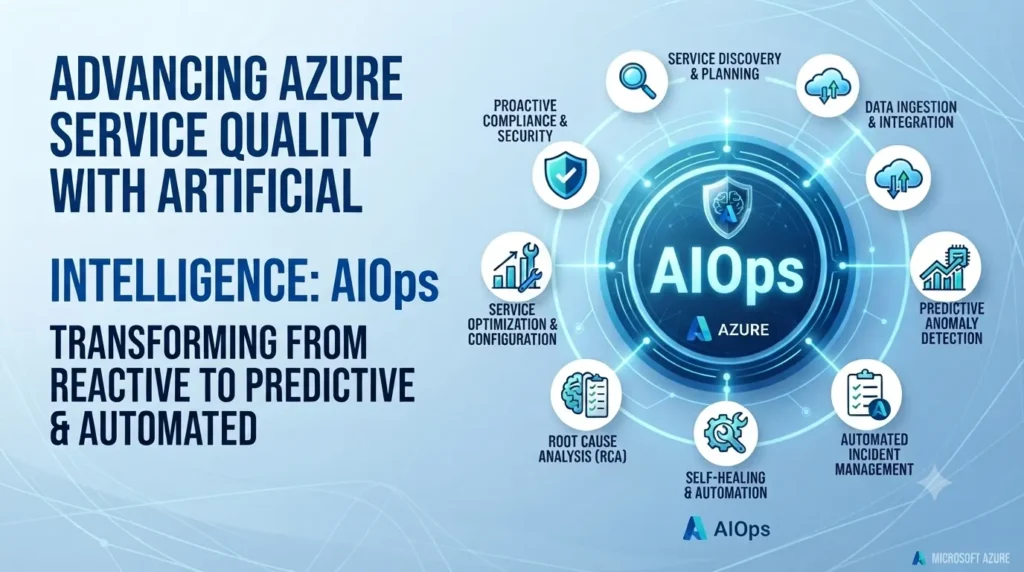
Advancing Azure service quality with artificial intelligence: AIOps

We are going to share our vision on the importance of infusing AI into our cloud platform and DevOps process. Gartner referred to something similar as AIOps (pronounced “AI Ops”) and this has become the common term that we use internally, albeit with a larger scope. Today’s post is just the start, as we intend to provide regular updates to share our adoption stories of using AI technologies to support how we build and operate Azure at scale. Why AIOps? There are two unique characteristics of cloud services: The ever-increasing scale and complexity of the cloud platform and systems The ever-changing needs of customers, partners, and their workloads To build and operate reliable cloud services during this constant state of flux, and to do so as efficiently and effectively as possible, our cloud engineers (including thousands of Azure developers, operations engineers, customer support engineers, and program managers) heavily rely on data to make decisions and take actions. Furthermore, many of these decisions and actions need to be executed automatically as an integral part of our cloud services or our DevOps processes. Streamlining the path from data to decisions to actions involves identifying patterns in the data, reasoning, and making predictions based on historical data, then recommending or even taking actions based on the insights derived from all that underlying data.   Figure 1. Infusing AI into cloud platform and DevOps. The AIOps vision AIOps has started to transform the cloud business by improving service quality and customer experience at scale while boosting engineers’ productivity with intelligent tools, driving continuous cost optimization, and ultimately improving the reliability, performance, and efficiency of the platform itself. When we invest in advancing AIOps and related technologies, we see this ultimately provides value in several ways: Higher service quality and efficiency: Cloud services will have built-in capabilities of self-monitoring, self-adapting, and self-healing, all with minimal human intervention. Platform-level automation powered by such intelligence will improve service quality (including reliability, and availability, and performance), and service efficiency to deliver the best possible customer experience. Higher DevOps productivity: With the automation power of AI and ML, engineers are released from the toil of investigating repeated issues, manually operating and supporting their services, and can instead focus on solving new problems, building new functionality, and work that more directly impacts the customer and partner experience. In practice, AIOps empowers developers and engineers with insights to avoid looking at raw data, thereby improving engineer productivity. Higher customer satisfaction: AIOps solutions play a critical role in enabling customers to use, maintain, and troubleshoot their workloads on top of our cloud services as easily as possible. We endeavor to use AIOps to understand customer needs better, in some cases to identify potential pain points and proactively reach out as needed. Data-driven insights into customer workload behavior could flag when Microsoft or the customer needs to take action to prevent issues or apply workarounds. Ultimately, the goal is to improve satisfaction by quickly identifying, mitigating, and fixing issues. Figure 2. AI for Cloud: AIOps and AI-Serving Platform. AIOps Moving beyond our vision, we wanted to start by briefly summarizing our general methodology for building AIOps solutions. A solution in this space always starts with data—measurements of systems, customers, and processes—as the key of any AIOps solution is distilling insights about system behavior, customer behaviors, and DevOps artifacts and processes. The insights could include identifying a problem that is happening now (detect), why it’s happening (diagnose), what will happen in the future (predict), and how to improve (optimize, adjust, and mitigate). Such insights should always be associated with business metrics—customer satisfaction, system quality, and DevOps productivity—and drive actions in line with prioritization determined by the business impact. The actions will also be fed back into the system and process. This feedback could be fully automated (infused into the system) or with humans in the loop (infused into the DevOps process). This overall methodology guided us to build AIOps solutions in three pillars. Figure 3. AIOps methodologies: Data, insights, and actions. AI for systems Today, we’re introducing several AIOps solutions that are already in use and supporting Azure behind the scenes. The goal is to automate system management to reduce human intervention. As a result, this helps to reduce operational costs, improve system efficiency, and increase customer satisfaction. These solutions have already contributed significantly to the Azure platform availability improvements, especially for Azure IaaS virtual machines (VMs). AIOps solutions contributed in several ways including protecting customers’ workload from host failures through hardware failure prediction and proactive actions like live migration and Project Tardigrade and pre-provisioning VMs to shorten VM creation time. Of course, engineering improvements and ongoing system innovation also play important roles in the continuous improvement of platform reliability. Hardware Failure Prediction is to protect cloud customers from interruptions caused by hardware failures.  Microsoft Research and Azure have built a disk failure prediction solution for Azure Compute, triggering the live migration of customer VMs from predicted-to-fail nodes to healthy nodes. We also expanded the prediction to other types of hardware issues including memory and networking router failures. This enables us to perform predictive maintenance for better availability. Pre-Provisioning Service in Azure brings VM deployment reliability and latency benefits by creating pre-provisioned VMs. Pre-provisioned VMs are pre-created and partially configured VMs ahead of customer requests for VMs. As we described in the IJCAI 2020 publication, As we described in the AAAI-20 keynote mentioned above,  the Pre-Provisioning Service leverages a prediction engine to predict VM configurations and the number of VMs per configuration to pre-create. This prediction engine applies dynamic models that are trained based on historical and current deployment behaviors and predicts future deployments. Pre-Provisioning Service uses this prediction to create and manage VM pools per VM configuration. Pre-Provisioning Service resizes the pool of VMs by destroying or adding VMs as prescribed by the latest predictions. Once a VM matching the customer’s request is identified, the VM is assigned from the pre-created pool to the customer’s subscription. AI for DevOps AI can boost engineering productivity and help in shipping

Advancing Azure service quality with artificial intelligence: AIOps Read More »