Welcome to Trident Information Systems!
Write us to - info@tridentinfo.com
Let's Socialize

warehouse management erp

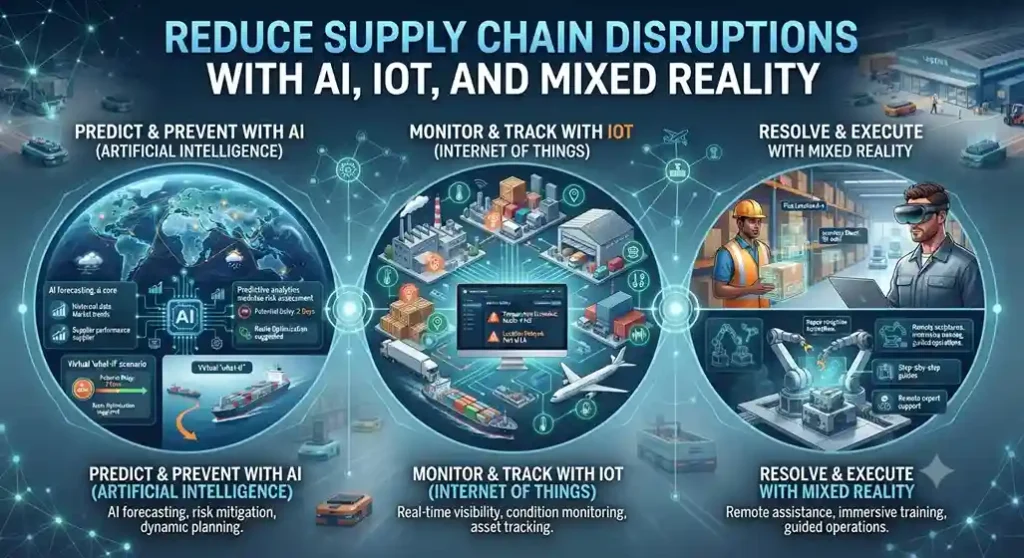
AI, IoT, and mixed reality technologies improving supply chain visibility, logistics, and warehouse operations.

Reduce supply chain disruptions with AI, IoT, and mixed reality

Reduce Supply Chain Disruptions With AI, IoT, and Mixed Reality Supply chains built on single suppliers and single locations don’t survive contact with real-world disruption — port closures, geopolitical trade shifts, or a single supplier’s factory going offline can stall production for weeks. [Flag: insert a recent disruption stat relevant to your audience’s industry — e.g., percentage of manufacturers reporting supplier delays in the past 12 months.] The response isn’t more inventory sitting idle; it’s a supply chain that senses problems early and reconfigures itself before they cascade. That’s the shift Dynamics 365 Supply Chain Management is built around — replacing static, just-in-time planning with predictive, adaptive planning powered by AI, IoT, and mixed reality across production, inventory, and warehouse operations. From “Just-in-Time” to “Just-in-Case” Planning The single-supplier, single-location model was optimized for cost, not resilience. When one link breaks, the entire chain stops. Manufacturers are now deliberately building in redundancy — multiple suppliers and locations for mission-critical parts — even where it costs more, because the cost of a stalled production line consistently outweighs the premium paid for supply flexibility. This shift also demands shorter production runs. Factories need to serve a wider range of products in smaller batches, with lower changeover time between runs. That requires planning systems that recalculate in near real time as demand shifts, not systems that lock in a monthly production plan and treat disruption as an exception to manage manually. Predictive Planning Instead of Reactive Firefighting D365 Supply Chain Management applies AI-driven demand forecasting across planning, production, inventory, warehouse, and transportation management — so a shift in demand or a supplier delay triggers a re-plan before it becomes a stockout. IoT sensor data from equipment feeds directly into this loop, flagging machine performance drift or maintenance needs before a breakdown takes a production line offline unexpectedly. For manufacturers running multi-location operations across India, UAE, or East Africa, this matters more than it might in a single-plant setup — a delay at one facility needs to trigger an automatic reallocation check against inventory and capacity at other sites, not a phone call three days later. Cut Training Time With Mixed Reality Guidance One of the more underused levers in supply chain resilience is workforce agility — how fast you can get a new or reassigned worker productive on unfamiliar equipment. D365 Supply Chain Management integrates with Dynamics 365 Guides, delivering step-by-step, hands-free instructions through a HoloLens device, walking workers through exactly which tool and part to use at each step of a task. This does two things for resilience specifically. First, it makes equipment maintenance skillset-agnostic — you’re no longer waiting on one specialist who knows a particular machine, because any trained worker can follow the holographic guide. Second, it shortens the ramp-up time when you need to redeploy staff to a different line or location during a disruption, which is exactly when you can’t afford a multi-week training cycle. Guides are authored without code — someone writes the instructions and places holographic markers directly on the machine where the work happens, which means your own team can build and update guides as processes change, not wait on an external developer. What This Means for Your Operation Resilience isn’t a single feature — it’s the combination of predictive planning that reduces reaction time, IoT visibility that catches problems before they cause downtime, and a workforce that can be redeployed without retraining bottlenecks. Manufacturers evaluating this shift should look specifically at how their current ERP handles multi-location inventory visibility and whether production re-planning happens in real time or requires manual intervention. [Flag: insert a client example or case study reference here if available — a specific implementation outcome carries more weight than a general capability claim.] Considering a resilience-focused upgrade to your supply chain platform? Talk to Trident’s Dynamics 365 Supply Chain Management team about what a multi-location, AI-driven planning setup looks like for your operation.

Reduce supply chain disruptions with AI, IoT, and mixed reality Read More »
Business team using CRM software to manage sales, customer data, and communication workflows.

5 Clear Signs Your Business Needs CRM Software in 2026

Here is a question most business owners ask too late: at what point does managing customer relationships in spreadsheets, email inboxes, and memory become a liability rather than a system? The honest answer is — sooner than you think. Customer Relationship Management (CRM) software is not just for large enterprises with complex sales teams. It is for any business that wants to grow its customer base, retain the customers it already has, and make sure no opportunity falls through the cracks. The challenge is recognising when the moment has arrived. Here are five clear signs that your business needs CRM software — and why Microsoft Dynamics 365 is the platform most businesses choose. What Is CRM Software and Why Does It Matter? CRM software is a centralised system that manages every interaction between your business and your customers — from the first marketing touchpoint through the sales cycle, the initial purchase, ongoing service, and renewal. Done well, CRM gives every team member a complete, real-time picture of every customer relationship. Sales knows what marketing has sent. Customer service knows what sales has promised. Management knows exactly where every opportunity stands. Without CRM, this information lives in individual inboxes, personal spreadsheets, and people’s heads — and every time someone leaves the business, some of that knowledge leaves with them. 5 Signs Your Business Needs CRM Software Now Sign 1 — You Are Losing Leads Without Knowing Why Leads come in through your website, social media, phone calls, and referrals. But if you are managing them manually, some of those leads are simply not being followed up — because they were logged in the wrong place, assigned to the wrong person, or forgotten during a busy week. A CRM captures every lead automatically, assigns it to the right team member, sets follow-up reminders, and tracks every interaction. Nothing gets lost. Every opportunity gets the attention it deserves. If you have ever discovered a warm lead that was never followed up weeks after it arrived — your business needs CRM. Sign 2 — Your Marketing and Sales Teams Work in Silos Marketing generates leads. Sales closes deals. But when these two teams work from different systems and different data, the handoff between them is where opportunities die. Marketing does not know which leads converted. Sales does not know which campaigns generated their best prospects. Neither team can make decisions based on the complete picture — because that picture does not exist in any single place. CRM creates a shared view of every customer and every lead — so marketing can see which campaigns produce sales-ready prospects and sales can engage leads with full context on their marketing journey. The result is better targeting, higher conversion rates, and a measurable improvement in revenue. If your marketing and sales teams regularly blame each other for pipeline problems — your business needs CRM. Sign 3 — You Cannot Easily Create Quotes and Track Invoices For businesses that sell through a quotation process — professional services, manufacturing, technology, or any B2B operation — the ability to create, track, and follow up on quotes directly impacts how quickly deals close. A CRM with a built-in quoting and invoicing module connects the entire opportunity-to-cash process: If your team is manually creating quotes in Word documents and tracking them in a spreadsheet — your business needs CRM. Sign 4 — Customer Service Issues Are Falling Through the Gaps Customer service quality is directly tied to information quality. When a customer calls with a problem, the speed and accuracy of the resolution depends on whether your team can instantly see their complete history — what they bought, when, what issues they have had before, and what was promised. Without CRM, this information is scattered across email threads, support tickets, and different team members’ notes. The customer ends up repeating themselves. Issues take longer to resolve. Satisfaction drops. CRM centralises customer service management: If customers regularly complain about having to repeat their issue to multiple people — your business needs CRM. Sign 5 — You Cannot See How Your Business Is Really Performing Good management decisions are built on good data. But if your sales pipeline lives in a spreadsheet, your customer data is in email, and your service records are in a helpdesk tool — getting a clear, current picture of business performance requires manual compilation that takes hours and is outdated the moment it is finished. CRM provides real-time dashboards and reports that give every level of the organisation instant visibility: If your management team regularly makes decisions based on instinct because the data is too hard to access quickly — your business needs CRM. Why Microsoft Dynamics 365 CRM Microsoft Dynamics 365 is one of the world’s most widely adopted CRM platforms — and for good reason. It covers every scenario described above in a single, unified platform: lead management, marketing automation, sales pipeline, quoting and invoicing, customer service, and real-time analytics — all connected on the same data model. Key advantages over standalone CRM tools: Why Trident Is India’s Trusted Dynamics 365 CRM Partner As a certified Microsoft Dynamics 365 partner, Trident Information Systems has helped businesses across sales, marketing, manufacturing, retail, and professional services in India implement CRM solutions that close the gaps described in this article. Our CRM implementations are configured around your specific sales process and customer management requirements — not a generic template. Ready to find out how CRM software can transform your customer relationships? Book a free Dynamics 365 CRM assessment with Trident today. For more insightful content and industry updates, follow our LinkedIn page.

5 Clear Signs Your Business Needs CRM Software in 2026 Read More »

Microsoft Dynamics 365 dashboard managing transportation, logistics, and delivery operations in real time.

Microsoft Dynamics 365 for Transportation & Logistics: Smarter Operations, Lower Costs, Faster Delivery

The global logistics industry does not forgive inefficiency. With razor-thin margins, volatile fuel prices, increasingly complex regulatory environments, and customers who expect real-time visibility into every shipment — transportation and logistics businesses that rely on disconnected, outdated systems are fighting with one hand tied behind their back. Microsoft Dynamics 365 for transportation and logistics changes that equation entirely. By unifying fleet management, warehouse operations, yard control, rail logistics, billing, and financial management into a single intelligent platform, Dynamics 365 gives logistics organizations the real-time visibility, operational agility, and data-driven decision-making capability they need to compete — and win — in today’s volatile markets. Trident’s Logistics and Transportation Solutions, built on Microsoft Dynamics 365, have been helping organizations across the supply chain realize measurable value from their technology investments for over a decade. Whether you are a third-party logistics provider managing complex multi-modal operations, a fleet operator focused on on-time delivery, or a warehouse operator building toward smart fulfillment — Trident has the modular, scalable solution your operation needs. The Growing Challenges Facing Transportation & Logistics Businesses The transportation and logistics sector is under pressure from every direction simultaneously. Understanding these challenges is the first step toward building a technology strategy capable of addressing them. Rising Operational Costs: Fuel, Warehousing and Shrinkage Operational cost management is the defining challenge for most logistics businesses. Elevated warehousing costs, fluctuating fuel prices, product loss from errors and shrinkage, and the compounding effect of a stagnant economy on profit margins create a financial environment where inefficiency is simply not survivable. Even the best-managed logistics operations bleed revenue through manual processes, scheduling errors, poor route optimization, and inventory inaccuracies. The businesses that are protecting and growing their margins are those that have replaced manual intervention with intelligent automation — and reactive management with predictive analytics. Intensifying Competition Across National and Global Markets Across both domestic and international markets, competition in the transportation and logistics industry has never been more intense. Manufacturers, suppliers, and distributors are constantly evaluating their logistics partners — and they are increasingly choosing those that offer the best combination of speed, visibility, reliability, and cost efficiency. For 3PL companies in particular, the pressure to deliver innovative, cost-reducing solutions to clients while maintaining their own operational profitability requires a technology platform that scales with demand and adapts to shifting client requirements without constant reconfiguration. Regulatory Compliance: A Growing Cost of Doing Business Environmental regulations, cross-border customs requirements, driver hours-of-service rules, and government mandates at local, national, and international levels add layers of complexity and cost to every logistics operation. Non-compliance is not just expensive — it can ground fleets, halt shipments, and damage client relationships irreparably. The right ERP platform does not just help you comply with current regulations — it gives you the infrastructure to adapt quickly when regulations change, without rebuilding your operational processes from scratch. How Microsoft Dynamics 365 Addresses Logistics Industry Challenges Microsoft Dynamics 365 is not a generic ERP platform adapted for logistics — it is a powerful, configurable business management solution with deep capabilities across every function critical to transportation and supply chain operations. Real-Time Visibility Across Your Entire Supply Chain In logistics, information delayed is opportunity lost. Dynamics 365 gives every stakeholder in your operation — from dispatchers and warehouse managers to executives and end customers — real-time visibility into shipment status, asset location, inventory levels, and operational performance. When a delay occurs, your team knows immediately. When demand spikes, your system adapts automatically. When a compliance issue emerges, it is flagged before it becomes a crisis. That is the operational intelligence that separates logistics leaders from logistics laggards. Smarter Scheduling, Capacity Planning and Workflow Automation Manual scheduling, spreadsheet-based capacity planning, and paper-driven workflows are productivity killers in any logistics environment. Dynamics 365 automates the routine operational decisions that consume management time — optimizing routes, allocating resources, triggering reorder points, and flagging exceptions — so your team can focus on the strategic decisions that actually grow the business. Trident’s Modular Logistics Suite Built on Microsoft Dynamics 365 Trident’s Logistics Suite is modular by design — meaning your organization can implement the specific capabilities you need today, and scale into additional modules as your operation grows. Every module is tightly integrated with Trident’s globally recognized HCM and Finance modules, creating a single unified processing and analysis interface across every functional area of your business. Yard and Terminal Management: Put Productivity on the Fast Track Yard inefficiency is a silent revenue drain. Every minute a trailer sits in the wrong position, every gate check that requires manual processing, and every asset that cannot be located in real time costs your operation money. Trident’s Yard and Terminal Management solution — powered by Zebra’s electronic asset tracking — eliminates the manual processes that slow down yard operations and gives your team the live visibility they need to: Rail Operations: Connecting Shippers Without Direct Rail Access Rail transportation remains the most efficient and cost-effective mode for moving large quantities of bulk commodities over long distances. But not every shipper or receiver has direct rail service — and that gap creates significant logistical complexity. Trident’s Rail Operations solution transforms rail transload terminals into seamless links in the supply chain, enabling shippers without direct rail access to access the cost and efficiency benefits of rail transportation through a managed, technology-enabled transload operation. Warehouse Management: Enabling the Smart, Connected Warehouse Modern warehouse operations demand more than basic inventory tracking. From receiving and putaway through picking, staging, and loading — every process must be optimized, compliant, and connected to real-time operational intelligence. Trident’s Warehouse Management solution integrates your supply chain end-to-end, enabling: Fleet and Delivery Management: Nonstop Optimization for Any Operation Fleet performance is the heartbeat of any transportation business. Every vehicle off the road, every missed delivery window, and every compliance violation is a direct cost to your operation and a risk to your client relationships. Trident’s Fleet and Delivery Management solution keeps drivers on the road and assets moving with: Billing, HCM and

Microsoft Dynamics 365 for Transportation & Logistics: Smarter Operations, Lower Costs, Faster Delivery Read More »