INTRODUCTION
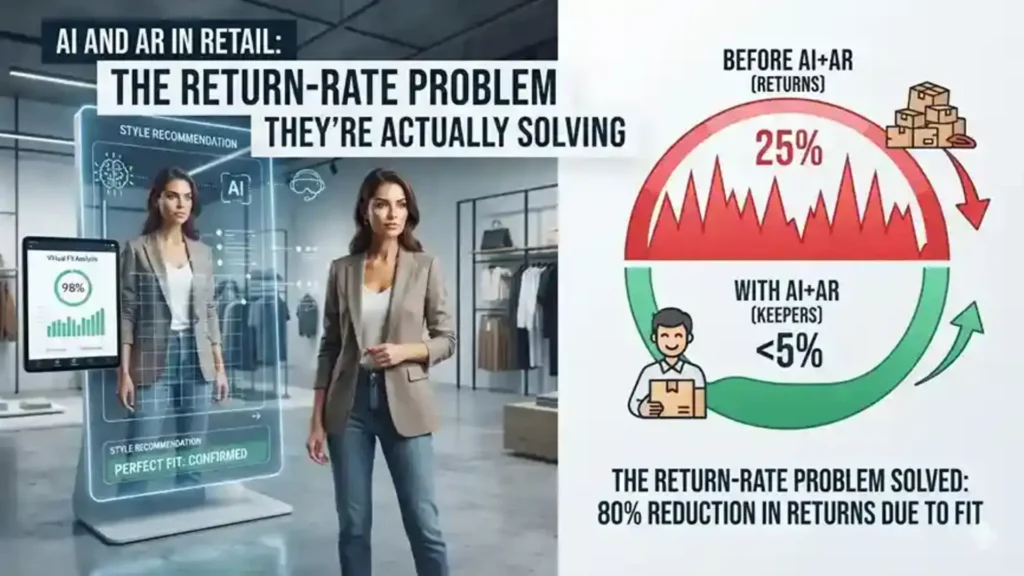
Each returned item represents a double cost for the retailer: once when shipping it and once when processing its return. AI and augmented reality (AR) in retail largely exist to avoid that round trip in the first place, helping the shopper choose the right product the first time. Virtual try-on technology alone has been shown to significantly increase conversion rates in e-commerce and reduce returns by over 8%; figures that explain why beauty, fashion and home goods retailers were the first to adopt it.
Take the fitting room to the client’s living room
Opticians were pioneers in this area for an obvious reason: glasses are a product that people do not buy without seeing how they look on their own face. The virtual try-on solved this problem entirely online, and some retailers have gone further by using AI to recommend frame shapes suitable for the customer’s face, rather than forcing them to guess which one will fit them.
The same logic applies to any situation where excess options are the true barrier to purchase. A beauty catalog with hundreds of thousands of products is impossible for a human being to explore; However, an AI-based recommendation service can reduce that number to a few relevant options based on the user’s search and purchase history, transforming an overwhelming catalog into a short, personalized selection.
Make the “infinite hallway” truly navigable
A larger online catalog is only useful if customers can find what fits their tastes. Wayfair’s approach is a clear example: its search algorithm interprets style preferences from a customer’s search history to show furniture that is likely to fit their tastes; Additionally, a visual search feature allows the shopper to photograph an item they like and find matches among millions of products in inventory.
Augmented reality expands this concept: it goes from “will I like it?” to “Will it fit in my space?” It allows the buyer to view a digitally recreated piece of furniture in their own room before purchasing it, which goes a long way to explaining why this category has seen measurable improvements in conversion and a reduction in returns.
In the fashion sector, the question of sizes works in a similar way. Levi’s uses an AI chatbot that asks for fit, rise and stretch preferences—in addition to the size the customer wears in other brands—to recommend the right size, addressing the leading cause of fashion returns: a garment not fitting as expected. H2: 3. Turn purchasing behavior into better forecasts
Turn Shopping Behavior Into Better Forecasts
Every interaction with an AI-powered shopping tool—a search, a virtual product try-on, or a completed purchase—generates data that retailers didn’t previously have. Used correctly, this data refines inventory and demand forecasts far beyond what historical sales data alone allows, and facilitates truly relevant follow-up marketing: A shopper who has just purchased kitten supplies is an ideal candidate for a cat food subscription offer, not a mass generic newsletter.
This same data allows retailers to target their promotions more precisely, tailoring the discount type and channel to what a specific customer actually responds to based on their history, rather than launching a one-size-fits-all promotion.
Keep shelves stocked before customers notice they are empty
AI-based forecasting is increasingly used to anticipate not only typical demand, but also disruptions to it; This involves recalculating replenishment quantities and adjusting supply in response to real changes, and not simply historical averages. Some retailers have piloted robots that scan shelves to automatically detect out-of-stocks; Likewise, real-time replenishment signaling systems in selected stores seek to solve a basic but persistent problem: the customer who comes expecting to find an item and finds an empty shelf.
What does this mean for retailers who don’t have Wayfair’s budget?
None of this requires developing AI and computer vision capabilities internally. ERP platforms for the retail sector increasingly integrate AI-based demand forecasting and customer data unification as standard functionality; This is what really puts personalization and smarter inventory management within reach of a mid-sized retailer, not a multimillion-dollar in-house AI team.
Curious what AI-powered forecasting and personalization would look like on your retail platform? Contact Trident to request a demo of your retail ERP.