INTRO
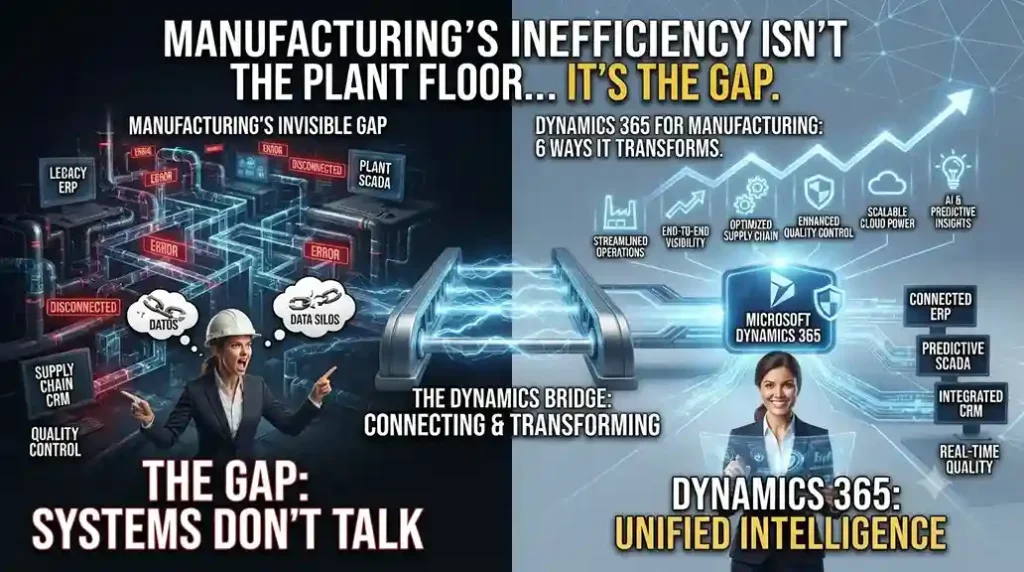
A machine on the shop floor and a service technician in the field often work off completely different data — one sees production output, the other sees a support ticket, and neither sees the customer’s purchase history. Dynamics 365 for manufacturing exists to close exactly that gap, by ending the divide between CRM and ERP instead of running them as separate systems that happen to sit on the same network.
Here are the six shifts that gap-closing actually produces on the ground.
1. Supply Chain Visibility That Goes Beyond a Dashboard
Collecting and visualizing supply chain data across every location does more than create a nicer report — it changes how fast a disruption gets caught. Manufacturers using remote monitoring across distributed installations have shortened time-to-market by catching supply issues before they cascade into production delays, rather than discovering them after a shipment is already late.
2. Asset and Production Management, Consolidated Into One View
When production oversight and real-time equipment monitoring sit in one system instead of three, manufacturers stop reacting to breakdowns and start resolving issues remotely before they cause downtime. This is the operational basis for near-continuous uptime models in equipment-heavy manufacturing — and it also opens a second revenue line: monitoring and proactive support sold as an ongoing service, not a one-time sale.
3. Customer Engagement Built on Usage Data, Not Guesswork
Personalized service at scale requires predictive analytics and self-service options that are actually relevant to what a specific customer does with the product — not a generic contact form. Manufacturers with a connected sales-through-service platform can flag potential equipment issues before a customer notices a problem, while also tailoring offers based on that customer’s real purchasing and usage pattern.
4. Service Centers as a Profit Center, Not a Cost Center
Falling costs for IoT sensors and mobile devices have made remote monitoring and proactive maintenance commercially viable additions to standard break/fix support — not just a premium add-on for enterprise accounts. Combining customer records, technician availability, and inventory into a single mobile-accessible system is what lets a service team actually deliver on that model instead of just theorizing it.
The Data Advantage: Better Products, Not Just Better Service
IoT-connected parts and equipment feed usage data back to engineering — which components fail early, which are over-built, how products actually get used in the field. That feedback loop is what shortens the cycle between a design flaw and a fix, rather than waiting for failure reports to pile up.
5. Technicians Who See the Full Job, Not Just the Ticket
A 360-degree view of a customer’s asset and service history changes what a technician can do on-site — they’re working from context, not just a work order. Paired with machine learning that surfaces similar past cases, this turns troubleshooting into pattern-matching against real precedent instead of starting from zero on every call.
6. One System Connecting the Floor to the Front Office
Manufacturers that unify production and project management data with CRM stop treating customer service and customer engagement as separate departments working from separate records. The practical result is service and recommendations grounded in what a customer has actually bought and experienced — not assumptions.
Why Dynamics 365 Specifically
Dynamics 365 for manufacturing removes the artificial line between CRM and ERP, running both on one system with embedded analytics rather than bolting a reporting layer on top of disconnected tools. For a mid-size manufacturer, this matters less as a technology upgrade and more as an operating model change — supply chain, service, and sales working from the same data instead of reconciling three versions of it.
Curious what a unified CRM-ERP model would look like on your production floor? Talk to Trident about a Dynamics 365 manufacturing assessment.