
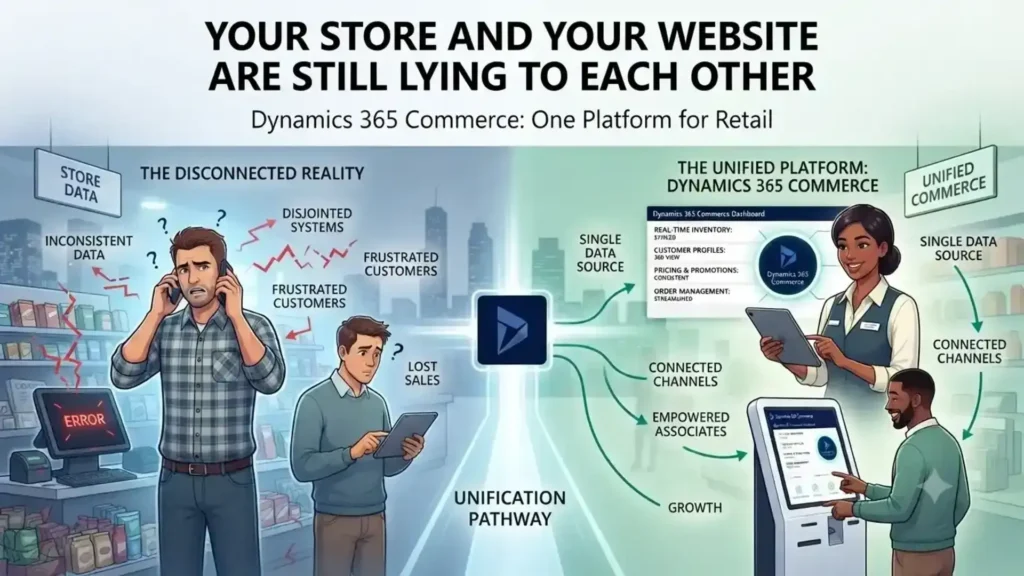
A customer checks stock online, drives to the store, and finds the shelf empty — because the website and the POS were never talking to each other. Dynamics 365 Commerce closes that gap, running e-commerce, POS, and inventory on one shared data model instead of three disconnected systems. The result: what the customer sees online is what’s actually on the shelf.
A customer checks stock online, drives to the store, and finds the shelf empty. The website said 12 in stock. The POS system never told it otherwise. This is the gap that kills conversion — not a lack of channels, but channels that don’t talk to each other.
Physical retail isn’t dying. US retail storefronts have kept expanding even as e-commerce grows in double digits, and most large online retailers still run physical stores alongside their digital ones. The real shift isn’t online-versus-offline. It’s whether a retailer’s systems present one version of the truth across both.
Why Omnichannel Keeps Failing on the Back End
Most retailers don’t lack an omnichannel strategy. They lack an omnichannel database. Inventory sits in one system, POS transactions in another, e-commerce orders in a third — and “click and collect” becomes a manual reconciliation problem instead of a feature.
Dynamics 365 Commerce solves this by running POS, e-commerce, call center, and back-office inventory on a single data model. A sale on the shop floor and an order placed on the app update the same stock ledger in real time. There’s no overnight batch sync, no separate inventory feed that drifts out of date by midafternoon.
What Changes for the Store Team
Store associates stop being the last to know. With real-time inventory visibility built into the POS, an associate can check stock at another location and place a transfer or a customer order without calling around. Paired with Dynamics 365 Customer Insights, they can also pull up a shopper’s purchase history and preferences mid-conversation — turning a routine sale into something closer to how a regular customer at a neighborhood store gets treated, at chain scale.
Personalization Is a Retention Lever, Not a Nice-to-Have
Younger shoppers in particular respond to retailers that recognize repeat behavior instead of treating every visit as anonymous. [Verify with a current source — this stat should reflect the latest data, not be carried over from the original piece.] Recommendation logic built on unified purchase data — not guesswork — is what makes that personalization operationally possible instead of aspirational.
Where This Matters Most: Mid-Size Chains
Enterprise retailers can afford to bolt together five vendors and a systems-integration team to keep it running. Mid-size retail chains usually can’t. That’s where a single-platform approach pays off fastest — fewer integration points to maintain, one vendor accountable for uptime across channels, and IT teams that aren’t stitching together POS, ERP, and e-commerce patches every quarter.
The Real Competitive Line Isn’t Online vs. In-Store
E-commerce alone won’t differentiate a retailer for much longer — most competitors have it. What separates retailers now is whether a customer gets the same accurate stock count, price, and service history whether they’re on the app, on the phone with support, or standing at the register. That consistency is an infrastructure decision, not a marketing one.
Ready to see it on your own store’s data? Talk to Trident about a Dynamics 365 Commerce assessment for your retail environment.
FAQ
What is Dynamics 365 Commerce used for?
It’s Microsoft’s unified retail platform that runs POS, e-commerce, call center, and inventory management on one data model, so stock and order data stay consistent across every sales channel.
Is Dynamics 365 Commerce the same as Dynamics 365 for Marketing?
No — they’re different products. Commerce handles retail operations and omnichannel sales; Marketing handles campaign management. Retailers evaluating an ERP should look at Commerce.
Can Dynamics 365 Commerce support click-and-collect?
Yes. Because inventory updates in real time across channels, a “buy online, pick up in store” order reflects accurate stock without manual reconciliation between systems.