INTRO
A generic ERP will run your sales, accounting, and inventory just fine. What it won’t do is catch a batch that needs recalling, track an allergen through your supply chain, or enforce a food safety hold before a bad ingredient reaches the line. ERP for food manufacturing has to be built for those problems specifically — not adapted to them after the fact.
After 20+ years implementing food manufacturing ERP for clients including Haldiram’s and Nik Bakers, here’s what actually separates a system that fits from one that technically works.
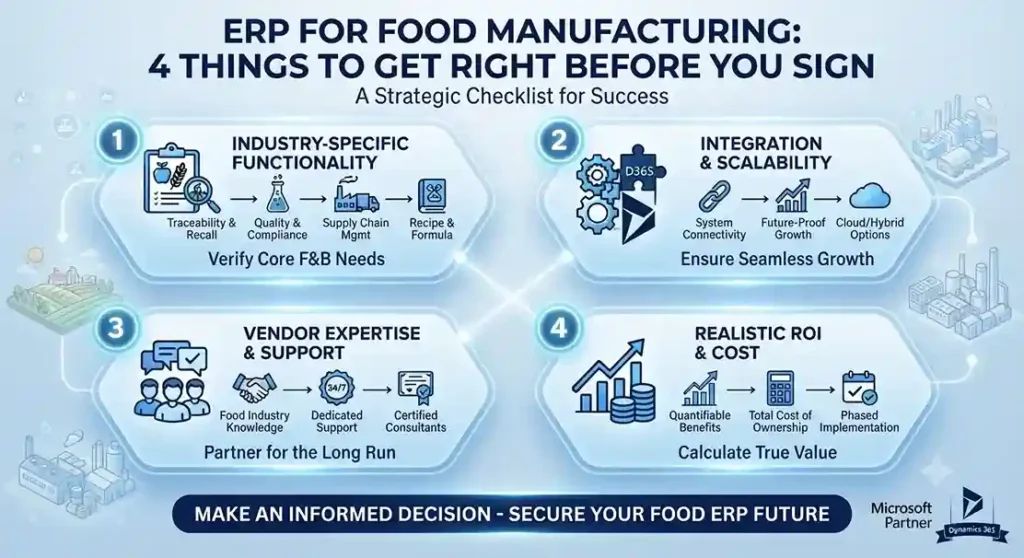
1. Food-Specific Functionality Isn’t Optional
Most mid-market ERPs cover sales, procurement, accounting, and basic inventory — the functions every business needs. Food manufacturing needs more than that as a baseline, not an add-on:
- Food safety and compliance built into the workflow, not bolted on as a separate audit process
- Manufacturing and quality control that can enforce holds and inspections at the right production stage
- Recipe and formulation management that accounts for ingredient substitutions and yield variability
- Recall and traceability that can trace a batch forward and backward through the supply chain in minutes, not days
Before evaluating vendors, it’s worth asking directly how much customization a “standard” ERP would need to deliver each of these — the honest answer is often a lot more than the sales pitch implies.
2. Your Business’s Functionality Gap Is Specific to You
A bakery, a frozen food manufacturer, and a meat processor don’t run the same operation, and they don’t need the same system configuration. Instead of starting from a feature list, start from what’s actually broken today: build a working “wish list” of what your current process can’t do, then use that list to filter vendors — not the other way around. This narrows the field fast, and it keeps the evaluation grounded in your actual operation instead of a generic checklist.
3. Usability Determines Whether the ERP Actually Gets Used
An ERP that’s technically powerful but unfamiliar to your workforce creates a second problem on top of the first: adoption. A warehouse worker or line technician forced to learn an unfamiliar system fast, on top of their existing job, is a recipe for workarounds and shadow spreadsheets — which defeats the purpose of implementing the system in the first place.
Platforms built on tools your team may already know — Microsoft Dynamics 365, for instance, shares design language with Excel and Outlook — shorten that adoption curve meaningfully, because the interface isn’t a second thing to learn on top of the new processes.
4. Implementation Is Months, Support Is Years
A food manufacturing ERP implementation typically runs five to nine months — but that’s the short part of the relationship. What happens after go-live matters more over the life of the system: patches, process changes, new regulatory requirements, and staff turnover all require an ongoing relationship with a partner who understands your operation, not just the software.
That partner needs to understand food manufacturing specifically, not just ERP generically. The distinction matters the same way it would if you were hiring for your own production floor — general competence isn’t the same as domain expertise, and in food manufacturing, that gap shows up in exactly the moments (a recall, an audit, a compliance deadline) where it matters most.
Evaluating ERP for a food manufacturing operation? Contact Trident’s food manufacturing ERP team to talk through your specific requirements.