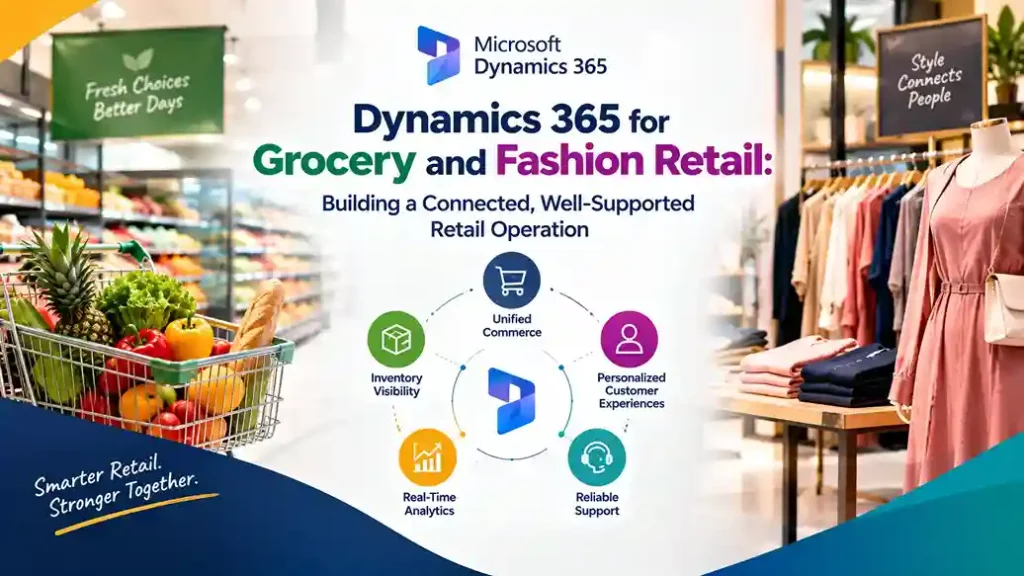
Grocery and fashion are two of the most demanding retail segments. Grocery runs on high volumes, thousands of SKUs and perishable stock. Fashion runs on seasons, sizes, colours and fast-moving trends. Both depend on connected systems — and on those systems staying healthy every trading hour.
Grocery: fast retail needs a smarter ERP
Grocery retailers deal with high-volume transactions, thousands of SKUs, multiple stores, frequent promotions, perishable products, complex replenishment and omnichannel orders. When systems operate in silos, inventory visibility suffers, store operations become manual, stockouts increase and margins get squeezed.
The biggest problem in grocery isn’t selling. It’s knowing what to buy, how much to buy and where to put it — before demand changes.
- Stock availability: empty shelves don’t just lose sales, they lose customers
- Fresh and perishable: in grocery, inventory has an expiry date — overstock leads to waste and markdown, understock to lost customers
- Pricing and promotions: grocery promotions move fast; pricing errors move faster
- Demand forecasting: weather, festivals, weekends and promotions all change demand
Dynamics 365 Commerce and Supply Chain Management connect store, POS, inventory, supply chain, pricing, customer and commerce, so grocery businesses can move from fragmented operations to one connected platform.
Fashion: one style becomes hundreds of SKUs
Size, colour, style, season, store and channel — fashion complexity multiplies fast. Your customer doesn’t want the shirt; they want the right size. Collections have launch dates, and the ERP needs to be ready before them. Margins are won or lost at markdown, and last season’s bestseller doesn’t guarantee this season’s success.
With D365 Commerce and Supply Chain, fashion retailers can connect product, inventory, stores and fulfilment to support endless-aisle selling, one inventory view across online and store, and data-driven markdown and allocation decisions.
From ERP to Agentic ERP
Your D365 environment already knows your sales, inventory, purchasing, suppliers and stores. The next step is an intelligent layer that can sense, predict, decide and act — identifying likely stockouts, excess inventory, expiry risk and transfer opportunities, and recommending the next best action inside D365 F&O. The shift is from ERP as a system of record to ERP as a system of intelligence and action.
Keeping it running: D365 Retail Managed Services
A connected platform only delivers value if it performs. A small system issue can quickly affect POS transactions, store operations, inventory visibility, order processing and customer experience. Common pressure points include:
- POS downtime and failed transactions
- Inventory mismatches between system and shelf
- Omnichannel order and synchronisation issues
- Pricing and promotion configuration errors
- Integration failures across ERP, eCommerce, payments and warehouses
- Performance slowdowns and risky updates
Trident’s D365 Retail Managed Services cover Store, Commerce, Inventory, Integrations, Technology and Business optimisation through one approach: Monitor → Support → Analyse → Optimise. Reactive support fixes problems. Proactive support reduces them.
Is your D365 Retail environment healthy?
- Are POS issues recurring?
- Are store teams frequently raising tickets?
- Are inventory discrepancies common?
- Are integrations generating repeated errors?
- Are users complaining about performance?
- Are D365 updates difficult to manage?
If you answered yes to two or more, your environment may need proactive managed services — not just reactive support. Request a D365 Retail Health Check.