
Welcome to Trident Information Systems!
Write us to - info@tridentinfo.com
Let's Socialize

dynamics 365 field service

Microsoft Dynamics 365 ERP dashboard managing food manufacturing production, inventory, and quality control.

Microsoft Dynamics 365 for Food Manufacturing: The Complete ERP Solution

Food manufacturing is one of the most operationally complex industries in the world — and one of the least forgiving when systems fail. Recipe variations must be managed precisely. Ingredients must be traced from field to shelf. Shelf life must be monitored in real time. Seasonal demand must be forecasted accurately. Compliance with FSSAI and export market food safety standards is non-negotiable. Managing all of this on disconnected systems — or outdated ERP platforms not built for food — means your team spends more time managing complexity than growing the business. Microsoft Dynamics 365 for food manufacturing changes that entirely. It is a complete, cloud-native ERP platform with food and beverage-specific capabilities built in — covering every function from production and quality control to finance, supply chain, and compliance. This is the platform that gives food manufacturers the connected intelligence they need to operate efficiently, grow confidently, and stay compliant effortlessly. Why Food Manufacturers Need Industry-Specific ERP Generic ERP systems can manage inventory and finances. What they cannot handle natively — without expensive customisation — are the specific operational requirements of food production: Without these capabilities built in, food manufacturers either build expensive custom workarounds or manage critical food safety processes manually — both of which create risk and cost that grow with the business. Microsoft Dynamics 365 delivers all of these natively. No customisation required. No separate food safety module to integrate. One platform, built for the way food manufacturing actually works. Key Features of Microsoft Dynamics 365 for Food Manufacturing Recipe and Formula Management Food products are defined by their recipes — and recipes change. New formulations, ingredient substitutions, cost-driven reformulations, and regulatory-driven changes must all be managed carefully, with full version history and approval workflows. Dynamics 365 provides flexible recipe management with: When a recipe changes, the ERP ensures the correct version is what gets produced — every time. End-to-End Traceability In the event of a food safety incident, the ability to trace affected product instantly — backward to source ingredients and forward to every customer who received it — is the difference between a contained recall and a crisis. Dynamics 365 delivers two-way lot traceability across the complete supply chain: This traceability capability is not just a food safety requirement. It is increasingly a prerequisite for supplying major retailers and export markets that conduct rigorous supply chain audits. Shelf Life and Expiry Management For food manufacturers, shelf life management directly impacts both food safety and profitability. Products that expire before sale are waste. Products that reach customers close to their expiry date create complaints and damage brand reputation. Dynamics 365 manages shelf life automatically: Demand Forecasting for Seasonal Products Food demand is inherently seasonal. Ice cream peaks in summer. Festive products spike before Diwali and Christmas. Certain ingredients are only available — or affordable — at specific times of year. Planning production and procurement around these patterns requires forecasting that goes beyond simple historical averaging. Dynamics 365 provides AI-powered demand forecasting that: Regulatory Compliance and Labelling Food manufacturers operate under increasingly complex regulatory requirements — FSSAI in India, EU food safety regulations for export markets, retailer-specific compliance standards, and GMP requirements for certain product categories. Dynamics 365 embeds compliance management throughout the production process: Complete Financial and Operational Integration Beyond food-specific capabilities, Dynamics 365 connects every function of the food manufacturing business on a single platform: When every function operates from the same data, decisions are faster, errors are fewer, and the business runs more efficiently at every level. The Industry 4.0 Advantage As the Fourth Industrial Revolution reshapes food manufacturing, Dynamics 365 positions food businesses at the forefront — not behind it. Azure IoT integration connects production equipment and cold chain monitoring devices — providing real-time data on machine performance, temperature, and production conditions that feeds directly into quality and maintenance decisions. Microsoft Copilot AI — embedded across Dynamics 365 — provides natural language analytics, automated anomaly detection, and intelligent recommendations that help operations teams make better decisions faster. Cloud delivery means automatic updates, no on-premises infrastructure burden, and access from any device — so your team has the information they need wherever they are. Why Trident Is India’s Trusted Dynamics 365 Food Manufacturing Partner As a certified Microsoft Dynamics 365 partner with specific experience in food and beverage manufacturing, Trident Information Systems delivers ERP implementations that are configured for the operational realities of Indian food manufacturers — from FSSAI compliance and GST integration to multi-plant production management and export market traceability requirements. Ready to give your food manufacturing business the ERP platform it deserves? Book a free Dynamics 365 assessment with Trident today. For more insightful content and industry updates, follow our LinkedIn page.

Microsoft Dynamics 365 for Food Manufacturing: The Complete ERP Solution Read More »
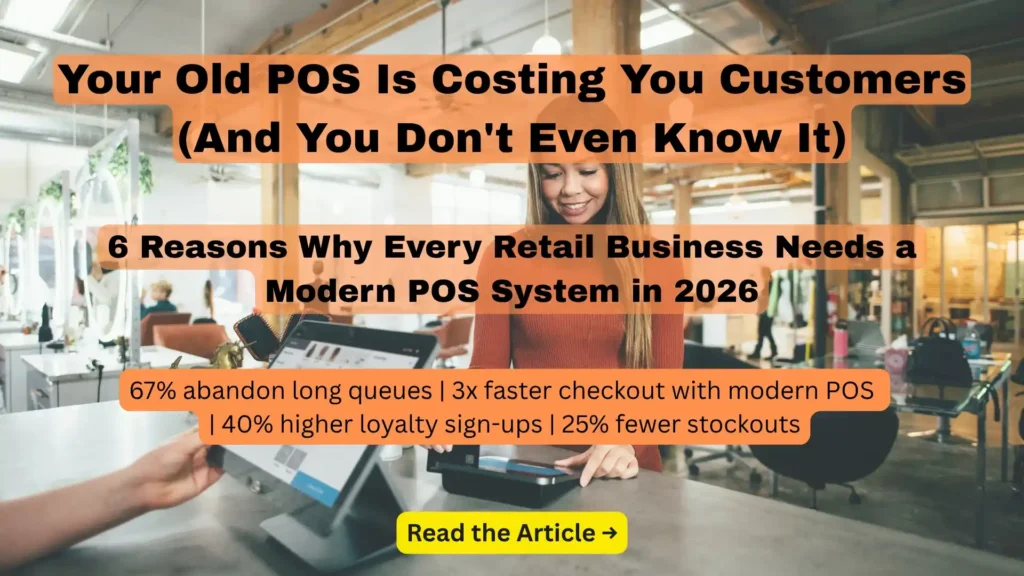
Modern retail POS system processing sales, managing inventory, and tracking customer transactions.

6 Reasons Why Every Retail Business Needs a Modern POS System in 2026

If your retail business is still running on a cash register, a paper receipt book, and a stock count done manually at night — you are not just working harder than you need to. You are actively limiting how fast your business can grow. Modern POS (Point of Sale) systems have transformed from simple payment tools into complete retail command centres. They process payments, manage inventory in real time, track customer behaviour, run loyalty programmes, monitor staff performance, and generate the business intelligence that drives better decisions — all from one connected platform. Top retail businesses globally — and increasingly in India — have made the modern POS system the operational backbone of their operation. Here are six concrete reasons why yours should too. What Is a Modern POS System? A modern POS system is far more than a payment terminal. It is a centralised retail management platform that connects every function of your store — sales, inventory, customers, staff, and finances — in one real-time system. Unlike traditional cash registers or basic billing software, a modern POS: In short — it replaces the disconnected tools, manual processes, and end-of-day headaches that slow retail businesses down. 6 Reasons Your Retail Business Needs a Modern POS System 1. Real-Time Sales Reports That Drive Smarter Decisions Running a retail business without accurate sales data is like driving with a fogged windscreen. You move forward — but you cannot see clearly enough to navigate confidently. A modern POS generates detailed sales reports automatically — by product, category, time period, staff member, and store location. You can see instantly: This intelligence does not require a business analyst. It is generated automatically — available on your dashboard the moment you need it. Competitive edge: Top-ranking competitors mention reporting. None go into the depth of what it actually tells you. This section goes further. 2. Adapt Instantly to What Your Customers Actually Want Customer preferences shift constantly. A product that sold strongly last quarter may be declining this quarter — and without data, you will not know until you are sitting on excess stock. A modern POS analyses purchasing behaviour continuously — showing you which product categories are growing, which are contracting, and where you have opportunities to introduce complementary products. This means you can: Retailers who act on this data outperform those who rely on intuition — every time. 3. Save Time on Inventory and Ordering Inventory management is one of the most time-consuming tasks in any retail operation — and one of the most prone to human error when done manually. A modern POS connects sales directly to inventory: The result is less time on stockroom management and more time on customer service. Staff can answer availability questions instantly — without leaving the shop floor to check the back. 4. Eliminate Pricing Errors Across Your Entire Store Manual pricing is a source of constant small errors that collectively damage both profitability and customer trust. A price updated in one place but not another creates inconsistencies that frustrate customers and can lead to regulatory issues. A modern POS manages pricing centrally: No more customer complaints about being charged the wrong price. No more staff confusion during promotions. Consistent, accurate pricing — every transaction. 5. Run a Loyalty Programme That Actually Drives Repeat Business Customer loyalty is built through recognition and reward — and a modern POS makes running an effective loyalty programme simple. Every customer’s purchase history is stored and accessible at the POS. This enables you to: Research consistently shows that loyal customers spend significantly more per visit than new customers. A POS-integrated loyalty programme is one of the highest-ROI investments a retailer can make. 6. Manage Your Team More Effectively Your staff are your front line — and a modern POS gives you the tools to manage, motivate, and develop them effectively. When employees can see their own performance data, motivation increases. When managers can see it too, coaching becomes evidence-based rather than anecdotal. What to Look for in a Modern POS System Not all POS systems are equal. Based on SERP analysis of top-ranking competitors, here is what genuinely matters: Feature Why It Matters Cloud-based Access data anywhere, automatic updates, no server maintenance Offline capability Continues working if internet drops — critical for uninterrupted service Multi-payment support Cards, UPI, wallets, cash — essential for Indian retail market Inventory integration Real-time stock management without separate tools CRM and loyalty built-in Customer data and rewards without additional software Scalable Grows from one store to a chain without platform replacement ERP integration Connects to your broader business management platform How LS Central on Microsoft Dynamics 365 Delivers All 6 Benefits LS Central — built on Microsoft Dynamics 365 Business Central — is the unified commerce platform that covers every capability above in a single, connected system. Unlike standalone POS software, LS Central connects your POS directly to inventory, purchasing, customer management, loyalty, staff management, and financial reporting — in real time, across every location. For Indian retailers specifically, LS Central supports: Trident Information Systems is a certified LS Central and Microsoft Dynamics 365 implementation partner — helping retailers across India upgrade from outdated billing systems to connected, intelligent retail platforms. Ready to make your POS the competitive advantage your retail business deserves? Book a free retail technology assessment with Trident today. For more insightful content and industry updates, follow our LinkedIn page.

6 Reasons Why Every Retail Business Needs a Modern POS System in 2026 Read More »

Business team evaluating CRM software dashboards and customer management features.

How to Choose the Right CRM Software for Your Business: 5 Criteria That Actually Matter

Choosing a CRM is one of the most important technology decisions your business will make — and one of the easiest to get wrong. Not because CRM software is complicated. But because there are hundreds of options, every vendor claims to be the best, and the criteria that matter most for your business are rarely the ones that feature prominently in a product brochure. The wrong CRM creates problems that compound over time: sales teams who do not use it because it does not fit their workflow, data that is siloed rather than shared, reports that take hours to generate manually because the system cannot produce them automatically, and a growing maintenance burden every time your business needs to do something slightly different from what the CRM was configured to handle. The right CRM, on the other hand, becomes the operational backbone of your business. It gives your sales team the context they need to close deals. It gives your marketing team the data they need to run campaigns that actually convert. It gives your service team the customer history they need to resolve issues on the first contact. And it gives leadership the real-time visibility they need to make confident strategic decisions. So how do you tell the difference before you commit? This guide covers five practical criteria for evaluating any CRM — the questions to ask, the red flags to watch for, and what great actually looks like at each stage of the decision. Why Choosing the Wrong CRM Is More Expensive Than You Think The Real Cost of a Poor CRM Decision Most businesses focus on the upfront cost when evaluating CRM software. That is understandable — it is the most visible number. But it is rarely the most significant one. The real cost of a poor CRM decision shows up over 12 to 36 months: Research by Gartner consistently shows that CRM failure rates remain high — not because of the technology, but because of poor selection and implementation decisions. Getting the selection right is the most important part of a successful CRM project. What a Great CRM Actually Does for Your Business Before evaluating specific platforms, it is worth being clear about what you are actually buying. A CRM is not just a contact database. At its best, it is a system that: With that benchmark in mind, here are the five criteria that determine whether a CRM actually delivers on these promises for your business. 5 Criteria to Evaluate Before Investing in Any CRM Criterion 1: Accessibility and Scalability — Can It Grow With You? Why this matters: A CRM that is difficult to access or that creates barriers to daily use will not be used consistently. And a CRM that cannot scale as your team grows will need to be replaced — at significant cost and disruption — at exactly the moment your business is growing fastest. What to evaluate: Cloud vs on-premises Cloud-based CRM software is the clear choice for most businesses in 2026. It eliminates the hardware investment and maintenance overhead of on-premises deployment, provides automatic updates and security patches, and enables access from any device with an internet connection. On-premises deployment may still be appropriate for organizations with specific data residency or compliance requirements — but for most businesses, the flexibility, lower upfront cost, and reliability of cloud CRM significantly outweighs any on-premises advantage. Multi-device access Your sales team works from wherever their customers are — offices, client sites, airports, coffee shops. Your CRM needs to work in all of these environments — on desktop, laptop, tablet, and mobile — with a consistent, properly optimized experience on each device. A CRM that only works well on a desktop computer is not a field sales tool. It is an office administration tool. The two are very different. Scalability — adding users without headaches As your team grows, adding new users to your CRM should be straightforward and cost-effective. Evaluate: Microsoft Dynamics 365 advantage: Dynamics 365 is a cloud-native platform with native iOS, Android, and Windows apps — providing consistent, full-featured access across every device. Licensing scales from small teams to enterprise organizations, with role-based access configuration that ensures every user sees exactly what they need. Criterion 2: Beyond Sales — Does It Cover Your Whole Business? Why this matters: Many CRM systems were originally built as sales tools — and they remain primarily sales tools, with bolt-on modules for marketing and customer service that feel like afterthoughts. When your CRM only handles part of the customer relationship, the data gaps between functions create the inconsistent experiences that frustrate customers and reduce team effectiveness. What to evaluate: End-to-end customer journey coverage The best CRM platforms follow the customer through the entire relationship — from the first marketing touchpoint through the sales cycle, the initial purchase, ongoing service interactions, and renewal or upsell opportunities. Ask each vendor: can a customer service agent see the complete sales history for a customer they are supporting? Can a salesperson see the support tickets a customer has raised before they call? Can marketing see which customer segments have the highest lifetime value, based on sales and service data? If the answer requires custom integration work, that is a yellow flag. Marketing automation integration Modern CRM platforms include — or natively integrate with — marketing automation tools that capture leads, run nurture campaigns, score prospects based on engagement, and hand qualified leads to sales with full context on their journey. Evaluate the depth of this integration: is marketing data visible to sales in real time, or does it sync on a schedule? Can marketers segment audiences based on sales stage and customer service history, or only on marketing engagement data? Customer service and support coverage If your business provides ongoing support to customers, evaluate whether the CRM includes case management, SLA tracking, knowledge base management, and multi-channel service capabilities — or whether these require a separate system. Microsoft Dynamics 365 advantage: Dynamics 365 is a full customer

How to Choose the Right CRM Software for Your Business: 5 Criteria That Actually Matter Read More »

Business intelligence dashboard displaying real-time analytics, KPIs, and organizational insights.

5 Reasons Business Intelligence Should Be at the Heart of Your Organisation

Here is a question worth sitting with: how many decisions does your business make every week based on gut instinct rather than real data? For most organisations, the honest answer is — more than it should. Not because the data does not exist. It does. It sits in spreadsheets, CRM systems, ERP platforms, and finance tools across your organisation. The problem is that it is scattered, siloed, and impossible to see clearly as a whole picture. Business intelligence (BI) is what changes that. It connects your data, organises it into meaningful insights, and puts the right information in front of the right person at exactly the right moment. Here are five compelling reasons why BI should be at the heart of every modern organisation — and why 2025 is the year to make it a strategic priority. What Is Business Intelligence and Why Does It Matter Now? Business intelligence is the technology, processes, and tools that transform raw organisational data into clear, actionable insights. It covers everything from interactive dashboards and real-time reports to advanced analytics and predictive modelling. In today’s digital-first environment, business leaders face a paradox — they have more data than ever before, yet feel less certain about the decisions they are making. BI resolves that paradox. It turns data overload into decision-making clarity. 5 Reasons Every Organisation Needs a BI Strategy 1. Make Smarter, Faster Business Decisions Data is not the same as intelligence. A business manager can be surrounded by reports and spreadsheets and still have no clear picture of what is actually happening — because the data is fragmented, delayed, and inconsistent across systems. BI changes this fundamentally. It creates a single, unified source of truth — pulling data from every corner of your organisation into one place and presenting it clearly through real-time dashboards. Instead of waiting for someone to compile a weekly report, you see exactly where your business stands right now. The result is better decisions, made faster, with genuine confidence behind them. 2. Supercharge Sales and Marketing Performance Sales and marketing teams are most effective when they work from the same data — and when that data tells them exactly where the opportunities are. For sales teams, BI identifies trends in customer behaviour, highlights the accounts most likely to convert, surfaces upsell and cross-sell opportunities, and quantifies pipeline performance in real time. No more guesswork about where to focus time and effort. For marketing, BI makes campaign performance immediately visible — showing which channels, messages, and audiences are delivering results, and which are wasting budget. Teams can adjust campaigns mid-flight based on real evidence rather than waiting for a post-campaign review. When both teams work from the same BI platform, the alignment between sales and marketing improves dramatically — and so do the revenue results. 3. Eliminate Inefficiencies and Boost Productivity Every organisation has processes that consume more time and resources than they should. The challenge is that inefficiencies are often invisible — buried in the day-to-day routine and never questioned because “that is how we have always done it.” BI makes inefficiencies visible. It identifies bottlenecks in production workflows, reveals where time is being lost in sales cycles, highlights which processes are underperforming against targets, and automates the routine reporting tasks that consume hours of management time every week. The productivity gains from a well-implemented BI strategy are felt across every department — from customer service and operations to finance and product development. 4. Improve Data Quality and Accuracy Across the Business When data lives in separate systems — a CRM here, an ERP there, a spreadsheet somewhere else — inconsistencies multiply silently. The same customer appears in three systems with three different records. Sales figures differ between the finance report and the sales report. Nobody is sure which number to trust. This is not just an inconvenience. Poor data quality leads to wasted marketing spend, missed sales opportunities, flawed forecasts, and brand damage from miscommunication with customers. BI addresses this at the root. By centralising data and creating a single validated source of truth, it surfaces inconsistencies and gaps that would otherwise remain hidden — improving the accuracy and reliability of every business decision that depends on data. 5. Deliver a Measurable, Business-Wide ROI Every investment decision your organisation makes should have a measurable return — and BI investment is no different. The good news is that the ROI from a well-implemented BI strategy tends to be both significant and multi-dimensional. Better decisions lead to more revenue. Eliminated inefficiencies reduce costs. Improved data quality reduces waste. Smarter sales and marketing generates higher conversion rates. Together, these improvements compound — creating a measurable uplift in business performance that justifies the investment many times over. Organisations that treat BI as a strategic priority consistently outperform those that do not — not because they have access to different data, but because they use their data more intelligently. What Business Intelligence Looks Like in Practice The best BI implementations are not complex IT projects. They are practical, accessible tools that become part of how people work every day. A sales director starts each morning with a dashboard showing pipeline health, conversion rates, and this week’s revenue forecast — updated overnight from live system data. A marketing manager checks campaign ROI in real time — adjusting spend toward channels that are converting and pulling back from those that are not. A CEO reviews a single consolidated view of company-wide performance — financial, operational, and customer — in one place, in minutes rather than hours. This is what BI enables. And with modern cloud-based platforms, this level of insight is accessible to organisations of every size. How Microsoft Power BI Delivers All 5 Benefits Microsoft Power BI is one of the world’s most widely adopted business intelligence platforms — and for good reason. It connects natively to Microsoft Dynamics 365, Azure, Excel, SQL databases, and hundreds of third-party data sources — bringing all your organisational data into one unified analytics environment. Interactive dashboards

5 Reasons Business Intelligence Should Be at the Heart of Your Organisation Read More »

Microsoft Dynamics 365 Connected Field Service dashboard monitoring predictive maintenance and service operations.

Microsoft Dynamics 365 Connected Field Service: How Industry Leaders Are Moving From Break-Fix to Predictive Service

What if your field technician could fix a problem before the customer even knew it existed? That is not a futuristic scenario. It is what Microsoft Dynamics 365 Connected Field Service — powered by IoT integration through Microsoft Azure — is delivering for industry leaders right now. And organizations that have made the switch are seeing return on investment in as little as four months. Field service has always been the moment of truth in customer relationships. The technician who arrives on time, with the right parts, with full knowledge of the customer’s history — or doesn’t — defines how that customer feels about your brand for years. But the traditional break-fix model of field service is no longer a viable competitive strategy. Customers today expect 100 percent uptime, hyper-speed service delivery, and proactive care that anticipates problems before they escalate. In an environment where competitive pressure is intensifying across every industry — from manufacturing and utilities to telecommunications and retail — field service has become a primary differentiator. The organizations winning are those that have moved from reactive to predictive, from disconnected to connected, and from legacy systems to intelligent, cloud-based field service platforms. This guide covers everything you need to know about Microsoft Dynamics 365 Connected Field Service — what it is, how it works, what real organizations have achieved with it, and how Trident Information Systems can implement it for your operation. The Field Service Revolution: Why the Old Model Is Failing From Break-Fix to Predictive: The New Standard for Field Service The break-fix model of field service — wait for something to fail, dispatch a technician, fix the problem, send the invoice — was the industry standard for decades. It worked adequately in a world where customers had limited alternatives and modest expectations. Neither of those conditions applies today. Modern customers expect continuous uptime, not reactive repairs. They expect service providers to know about potential failures before they occur — and to resolve them without disruption to operations. In industries like utilities, manufacturing, and facilities management, an unplanned outage or equipment failure is not just an inconvenience. It is a financial event, a safety risk, and a potential contract termination. The shift from break-fix to proactive and predictive service is not a trend — it is a market requirement. And it is only possible with the right connected technology infrastructure. Why Customer Experience Has Become the Frontline of Field Service Field service is no longer just an operational function. It is a customer experience function — and in many industries, it is the single most important touchpoint in the entire customer relationship. The field technician who arrives at a customer’s facility is representing your brand at its most direct and personal. What they know, what tools they have, how quickly they resolve the issue, and how well they communicate throughout the process determines whether that customer renews their contract, refers your company to others, or starts evaluating your competitors. This is why leading organizations across retail, telecommunications, manufacturing, utilities, and professional services are investing in connected field service — not just as an operational upgrade, but as a strategic investment in customer retention and competitive differentiation. What Is Microsoft Dynamics 365 Connected Field Service? Microsoft Dynamics 365 Connected Field Service is an intelligent, IoT-powered field service management solution that connects physical assets, field technicians, customer data, and service operations on a single platform — enabling organizations to shift from reactive maintenance to proactive, predictive service delivery. At its core, Connected Field Service integrates three technology layers that traditional field service solutions have always kept separate: When these three layers work together, something fundamental changes: your service operation stops reacting to failures and starts preventing them. IoT Integration: Knowing About Problems Before Customers Do The most powerful capability in Microsoft Dynamics 365 Connected Field Service is the integration with Microsoft Azure IoT Hub — which enables continuous monitoring of connected assets and automatic work order generation when sensor data indicates a potential failure. Here is what that means in practice: The result is not just faster service. It is service that prevents the problem from becoming a crisis — protecting the customer’s operations and your relationship simultaneously. Mobile-Connected Field Teams With a 360-Degree Customer View The value of IoT monitoring is only fully realized when the field technician who responds to it is properly equipped. Microsoft Dynamics 365 Connected Field Service gives every technician a complete, real-time view of the customer and asset before they arrive on site: When a technician arrives fully informed and properly equipped, first-time fix rates increase dramatically — and repeat visits, which are expensive for the service provider and frustrating for the customer, decrease proportionally. H3: Mixed Reality and the Future of Field Service Delivery Microsoft Dynamics 365 Connected Field Service also supports Mixed Reality technologies — including Microsoft HoloLens and Remote Assist — that are reshaping how complex field service challenges are resolved: Mixed Reality in field service is not yet universal — but for organizations managing complex, high-value assets in industries like aerospace, industrial manufacturing, and energy, it is rapidly becoming a standard capability. Real-World Proof: MacDonald Miller Facility Solutions Case Study Theory is valuable. Proof is better. The MacDonald Miller Facility Solutions case study is one of the most compelling demonstrations of what Microsoft Dynamics 365 Connected Field Service delivers in practice — and the speed at which it delivers it. The Challenge: Managing Complex, Interconnected Facility Systems MacDonald Miller Facility Solutions is a professional services company specializing in facilities management — a sector defined by complexity. Managing multiple interlocking, interdependent building systems across a large portfolio of client facilities, with the expectation of continuous uptime and proactive maintenance, requires a technology platform capable of integrating disparate data sources and coordinating rapid field response. Before adopting Connected Field Service, MacDonald Miller’s technicians were working without complete asset history when deployed to service calls. Work order creation and dispatch was reactive. The information needed to diagnose and resolve issues

Microsoft Dynamics 365 Connected Field Service: How Industry Leaders Are Moving From Break-Fix to Predictive Service Read More »