Welcome to Trident Information Systems!
Write us to - info@tridentinfo.com
Let's Socialize

dynamics 365 implementation india

Whitepaper: The business owner’s guide for replacing accounting software

Replacing your accounting software is easier and more affordable than you may think. Use this guide to learn about the benefits of a modern technology platform, better understand the advantages of a cloud-based solution, and know what questions to ask when evaluating your options.

Whitepaper: The business owner’s guide for replacing accounting software Read More »

Reduce supply chain disruptions with AI, IoT, and mixed reality

Disruptions in global supply chains have significantly increased over the last decade, fueled by a myriad of triggers ranging from trade wars, demand surges from social marketing, natural disasters, and most recently, the recent COVID-19 pandemic. Updates to Microsoft Dynamics 365 Supply Chain Management in the 2020 release wave 1 help organizations proactively transform every aspect of manufacturing and supply chain operations to reduce disruptions. These new and updated capabilities drive automation and reduce downtime using IoT and mixed reality, and provide the agility to re-plan production in real time to dynamically changing demand. In fact, the agility enabled by Supply Chain Management is currently being leveraged by a consortium of major UK industrial, technology, and engineering businesses from across the aerospace, automotive, and medical sectors that has come together to produce medical ventilators for the NHS. Reducing the risk of supply chain disruptions As the threat of disruptions increase, companies are pressured to ask if the supply chain is ready for the next event, pushing them to build a more resilient supply chain to ensure business continuity for them and their customers in the most cost-effective manner. More companies will start buffering for risks and move from a “Just-in time” mentality to a “Just-in case” mentality. Factories will need to transform rapidly to adapt to change, serving a wider range of products produced in smaller batches with lower set up time, faster throughput, and the ability to quickly respond to fluctuating demand and customer expectations. Companies are likely to move from single supplier to multi-supplier and single location to multi-location models for mission critical parts even if it is cost prohibitive in order to reduce the impact of supply chain disruptions. To reach this optimal state of agility and delivery speed, manufacturers need to adapt every aspect of the supply chain to enable tools, equipment, and people to become instrumented, interconnected, and intelligent—a state of persistent adaptive learning and optimization as more data is available to tighten links between manufacturers, suppliers, and customers. The latest release from Dynamics 365 Supply Chain Management enables customers to reach this optimal state by proactively transforming their manufacturing and supply chain with predictive insights and intelligence from AI, IoT, and mixed reality—across planning, production, inventory, warehouse, and transportation management—to maximize operational efficiency, product quality, and profitability. Train workers faster with integrated mixed reality learning experiences Dynamics 365 Supply Chain Management is now integrated with Dynamics 365 Guides to help mainstream mixed reality for manufacturing. Companies can deliver a faster ROI by getting the workforce trained sooner with fewer trainers and with an interactive learning experience. Workforce efficiency can skyrocket with step-by-step instructions that guide employees to the tools and parts they need and how to use them in real work situations, available at a glance on a Microsoft HoloLens device that keeps their hands free to do the work. Dynamics 365 Guides can not only eliminate costly errors in production but also improve workforce safety. Companies can significantly reduce asset downtime by making asset maintenance skillset-agnostic and avoid costly waiting time for a specific expert to perform maintenance on an asset. The guides are extremely easy to author and do not require any coding. A guide can be authored by simply writing the step-by-step instructions on a PC followed by picking and placing the holographic parts and inbuilt icons on the machine where the work is happening. Introducing Dynamics 365 Guides for HoloLens 2 Dispatch the right resources at the right time Dynamics 365 Supply Chain Management is now integrated with Microsoft Dynamics 365 Field Service. Customers can significantly reduce downtime of geographically dispersed mission critical assets by automating field service operations so that the right resources—workforce, machines, parts, and tools—are available at the right place, at the right time, to proactively maintain them. Companies can improve the overall equipment effectiveness (OEE) of their geographically dispersed mission critical assets by performing predictive maintenance based on real-time performance data from IoT and field data from Dynamics 365 Field Service. Traditionally, disparate systems hinder the ability to accurately forecast demand for critical and expensive parts frequently used in both service and new production. Due to lack of forecasting for service demand, companies constantly take parts from production to fulfill the service demand, and vice versa, to deliver good customer service. This often creates a shortage for new production and significantly impacts on time delivery to new customers. As a result, the company is unable to deliver a delightful customer experience on both fronts. This integration will eliminate the need for disparate systems and significantly improve the forecast accuracy of these mission-critical parts due to real time tracking in the service supply chain. Seamlessly integrate IoT capabilities Dynamics 365 Supply Chain Management now offers out-of-the-box IoT capabilities that leverage Microsoft Azure IoT Hub to connect signals from mission-critical assets with business transaction data. Manufacturers can improve uptime, throughput, and quality by proactively managing shop floor and equipment operations with a real-time view of their entire production and stock. This will significantly reduce costly downtime of business-critical equipment by performing predictive maintenance before disruptive failures occur. There is no coding required to implement these out-of-the-box IoT scenarios on your manufacturing floor today. Dynamics 365 Supply Chain Management and IoT Intelligence customer spotlight with Majans Improve on-time delivery with real-time production planning The Planning Optimization Add-in for Dynamics 365 Supply Chain Management enables companies to improve on-time delivery by performing production planning in real time, accounting for dynamically changing customer demand, material availability, and capacity constraints across multiple sites and warehouses. It also enables customers to improve inventory turns by right-sizing inventory levels based on dynamically changing customer demand and capacity constraints. This helps eliminate excess and reduces slow moving inventory. Planning Optimization Add-in for Retail and Distribution is available and Production planning is currently in preview.

Reduce supply chain disruptions with AI, IoT, and mixed reality Read More »

Enterprise ERP software dashboard managing retail, hospitality, and manufacturing operations.

Enterprise ERP Software for Retail, Hospitality & Manufacturing: 6 Benefits That Transform Your Business

Running a business in retail, hospitality, or manufacturing means managing a constant flow of moving parts — staff schedules, customer orders, inventory levels, supplier deliveries, and financial transactions — all happening simultaneously, every single day. When those moving parts are managed through disconnected systems — a spreadsheet here, a separate POS there, a standalone HR tool — the gaps between them create errors, delays, and blind spots that cost real money. Enterprise ERP software brings everything together. One platform. One source of truth. Every department — finance, operations, HR, sales, and customer service — working from the same real-time data. Here is how ERP transforms operations specifically in retail, hospitality, and manufacturing — and why Microsoft Dynamics 365 Business Central is the platform Trident recommends. Why Retail, Hospitality, and Manufacturing Need ERP Most These three industries share a common challenge: high operational complexity at every level. A retail chain manages hundreds of SKUs across multiple locations. A hotel or restaurant balances reservations, kitchen operations, staff rotas, and customer satisfaction simultaneously. A manufacturer coordinates raw material procurement, production scheduling, quality control, and order fulfilment — often across multiple sites. Without a unified system connecting all these functions, management is reactive. With the right ERP, it becomes proactive — with real-time visibility that enables better decisions at every level of the organisation. 6 Key Benefits of ERP for Retail, Hospitality and Manufacturing 1. Real-Time Data Across Every Department Business data changes constantly. Inventory levels shift with every sale. Staff schedules update daily. Customer orders flow in around the clock. Financial positions move with every transaction. Without real-time visibility, managers make decisions based on yesterday’s data — and the gaps between systems mean different departments often work from different numbers. ERP solves this fundamentally. Every transaction updates the central system instantly — so whether you are checking stock levels, reviewing sales performance, or approving a purchase order, you are always working from current, accurate information. No delays. No discrepancies. No guesswork. 2. Integrated Point of Sale In retail and hospitality, the POS system is the heartbeat of the operation. Every sale, every order, every payment flows through it — and what happens to that data after the transaction determines how well the rest of the business functions. A standalone POS that does not connect to inventory, finance, and customer management creates manual work and data silos. An ERP-integrated POS changes everything: For retail chains and multi-outlet hospitality businesses, this integration is particularly powerful — giving head office a live view of every location’s performance without waiting for manual reports. 3. Smarter Customer Management Your customers are your most valuable asset — and your ERP should help you treat them that way. An ERP system captures complete customer profiles: purchase history, preferences, communication records, loyalty points, and service interactions. This data enables: In hospitality especially, knowing your guest’s preferences before they arrive is a powerful differentiator. In retail, personalised offers based on real purchase data consistently outperform generic promotions. ERP makes both possible at scale. 4. Efficient Employee Management Managing staff across retail stores, restaurant shifts, or manufacturing shifts — potentially across multiple locations — is one of the most operationally demanding functions in any of these industries. ERP centralises employee management in one system: When employee data is connected to operational data, managers can make faster and fairer staffing decisions — and compliance documentation is always complete and current. 5. Streamlined Inventory Management Inventory management is the operational function where ERP delivers the most immediate and visible impact — particularly in retail and manufacturing. Without a connected inventory system, businesses either over-order (tying up cash in excess stock) or under-order (losing sales to stockouts). Neither is acceptable in competitive markets. ERP provides: For manufacturers, ERP takes this further — connecting inventory management directly to production planning and supplier procurement, ensuring materials are always available when production needs them. 6. Unified Financial Management Every operational decision has a financial consequence — and ERP connects the two in real time. Rather than waiting for month-end reports compiled manually from multiple systems, ERP gives finance teams live visibility into revenue, costs, margins, and cash flow across every business unit. Invoices are matched automatically. Budget variances are flagged immediately. Financial close processes that once took days are completed in hours. For multi-entity businesses — retail chains, hospitality groups, or multi-site manufacturers — ERP consolidates financial data across all locations into a single, accurate picture that leadership can act on immediately. Why Microsoft Dynamics 365 Business Central Microsoft Dynamics 365 Business Central is the modern, cloud-native evolution of Dynamics NAV — one of the most widely deployed ERP platforms in retail, hospitality, and manufacturing globally. It delivers all six benefits above in a single, integrated platform — with the added advantage of: Whether you are running a single restaurant, a retail chain, or a manufacturing facility, Business Central scales with your operation — without platform replacement as you grow. Why Trident Is India’s Trusted ERP Partner As a certified Microsoft Dynamics 365 Business Central partner, Trident Information Systems has helped businesses across retail, hospitality, and manufacturing in India implement ERP solutions that deliver measurable results — from initial assessment through go-live and ongoing optimisation. Ready to unify your business on one intelligent platform? Book a free ERP assessment with Trident today.

Enterprise ERP Software for Retail, Hospitality & Manufacturing: 6 Benefits That Transform Your Business Read More »

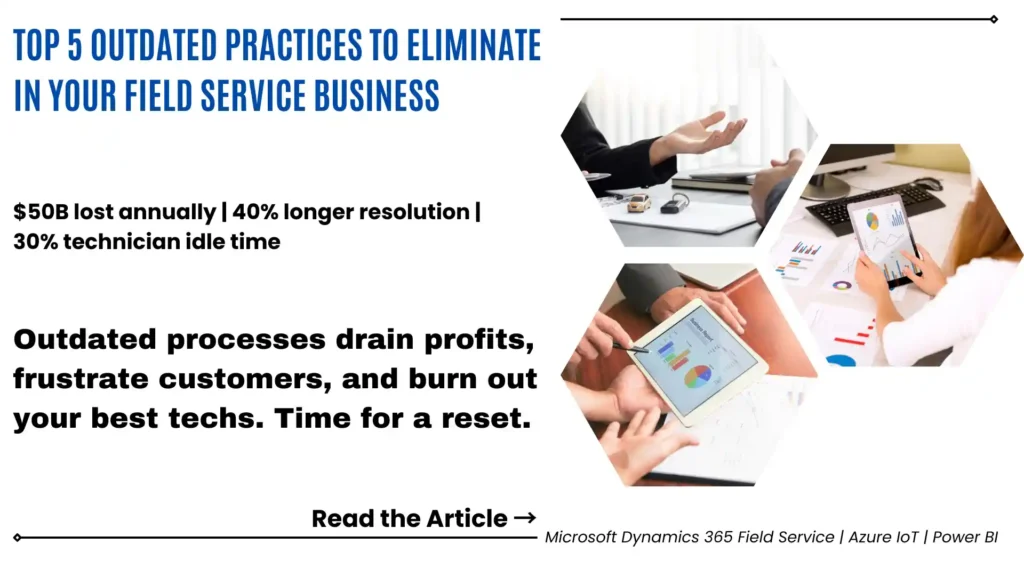
Field service management software replacing manual scheduling and paper-based workflows.

Top 5 outdated practices that should be eliminated in your Field Service Business

Be honest with yourself for a moment: is your field service operation running the way it should be in 2026 — or is it running the way it has always run? Because there is a significant difference. Field service businesses that have modernized their operations — replacing manual processes with intelligent automation, paper forms with mobile apps, and siloed systems with a single connected platform — are consistently outperforming those that have not. They are completing more jobs per technician per day. They are meeting more SLAs. They are receiving better customer reviews. And they are doing it with less administrative overhead, not more. The gap between a modern field service operation and an outdated one is not primarily about the technology. It is about the practices — the daily habits, workflows, and management approaches that have been in place for years, often unchallenged, because “that’s how we do things here.” Some of those practices need to go. This article covers the five outdated field service management practices that are most commonly holding service businesses back in 2025 — why each one is costing you more than you realize, and what replacing them actually looks like in a modern, well-run service operation. Why Your Field Service Business Cannot Afford to Stay Stuck in Old Habits The Cost of Outdated Field Service Practices in 2026 Here is the challenge with outdated field service practices: they rarely announce themselves as problems. They just quietly consume capacity, erode margins, and push customers toward competitors who have figured out a better way. Manual scheduling that takes a dispatcher an hour could be done by an intelligent system in seconds — and the system’s answer will be more optimized. Paper forms that a technician fills out at the end of a job represent data that could have been captured automatically throughout the day. Delayed service updates that leave dispatchers guessing about job status could be real-time with a mobile app already in most technicians’ pockets. None of these are edge cases. They are systemic inefficiencies — and in a field service business where technician time, vehicle costs, and SLA penalties are your primary operational variables, systematic inefficiency compounds fast. What Modern Field Service Operations Actually Look Like The best-run field service businesses in 2026 share common characteristics. Their dispatchers spend their time managing exceptions — not manually assigning every job. Their technicians arrive on site already knowing the customer’s history, the asset’s service record, and the most likely diagnosis. Their customers book appointments through whichever channel they prefer and receive automatic updates throughout the service day. And their management team has real-time visibility into every job, every technician, and every SLA commitment — without anyone having to compile a morning report. That is not a vision of the distant future. It is what the right field service management technology makes possible today. And the gap between that reality and a business still running on manual scheduling and paper forms is, quite simply, the competitive gap. The 5 Outdated Field Service Practices You Need to Leave Behind Practice 1: Manual Scheduling — The Bottleneck at the Heart of Your Operation Let us start with the one that affects everything else: manual scheduling. If your dispatchers are still assigning jobs by hand — looking at a whiteboard, a spreadsheet, or a basic calendar — they are making scheduling decisions without access to the full picture. They cannot simultaneously optimize for travel time, technician skill match, equipment availability, parts inventory, SLA priority, and real-time traffic conditions. Nobody can — not without software specifically designed to do exactly that. The result is a scheduling process that is slower than it needs to be, less optimized than it could be, and highly dependent on the knowledge and availability of one or two experienced dispatchers. When those people are sick, on holiday, or simply overwhelmed during a busy period, the quality of scheduling decisions deteriorates immediately. What a modern field service operation does instead: Intelligent automated scheduling software — like the Resource Scheduling Optimization (RSO) capability in Microsoft Dynamics 365 Field Service — continuously optimizes the entire schedule in real time. It assigns the right technician to every job based on their skills, location, and availability. It adjusts when jobs run over, when new urgent work comes in, or when traffic changes the optimal routing. And it does all of this automatically — freeing your dispatchers to focus on customer communication and exception management rather than manual job allocation. The business impact is immediate and measurable: more jobs completed per technician per day, lower travel costs, higher first-time fix rates, and SLA compliance rates that are built into the scheduling model rather than hoped for. Ask yourself honestly: how many hours per week does your team spend on manual scheduling — and how often does that scheduling fall apart when something unexpected happens? Practice 2: Paper-Based Forms — The Productivity Drain Nobody Talks About Research from Aberdeen Group and multiple field service industry surveys consistently finds the same thing: field technicians report that paperwork and administrative tasks are the most frustrating and unexpected part of their working day. Think about what that means. You are employing skilled engineers, mechanics, or technicians — people whose value to your business lies in their technical expertise — and you are having them spend significant portions of their working day filling out paper forms, completing job sheets by hand, and processing paperwork that will then need to be re-entered into a digital system by someone in the office. It is not just the time that is wasted. It is the errors. Paper forms get damaged, lost, or illegible. Information that should have been captured at the point of service gets reconstructed from memory hours later. Job data that should be in your system in real time sits in someone’s van overnight and gets entered the following morning — or not at all. What a modern field service operation does instead: Mobile digital forms —

Top 5 outdated practices that should be eliminated in your Field Service Business Read More »