Welcome to Trident Information Systems!
Write us to - info@tridentinfo.com
Let's Socialize

dynamics crm partner

Software for Retail Shop

Pop-up Stores: An Excellent Medium to Grow Customer Engagements

Big retail brands like French fashion Sézane are including pop-up stores in their strategies. They understand the need to physically connect with customers. With the help of Software for Retail Shop, they can easily get insights into their customers and create strategies to connect with them on a physical level. This is what Sézane did.   How did Sézane’s Pop-up Store Become a Hit?  They attracted a massive crowd in Los Angeles and asked them to check out their new launches in a pop-up store called Residence. The store displayed Sezen’s stylish collection, along with other French brands such as Bien Aimé perfumes, Ysé Paris swimsuits, and a children’s collection made in collaboration with Bobo Choses.   They also invited customers to special events like shirt embroidery and bag personalization workshops. The aim was to bring Paris’s retail store experience to the US market. For Sézane, it was a great opportunity to grab customers’ interest before establishing a permanent store.   Pop-ups for eCommerce Stores and Future Eco-conscious Shops  Pop-ups have also helped retailers to try out new locations. It is also benefiting online retail stores. With the help of Software for Retail Store, it gets easy for them to find the most suitable locations for their pop-ups. Many use the Best eCommerce Platform 2022: LS Central. Pop-up stores are a great medium for retailers with no physical store, to connect with customers physically and allow them to experience the touch and feel of the product.   Another interesting use of pop-up stores includes trying out new items and generating a buzz. In the UK, Selfridges pop-up retail gave customers a vision of what future eco-conscious shops may look like. It displayed 3D printing robots and real-time tailoring and introduced a new ownership concept  How to Use Pop-ups to Enhance Sales?  At times when customers expect great experiences in-store, but with pop-ups it’s much easier. Moreover, you can attract more customers to visit your physical or online store. We have designed a few strategies to enhance your retail business with pop-ups:   Boost Marketing and Brand Awareness   In the era of unlimited content and social media scrolling, how can you stand out in the market? Pop-up stores are a great way to grab customers’ attention and generate excitement. Since they are only for a short time, customers go out of their way to visit these pop-ups. In a survey conducted by Business Insider Intelligence, more than 50% of retailers admitted they could increase their market visibility by 46%. Software for Retail Shop like LS Central helps track customer interactions and use it for further promotions.  Finding New Partnerships   Some retailers prefer to work solo, however, some unlikely partnerships in the market could get a massive advantage from the alliance. One such example is Taco Bell and T-Mobile. They created a pop-up store to draw more customers. Those who visited T-MoBell could get their hands on surprising goodies, free drinks, and limited-edition T-Mobile giveaways.  This was just one example of a unique partnership. Such strategies allow one’s business to have a larger customer base and pull off campaigns that they would not be able to manage on their own. Software for Retail Shop also helped them organize these events. With customer insights, both partners could find a common area to set up the pop-up and offer interesting deals.   Offer Innovative Customer Experience Pop-up stores are designed to be experimental, which means you do not have to stay behind confined brick-and-mortar walls. For instance, IKEA tried augmented reality at its pop-up store and encouraged visitors to create their personalized space using touchscreens. They incorporated storage, lighting, and furniture of their choice. They were thrilled to see their dream space coming to life in front of their eyes.   Another innovative step was taken by adidas, who prompted sustainable shopping. They launched a one-day-only pop-up and encouraged alternative currency. They asked their visitors to buy a unique piece in exchange for their old clothes. They accepted clothes by their weight in exchange for a unique, one-of-a-kind, and upcycled piece.   Test New Locations Using Software for Retail Shop  Before committing to a location, you can try out different areas and see where the crowd shows the most interest. You can use Software for Retail Shop to track customer interactions and identify their interests. Also, you can use your previous interactions to find out customers from which area showed the most interest. This will help you shortlist the location you want to open your next pop-up store. A pop-up is a very cost-effective method to find and test an ideal location for your store. According to a report by Business Insider, 44% of respondents opened their pop-ups within $5,000.   Pop-up stores are catching pace among SMBs too due to their low-cost investment, temporary nature, and interaction with a wider range of customers without setting a permanent base. They are ideal to increase customer engagement. Retailers must use Software for Retail Shop to track and optimize those interactions.   LS Central is the best Retail ERP that offers CRM on the same platform. It has been rated as the Best eCommerce Platform 2022. If you are looking for a Retail ERP Implementation Partner, you can Contact Trident Information Systems, a Microsoft Dynamics 365 Gold Implementation Partner, and LS Central Diamond Partner.  

Pop-up Stores: An Excellent Medium to Grow Customer Engagements Read More »

Restaurant Management System

LS Central Helps Optimizing Your Restaurant Operations   

Are you running a flourishing restaurant where your current Restaurant Management System fails to support your growth? LS Central can help you in this case. It assists you in polishing your customer services with its robust features and tools. LS Central is a unified Hospitality ERP Software that helps you optimize your restaurant services by integrating your floor staff with the kitchen to bring what your customers ordered without delay. It provides a transparent view of your business with dashboards and real-time reports to help you create logical and data-driven decisions.   With actionable customer insights, you can create successful loyalty programs. Also, with real-time inventory reports, you will always have balanced stocks with minimum wastage. Predictive analysis will never let you go out of stock. And with automation, you will hand over monotonous tasks to the machine.   There are more features, tools, and benefits of LS Central than you can count. In this blog, we will explain how LS Central can get your restaurant at a rapid pace.   LS Central Restaurant Management System Works Wonders for Your Business   LS Central is one of the most renowned Restaurant Management Systems designed for SMBs and enterprises. It will help you:   Get Centralized Control Over your Restaurant Business  LS Central collects and stores data centrally and gives decision makers a centralized view over their business. You can access details on all your restaurant chains located in different locations from the headquarters. With real-time reports, you can decide menus, prices, and recipes according to their popularity in a certain location. Purchase mindfully while cutting wastage, look through your exhausted stocks and order the right amount. Also, you can order according to demand prediction and simply automate your replenishment. The best part of this Restaurant Management System is that it helps you manage your staff more efficiently. You can assign your staff duties that fit their talents.   No Errors with LS Central   Those restaurants that prefer to work on different software for different purposes, facing errors now and then are pretty common for them. Not to mention, the time and resources they lose on their maintenance are huge. However, this is not the case with LS Retail ERP, it is a unified Restaurant Management Software that helps manage your entire restaurant on the same platform. You can easily store and access data in one place. Easily accessible data leads to more accurate operations in less time.   Attract More Customer Loyalty and Grow your Business   LS Central Restaurant Management System stores customer data and presents it in actionable and insightful reports. Customer insights are the strongest tool to cater to your customers; when you understand your customers, their spending patterns, and preferences, you can create successful loyalty programs to attract more customers. Moreover, with a POS System, customers can place easy orders and pay easily at the table and can customize the menu. With the right knowledge, you can personalize discounts, promotions, and other offers for individuals or groups. It is essentially important if you aspire to deliver faster and more precise services.   Connect Your Kitchen Floor Staff with LS Central   With LS Central, you can link your staff to the kitchen by showing the status of each table’s orders and establishing delay-warnings. Staff members can correctly serve consumers thanks to this user-friendly graphical interface Restaurant Management System. Having a faultless atmosphere can help your management, even if your restaurant has the biggest floor. Keep track of your clients and reservations so you can handle them flawlessly and professionally. Furthermore, connecting the kitchen with staff also saves the bulk of their time. The server doesn’t have to travel from the front to the kitchen and find the right kitchen counter to transfer orders. Instead, they can simply take orders at the table and share the details with the KDS (Kitchen Display System) via Point of Sale Systems.   LS Central is one of the most renowned Restaurant Management Systems across the globe and has been serving SMBs and enterprises for a while. If you wish to implement it, you can contact Trident Information Systems, a Microsoft Dynamics 365 Gold Implementation Partner, and LS Central Diamond Partner. With a robust track of accomplishment, we have managed to acquire a massive team of technical resources, strong clientage, and various awards every year. Contact us for further information or a demonstration.  

LS Central Helps Optimizing Your Restaurant Operations    Read More »

AX to D365 Upgrade

It’s High Time to Upgrade Your AX 2012 to Microsoft Dynamics 365 Finance and Operations 

Today, almost all businesses leverage technology to surpass one another. When technology comes with exceptional benefits, it makes the competition harder. Hence, the one with the latest technology is most likely to win. As Microsoft mainstream support for 2012 ended in October 2021, businesses must Upgrade AX to D365. Nevertheless, this is not the only reason to upgrade.   In the era where the cloud rules, businesses running on on-premises technology will fall behind. In addition, Microsoft has stopped its AX 2012 upgrades, which means your services will become more and more irrelevant with time.   Some major drawbacks businesses already witness include:   Microsoft Dynamics AX is not a good choice for small-scale businesses. It majorly supports midsize to large-scale businesses.   Even Though this solution is very flexible and can be customized according to certain market needs, the dependency on ISV and partner channels can heavily cut your ROI.   You cannot get enough Cloud ERP and SaaS options if you run this software on-premises.  Upgrade AX to D365 to Get Exceptional Services   Given below are the top outstanding services you will get after D365 Migration:   Web-and-cloud Based Solutions   One of the major factors promoting AX to D365 Upgrade is its infrastructure. On one side, D365 AX is an on-premises version, which means the business will have to host it on a privately owned server. And on the other hand, Dynamics 365 for Finance and Operations is a cloud-based solution that runs by and on Microsoft Azure. The fact that cloud-based solutions are entitled to more advanced, agile, and flexible solutions makes the difference. Your business needs to become agile and flexible with suitable tools to thrive in this ever-changing market.  One of the greatest benefits of cloud-based solutions is that you do not have to manage the entire ecosystem yourself. Your service provider is responsible for all your upgrades and updates. AX to D365 Finance and Operations Upgrade will support your software on any browser and OS wherever you want.   Consistent Upgrades   Upgrade AX to D365 to get a consistent iterative list of upgrades. The best part is you can install or disable whatever feature you like. You can even pause three upgrades in a row with no fuss. Make your software feature-rich and powerful, and access only the tools you need. Not to mention, this will also save your IT team a bulk of their time.   Since the updates are automatic, your IT team doesn’t have to engage there. Assign them other development projects that count. AX to D365 Finance and Supply Chain Management Upgrade ensures you are on the most up-to-date technology.   Extensively Innovative Tools   If you Upgrade AX to D365 Finance and Operations, you can tap into a plethora of different tools and features designed for different industries. Microsoft is said to have 3700 vertical solutions crafted for different industries. Associated features include human resource management, manufacturing management, purchasing management, inventory management, sales management, quality management, and product technology.   Combining all these features on the same platform presents Microsoft Dynamics 365 for Finance and Operations: an ERP solution that supports every business type, size, and industry.   Intuitive Interface   One of the most noticeable differences between Dynamics AX and Dynamics F&O is their user interface. AX has a standard user interface that can only be used via desktops. Dynamics AX, however, has a friendly user interface and can be used via different browsers, and mobile devices which encourage remote work and support anywhere access.   Additionally, after the AX to Dynamics 365 Finance and Operations upgrade, the user can access workspaces where they can create custom queues and links to get them through day-to-day tasks.   On-demand Scalability   Upgrade AX to D365 and get scaling capabilities whenever and wherever you need them. In contrast to Dynamics AX where scalability was a big concern, Dynamics 365 Finance and Operations gives you the flexibility you need in a growing business. Furthermore, it is excellent to support your business in a rapidly changing environment.   You don’t even have to make a single upfront investment; you can pay in monthly subscriptions too. You can initially get the very minimum service package and increase resources as per need.   If you are looking forward to Upgrade AX to D365, you must get a suitable partner first. It is suggested to choose from a Microsoft Dynamics 365 Gold Implementation Partner. It’s perfect if they are old enough in the market, such as Trident Information Systems. We are a Microsoft Dynamics 365 Gold Implementation Partner and LS Central Diamond Implementation Partner. With a robust track of accomplishments, we have gathered impressive clientage and helped them thrive in the market. If you want to add yourself to the list, Contact Us.  

It’s High Time to Upgrade Your AX 2012 to Microsoft Dynamics 365 Finance and Operations  Read More »

How does a Vision Intelligence System Outraces Manual Defect Detection While Manufacturing? 

Quality and Productivity are the two key aspects of a manufacturing company. However, bringing them both into equilibrium has become a daunting challenge. Manufacturers desperately need a Vision Intelligence System to restore balance. A Vision Inspection System Manufacturers assist with meeting dynamic customer demands and keeping up with the quality requirements.   Manual Defect Detection in Manufacturing, on the other hand, is insufficient to deal with current market dynamics. It becomes next to impossible to get productivity and quality complementing each other. It is prone to setbacks such as:   The inefficiency of human eyes to detect minute defects.   Inability to identify differences in similar spectrums of colors.   Too much workforce is needed to detect defects manually.   A rather costly approach.   Crowded floor space may cause staff to bump into each other.   Delayed reporting can lead to defective pieces passing through the conveyor.  A Vision Intelligence System is capable of abolishing each of these hindrances and providing a seamless quality inspection. Trident Information Systems has designed a technology called Vision Intelligence System. It is specifically for manufacturers. It digitally detects defects of manufactured items right on the conveyor, demanding low or no human interference.   How Does Trident’s Visual Quality Inspection Work?  Trident’s Machine Vision Inspection is a solution that digitally does everything a human inspection does, but more efficiently.   Identifies Minute Defects  This Visual Defect Detection System catches even minute defects such as small dents, scratches, breaks, burrs, chips, and so on. Human eyes may get tired, and miss these faults sometimes, or due to lack of focus, the outcome could be similar. It is faster and more efficient than a human, hence delivering results with more accuracy.  Presence/ Absence of Components   It can also identify the absence or presence of a component while manufacturing. For Instance, during FMCG production, it can identify small animals, dust, stone, and any other component that is not supposed to be there. In addition, it can also detect missing items. E.g., it can easily identify missing bolts, nuts, screws, etc.   Color Monitoring  Human eyes can sometimes miss judging certain colors, but this Vision Intelligence System does not. It can precisely monitor colors and only lets those pieces pass which has an acceptable color range than what is standardized. Color monitoring ensures uniformity among items produced.   Dimension Quality   Vision Intelligence System also ensures a dimensional uniformity among all the items. In human inspection, the chances for faulty dimension quality are higher. A Visual Quality Inspection, however, precisely monitors the dimensional quality of a product. It checks if all the bottles are properly capped and sealed. It detects any thorns in the packaging too.   Printing Accuracy   Apart from color monitoring, it also identifies if printing is accurate, the colors match the standards, and the logo is professionally printed. It also inspects if the labels are mentioned within the assisted dimensions.  How Does it Work in the Favor of Your Business?  Trident’s Vision Quality Inspection, also known as Vision Intelligence System, outweighs common manual inspection challenges and provides a better, faster, smoother, and optimized defect detection.   Accurate and Faster Defect Detection   With machine handling your defect detection, you can expect a more accurate defect detection. Even little scratches, dents, burns, etc. which are generally missed by human eyes, this Machine Vision System catches them right away. In addition to being accurate, it is also faster than your traditional inspection. It quickly catches the defect and commands to discard it, hence leading only pieces to pass through.   Prompt Reporting   In inspection by man, reporting can be delayed, and surplus time is given for defective pieces to blend with the accurate items. A Machine Vision System flashes it on the associated monitor as soon as a defect is identified.  Boosted Productivity   Faster and more accurate detection with low to no human interference leads to boosted productivity. You will not have to hire new staff as you can use your current staff on other productive tasks which they would get the time for earlier. For instance, assigning packaging work to more staff if you do not have automatic packaging technology.   Empty Floor Space  No human interference leaves floor space empty. With plenty of free space, the chances of staff bumping into one another and getting into clashes diminish.   Trident’s Vision Intelligence System is crafted specifically for manufacturers. We serve glass, steel, laminate, FMCG, automotive, and pharmaceutical manufacturing industries. Contact us for further information. 

How does a Vision Intelligence System Outraces Manual Defect Detection While Manufacturing?  Read More »

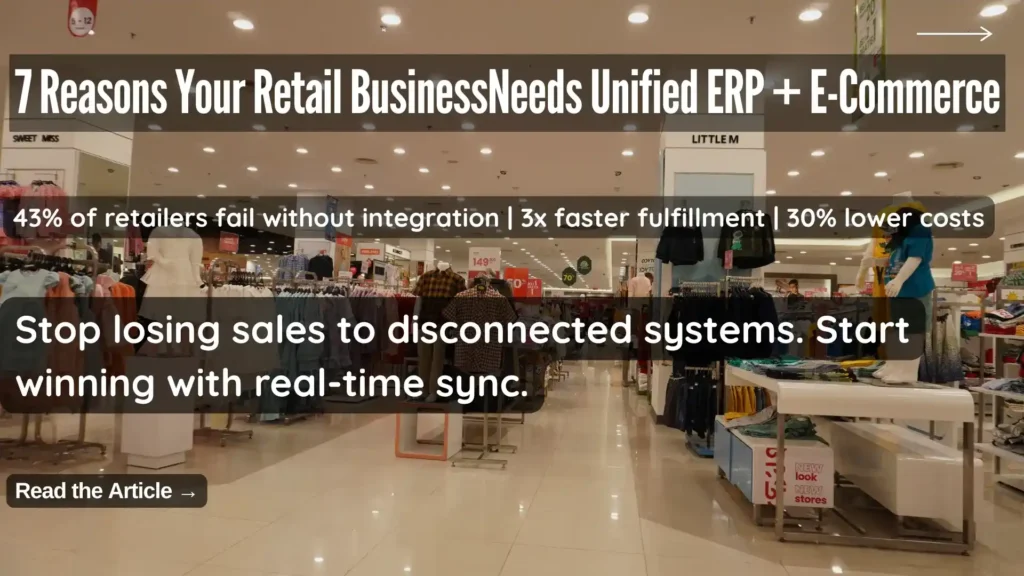
Retail ERP and e-commerce integration dashboard managing inventory, orders, and online sales.

7 Reasons Your Retail Business Needs a Unified ERP and E-Commerce Integration Solution

Here is a scenario that will feel familiar to most retail operators: a customer visits your website, sees a product marked as available, drives to your store to buy it, and finds out the shelf is empty. Your website still shows it in stock. Nobody knows why. Or this one: a loyal customer who buys from you in-store every week places their first online order — and receives a “welcome, new customer” email. No recognition of their purchase history. No loyalty points applied. No sense that the business they have been giving you for two years means anything in the digital channel. These are not technology failures. They are integration failures — and they happen every day in retail businesses running separate, loosely connected systems for their physical stores and online channels. The solution is retail ERP and e-commerce integration — specifically, a retail-oriented integration solution designed from the ground up for the way retail businesses actually operate, rather than a generic middleware tool that treats your retail operation like any other business. This article covers the seven concrete reasons why retail-specific ERP and e-commerce integration delivers outcomes that generic solutions simply cannot match — and what to look for when evaluating your options. Why Separate Retail Systems Are Now a Competitive Liability Brick-and-mortar retail is not dead — but purely physical retail without a connected online presence is becoming increasingly rare. Today’s retail customer moves fluidly between channels. They discover products on social media, research them on your website, check availability through your app, visit your store to see them in person, and expect to complete the purchase on whichever channel is most convenient at that moment. Research consistently shows that 81% of consumers use mobile devices as part of their shopping research — and the majority of purchasing journeys now involve at least two channels before a transaction is completed. For retail businesses, every additional sales channel represents a potential revenue stream. But it also represents a new source of operational complexity — unless every channel shares the same data, the same inventory, the same customer records, and the same pricing. When they do not, the experience falls apart. And in a market where customers have endless alternatives, an experience that falls apart drives them to a competitor without a second thought. The Real Cost of Running Disconnected ERP and E-Commerce The cost of disconnected retail systems is distributed across every channel, every function, and every customer interaction — making it easy to underestimate until you try to measure it: Why Generic Integration Tools Fall Short for Retail Many businesses attempt to solve the integration challenge with general-purpose middleware tools — platforms designed to connect any two applications regardless of industry. Generic integration tools can technically connect a retail ERP with an e-commerce platform. The problem is that retail has specific operational requirements — BOPIS fulfilment logic, zip-code-based inventory routing, loyalty program data synchronization, multi-currency retail pricing rules — that generic tools are not built to handle natively. The result is months of expensive custom development to configure a generic tool for retail-specific scenarios, followed by ongoing maintenance overhead every time either connected system updates. A retail-specific integration solution — or better, a unified retail platform — delivers all of this functionality out of the box. 7 Reasons to Choose a Retail-Specific ERP and E-Commerce Integration Reason 1: Consistent Products and Pricing Across Every Sales Channel The most fundamental requirement of a unified retail operation is consistency — every channel showing the same products, the same prices, and the same promotions at the same time. When your product catalog, pricing structure, and promotional mechanics live in your ERP and distribute automatically to every connected channel, consistency is structural — it happens automatically rather than requiring manual synchronization. A retail-specific integration solution enables: For retailers managing hundreds or thousands of SKUs across multiple channels, centralized product management is not just a convenience — it is a necessity. Reason 2: True Omnichannel Fulfilment — Buy Anywhere, Deliver Anywhere The modern retail customer expects to complete their shopping journey on their own terms — and that means the fulfilment model needs to be as flexible as they are. Buy Online, Pick Up In-Store (BOPIS) is now a baseline expectation for omnichannel retailers — customers order online and collect from their preferred store, combining the convenience of online shopping with the immediacy of in-store collection. But executing BOPIS reliably requires real-time integration between your e-commerce platform, your ERP, and your in-store systems. A retail-specific integration solution enables the full range of omnichannel fulfilment scenarios: Each of these scenarios requires real-time data sharing between the e-commerce platform, the ERP, and store-level inventory — which only a retail-specific integration solution delivers reliably. Reason 3: Real-Time Inventory Visibility Across Every Location Inventory accuracy is the operational foundation on which everything else in omnichannel retail depends. Without accurate, real-time inventory data across every location, BOPIS fails, online availability is unreliable, and customer trust erodes. A retail-specific integration solution delivers inventory visibility that generic tools cannot: The business impact of real-time inventory accuracy extends beyond customer experience. Buyers make better purchasing decisions. Markdowns are more targeted. Overstock and out-of-stock situations are identified earlier and resolved faster. Reason 4: Unified Customer Data Across Digital and Physical Channels A customer who has shopped with you for five years should feel known — regardless of which channel they use. Their purchase history, preferences, loyalty status, and contact information should follow them seamlessly across every interaction with your brand. This only happens when your ERP and every connected channel share a single customer database — updated in real time by every transaction, regardless of where it occurs. A retail-specific integration solution delivers: Reason 5: A Single Loyalty Program That Works Everywhere Loyalty programs are one of the most powerful customer retention tools available to retailers — but only when they work seamlessly across every channel a customer uses. A loyalty program that earns points in-store but cannot redeem them online,

7 Reasons Your Retail Business Needs a Unified ERP and E-Commerce Integration Solution Read More »

Turn prospects into engaged customers with intelligent sales and marketing

[vc_row][vc_column][vc_column_text] The selling landscape is undergoing fundamental changes, many of them driven by the effects of B2B customers’ experience as everyday consumers. Many retailers have created personalized, nearly immersive, online experiences for each customer. Consumers shopping for goods and services continually experience fresh and delightful interactions, from highly customized offers and recommendations to frictionless channels to 24/7 interactions. Using Microsoft Dynamics 365 for Marketing and Microsoft Dynamics 365 for Sales organisations are improving  their profit margins. The impact of B2C on B2B Today’s B2B buyers have high expectations, and those expectations will not be met if B2B buyers are accustomed to sophisticated consumer interactions in their personal lives. Executive B2B buyers are not impressed by marketing driven by large, relatively impersonal data analysis that leads to inconsistent and conflicting interactions or sales outreach that doesn’t cater specifically to their needs at the right time. The source of the problem may be largely invisible to the companies perpetuating this issue. Many organizations believe themselves to be customer-centric, while their buyers may not agree. That’s a significant disconnect. Clearly, B2B has much to learn from B2C companies. Customer experience – the rewards for getting it right Many B2C organizations have strategically embraced modern technologies like customer data platforms (CDP) and artificial intelligence (AI) to gain a 360-degree view of their customers and follow through on those insights to optimize customer engagement. The rewards for getting this engagement right are substantial. Many buyers are willing to pay more for a better customer experience. In terms of the potential benefits a great experience can have on sales success, a McKinsey study reported that organizations can expect: 10-15 percent lower customer churn 20-40 percent increase in the win rate of offers Up to 50 percent lower service costs Take a new approach B2B companies must move away from their legacy approaches based on large, relatively impersonal data analysis and move to solutions that unify relationship data across the full customer lifecycle. That way, they can gain insights that help build credibility and trust with buyers. They can run multi-channel campaigns to increase sales-ready leads, create personal experiences, and use guided process and AI to anticipate and respond faster to customer needs. They can build the ongoing, high-quality relationships that are necessary for long-term success. Four principal goals Turning prospects into engaged customers is a process. In order to achieve these goals, organizations must focus on 4 key priorities: Nurture more demand Personalize buyer experiences Build relationships at scale Make insight-driven decisions Each of these drives results by using deep reservoirs of data in making technology feel more human. Nurture more demand Relying only on conventional, basic email marketing as the primary source of leads is simply not effective enough. In fact, the more focused and demanding the customer universe is, the more essential it is to gain deep insights into what those customers expect. Northrop & Johnson,  a leading global yacht brokerage, competes for multi-million dollar customers using technology its industry has been slow to adopt. Using Microsoft Dynamics 365 for Marketing has created a decided competitive advantage: Vital insights into their customer base have helped to drive a 70 percent increase in charter sales. In any industry, companies need to generate leads across multiple channels, nurture large numbers of leads while prioritizing each one, and use data-driven insights to deliver leads that are sales-ready. Nurturing more demand is critical to growth. Personalize buyer experiences It’s time to end friction, inconsistencies, and the “do you know who I am?” part of the customer experience. Companies can acquire a holistic view of buyers, predict buyer intent, and orchestrate a connected, personalized journey for customers. In an era where guests have more choices than ever for leisure and entertainment, Tivoli delights its guests by using Dynamics 365 Customer Insights to stay one step ahead of expectations and transform the guest experience. With its deeper understanding of guests, it can add new chapters to its long tradition of imagination and innovation. Build relationships at scale Mutually beneficial relationships don’t simply happen with more data. Companies need to build credibility to establish and grow relationships with customers. Together, Dynamics 365 and LinkedIn enable the company to have increased information about, and impact on the sales relationships that are added to its sales pipeline, even as that pipeline experiences exponential growth month over month. Make insight-driven decisions Here’s where sales and marketing can truly align: utilizing data to uncover insights that lead to better-informed decisions throughout the sales process. This can improve performance, empower employees, and enable the company to gain increasingly effective strategic insights. With more than 1,500 pubs serving guests throughout the UK, Marston’s launched a business transition by bringing together guest data that was scattered across multiple systems into Dynamics 365. With their locations’ guest data now unified, Marston’s will gain a complete view of guests, which can be harnessed to generate customer satisfaction and strategic insights. This approach helps drive improved performance throughout the company, including the opportunity to empower employees – an often-overlooked aspect of a company’s success. Aligning sales and marketing: The intelligent way to succeed It’s possible to create exceptional experiences, drive more qualified leads, and increase revenue if an organization has the vision, process, and technology to harness all the data available. This requires high-level technology with well-defined business goals and sales and marketing applications fueled by keen intelligence. We have a compelling offering to accomplish just that with Microsoft Dynamics 365. Get in touch with our representative to request a demo for Microsoft Dynamics 365 for Sales & Microsoft Dynamics 365 for Marketing Blog Reference : https://cloudblogs.microsoft.com/dynamics365/bdm/2019/09/19/turn-prospects-into-engaged-customers-with-intelligent-sales-and-marketing/[/vc_column_text][/vc_column][/vc_row]

Turn prospects into engaged customers with intelligent sales and marketing Read More »

Slash costs in your restaurant with the right software system

[vc_row][vc_column][vc_column_text]How do you manage costs in your restaurant business? Are you operating as efficiently as you could be? We know how difficult it can be to maintain optimal efficiency and make money in a time of razor-thin margins and intense competition. By their very nature, restaurants are characterized by predictable, seasonal factors as well as by unpredictable ones, including changing customer preferences and fluctuating running costs. But there are ways to get a better handle of your business, helping you to plan ahead more effectively, become leaner and reduce costs in the process. For many restaurant owners, the answer lies in choosing a modern unified technology platform that provides a complete overview of your business operations from Point of Sale (POS) to back office. Indeed, research by the National Restaurant Association in the US found that over 80% of restaurants are turning to technology like online ordering and reservations and restaurant analytics to help them run their business successfully and efficiently. The same report found that four in five restaurant operators agreed that: Technology helps increase sales Technology makes their restaurant more productive Technology provides a competitive advantage. If you’re in two minds as to whether a restaurant management system could help your business grow, rather than simply cost you money, here are some specific areas in your business where the right technology can make a real difference: Optimize staff management If your staff schedules are currently handled manually, in spreadsheets or even on paper forms, you could be missing out on a trick. Staff management software has the capabilities you need to ensure rosters correspond with table bookings and helps you plan for the right amount of labor you need. The result is optimized schedules, which means you don’t have too many employees at work during quiet periods, and yet you have enough on hand to see you through the busy times. If you select a unified system for your restaurant, the staff management functionality can be part of the same platform used to manage the rest of your business. This allows you to make truly informed decisions using historic sales data and drilling down by location, day of the week and time to see patterns emerging and better determine when you will be busy or quiet. Another factor to consider is how you can use the software to keep track of your budgets and make sure you’re not paying out more than you should be. We know how difficult it can be to check and confirm the hours worked by each of your employees, especially when you are likely dealing with so many. But a staff management system can automate this for you, confirming actual hours worked are the same as those planned and highlighting any discrepancies for you to follow up on, minimizing errors and costs. With the functionality to analyze how much you are spending by employee, work code, shift and role, you can compare actual costs and performance against your business plan, and minimize unnecessary extra expenses, such as overtime. Simplify staff training In this industry, we know that workers tend to be transient – maybe you have lots of students or temporary workers on your payroll. High staff turnover can be a real pain point and loss maker for your business, especially as recruiting and training staff is both time consuming and costly. But there are ways technology can help you control this better, and reduce the costs and pain of getting new staff on board. If the systems you use are intuitive and easy for all employees to understand, you won’t have to spend as long training them on how to use them in the first place. Some retail management systems allow you to set up your POS so it mirrors your menu, making it far simpler for staff to find their way around while also helping to reduce mistakes. To simplify training even further, it could pay off to choose a system that uses a logic your staff is already familiar with. The LS Retail restaurant solutions, LS First and LS Central, are built on well-known Microsoft technology. This means new employees can be up and running quickly, as any experience with Microsoft software such as Office or Windows means they already know where to find menus and information in the system. Having one enterprise-wide platform, rather than multiple software solutions strung together, also means you only need to train your staff up once. This not only saves time and cost but gives you greater flexibility too. If you need to move staff from the bar to the restaurant floor, you can do so with ease. No extra training required to use a separate system; no time wasted. Increase table turnover and order value Is your restaurant floor running as smoothly as it could? There are some steps you can put in place to subtly speed up the process, allowing you to serve more customers without making your diners feel rushed. Mobile POS devices are a great way of doing this. As they connect your servers directly to the kitchen, kitchen staff can act on orders as soon as they are taken at the table, speeding up food preparation. Your waiters can get an alert on their POS devices when orders are ready, and they can also take payments on the device as soon as diners are ready to leave – no waiting for card readers or an available cash register. If you select the right mobile POS, your staff can also handle conversational ordering, where they take orders in the same way that customers reel them off – extra cheese on their burger and no mayo, with large chips, for example. Everything can be quickly inputted into the POS, speeding up service time and reducing errors. At the same time, because staff have all menu information right in front of them, they can improve their upselling potential by suggesting upsell items and upgrades as they take orders. Streamline kitchen operations A unified platform complete with a kitchen management system could help your restaurant serve up food more quickly and efficiently than ever. In the kitchen, having Kitchen Display System (KDS) screens connected to the

Slash costs in your restaurant with the right software system Read More »

How Trident’s Cloud Platform Can Manage Your Restaurant Effortlessly in 2026

Food costs are volatile, labor is expensive, and customer expectations keep rising — yet your margins stay razor-thin. Trident’s cloud restaurant management software, built on Microsoft Dynamics 365, gives you real-time inventory, AI-powered demand forecasting, and unified POS across dine-in, delivery, and takeaway — so you stop firefighting and start running profitably. Running a restaurant in 2026 is harder than ever — and easier than ever. It all depends on the technology you choose. Food costs are volatile. Labour is expensive and hard to retain. Customer expectations are higher. Delivery platforms, dine-in, takeaway, and QR ordering all need to work together seamlessly. And through it all, your margins remain razor-thin. The restaurants thriving in 2026 aren’t necessarily the ones with the best chefs or the biggest marketing budgets. They’re the ones running smarter back-of-house operations — powered by cloud-based restaurant management software. Trident Information Systems’ cloud-based restaurant management platform, built on Microsoft Dynamics 365, is designed specifically to solve this challenge. Here’s how it transforms the way restaurants operate — and why more restaurateurs are making the switch right now. The Restaurant Technology Reality in 2026 The numbers tell a clear story. <cite index=”18-1″>AI-driven forecasting tools have been adopted by 47% of large restaurant groups to improve demand planning accuracy and optimize staff scheduling efficiency.</cite> <cite index=”20-1″>81% of restaurant operators plan to expand AI usage in reservations and orders.</cite> And <cite index=”23-1″>cloud-based POS adoption has crossed a tipping point — legacy on-premise systems are increasingly becoming operational liabilities rather than assets.</cite> In short: the industry has moved. If your restaurant is still running on disconnected, on-premise systems, you’re not just behind — you’re losing money every day. What Trident’s Cloud Restaurant Management Platform Covers Trident’s solution is built to manage every facet of restaurant operations from a single, unified platform: All of it connected. All of it in the cloud. All of it accessible from anywhere. 7 Reasons Restaurants Are Moving to Trident’s Cloud Platform 1. Access Your Business From Anywhere Whether you’re on the restaurant floor, at home, or travelling between locations — Trident’s cloud platform gives you full visibility into your operations from any device with a browser or mobile app. No VPNs. No private networks. No dependency on being physically present. For multi-location operators especially, this is a game-changer. <cite index=”23-1″>Cloud POS platforms enable real-time access to sales, inventory, and performance data across locations, devices, and channels.</cite> Your numbers are always live, always accurate, always at your fingertips. 2. No Heavy Upfront Investment or Long Contracts Traditional on-premise restaurant systems require significant capital expenditure, long vendor contracts, dedicated hardware, and expensive IT maintenance. For a new or growing restaurant, that’s a risky bet. Trident’s cloud platform operates on a SaaS subscription model — meaning lower monthly costs, no surprise IT bills, and a clear ROI from day one. <cite index=”19-1″>The adoption of subscription-based software models is accelerating, allowing for continuous updates to features like digital menu management and marketing automation tools.</cite> You always have the latest version, the latest features, and the latest security — without paying extra for upgrades. 3. Flexible Payments That Suit Your Cash Flow Cash flow is one of the biggest challenges in the restaurant business. Trident’s SaaS model offers flexible payment terms — monthly or annual — so you’re not locked into arrangements that don’t suit your business cycle. More importantly, <cite index=”25-1″>POS systems, self-service kiosks, and chatbots are already reshaping the way the restaurant industry works</cite> — and Trident’s platform supports all modern payment methods, including UPI, digital wallets, contactless payments, and split billing, keeping your checkout experience fast and frictionless. 4. Scale Instantly as Your Business Grows Opening a new outlet? Adding a cloud kitchen? Launching a delivery-only brand? With Trident’s cloud platform, scaling is as simple as activating a new location within your existing subscription. No technician visits. No server installations. No lengthy implementation cycles. <cite index=”18-1″>Omnichannel order management adoption has reached 54% across the industry — platforms that can’t unify these channels leave money and data on the table.</cite> Trident ensures every new location is connected to your central system from day one, feeding the same live data across your entire operation. 5. Seamless POS and Third-Party Integration <cite index=”23-1″>POS systems have evolved into intelligent operating platforms. Cloud infrastructure, AI-driven analytics, advanced hardware, diversified payments, and automation are converging faster than many business owners realize.</cite> Trident’s platform integrates natively with your POS system and connects effortlessly with third-party delivery platforms, accounting software, CRM tools, and kitchen display systems via APIs. Every order — whether from dine-in, Zomato, Swiggy, or your own website — flows into one system, one set of reports, one source of truth. 6. Enterprise-Grade Security Without the Enterprise IT Team Storing your restaurant data on a local server is a serious risk. A hardware failure, a flood, a fire, or even a simple power surge can wipe out months of transaction data, customer records, and financial history. Trident’s cloud platform stores your data securely on Microsoft Azure — with built-in encryption, two-factor authentication, automatic backups, and disaster recovery built in. <cite index=”18-1″>AI-based analytics adoption has reached 49% and is accelerating as platforms embed machine learning directly into menu optimization, demand forecasting, and waste reduction workflows</cite> — all secured within the same enterprise-grade cloud environment. Your data is always safe. Always backed up. Always recoverable. 7. AI-Powered Insights That Drive Real Profitability This is where 2026 changes everything for restaurant operators. <cite index=”20-1″>Early adopters of AI report a 41% average ROI</cite> — and it’s not hard to see why. Trident’s platform, integrated with Microsoft’s AI and Power BI capabilities, gives restaurant managers and owners: <cite index=”24-1″>A casual dining restaurant can use AI-driven forecasting to prepare the right amount of ingredients for weekends, reducing spoilage while ensuring popular menu items never run out.</cite> These aren’t futuristic capabilities — they’re available today, built into Trident’s platform. Why Trident Is the Right Cloud Partner for Your Restaurant Trident Information Systems isn’t just a software provider — it’s a

How Trident’s Cloud Platform Can Manage Your Restaurant Effortlessly in 2026 Read More »

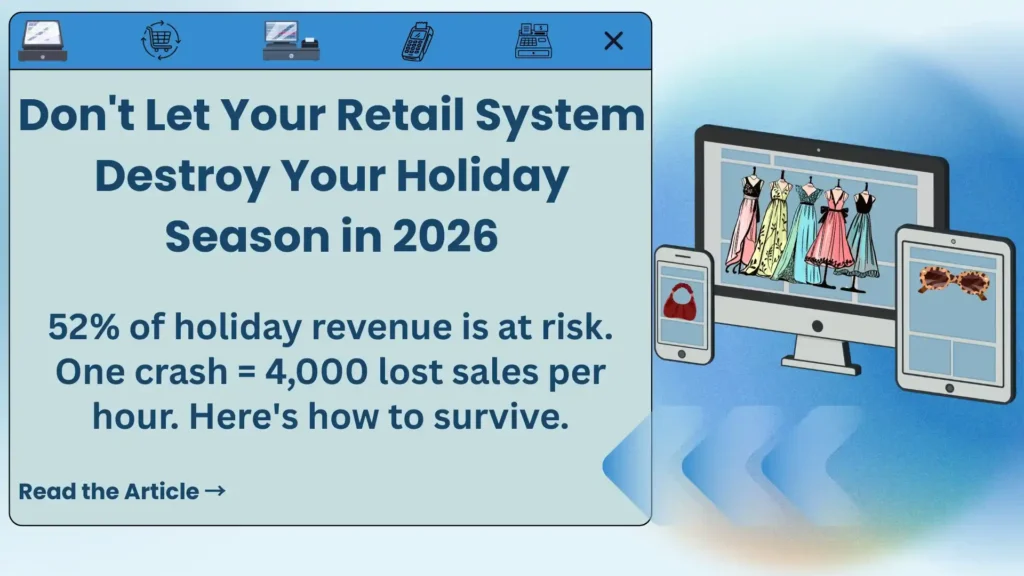
Busy retail store during holiday shopping season using modern retail software to manage sales and inventory.

Don’t Let Your Retail System Destroy Your Holiday Season in 2026

The holiday season can make or break your retail year — but if your systems are outdated, it will break you instead. LS Retail, built on Microsoft Dynamics 365, gives you the unified, cloud-native foundation to handle Black Friday surges, real-time inventory, and omnichannel chaos without missing a single sale. The holiday season is the most profitable time of the year for retailers — and the most dangerous. Black Friday, Cyber Monday, Christmas, and New Year together pack months of normal trading volume into just a few weeks. Your systems either handle it or they don’t. And in 2026, the cost of “they don’t” has never been higher. A recent New Relic report found that the median hourly cost of a critical retail outage is $1 million. Nearly one in three retailers experience critical outages every single week — not just during peak season. Add to that the fact that global e-commerce sales are projected to hit $8.1 trillion in 2026, and the stakes become very clear. The good news? Every problem below has a known solution. Here’s what to watch for — and how to fix it before the rush hits. Issue #1: Your Technology Buckles Under Peak Season Volume The Cause Legacy retail systems were built for a different era. They were never designed to handle today’s transaction volumes across physical stores, e-commerce, mobile apps, and social commerce — all simultaneously. When Black Friday traffic spikes 10x overnight, disconnected systems that limp along the rest of the year simply fall over. The New Relic report found that retailers take a median of 30 minutes to even detect an outage — and another 42 minutes to resolve it. During peak trading, that’s catastrophic. In 2026, the problem has a new dimension too. Many retailers racing to adopt AI-assisted tools have introduced new failure risks. Even Amazon suffered high-profile outages in early 2026 linked to AI-generated code changes — resulting in millions of lost orders and a 90-day code safety reset across 335 critical retail systems. Scale doesn’t guarantee safety. The Solution The answer isn’t more patches on aging systems — it’s replacing them. Unified commerce removes silos and enables real-time coordination across stores, warehouses, and digital channels, providing a single source of truth that improves accuracy, speed, and customer satisfaction. A modern unified retail platform like LS Retail, built on Microsoft Dynamics 365, is cloud-native, scalable, and built to absorb holiday volume spikes without breaking a sweat. One platform. One codebase. No Frankenstein patchwork. Issue #2: Something Breaks and You Can’t Find — or Fix — It Fast The Cause When your retail stack is made up of five or six disconnected tools, a failure in one doesn’t just hurt that tool — it silently corrupts everything connected to it. Stock figures go wrong. Transactions don’t post. Customer accounts stop updating. And your team spends hours figuring out which part of the chain snapped. This is exactly what happened to Gallo Clothing one Christmas Eve — its busiest day of the year. Cash registers stopped mid-trade. With no way to quickly identify where the disconnect happened, staff were forced to process every transaction manually. Queues grew, customers left, and some never came back. In 2026, this scenario is more likely, not less. 60% of retail engineers spend at least a fifth of their time managing outages — and 14% said engineers spend half their time or more on incident response. That’s an enormous drain on resources that should be serving customers. The Solution Gallo Clothing implemented LS Retail‘s unified commerce platform and hasn’t experienced a system failure since. Their president said it plainly: “We’ve seen more customers, sold more products, and had much shorter lines.” Modern unified systems give you full visibility across every component in real time. When something flags, you know immediately — where it is, what’s affected, and what to do. Resolution time drops from hours to minutes. Issue #3: You Run Out of Stock and Lose Sales to Competitors The Cause Out-of-stock situations are one of the biggest revenue drains in retail. Research by IHL Group found that retailers globally lose nearly $1 trillion annually due to out-of-stock items — with almost a third of shoppers immediately turning to a competitor when they can’t find what they need. In 2026, the bar for inventory accuracy has risen sharply. Customers expect accurate availability and delivery commitments — unified commerce is becoming a requirement, not a roadmap slide. Shoppers check stock online before visiting a store. If your website shows “in stock” but the shelf is empty, you don’t just lose a sale — you lose trust. The root cause is always the same: no real-time inventory visibility, unreliable data, and demand forecasting that relies on weekly reports rather than live signals. The Solution Retailers leveraging AI for inventory management report 95% accuracy in demand forecasting, a 40% drop in inventory carrying costs, and 60% fewer stockouts. A unified retail platform gives you live inventory visibility across every store, warehouse, and channel simultaneously. When one location runs low, you see it instantly and can act — whether that’s triggering a warehouse replenishment, transferring stock between stores, or updating your online availability in real time. Luxury retailer Club 21|Armani Exchange experienced this firsthand after implementing LS Retail. On the first Black Friday post-implementation, their team spotted a surge at one store at 10pm, called the warehouse, arranged an emergency delivery, and tripled sales at that location over the weekend — something simply impossible without real-time visibility. Issue #4: Returns and Omnichannel Journeys Are a Mess The Cause Most retailers in 2026 claim to be omnichannel. Very few actually are. True omnichannel means a customer can browse online, buy on mobile, pick up in-store, and return via any channel — with every interaction reflected instantly across your entire system. What most retailers actually have is multiple channels operating as separate businesses with occasional, unreliable data syncs between them. Over 55% of Gen Z’s total holiday spend now occurs

Don’t Let Your Retail System Destroy Your Holiday Season in 2026 Read More »

Modern restaurant POS system managing orders, billing, and kitchen operations efficiently.

How a Modern Restaurant POS System Boosts Productivity by Up to 40%

Nearly a quarter of restaurant owners who have not updated their POS system in the past year plan to do so in the next twelve months. If you are one of them, the question is not whether to upgrade — it is how to choose the right system and make the most of the investment. Your POS is the operational heartbeat of your restaurant. Every order, every payment, every table movement flows through it. When it works well, your team works well. When it is clunky, slow, or poorly configured, the entire service suffers — and often, you do not even realise how much productivity you are losing until you switch to something better. Research consistently shows that the right POS configuration can improve restaurant floor productivity by at least 20 to 40 percent. Here are four features that make that possible. Why Restaurants Stay Stuck on Outdated POS Systems It is easy to understand why so many restaurants keep running on ageing systems. Replacing a POS means disrupting the operation, retraining the team, and making a significant financial commitment — without always knowing what the return will be. It feels risky. So the outdated system stays, and the inefficiencies it creates become invisible because they are simply how things are done. But the hidden cost of an outdated POS compounds over time. Slower service leads to fewer table turns. Order errors frustrate customers and damage reviews. Manual processes consume staff time that should be spent on hospitality. And the data that a modern POS would generate — on sales patterns, peak times, menu performance — simply does not exist. The right modern POS does not just replace your old one. It fundamentally changes how your team works. 4 POS Features That Transform Restaurant Productivity 1. A POS That Mirrors Your Menu The biggest single productivity gain from a POS upgrade comes from one simple change: configuring the system to match how your team actually takes orders — not how the software developer imagined they would. When menu items, modifiers, and customisation options are arranged in the POS exactly as they appear on the menu — in the same order, using the same language — your staff can take orders conversationally without hunting through menus or navigating confusing interfaces. No mayo and extra sauce? Your team handles it in seconds. Dietary modifications? Captured instantly without slowing the order flow. One large restaurant chain we worked with saw floor efficiency improve by 40% after configuring their POS to mirror the menu. Staff moved faster, orders were more accurate, customers received better service, and table turns increased — all from a configuration change, not a workflow overhaul. The lesson: a well-configured POS is as important as the technology itself. 2. Colour-Coded Menu Sections Speed on the restaurant floor depends on how quickly staff can find what they need without thinking. Colour coding is a simple, powerful tool that makes this effortless. Assign a distinct colour to each menu category — starters, mains, desserts, beverages. Then break those categories down further with colour-coded sub-sections within each course. Staff can navigate the entire menu at a glance rather than reading through text-heavy lists. For accessibility, colour schemes can be configured in high-contrast or grayscale modes for team members with visual impairments — ensuring everyone benefits equally. The result is a POS that staff can navigate confidently from their first shift — reducing training time, reducing errors, and freeing attention for what actually matters: the customer experience. 3. Flexible Seating and Split Payment Modern restaurant service is rarely straightforward. Guests move tables. Groups merge. Bills get split in complex ways. Each of these situations, handled poorly, creates friction for staff and frustration for customers. A modern POS handles all of it smoothly. When a group arrives with an advance booking, staff can pull up their reservation instantly — including dietary requirements and allergy notes — and seat them within seconds. If they want to join colleagues at another table, the POS table management feature moves diners and updates the kitchen queue in real time without confusion. When it is time to pay, split billing is handled intuitively — dividing the bill by item, by person, or any combination — with automatic gratuity calculation and tax handling built in. No manual arithmetic. No errors. No awkward moments at the end of the meal. This flexibility does not just improve the customer experience. It significantly reduces the time staff spend on administrative tasks at the end of each table’s visit — freeing them for the next guests. 4. A Centralised System for the Whole Operation Individual POS terminals are useful. A centralised POS system that connects every terminal — and every department — is transformative. When all POS terminals draw from and contribute to the same central data source, the benefits multiply across the entire operation: When your entire team works from a single source of truth, communication improves, errors decrease, and management decisions are based on real data rather than approximation. The Real Cost of Staying on an Outdated POS Before evaluating what a new POS would cost, consider what your current system is costing you. Every order that takes an extra thirty seconds to enter. Every split bill that requires a manager’s intervention. Every table that turns slower than it should because the system cannot keep pace with the service. Every week that passes without useful sales data to inform menu and staffing decisions. These are real costs — distributed across every service, every shift, every week. Aggregated over a year, they significantly outweigh the investment in a modern system. Microsoft Dynamics 365 for Restaurant Management Microsoft Dynamics 365 — combined with LS Central for Restaurants — delivers all four capabilities above within a single, unified restaurant management platform. From POS configuration and table management through kitchen display integration, inventory tracking, and real-time analytics — it connects every aspect of your restaurant operation on one intelligent platform that scales from a single outlet to

How a Modern Restaurant POS System Boosts Productivity by Up to 40% Read More »