Top eight trends every COO should know about the future of manufacturing
Top eight trends every COO should know about the future of manufacturing Read More »

Transform business process automation and people productivity with Microsoft Dynamics 365 and the Microsoft Cloud
Reimagine productivity with Microsoft Dynamics 365 Read More »
The focus of every industrial revolution has been increasing the productivity of production systems. The fourth industrial revolution is here, and it’s seeking to improve both production and management systems. Digital transformation driven by smart manufacturing (also known as Industry 4.0) is the basis of this latest one – creating opportunities to achieve levels of productivity and specialization not previously possible. Combining data generated through the Industrial Internet of Things (IIoT) and analytics creates a new set of capabilities known as predictive maintenance and quality. Fueled by smart manufacturing, these new capabilities are changing the way we do and see business, helping recognizing patterns and predicting failures or product quality issues before they happen. Introducing the new industrial IoT platform Most factories are composed of operation technology (OT) assets such as machines, equipment lines and robotic devices that aren’t always connected. The current trend is leaning toward smart manufacturing with a more IT-based factory floor to help save time, labor, cost and maintenance and upkeep. With OT and IT converging, the IIoT platform is emerging as a new, innovative concept for smart manufacturing with artificial intelligence (AI)-based technologies, including analytics, big data and cognitive manufacturing. Smart manufacturing can spur a new surge of manufacturing productivity. Targeting the pain points for key manufacturing personnel In order to understand the impact of Industry 4.0 solutions, we must examine the key people involved in all aspects of a factory. True transformation happens when all unique challenges and each pain point is targeted. Transforming your factory with a three-tiered architecture solution from IBM Keeping the needs of different types of workers in mind and using our extensive manufacturing experience, IBM developed a three-tiered distributed architecture to implement smart manufacturing more efficiently. The model addresses the autonomy and self-sufficiency requirements of each production site and balances the workload between the three tiers. Mapping IBM’s three-tiered architecture. Edge level. The most physical part of the factory where product-related activities are performed. Plant or factory level. Where plant and local activities are orchestrated and connected. Enterprise level. Where analysis of all levels of information happens, and information storage for visualization and analytics is provided. Leveraging the three architecture tiers to drive performance IBM offers a suite of enterprise asset management (EAM) solutions to help drive cost savings and operational efficiency across the factory value chain. The portfolio of EAM solutions from IBM analyzes a variety of information from workflows, context and the environment to drive quality and enhance operations and decision making. The portfolio of EAM solutions from IBM helps deliver a smart manufacturing transformation. Production quality insights use IoT and cognitive capabilities to sense, communicate and self- diagnose issues to optimize each factory’s performance and reduce unnecessary downtime. Insights help reduce unplanned downtime.
How smart manufacturing can optimize your factories for the new era Read More »
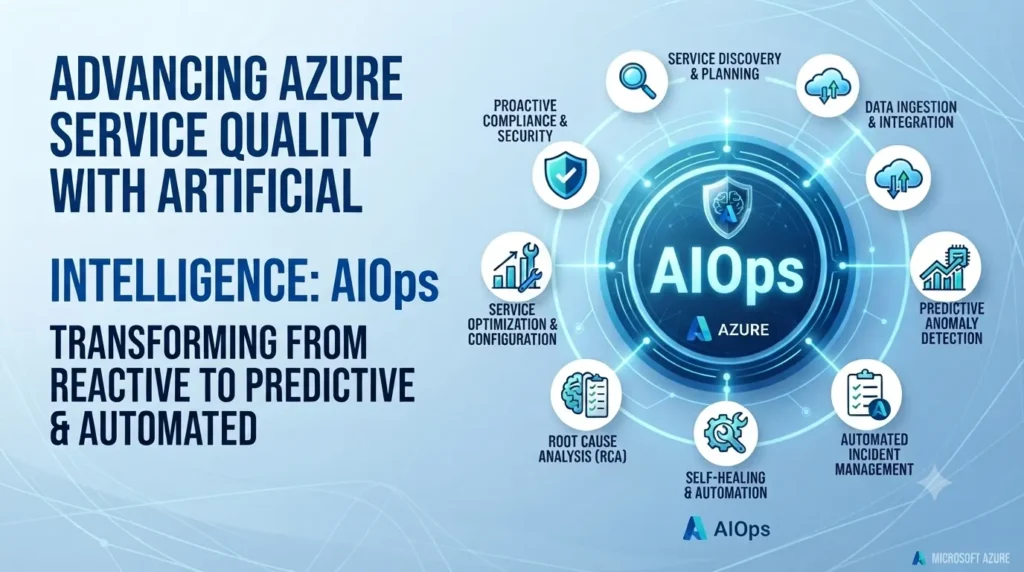
INTRO Somewhere on Azure’s infrastructure, a disk was predicted to fail — and your workload was migrated off it before that failure ever happened. That’s not a hypothetical. It’s Azure AIOps, Microsoft’s use of AI and machine learning to detect, predict, and fix infrastructure problems before they become customer-facing outages. For a business evaluating cloud reliability, this matters less as an engineering curiosity and more as a straight answer to a practical question: why does Azure keep improving its uptime numbers year over year? Failures Get Predicted, Not Just Detected Traditional infrastructure monitoring tells you something broke. Azure’s hardware failure prediction model tries to catch it before it does — flagging disks, memory, and networking hardware likely to fail, then automatically live-migrating affected virtual machines to healthy nodes. The customer impact of a hardware failure, in the cases this catches, is zero downtime rather than an outage ticket. Faster VM Provisioning, Powered by Prediction Azure’s pre-provisioning system uses historical deployment patterns to predict what VM configurations customers are likely to request — and creates a pool of them in advance. When a matching request comes in, it’s assigned from that pool instead of built from scratch. The practical effect for a business is faster deployment latency, without needing to know any of the prediction modeling happening behind it. Incidents Get Resolved Before They Escalate Azure tracks incident response against three metrics: time to detect, time to engage, and time to mitigate. AI-driven anomaly detection — built to catch not just obvious spikes but slow-building patterns like memory leaks — feeds directly into routing the right engineering team to an issue immediately, and in some cases triggers automated fixes with no human step at all. For a business running production workloads, that translates to shorter, less frequent disruptions. Safe Rollouts Prevent Widespread Impact Microsoft rolls out infrastructure changes constantly, which creates real risk of a bad change spreading before anyone notices. An internal system (code-named Gandalf) analyzes rollout patterns to catch issues that surface hours or days later, flagging suspicious changes before they propagate further. This is part of why platform-wide incidents from routine updates are rare rather than common. What This Actually Means for Your IT Roadmap None of this requires action on your end — it’s infrastructure Microsoft operates on your behalf. What it does mean is that Azure’s reliability improvements aren’t marketing claims; they’re the output of a systematic prediction-and-automation investment, which is a reasonable thing to weigh when comparing cloud providers on uptime and reliability, not just price. Want to know how Azure’s reliability engineering translates to SLAs for your specific workload? Talk to Trident about your cloud infrastructure options. FAQ What is Azure AIOps?Azure AIOps is Microsoft’s use of AI and machine learning to predict, detect, and resolve infrastructure issues on Azure automatically — including hardware failure prediction, faster VM provisioning, and automated incident response. Does Azure AIOps require any setup from customers?No — it operates at Microsoft’s infrastructure level. Customers benefit from improved reliability and uptime without configuring anything themselves. How does Azure predict hardware failures before they happen?Microsoft Research and Azure built models that analyze disk, memory, and networking behavior to flag components likely to fail, then automatically migrate affected virtual machines to healthy hardware.
Advancing Azure service quality with artificial intelligence: AIOps Read More »
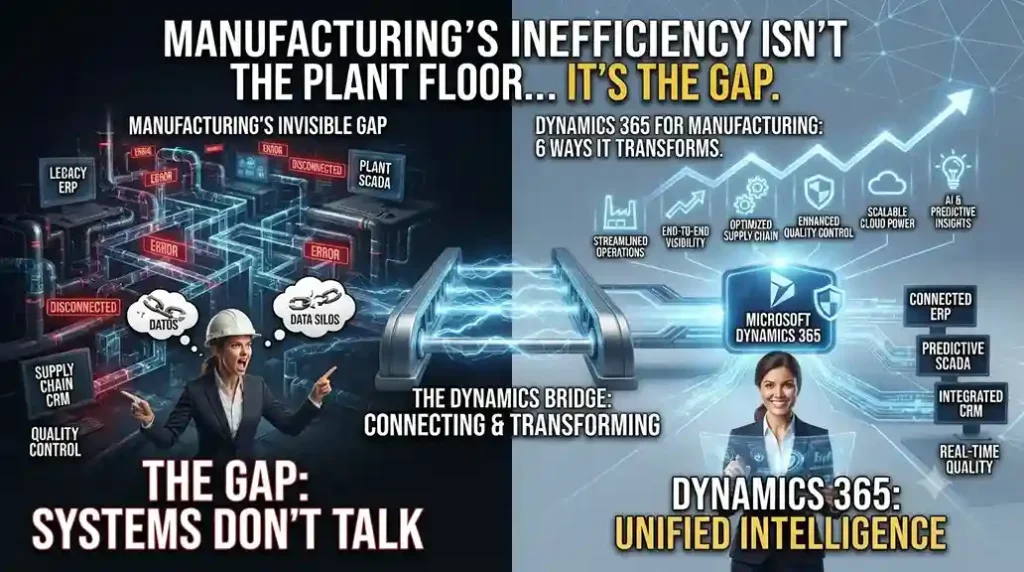
INTRO A machine on the shop floor and a service technician in the field often work off completely different data — one sees production output, the other sees a support ticket, and neither sees the customer’s purchase history. Dynamics 365 for manufacturing exists to close exactly that gap, by ending the divide between CRM and ERP instead of running them as separate systems that happen to sit on the same network. Here are the six shifts that gap-closing actually produces on the ground. 1. Supply Chain Visibility That Goes Beyond a Dashboard Collecting and visualizing supply chain data across every location does more than create a nicer report — it changes how fast a disruption gets caught. Manufacturers using remote monitoring across distributed installations have shortened time-to-market by catching supply issues before they cascade into production delays, rather than discovering them after a shipment is already late. 2. Asset and Production Management, Consolidated Into One View When production oversight and real-time equipment monitoring sit in one system instead of three, manufacturers stop reacting to breakdowns and start resolving issues remotely before they cause downtime. This is the operational basis for near-continuous uptime models in equipment-heavy manufacturing — and it also opens a second revenue line: monitoring and proactive support sold as an ongoing service, not a one-time sale. 3. Customer Engagement Built on Usage Data, Not Guesswork Personalized service at scale requires predictive analytics and self-service options that are actually relevant to what a specific customer does with the product — not a generic contact form. Manufacturers with a connected sales-through-service platform can flag potential equipment issues before a customer notices a problem, while also tailoring offers based on that customer’s real purchasing and usage pattern. 4. Service Centers as a Profit Center, Not a Cost Center Falling costs for IoT sensors and mobile devices have made remote monitoring and proactive maintenance commercially viable additions to standard break/fix support — not just a premium add-on for enterprise accounts. Combining customer records, technician availability, and inventory into a single mobile-accessible system is what lets a service team actually deliver on that model instead of just theorizing it. The Data Advantage: Better Products, Not Just Better Service IoT-connected parts and equipment feed usage data back to engineering — which components fail early, which are over-built, how products actually get used in the field. That feedback loop is what shortens the cycle between a design flaw and a fix, rather than waiting for failure reports to pile up. 5. Technicians Who See the Full Job, Not Just the Ticket A 360-degree view of a customer’s asset and service history changes what a technician can do on-site — they’re working from context, not just a work order. Paired with machine learning that surfaces similar past cases, this turns troubleshooting into pattern-matching against real precedent instead of starting from zero on every call. 6. One System Connecting the Floor to the Front Office Manufacturers that unify production and project management data with CRM stop treating customer service and customer engagement as separate departments working from separate records. The practical result is service and recommendations grounded in what a customer has actually bought and experienced — not assumptions. Why Dynamics 365 Specifically Dynamics 365 for manufacturing removes the artificial line between CRM and ERP, running both on one system with embedded analytics rather than bolting a reporting layer on top of disconnected tools. For a mid-size manufacturer, this matters less as a technology upgrade and more as an operating model change — supply chain, service, and sales working from the same data instead of reconciling three versions of it. Curious what a unified CRM-ERP model would look like on your production floor? Talk to Trident about a Dynamics 365 manufacturing assessment.
4 ways technology can help businesses thrive in a digital world. The good news is that the tools that help businesses capitalize on this digital transformation are more accessible than ever before. The cloud is removing barriers like high up-front costs, ongoing maintenance, and IT dependency.
Whitepaper : Four technology trends helping businesses thrive in a digital world Read More »