
Welcome to Trident Information Systems!
Write us to - info@tridentinfo.com
Let's Socialize

erp for electronics manufacturing

How to Choose Technology for Effective Hi-tech and Electronics Manufacturing? 

The pace that the electronics industry is at is unmatched. The top ten electronic brands in the industries debuted hardly ten years ago. Hence, this industry is growing at a crazy speed that you need to match! Most of the business are adopting ERP for Electronics Manufacturing. Electronics manufacturing is ideal for tech-savvy people who can be as flexible and fast as it demands. Backing up with the right technology is the most important thing. Having a unified solution like Microsoft Dynamics 365 can help you beat electronics manufacturing challenges and competitions.   Electronics are subjected to faults the most, therefore, their manufacturing can become even challenging. With shrinking operating margins, global competition and innovations are lowering the prices. Hence, it becomes a necessity to become more cost-effective to balance profit.    It gets even tougher to comply with the ever-changing customer preferences. Therefore, EMS companies and contract manufacturers have to establish a New Product Introduction (NPI) process. Closed-loop communication among sales, engineering, and manufacturing are essential to meet the dynamic demands of the target audience.   Economic dynamics and customer cyclical demands cause production fluctuations. Customers’ preferences influence the production of a device or a certain brand on a granular level. Hence, effective lean capabilities should be established to keep up with the demands.  When it comes to electronics manufacturing, sustainability is the first thing that comes to mind. Having new regulations popping up concerning social responsibilities, companies are becoming accountable for sustainable production. Since E-waste is a hot topic nowadays, the federation is more concerned about the impact it has on the environment.  How To Spot Perfect Technology for Hi-tech and Electronics Manufacturing?  While choosing the right technology for your electronics manufacturing you need to make sure it is a centralized solution, which provides all the necessities within the same platform. Check out groundbreaking factors the ideal software solution must have, which never ditch the manufacturers. Hit demands to the and operates business more effectively with a suitable technology such as Microsoft Dynamics:   Component Purchasing and Sourcing   Component sourcing includes locating, managing, and acquisition components of each important input necessary to operate your business. It may include raw material, parts labor, and production in all its forms, services, and location.   Purchasing is one of the most crucial parts of any manufacturing industry. Make sure the software allows organizations to automate their source to pay cycle comprehensively.   The software must manage everything related to the supplier. From sparrow messages to quotations, it must cover everything. It must manage, supplier, and keep a keen eye on the stock level.   Bill of Material Management   It is a must-have feature in the software solution you are about to acquire. Bill of Material is a full-fledged list of components acquired addressing the name and details of the manufacturer. BOM (Bill of Materials) is a comprehensive list of raw materials, components, parts, assemblies, and sub-assemblies placed in a hierarchical order to produce a single unit of products.   The better and more detailed the Bills of Management are, the better manufacture-oriented decisions you can make with the real-time accurate data at hand. It allows production, R&D, procurement, logistics, pricing, and sales analysis within a centralized platform.   The inventory management system must integrate with the ERP system to minimize mistakes and make faster and more logical decisions. It suggests the most efficient stocking methods for your inventory and enhances internal business operations overall. You can claim a well-structured reporting mechanism with ERP systems within your store and warehouse. This helps manufacturers to plan their production accordingly. You can tackle common inventory management issues and minimize overhead costs.   Production Planning and Sourcing   Resource planning is considered one of the most effective planning methods of all. It includes operational planning, financial planning and has a simulation capability to answer. The planning includes machine hours, man hours, storage, standard cost dollars, inventory levels, shipping levels, and so on.   Visual Quality Inspection   An automatic visual quality inspection boosts the manufacturing process and minimizes the manual efforts of your employees. Having this software complementing with the right hardware, defect detection gets easier. Only a few software service providers such as Trident Information System provide this service. Inspect dimensions, color, the texture of the component and remove the defective pieces right away.   Why Trident Information Systems?   Being the Gold Partner of Microsoft Dynamics 365, we have been serving numerous successful business ventures. Backed up with an experience of over 22 years and 150+ technical resources, we conduct thorough research, assemble different tools, and customize a suitable software solution as per your business requirements. You can save time and build an adaptive business network, generate more revenue, and adapt quickly to market dynamics. For further queries or a demo contact us.  

How to Choose Technology for Effective Hi-tech and Electronics Manufacturing?  Read More »
Beat the Skill Gap in Manufacturing

The manufacturing industry contributes a massive part to India’s GDP. India’s gross domestic products at current counts at Rs. 51.23 lakh crores (USD 694.93 billion). In the first quarter of FY22, according to the provisional estimates of gross domestic product for the first quarter of 2021-22. The manufacturing GVA at current prices was estimated at USD 97.41 billion in the first quarter of FY22.   This pandemic has pushed this sector back causing skill gaps. Unfortunately, various manufacturers were exposed to crisis fallouts. Despite manufacturing companies trying their hardest to strengthen and rebound in the post-COVID 19 eras, this has impacted hugely on the existing workforce. To overcome this scenario, manufacturers may opt for Manufacturing ERP Software like Microsoft Dynamics 365 which integrates every aspect of manufacturing under the same platform and hence provides a centralized and streamlined manufacturing experience.  There are multiple ways in which manufacturers have changed the way they operate their business. For example, Manufacturers all over the world had to cut budgets and let workers go to secure their bottom line. Apart from reducing the effectiveness of the remaining workforce, it fundamentally altered the functioning of the organization overall. With limited employees left behind, they have to pick up the slack. This leads to increased workload and adjusting with more than what they are assigned to. And not to mention employee safety becomes the top priority (an even bigger priority than it ever was).     Can Digitalization Address Skill Gaps As-Well-as Safety Compliance?  The manufacturing industry has been transforming even before the COVID 19 pandemic hits the world. It was so rapid that it was even tougher for your workforce to keep up with it. Rapid digital transformation contributes to the growing skill gap on the shop floor as well as brings new challenges to the worker’s safety and productivity.   In simple words, your workforce needs to transform to keep up with it. They need to embrace resilient technology like Microsoft Dynamics 365 that can attract, train, and retain the next generation of workers while embedding skills they need to recreate manufacturing and shape a sustainable future.   The talent hunt needs to be done keeping the uneven and protracted recovery environment to balance productivity and achieve desired business outcomes.   Manufacturers can rejoice now as by integrating suitable productive applications, intelligent cloud services, and security, the industry can easily set its workforce up for victory. This is how digital transformation can help employees fill the skill gap:   Connecting empowered technicians and remote assets security to troubleshoot issues, therefore dispatching technicians only when required.  Providing frontline workers with expert assistance remotely to avoid downtime while allowing them to do their best by unifying devices, relationships, processes, and data into intelligent apps, and guiding them securely through the compliance requirements and the most suitable practices.   Ensuring better productivity with team collaboration tools, remote assists, mixed-reality, AI-enhanced applications, and IoT-enables machines to keep up with the boosted process complexities and operational maintenance.   Technology Transforms Manufacturing Operations  Technology-centered agile businesses ensure business practices from anywhere. This is especially useful for businesses having a workforce scattered remotely and, in the workplace, globally. Research commissioned by Microsoft reveals that 97% of entrepreneurs require more agile and mongrel techniques for working in the longer run. With a dynamic as-well-as cohesive workforce all around the world, businesses have numerous opportunities to encompass a technology-centric approach like Microsoft Dynamics 365 for Manufacturing.  Manufacturers can balance productivity with remote work. They can reinforce their organizations and frontline workers with robust and intuitive tools delivering a remote, integrated as-well-as in resilient business experience.   COVID 19 pandemic has raised a grave concern about employee safety and health. As soon as they enter the workplace, their safety and health will be the major priority. Having such technology can help with the health and safety compliance set by the government.   With the rise of connectivity and mobility, security compliance becomes a big issue. Since the data is more prone to various malware, viruses, etc., manufacturers have to find new ways to keep their data safe. Microsoft Azure ensures bank-level security and backup.   As words, manufacturers have to deploy remote and more agile business practices and optimally boost their productivity. Microsoft Dynamics 365 allows manufacturers to grow and attain excellent customer service while:   Transforming your workforce by integrating intelligent cloud services, productive apps, and security to reimagine the way you operate your business.    Engaging more customers with innovation by delivering exponent customer experience throughout marketing, sales, and service channels.   Creating more robust, secure, and safe factories with IoT (Internet of Things), IT, and industrial IoT.   Building more flexible supply chains with intelligent supply chain planning ensures more resilient services and profitability.   The world is transforming, and therefore mounting pressure on the manufacturers to address skill gaps in their factories and deliver impeccable services. Centering trust, security, innovation, and compliance, Microsoft, ERP for Manufacturing Industry, enables the digital transformation of your business. Trident Information Systems is a Gold Microsoft Partner. If you are looking for Microsoft implementation, you may contact us.  

Beat the Skill Gap in Manufacturing Read More »

How to Choose a Technology for Effective Hi-tech and Electronics Manufacturing?

The pace that the electronics industry is at is unmatched. The top ten brands of electronics in the industries debuted hardly ten years ago. Hence, this industry is growing at a crazy speed that you need to match!   Electronics manufacturing is ideal for tech-savvy people who can be as flexible and fast as it demands. Backing up with the right technology is the most important thing. Having a unified solution like Microsoft Dynamics 365 for Electronics Manufacturing can help you beat electronics manufacturing challenges and competitions.   Electronics are subjected to faults the most, therefore, their manufacturing can become even challenging. With shrinking operating margins, global competition and innovations are lowering the prices. Hence, it becomes a necessity to become more cost-effective to balance profit.    It gets even tougher to comply with the ever-changing customer preferences. Therefore, EMS companies and contract manufacturers have to establish a New Product Introduction (NPI) process. Closed-loop communication among sales, engineering, and manufacturing are essential to meet the dynamic demands of the target audience.   Economic dynamics and customer cyclical demands cause production fluctuations. Customers’ preferences influence the production of a device or a certain brand on a granular level. Hence, effective lean capabilities should be established to keep up with the demands.  When it comes to electronics manufacturing, sustainability is the first thing that comes to mind. Having new regulations popping up concerning social responsibilities, companies are getting accountable for sustainable production. Since E-waste is a hot topic nowadays, the federation is more concerned about the impact it leads on the environment.  How To Spot the Perfect Technology for Hi-tech and Electronics Manufacturing?  While choosing the right technology for your electronics manufacturing you need to make sure it is a centralized solution, which provides all the necessities within the same platform. Check out groundbreaking factors the ideal software solution must-have, which never ditch the manufacturers. Hit demands to the and operates business more effectively with a suitable technology such as Microsoft Dynamics:   Component Purchasing and Sourcing   Component sourcing includes locating, managing, and acquisition components of each important input necessary to operate your business. It may include raw material, parts labor, and production in all its forms, services, and location.   Purchasing is one of the most crucial parts of any manufacturing industry. Make sure the software allows organizations to automate their source to pay cycle comprehensively.   The software must manage everything related to the supplier. From sparrow messages to quotations, it must cover everything. It must manage, supplier, and keep a keen eye on the stock level.    Bill of Material Management   It is a must-have feature in the software solution you are about to acquire. Bill of Material is a full-fledged list of components acquired addressing the name and details of the manufacturer. BOM (Bill of Materials) is a comprehensive list of raw materials, components, parts, assemblies, and sub-assemblies placed in a hierarchical order to produce a single unit of products.   The better and more detailed the Bills of Management are, the better manufacture-oriented decisions you can make with the real-time accurate data at hand. It allows production, R&D, procurement, logistics, pricing, and sales analysis within a centralized platform.     Integrated Inventory Management   The inventory management system must integrate with the ERP system to minimize mistakes and make faster and more logical decisions. It suggests the most efficient stocking methods for your inventory and enhances internal business operations overall. You can claim a well-structured reporting mechanism with ERP systems within your store and warehouse. This helps manufacturers to plan their production accordingly. You can tackle common inventory management issues and minimize overhead costs.    Production Planning and Sourcing   Resource planning is considered one of the most effective planning methods of all. It includes operational planning, financial planning and has a simulation capability to answer. The planning includes machine hours, man hours, storage, standard cost dollars, inventory levels, shipping levels, and so on.   Visual Quality Inspection   An automatic visual quality inspection boosts the manufacturing process and minimizes the manual efforts of your employees. Having this software complementing with the right hardware, defect detection gets easier. Only a few software service providers such as Trident Information System provide this service. Inspect dimensions, color, the texture of the component and remove the defective pieces right away.    Why Trident Information Systems?  Being the Gold Partner of Microsoft Dynamics 365, we have been serving numerous successful business ventures. Backed up with an experience of over 22 years and 150+ technical resources, we conduct thorough research, assemble different tools, and customize a suitable software solution as per your business requirements. You can save on your time and build an adaptive business network, generate more revenue, and adapt quickly to market dynamics with Microsoft Dynamics for Electronics Manufacturing. For further queries or a demo contact us. 

How to Choose a Technology for Effective Hi-tech and Electronics Manufacturing? Read More »
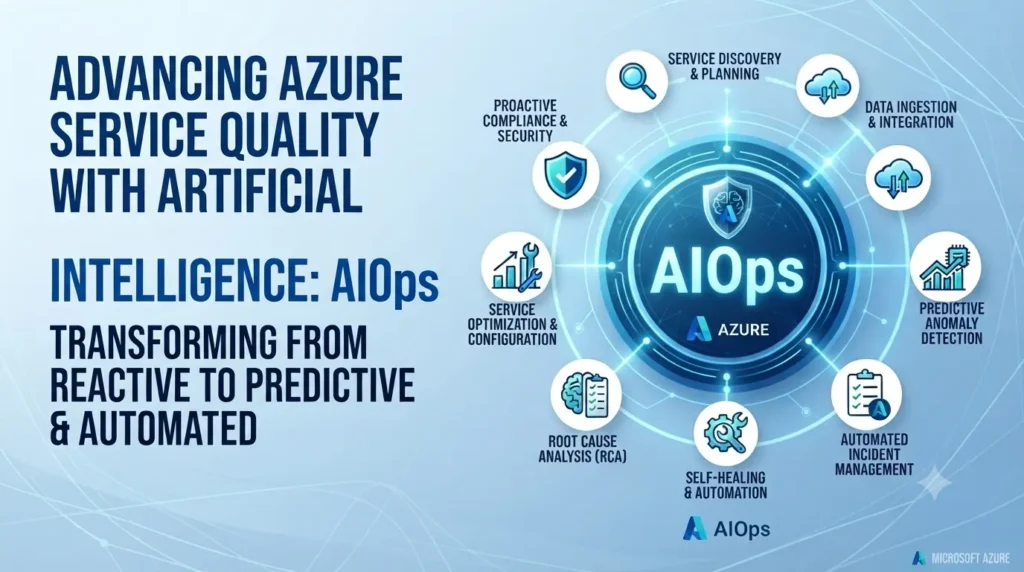
Microsoft Azure AIOps dashboard displaying AI-powered monitoring, predictive failure alerts, and real-time infrastructure health.

Advancing Azure service quality with artificial intelligence: AIOps

INTRO Somewhere on Azure’s infrastructure, a disk was predicted to fail — and your workload was migrated off it before that failure ever happened. That’s not a hypothetical. It’s Azure AIOps, Microsoft’s use of AI and machine learning to detect, predict, and fix infrastructure problems before they become customer-facing outages. For a business evaluating cloud reliability, this matters less as an engineering curiosity and more as a straight answer to a practical question: why does Azure keep improving its uptime numbers year over year? Failures Get Predicted, Not Just Detected Traditional infrastructure monitoring tells you something broke. Azure’s hardware failure prediction model tries to catch it before it does — flagging disks, memory, and networking hardware likely to fail, then automatically live-migrating affected virtual machines to healthy nodes. The customer impact of a hardware failure, in the cases this catches, is zero downtime rather than an outage ticket. Faster VM Provisioning, Powered by Prediction Azure’s pre-provisioning system uses historical deployment patterns to predict what VM configurations customers are likely to request — and creates a pool of them in advance. When a matching request comes in, it’s assigned from that pool instead of built from scratch. The practical effect for a business is faster deployment latency, without needing to know any of the prediction modeling happening behind it. Incidents Get Resolved Before They Escalate Azure tracks incident response against three metrics: time to detect, time to engage, and time to mitigate. AI-driven anomaly detection — built to catch not just obvious spikes but slow-building patterns like memory leaks — feeds directly into routing the right engineering team to an issue immediately, and in some cases triggers automated fixes with no human step at all. For a business running production workloads, that translates to shorter, less frequent disruptions. Safe Rollouts Prevent Widespread Impact Microsoft rolls out infrastructure changes constantly, which creates real risk of a bad change spreading before anyone notices. An internal system (code-named Gandalf) analyzes rollout patterns to catch issues that surface hours or days later, flagging suspicious changes before they propagate further. This is part of why platform-wide incidents from routine updates are rare rather than common. What This Actually Means for Your IT Roadmap None of this requires action on your end — it’s infrastructure Microsoft operates on your behalf. What it does mean is that Azure’s reliability improvements aren’t marketing claims; they’re the output of a systematic prediction-and-automation investment, which is a reasonable thing to weigh when comparing cloud providers on uptime and reliability, not just price. Want to know how Azure’s reliability engineering translates to SLAs for your specific workload? Talk to Trident about your cloud infrastructure options. FAQ What is Azure AIOps?Azure AIOps is Microsoft’s use of AI and machine learning to predict, detect, and resolve infrastructure issues on Azure automatically — including hardware failure prediction, faster VM provisioning, and automated incident response. Does Azure AIOps require any setup from customers?No — it operates at Microsoft’s infrastructure level. Customers benefit from improved reliability and uptime without configuring anything themselves. How does Azure predict hardware failures before they happen?Microsoft Research and Azure built models that analyze disk, memory, and networking behavior to flag components likely to fail, then automatically migrate affected virtual machines to healthy hardware.

Advancing Azure service quality with artificial intelligence: AIOps Read More »

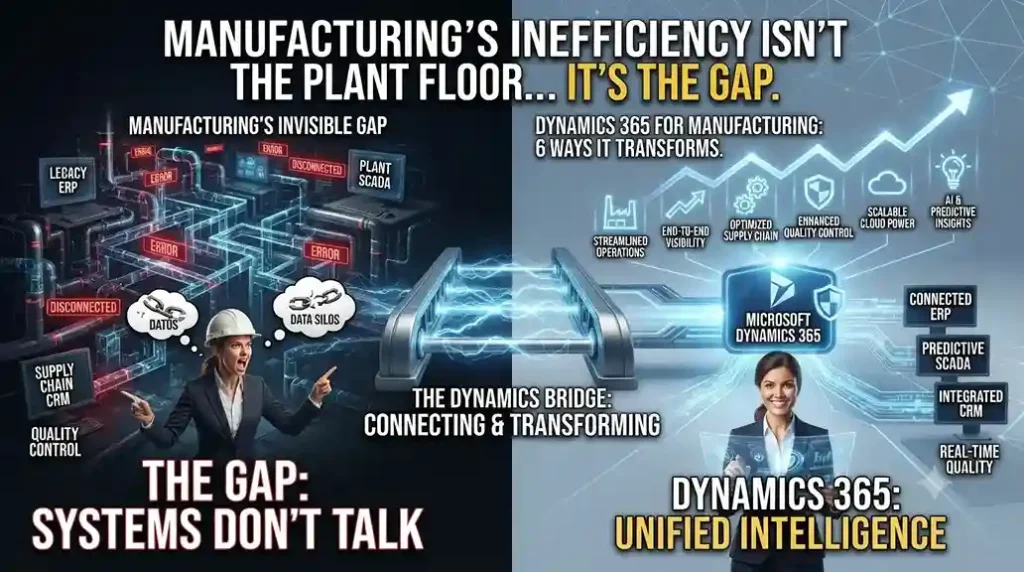
Microsoft Dynamics 365 for Manufacturing dashboard displaying production planning, inventory, supply chain management, and quality control.

Manufacturing’s Biggest Inefficiency Isn’t the Plant Floor — It’s the Gap Between Systems

INTRO A machine on the shop floor and a service technician in the field often work off completely different data — one sees production output, the other sees a support ticket, and neither sees the customer’s purchase history. Dynamics 365 for manufacturing exists to close exactly that gap, by ending the divide between CRM and ERP instead of running them as separate systems that happen to sit on the same network. Here are the six shifts that gap-closing actually produces on the ground. 1. Supply Chain Visibility That Goes Beyond a Dashboard Collecting and visualizing supply chain data across every location does more than create a nicer report — it changes how fast a disruption gets caught. Manufacturers using remote monitoring across distributed installations have shortened time-to-market by catching supply issues before they cascade into production delays, rather than discovering them after a shipment is already late. 2. Asset and Production Management, Consolidated Into One View When production oversight and real-time equipment monitoring sit in one system instead of three, manufacturers stop reacting to breakdowns and start resolving issues remotely before they cause downtime. This is the operational basis for near-continuous uptime models in equipment-heavy manufacturing — and it also opens a second revenue line: monitoring and proactive support sold as an ongoing service, not a one-time sale. 3. Customer Engagement Built on Usage Data, Not Guesswork Personalized service at scale requires predictive analytics and self-service options that are actually relevant to what a specific customer does with the product — not a generic contact form. Manufacturers with a connected sales-through-service platform can flag potential equipment issues before a customer notices a problem, while also tailoring offers based on that customer’s real purchasing and usage pattern. 4. Service Centers as a Profit Center, Not a Cost Center Falling costs for IoT sensors and mobile devices have made remote monitoring and proactive maintenance commercially viable additions to standard break/fix support — not just a premium add-on for enterprise accounts. Combining customer records, technician availability, and inventory into a single mobile-accessible system is what lets a service team actually deliver on that model instead of just theorizing it. The Data Advantage: Better Products, Not Just Better Service IoT-connected parts and equipment feed usage data back to engineering — which components fail early, which are over-built, how products actually get used in the field. That feedback loop is what shortens the cycle between a design flaw and a fix, rather than waiting for failure reports to pile up. 5. Technicians Who See the Full Job, Not Just the Ticket A 360-degree view of a customer’s asset and service history changes what a technician can do on-site — they’re working from context, not just a work order. Paired with machine learning that surfaces similar past cases, this turns troubleshooting into pattern-matching against real precedent instead of starting from zero on every call. 6. One System Connecting the Floor to the Front Office Manufacturers that unify production and project management data with CRM stop treating customer service and customer engagement as separate departments working from separate records. The practical result is service and recommendations grounded in what a customer has actually bought and experienced — not assumptions. Why Dynamics 365 Specifically Dynamics 365 for manufacturing removes the artificial line between CRM and ERP, running both on one system with embedded analytics rather than bolting a reporting layer on top of disconnected tools. For a mid-size manufacturer, this matters less as a technology upgrade and more as an operating model change — supply chain, service, and sales working from the same data instead of reconciling three versions of it. Curious what a unified CRM-ERP model would look like on your production floor? Talk to Trident about a Dynamics 365 manufacturing assessment.

Manufacturing’s Biggest Inefficiency Isn’t the Plant Floor — It’s the Gap Between Systems Read More »

Whitepaper : Four technology trends helping businesses thrive in a digital world

4 ways technology can help businesses thrive in a digital world. The good news is that the tools that help businesses capitalize on this digital transformation are more accessible than ever before. The cloud is removing barriers like high up-front costs, ongoing maintenance, and IT dependency.

Whitepaper : Four technology trends helping businesses thrive in a digital world Read More »