Welcome to Trident Information Systems!
Write us to - info@tridentinfo.com
Let's Socialize

microsoft azure iot

This Why You Need Supply Chain Management Cloud ERP ASAP! 

The world is facing supply chain disruptions. But what exactly is the reason? Technology has helped us enjoy instant gratification; be it instant delivery, or product tracking, everything is a piece of cake. However, over the past two years, these services have been witnessing disruption. Many businesses shifted their approach to Supply Chain ERP Systems to manage their business with full efficiency. Dynamics 365 for Finance and Supply Chain Management System is one of the best Supply Chain Management Software.   However, what is the reason behind this? Certainly, a lot of factors, but businesses pulling out their interest in China is the major reason. Even though it is not a new thing, it still seems to have caught pace in recent years (after the COVID-19 outbreak).   An Overview of the Current Situation  For over two decades, China has dominated the manufacturing industry, contributing to shipping lanes and affordable labor rates. Therefore, working in or with China-made economic sense. However, over the last two years, China was hit with massive ordeals including COVID-19, increased geopolitical tensions, and high traffic. These factors lead to the departure of large manufacturing organizations from across the globe.   Innovation in technology even for supply chains such as Supply Chain ERP Systems has promoted remote work. Anyone can work efficiently without having to move abroad. Credits to AI (Artificial Intelligence) advancements and robotic developments, for more manageable labor costs. COVID-19 has so far pushed Chinese manufacturing to the verge of shutting down. Upstream suppliers failed to get raw materials on time, which caused delays. When China opened again, US and Europe were now shut down leading to another out-of-sync scenario.   COVID-19 impacted everyone in the world, irrespective of their industry. From teachers to doctors, to waiters, to childcare takers, to baristas, nobody could escape from this. Manufacturing perhaps hit the hardest due to supply chain issues. However, many manufacturers still managed to survive. They embraced more advanced technology such as Manufacturing ERP Software, and CRM for Manufacturing Industry. Some adopted a unified platform that provides ERP and CRM on the same platform such as Dynamics 365 for Finance and Supply Chain.   Supply Chain ERP Systems for Your Rescue  Having an enterprise system that can cope with demand and supply variability has become a must-have in today’s scenario. Hence, Supply Chain ERP Systems like Dynamics 365 for Finance and Supply Chain, Cloud Supply Chain ERP Software can help you with this. With this Top Supply Chain Management Software, you can manage multiple suppliers. Furthermore, you can seamlessly manage data with automation, which is time-consuming, frustrating, and impossible using disparate systems in current scenarios. Flexibility and foresight are critical requirements to tackle uncertainties.   Cloud Supply Chain ERP Systems provides a digital supply chain network that enables a single source of truth. Followed by artificial intelligence to power prescriptive and predictive analysis. Companies can easily source inventory and raw materials to stay afloat and ahead of the competition. Using Dynamic technology helps with planning and execution.   Business owners need to tackle disturbances and stay ahead of troubleshooting solutions for new processes. New technology comes up with new challenges along with its solutions. D365 solutions are reinforced with Power BI tools which analyze the customer’s spending pattern, also how the product moves throughout the supply chain.   Logistics play a vital role in the supply chain. Without efficient logistic management, the supply chain is bound to face inconveniences. ERP for Transport and Logistics offers complete logistics management. The user can find the shortest route possible to save time and fuel. You can also track and trace your vehicle’s current location, as well as check your driver’s background. Track your vehicle’s mileage with Transport ERP Software.   How can cloud ERP Help in Successfully Forging Links in the Supply Chain?  Having a global supply chain is one of the biggest achievements over the past three decades. To think of it, just about a few decades ago, it was unbelievable to experience an organized and coordinated system of raw materials, fabrication shops, and component manufacturers across the globe.  However, this convenient and connected system was as well delicate. It withstood all the natural outrages; be it earthquakes, typhoons, hurricanes, closed ports, and so on. Supply Chain ERP Systems contribution to withstand the shocks and uncertainties. With robust and connected supply chain management, you can streamline this chain and overcome all the hurdles.   Tackle the Great Resignation Enforced by COVID   Firstly, the COVID-19 outbreak was detected and reported in China, the region where most of the world’s raw materials and finished goods come from. This outbreak led major manufacturing plants to shut down throughout the world. As the pandemic forced lockdowns everywhere, certain products became scarce. Therefore, producers raced to search for an alternative.   However, the pandemic continued, and what was once a problem in an isolated region became a global issue. Followed by more factories and mines being shut down, raw material became limited, and for some, unavailable. Even among producers with adequate raw material, laborers began falling sick. Agonized by the hard-working environment, entered what has been depicted as the great resignation.    Supply Chain ERP Systems assists in streamlining manufacturing processes by automating manual and monotonous tasks while relieving staff from too much hard labor. It can even tackle labor shortages as it automates a pretty good sum. Therefore, allowing you to engage your labor in other profit-generating activities. This Cloud ERP Solution needs less training, as it works on an intuitive interface. Hence adapting to this ERP in Supply Chain Management is easier than other software.   Win the Battle Against Uncertainty with Cloud ERP   Cloud Supply Chain ERP Systems help beat frequent uncertainties. ERP like Dynamics 365 has embedded Power BI which collects data from different touchpoints and brings them all into the center. Then, it created insightful and actionable reports on the business and customers. Further, allowing you to understand your strengths and weaknesses more in-depth. Leveraging this data defines how you quickly respond to perspective and sudden threats.   You can

This Why You Need Supply Chain Management Cloud ERP ASAP!  Read More »
What Makes Azure Your Ultimate Cloud Server? 

Microsoft Azure Debuted in 2010, and since then it has used worldwide virtualization at Microsoft Data Centers. It offers up to 600 different services and is a leading brand in Infrastructure as a Service and has led to noticeable growth. Azure was fabricated to test, build, and manage application services via Microsoft data centers. Nowadays, Microsoft Cloud Azure is a growing cluster of integrated services and applications focusing on a seamless work environment It is a perfect match for small businesses. It has now become an integral part of the smooth work experience.  Azure supplies some unique benefits that deserve acknowledgment. It has also managed to outrace its competition by great lengths. Its more flexible and scalable capabilities make it the first choice of the user.   How Microsoft Azure Outraces Competition?  Azure supplies unmatched capabilities. Hence, the competition could not stay intact before it. Some clouds like AWS have similar IaaS capabilities for virtual machines, storage, and networking. However, Azure has no match in PaaS abilities. Given below are some of the features Microsoft Cloud Azure provides the best.   PaaS Capabilities   Microsoft PaaS provides the developers an environment, building blocks, and tools to build and deploy Microsoft Cloud Services. Furthermore, Azure Cloud also provides the vital Microsoft Azure DevOps connections which are critical for the managing, controlling, and monitoring of these applications. Azure PaaS takes care of your infrastructure behind the scenes.   .NET Suitability   One of the most useful benefits of Microsoft Azure is its .NET capabilities. It has an upper hand over its competitors when it comes to the .NET programming language. Azure has been successfully created and perfected to work smoothly with old and new applications with the .NET programming framework. Furthermore, it is easier to move your Windows App to Microsoft Azure Cloud as compared to its competition.   Security Benefits   Microsoft Azure Cloud is tailored following Security Development Lifecycle (SDL), a top industry-leading assurance process. It delivers Azure security to the heart. Your personal data and services enjoy guaranteed security when they are on Azure Cloud. Microsoft was the primary cloud vendor whom European Union’s data protection authorities approved. They were alone the first to receive the latest international standard for cloud privacy.   Hybrid Solutions   Where many of the competitors are testing their hybrid solutions, Microsoft Azure has had its hybrid capabilities fallen into place. It effortlessly integrates data centers to the Azure Cloud. It also provides easy mobility between the public cloud and on-premises.   Unlike most of the competitors, one can create hybrid apps on Azure using the available resources in data centers at the MS Azure Hosting Provider. You can also access a massive range of hybrid connectors which includes Virtual Private Networks (VPNs), Content Delivery Networks (CDN), catches, and Express Route Connectors to boost the performance and usability.   Connected Ecosystem   Azure provides an integrated ecosystem for building, testing, and deploying Azure Cloud Apps. It is up to the client how he prefers the application development to be. Furthermore, open development languages add more to the flexibility of Microsoft Cloud Azure. Further, ready-made services such as mobile, web, and media in addition to templates and APIs can work as a catalyst for Azure Application Development.   Why Do Businesses Primarily Pick Microsoft Cloud Azure?  The RightScale survey broke out; many businesses prefer to use Microsoft Cloud Azure for its excellent PaaS and IaaS. It enables various flexible business-friendly features which makes it the primary choice for most businesses.   You Can Integrate Azure Smoothly with Other Microsoft Tools  Most businesses rely on Microsoft services such as Office 365, Outlook, SharePoint, Teams, and so on. Cloud Services in Azure easily integrated with these tools providing persistent processing. In addition, Azure Cloud Services uses the same virtual machines as Windows and Linux, which businesses use on-premises. Organizations that have always had a challenging time integrating and coordinating their disparate systems must opt for Azure. It provides a fresh integration capability which saves time and money.   You Can Partner with Industry Leaders  According to a survey by The Virtualization Practice, a bulk of users mentioned Microsoft’s Image as a trusted industry leader. Thus, this was a major consideration they took while deciding to merge with Azure Cloud. It was also reported that Microsoft is the primary preference among Fortune 500 companies. The Steller’s image was driven by widely used tools such as Skype, Xbox, Bing, and so on. The rationale was simple since Microsoft tools are trusted, and Azure makes sense too.   You can customize your Solutions to Meet Your Specific Requirements  Another major reason that fosters Microsoft’s image as one of the most convenient solutions is its ability to use to fit your business. For instance, implementing Azure’s IaaS services allows the user to pay only for the services they use. In addition to it, PaaS allows you to design and develop applications without having to pay for the underlying infrastructure expenses. Therefore, you can tailor your cloud software to meet your business requirements without fuss.   Get Robust Open-Source Analytical Support  You can leverage managed SQL and NoSQL data services by assurance, followed by embedded support. Thus, you can access deeply dug insights to understand your business better and strategize better ways to improve your business productivity. Furthermore, you can also access Azure’s analytical tools such as HDInsight. According to Microsoft, it is the only completely managed Apache Hadoop feature which enables the user to optimize open-source analytical clusters for Hive, Spark, MapReduce, HBase, Storm, Kafka, and Microsoft Server backed up by a 99.9% SLA.   You Get an On-going Stream of New and Exciting Releases   Azure often updates its offerings and provides new services to its users. For instance, one of its releases was Azure Advisor, which provides tailored recommendations suiting the individual user’s needs. Further, a combination of two more functionalities; Site Recovery and Azure Data Backup aids businesses to build cost-efficient and robust business longevity and disaster recovery plans. Azure Disaster Recovery Plays a vital role in the same.   How Does Azure Benefit a Business?  Azure

What Makes Azure Your Ultimate Cloud Server?  Read More »

Why Should Large Scale Businesses opt for Microsoft Dynamics 365 Business Central SaaS?  

Back in the day, businesspeople perceived cloud-based software implementation to be well suited for only small to medium-sized businesses. It had an image of reducing the upfront and implementation costs for SMBs while large-scale businesses still preferred to stick to the traditional on-premises software. However, Microsoft Dynamics 365 Implementation has shunned this perception. Greater control, more functionality, and complete customization are some of many Dynamics 365 Business Central Features.   Large-scale businesses have begun to accept Microsoft Dynamics 365 Implementation to manage their complex requirements. It is one of the most popular enterprises resource planning which is now considered well suited for large enterprises. At the recent Annual Directions Conference, Rayner Vas (software engineer), and Christian Heide Damm (architect) elaborated on Microsoft’s investments and enhanced performance. Now, Business Central refrains from any limitations on the number of users, transactions, sessions, or size of the database, making it a suitable option for businesses of varied sizes. Business Central Licensing is also very flexible.   The Forrester research also backs up this claim; they state the total impact of Business Central on a business’s economy. They found out that businesses who opted for Microsoft Dynamics 365 Implementation successfully attained operational efficiency, cut costs, and easily scaled their deployments. This growth is a result of the support that the cloud offered.   However, if you are still unsure about Microsoft Business Central, we have compiled the top three reasons to convince you to choose it for your large-scale business.   Steady Scalability   Microsoft Business Central allows as many users as your business needs. There is no limitation to your growth. Each Business Central instance comes with data storage of 80 GB. According to Microsoft, this is more than enough space for different organizations. Even if a company needs expansion in their data storage, they can add it.   Business Central keeps adding regular performance enhancements to ensure enough scalability for even the largest organizations. Latest features like SQL Compression – a technique that is also employed throughout other Microsoft Dynamics 365 cloud services. It helps reduce database volume and enhance performance. Its service functionality also tracks unanticipated database growth while aiding users to catch issues in the earlier stages and prevent unexpected database use. In addition, the Business Central Admin Dashboard also helps the users to manage their database costs continuously. Having complete visibility of your data and being able to see exactly what you are using; you can calculate the total costs and plan the budget accordingly.   According to further reports by Forster, almost all the Business Central users state the benefits of being able to scale users and enjoy license types. Also, during turbulent times like pandemics, they could keep their ERP (Enterprise Resource Planning) resources on provision and cut costs.   On the Go Productivity  Being a cloud-first solution, Microsoft Dynamics 365 Implementation enables its user’s freedom of action. In the past couple of years, some large-scale businesses faced shortcomings when it came to making rapid changes. For instance, large-scale businesses working on premises could not fulfil the requirement of remote work overnight. Those who were already running in Cloud could successfully adapt to it.   Reports also suggest that firms who invest in technologies which enable remote work will eventually enjoy a competitive edge through a more engaged workforce. Furthermore, it was also reported that business central users noted that being on SaaS allows their transition to remote work a lot easier than it would have been with their previous on-premises ERP software.   Best In-class Security for Your Business   It is not hidden from anyone how robust Microsoft security is. Microsoft takes its security very seriously. It costs about USD 1 billion a year. It has shown its security’s continuous enhancement in multiple ways: from data encryption to identity isolation to automated threat detection, and just-in-time access.  A few years ago, some customers were hesitant about using cloud services because they thought it was not safe enough. Nowadays, however, the situation has reversed. Business owners are more inclined toward the concept of the cloud due to its unparalleled security. With Microsoft Dynamics 365 Implementation, users can take complete advantage of the full security infrastructure provided by Microsoft cloud to its users.   Overall, because of the above-mentioned reasons and more, numerous retailers chose Microsoft Dynamics 365 Implementation. For Microsoft Business Central Demo, contact Trident Information Systems. We are a gold Microsoft Dynamics 365 partner and have served various business ventures.  

Why Should Large Scale Businesses opt for Microsoft Dynamics 365 Business Central SaaS?   Read More »

How does Microsoft Azure Cloud help to Boost Productivity & Security?  

If you are looking for a service to improve business productivity and supply security to your organizational data, then Microsoft Azure Services are for you. Take advantage of universally available, scalable, and secure cloud infrastructure with Azure, and pay only for the resources you use.   Microsoft Azure Cloud Computing helps in:    Boosting remote productivity with a seamless virtual desktop experience.   Delivering efficiency with unified security and management capabilities.   Saving money by migrating to the cloud and getting more value from existing investments.   Businesses today face significant challenges, from enabling a remote work infrastructure and responding to increasing cyberattacks to managing cash flow.   Many companies follow policies to secure customer data. However, many times they do not fulfil end-to-end security requirements. Hacking attempts might not let a business use its software. Up to 28% of organizations meet data breaches and loss of revenue. It is a grave issue that needs to be fixed.   Poor work management is one of the factors hampering your business productivity. Every organization hires managers to create strategies and implement them in the best way possible for maximum output. Lower productivity could also be an outcome of deficiency of your current technology.   How Azure Guarantees Security?   It is recommended to follow the best security practices soon as you put your data on Azure. With a built-in security control, Azure gets you faster protection across network, identity, data, and tools with threat protection and security management. Microsoft Azure Services supplies the following services:    Manages Access and Identity    With Azure Active Directory, Microsoft centrally administers access throughout your Microsoft Azure Services such as Office 365 and multiple PaaS and SaaS (Software as a Service) cloud as well as on-premises services. Active Directory is the most used directory service globally. You can also secure your access with Microsoft Azure Services Multi-Factor Authentication as recommended by Microsoft itself.   Guarantees Network Security   With the help of Azure Virtual Network (VNet), Azure builds and maintains a secured network by segmenting subnets and configuring access rules via network and application security groups. You can also extend your on-premises network with a dedicated Azure EXPRESS ROUTE connection or a VPN. It also protects your applications with its in-built Web Application security system. It has already been announced that Azure DDoS Protection Standards offers better control over your DDoS Protection for virtual networks with turnkey protection, alerting, and telemetry.   Safeguards Data and Manages Secrets   When your data is in transit, don’t worry about security as Microsoft Azure Services take care of it. It uses industry-standard protocols for data encryption in transit between devices and Microsoft datacenters. The best part is that you can even protect your data when the recent Azure confidential computing is using it.   Threat Detection with Unified Security Management   Get insights into your security issues with the Microsoft Azure security center. Scan your workload and get a picture of what you need to fix. Azure security center exceeds the agentless alternative abilities you can find in other cloud services to detect threats in virtual machines and cloud resources with the help of an agent. You can make your security posture firmer with its reach across networking, identity, data, security management, and threat protection.   Boost Productivity with Microsoft Azure   Microsoft Azure Services with other services promises a productivity boost by streamlining work processes and offering a comprehensive ecosystem for the organization. you can get the following benefits:    Various Scalability Options    Microsoft integrates industry-standard level functions in azure. Organizations do not even have to fear going out of budget if integrated advanced solutions are what they look for. With Azure’s established infrastructure, they can easily deploy and change their web apps in no time.   Comprehensive Microsoft Ecosystem   This is one of the significances of Microsoft Azure, it comes with seamless integrations with your current Microsoft database and applications. Most of the businesses use Microsoft’s legacy organizational app suite for several years. When you adopt Azure, you do not have to bother with those tedious seminars since Microsoft cloud-based services offer the same user interface and have an essence familiar with almost all the Microsoft products.   Reliable Analytical Support    Organizations form their strategies by simply engaging with advanced data analytics. Earlier, this was an easily available option for enterprise-size businesses however, with a digital boost and craving for the “big data ” even SMBs can access this feature.   You can easily manage and access your organizational data with Microsoft Azure Services and get valuable insights. With the help of machine learning abilities, managed SQL services, stream analytics, and Cortana analytics your business gets wide assistance to make more valuable decisions and reveal the latest opportunities for sustainable and continuous growth.   Widespread Data Centre    Microsoft Azure Services own more data centers than anyone else across the globe. It allows instant data access and cuts any time lag that can hamper your productivity. For a business aiming to scale, data lagging can be one of the biggest hurdles of all time. As virtual machine systems replicate data throughout various regions, each user benefits from cloud connection.   Backup and Archive    You can follow business requirements and drop expensive business disruptions with Microsoft Azure. You no longer must worry about data loss since you have azure backup storage and archive options. Minimize cost and complexity and enhance efficiency and scalability. Even if your on-premises device is damaged, you still have your data backed up within the cloud. Business operations are bound to run smoothly. You can keep up with your business expansion and reduce deployment and management costs.   Disaster Recovery    If you majorly rely on your on-premises system to process your business operations, it is essential to get a backup plan ready as a minute system outrage can cause you severe losses. With Microsoft Azure you get a disaster recovery plan which allows a complete data download; from site data to application data in one go. Therefore, you can swear by its security and continuity of your operations.   Bottom Line    Microsoft Azure Services can be a game-changer for SMBs and larger businesses. With its tremendous benefits, witness rapid scaling of your

How does Microsoft Azure Cloud help to Boost Productivity & Security?   Read More »

Cutting IT Costs: 5 Ways to Minimize Ongoing Costs  

Is your IT sector eating up a lot of your company’s time and money? It is time to say no to money drain. Instead, we have rolled out the top five tips that can help you get rid of that excessive money loss. To tackle these, businesses are opting for cloud computing like Microsoft Azure Cloud, like Microsoft Business Central.  Businesses these days are looking for every measure to reduce their costs in any way without even considering how much their IT demands investments. They keep their IT staff engaged in constant upgrade, maintenance, and other time and money-consuming jobs. Little do they realize how much they can save only if they shift their approach and embrace what the modern market has to offer.  You can save a fortune if you adopt the right strategies and invest it into something more meaningful or you can simply increase your profit margin. You need to consider if your current system provides satisfactory ROI (Return on Investment). If not, it is time for an ultimate shift because your system is not taking you anywhere else.  We have rolled out the top five strategies you can implement and save a fortune.  #1 Move to a Cloud-Based System  On-premises software is going to demand a lot of your time and monetary investment. From implementation to maintenance to upgrades it is a time and money-consuming process. The implementation itself is costly and then comes the costs of hardware and maintenance. It is all too much to handle. Instead, we recommend you switch to a cloud-based solution where you do not need to engage your IT staff in its maintenance and other activities, you can encourage them to work on something more productive. A cloud-based system has proven to provide a greater ROI than an on-premises solution. Therefore, it is wiser to invest in cloud-oriented solutions.   #2 Automate Updates   When it comes to updates, make sure you do not have to make your IT staff spend tons of hours on it. It is better to opt for services that take charge of the updates automatically, for instance: Microsoft Business Central is one of the providers who take responsibility for your system’s update, implementation, and maintenance. You do not need any hardware and you only pay for the implementation. Microsoft holds updates now and then and twice a year it conducts major updates for which you will be notified beforehand. This process will not hamper your operational fluency at all.   #3 Ditch Disparate Systems  It is best if you adopt an all-in-one ERP (Enterprise Resource Planning) solution (Enterprise Resource planning) for your business. You will no longer have to manage and maintain different systems for sales, marketing, and finances. Instead, you can get it all under the same system. Microsoft Dynamics 365 is one such software provider that collects data in a sole source and displays it through insightful reports. You have no idea how much time it saves you. This not only saves costs but also boosts your human resource potency. You can fill the labor gap, which is also a widespread issue these days.   #4 Ensure a Post-go-live Support   Make sure who-so-ever you are contacting to implement a solution, they must provide after-implementation support to your business. Because no matter how efficient a system is, it is still likely to face some downtime at least once. You do not want to be left on your own and make your business suffer when that time comes. Thus, who you prefer for the implementation is a vital process. Choose someone with a robust record of accomplishment and solid experience in your field. Trident Information Systems is a Gold Microsoft Dynamics 365 Partner with experience of more than 2 decades. Reinforced with a massive team of experts, it has managed to accomplish a robust record of accomplishment so far.   #5: Implement DevOps and Agile practices  DevOps and Agile are collaborative practices that typically break down an organization’s silos between software developers and IT operational personnel. Orienting quicker time-to-market, low failure rates, quick updates, and fixes as well as faster recovery from system issues. They deliver an application-centric infrastructure built around boosting service and application delivery rather than managing switches, servers, telecommunication lines, and firewalls.   One of the best ways to save on your IT is to switch to a cloud-based solution like Microsoft Business Central, which takes charge of your implementation, maintenance, and upgrades while making sure you are always on the latest version. If you are looking for an implementation partner, contact Trident Information Systems, one of the Gold Partners of Microsoft Dynamics.  

Cutting IT Costs: 5 Ways to Minimize Ongoing Costs   Read More »

Why is Enterprise Mobility a Must-Have for your Business?

Have you thought of considering Enterprise Mobility Services already? If not, what are you waiting for? Enterprise Mobility showers tremendous benefits while allowing businesses to work remotely from any location via their laptops, personal computers, etc.   Businesses can access their data from the cloud. There are pretty good reasons why enterprise mobility is a boom these days: you get reduced resources, IT gaps being filled, and enhanced productivity all together!   It is a massive computation of innovation and collaboration for achieving organizational goals. Some enterprises might prefer a combination of an on-premise and remote working system for their employees. Overall, it is an effective and efficient technicity to attain business goals.    What is Enterprise Mobility?  Enterprise Mobility is usually addressed to Enterprise Mobility Management (EMM). It encompasses the comprehensive operations centered around data stored in a remote location- typically a cloud. It is usually the end-point management that checks on the inputs users can access, also the devices at hand being used.   Why Enterprise Mobility?   Credited to its flexibility and efficiency, enterprise mobility generously yields organizational benefits. You reap increased productivity, minimized benefits, and increased customer satisfaction, security, etc.   You can access Enterprise Mobility Services via Mobile App for Sales Tracking, Fields Sales Tracking Apps, etc. Enterprise Mobility Management (EMM) comprises people, technology, and services responsible to take care of the organizational data within its employee’s mobile devices. This rising on-demand trend allows entrepreneurs to operate their businesses in a safe, secured, and efficient environment without any hindrances.   Enterprise Mobility: A Must-Have    If you are still holding on to the traditional paper-oriented workflow system, it is time for a shift. Due to its Dynamic adaptability, mobility offers businesses flexible and competitive tools for sustainable growth. There are “n” number of reasons to adopt Enterprise Mobility. Some of them are:    Reduced operational costs    Competitive Advantages    Data Sharing Enablement   Targeted Support    Better Cost Management    Higher Customer Engagement    Reduced Operational Costs    Shifting your paper-based approach to the cloud is the ultimate game-changer. Being able to communicate with people across various locations via web and other mobile interfaces minimizes labor efforts and saves time. Once you are on this page, get ready to embrace streamlined operations. Therefore, save time and cut operational costs as much as possible. Instead, optimize your resources on other KPIs that need manual labor.   Competitive Advantages    One of the biggest challenges for any enterprise is to surpass its competition. Enterprise Mobility provides a set of flexible tools to streamline business operations as much as possible. Getting robust technology supporting web and mobile platforms simultaneously offers a secure and reliable business operation. Thus, generate superior values for the business. With enterprise mobility, you get to digitize business flow, drive better product and customer support, produce better quality at minimum costs, manage team and operation, streamline internal practices.   Data Sharing Enablement   Enterprise mobility is the greatest boon to modern businesses. With easy data transfer, organizations are embracing maximum benefits from this technology. Enterprise Mobility allows employees to share insights, data, and screens to enlighten customers more comprehensively, and ensures seamless regulation of relevant data throughout the organization. With this advancement, the owner can establish an enterprise mobility-enabled foundation, complying with the standard to ensure secure communication or data transfer. Organizations can tremendously embrace greater transparency and greater customer engagement.   Targeted Support    Enterprise Mobility frees up IT departments by providing timely and targeted support to the end-users. It typically connects employees with the resources and the tools to attain business goals, as well as drives IT resources to develop more useful business systems. It also pilots companies to recognize the importance of technology much sooner, allowing for deeper insights derived from the collected data, enabling more logical decisions.   Better Cost Management    Enterprise mobility reduces IT costs to a considerable extent. It minimizes in-house applications and ongoing IT maintenance through regular performance management and measurement. Cost management does not only optimize business spending throughout the organization but also ensures its proper allocation. With this technology, claim cost transparency, predictability, and management as your business scales.   Higher Customer Engagement    One of the key methods to get a massive loyal customer base is to provide prompt deliveries, no strategy is better than this. This mobile application ensures immediate interactions across users via quick messages and calls. Field technicians can resolve their queries in no time utilizing robust communication of these handy.   Why Trident?   With tons of Enterprise Mobility Service Providers around, endorsing themselves to be the best, it is important to do your research first. Trident Information Systems optimizes the Xamarin platform to develop and engage cross-platform and similar apps for iOS, Android such as Sales Automation Apps, which integrate business data to your staff’s mobiles. Our Enterprise Mobility Services ensure data security, ERP (Enterprise Resource Planning), CRM, and other line-of-business systems integration, irrespective of being on-premise, on the cloud, or in a hybrid environment.  

Why is Enterprise Mobility a Must-Have for your Business? Read More »

Why You Should Move Your IT Infrastructure to the Cloud?

Cloud service defines how businesses are going to operate. It is a business model taking the world by storm. Cloud computing defines not only how a business is going to operate and access their data but also what perks they can avail themselves of by their cloud service providers. Microsoft Cloud Azure Services is one of the biggest cloud service providers, assuring multiple and unique benefits to businesses irrespective of their size and structure.   Its flexibility and easy deployment get everyone. With faster data recovery and least maintenance save the bulk of your time. In Contrast, it gets more difficult to work on-premises due to its limited features.   While working on-premise, your business might come across:  Upgrading Issues: Upgrading your on-premise system might require certain investments.   Data lock: data locked in the previous format cannot be shared easily.   Complicated Deployment: the customer must purchase, deploy, operate, and upgrade their own IT infrastructure to get the software going.   Cloud: The Ultimate Business Booster  Get an automatic virtual office you can access anytime, anywhere via the growing web-enabled devices, such as tablets, smartphones, and so on. With the flexibility and additional perks of the cloud service provider, cloud computing becomes your ultimate business booster.   Increased Security  With essential data being saved to the cloud, you no longer must worry even if your laptop gets lost or breaks down. You can still access your company’s interface via another device. Since everything is stored online, you never have to worry about losing the company’s essential data to broken hardware.   Additionally, it gets a lot harder for someone to steal yours with comprehensive encryption and a login security system. Cloud computing gets your data to a safe place. On-premise systems can hardly provide this feature. As soon as your hardware disrupts, you lose your data unless you replicate it.   Reduced IT Costs   Cloud computing reduces IT running and management costs. Since you no longer must purchase expensive hardware and equipment for your business, you can use the tools your service provider provides and reduce operating costs. Your system upgrade costs fall significantly, and you even have new software and hardware comprehended within your contract. You cut costs on IT expert wages; you may also end up reducing your energy consumption with fewer time delays.   Scalability   You may want to scale-up or scale-down your business operation howsoever your current situation demands, allowing enough flexibility for desirable customizations. With an On-premise system, this whole thing becomes tedious and expensive. However, you no longer must worry about it with cloud; your cloud computer service provider handles the process on your behalf. Cloud can save a good deal of time so that you can optimize for more profitable causes.    Collaboration Efficiency   Cloud collaborates with your staff, clients, and third-party easier. You can share files or data more easily outside of your traditional methods. Suppose you have your staff working across various locations, or there are certain files you must share with the contractor, you can easily share its cloud access with them. Additionally, you can also utilize cloud computing models to share data with your advisors. For instance, sharing accounting records with your financial advisers quickly and securely.   Automatic Updates   Automatic Update fees depend upon your cloud service provider and the package. Depending upon the cloud computing service provider your system will be updated to the latest version, which might include up-to-date versions of the software, also the servers and computer processing power.   Cloud-Based Licensing      One of the most popular cloud-based licensing is MS Azure Licensing exhibiting vast benefits. The most attractive feature has to do with ease of usage and management according to the customer’s needs and desires. Microsoft Azure Licensing allows vendors and software developers to deliver software easily and quickly and give complete control to the customers over their licenses, their analytics, and much more.   How Microsoft Azure Outshines Other Cloud Service  Moving your IT infrastructure to Azure is a massive shift in how traditionally your business thinks of IT resources. Given below are top reasons how Azure Cloud Services outshine others:   Cost:  Cloud computing eliminates the capital expenses of purchasing hardware and software, and on-site data center running costs, i.e., the server racks, round the cloud electricity costs for power and cooling, also the IT experts for running and maintaining the infrastructure.   Global Scale: one of the major benefits of Azure is its elasticity. In terms of the cloud, this means delivering the right services at the location. For instance, diverse levels of computing powers, Bandwidth, and storage – right on time at the right geographic location.   Speed: Microsoft Azure delivers automatic services as well as on-demand. Therefore, provisioning a major amount of computing resources in a few clicks. It is flexible enough to take over the capacity planning pressure within a few clicks.   Productivity: Cloud computing eliminates the “rack and stack issues” such as software patching, hardware setup, and other tedious tasks. Therefore, your IT team can engage themselves in more productive tasks.   Performance: Microsoft Azure runs on the most worldwide network of secured data centers. It is frequently upgraded to the latest generation of fast and efficient computing hardware. Thus, availing multiple benefits on a single data center incorporating minimum application network latency and vast economies of scale   Reliability: Microsoft Azure allows easier MS Azure Backup, disaster recovery, and business continuity at minimum costs since the data can easily be replicated at multiple redundant sites within the provider’s network.   Armed with 150+ technical resources and over two decades of experience, Trident Information Systems has received multiple awards and is now renowned as the Gold partner of Microsoft Azure and LS Retail. We have a strong track of providing various successful businesses with Microsoft Azure Cloud Services. For further queries, contact us.

Why You Should Move Your IT Infrastructure to the Cloud? Read More »

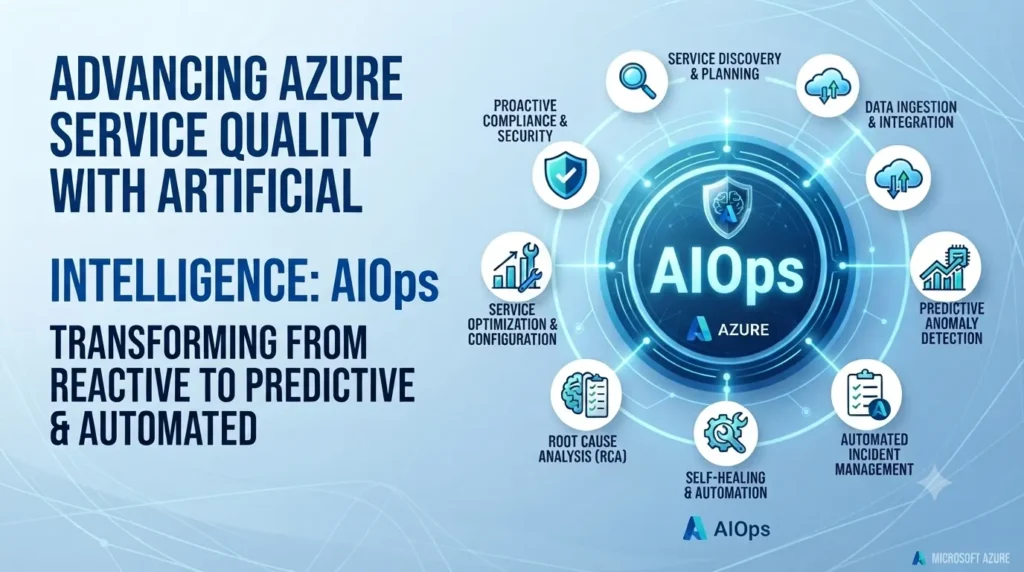
Microsoft Azure AIOps dashboard displaying AI-powered monitoring, predictive failure alerts, and real-time infrastructure health.

Advancing Azure service quality with artificial intelligence: AIOps

INTRO Somewhere on Azure’s infrastructure, a disk was predicted to fail — and your workload was migrated off it before that failure ever happened. That’s not a hypothetical. It’s Azure AIOps, Microsoft’s use of AI and machine learning to detect, predict, and fix infrastructure problems before they become customer-facing outages. For a business evaluating cloud reliability, this matters less as an engineering curiosity and more as a straight answer to a practical question: why does Azure keep improving its uptime numbers year over year? Failures Get Predicted, Not Just Detected Traditional infrastructure monitoring tells you something broke. Azure’s hardware failure prediction model tries to catch it before it does — flagging disks, memory, and networking hardware likely to fail, then automatically live-migrating affected virtual machines to healthy nodes. The customer impact of a hardware failure, in the cases this catches, is zero downtime rather than an outage ticket. Faster VM Provisioning, Powered by Prediction Azure’s pre-provisioning system uses historical deployment patterns to predict what VM configurations customers are likely to request — and creates a pool of them in advance. When a matching request comes in, it’s assigned from that pool instead of built from scratch. The practical effect for a business is faster deployment latency, without needing to know any of the prediction modeling happening behind it. Incidents Get Resolved Before They Escalate Azure tracks incident response against three metrics: time to detect, time to engage, and time to mitigate. AI-driven anomaly detection — built to catch not just obvious spikes but slow-building patterns like memory leaks — feeds directly into routing the right engineering team to an issue immediately, and in some cases triggers automated fixes with no human step at all. For a business running production workloads, that translates to shorter, less frequent disruptions. Safe Rollouts Prevent Widespread Impact Microsoft rolls out infrastructure changes constantly, which creates real risk of a bad change spreading before anyone notices. An internal system (code-named Gandalf) analyzes rollout patterns to catch issues that surface hours or days later, flagging suspicious changes before they propagate further. This is part of why platform-wide incidents from routine updates are rare rather than common. What This Actually Means for Your IT Roadmap None of this requires action on your end — it’s infrastructure Microsoft operates on your behalf. What it does mean is that Azure’s reliability improvements aren’t marketing claims; they’re the output of a systematic prediction-and-automation investment, which is a reasonable thing to weigh when comparing cloud providers on uptime and reliability, not just price. Want to know how Azure’s reliability engineering translates to SLAs for your specific workload? Talk to Trident about your cloud infrastructure options. FAQ What is Azure AIOps?Azure AIOps is Microsoft’s use of AI and machine learning to predict, detect, and resolve infrastructure issues on Azure automatically — including hardware failure prediction, faster VM provisioning, and automated incident response. Does Azure AIOps require any setup from customers?No — it operates at Microsoft’s infrastructure level. Customers benefit from improved reliability and uptime without configuring anything themselves. How does Azure predict hardware failures before they happen?Microsoft Research and Azure built models that analyze disk, memory, and networking behavior to flag components likely to fail, then automatically migrate affected virtual machines to healthy hardware.

Advancing Azure service quality with artificial intelligence: AIOps Read More »

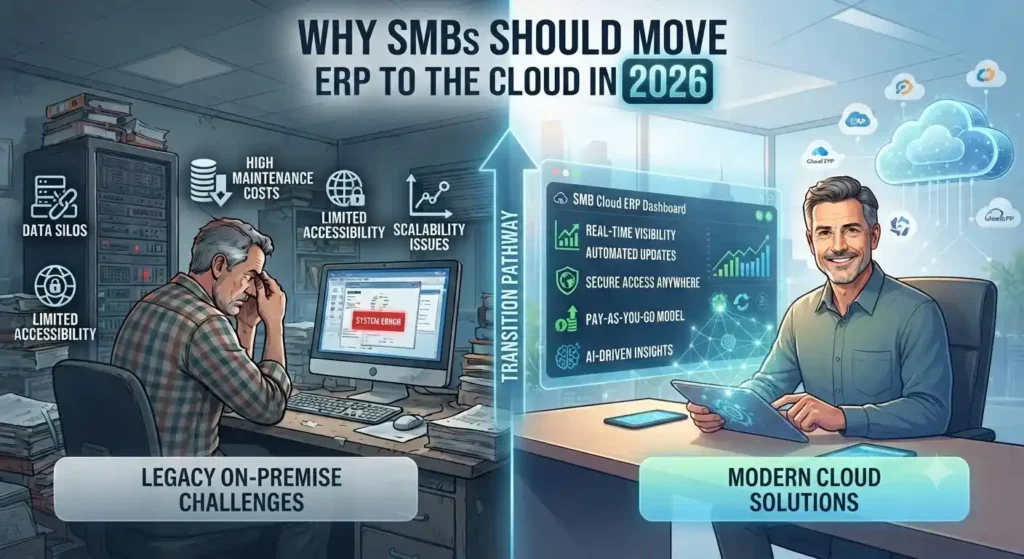
Cloud ERP dashboard helping SMBs manage finance, inventory, operations, and business performance.

Why SMBs Should Move ERP to the Cloud in 2026

Why SMBs Should Move ERP to the Cloud in 2026 Roughly 44% of small businesses now run meaningful cloud infrastructure, and that number keeps climbing. But most of that adoption is email and productivity tools — not the ERP system running finance, inventory, and operations. That gap is where SMBs quietly lose money every year. The Real Cost of Staying on Legacy ERP Companies spent 40% of their IT budgets in 2025 just keeping legacy systems running — patching, maintaining, and working around software that was outdated the day it was installed. That’s not investment; it’s maintenance debt with no return. Every year an SMB delays ERP migration, that wasted spend tends to grow, not shrink, because the gap between legacy capability and modern cloud ERP keeps widening. Global public cloud spending is projected to hit $723.4 billion in 2025, up from $595.7 billion the year before — a jump driven largely by core workloads shifting into the cloud, not just email. ERP is where legacy costs compound fastest, which is exactly why it’s driving so much of that growth. Predictable Costs Instead of Capital Surprises The CapEx-to-OpEx shift is the change SMBs feel first. Instead of a large upfront hardware and licensing spend followed by unpredictable maintenance bills, cloud ERP runs on subscription pricing tied to actual usage. For Microsoft-centric SMBs, this gets stronger. Azure Hybrid Benefit lets businesses that already own Windows Server or SQL Server licenses apply them toward cloud costs, cutting Azure VM costs by up to 40-55% compared to standard pay-as-you-go pricing. If your SMB already runs Microsoft 365 or Windows Server, that discount alone changes the ROI math on a Dynamics 365 migration. Security Concerns Are Backwards Now The instinct to keep ERP on-premises for “control” doesn’t hold up anymore. Modern cloud platforms often deliver stronger security, better uptime, and greater scalability than most SMBs can achieve running their own infrastructure. Built-in compliance frameworks and dedicated provider security teams cover ground most SMB IT teams can’t staff for — a real constraint for a five-person IT department juggling help desk tickets and server patching at the same time. Scalability Without the Hardware Gamble Legacy ERP forces a bet: buy enough server capacity for growth you haven’t hit yet, or underprovision and hit a wall mid-quarter. Cloud ERP removes that bet. Resources scale with actual transaction volume, seasonal demand, or headcount growth, with no hardware refresh cycle every three to five years. What This Means for a Dynamics 365 Decision For SMBs already in the Microsoft ecosystem, this isn’t a “should we move to the cloud” question anymore — it’s a “why are we still running Dynamics NAV or an on-prem F&O instance in 2026” question. The path to Dynamics 365 Business Central or Finance & Operations keeps the interface logic staff already know, while shifting cost structure, security posture, and scalability all at once. Still running ERP on-premises or on an older Dynamics NAV instance? Talk to Trident’s Dynamics 365 team about what a cloud migration looks like for your cost structure and timeline. FAQ Q: Is cloud ERP more secure than on-premises ERP for SMBs?A: Often yes — cloud providers invest in dedicated security teams and compliance frameworks most SMB IT departments can’t match in-house. Q: How much can SMBs save moving ERP to Azure?A: Businesses with existing Windows Server or SQL Server licenses can save 40-55% on Azure costs through Azure Hybrid Benefit. Q: What’s the cost of staying on legacy ERP systems?A: Organizations spent roughly 40% of their 2025 IT budgets just maintaining legacy systems — spend that delivers no new capability, only upkeep.

Why SMBs Should Move ERP to the Cloud in 2026 Read More »