Welcome to Trident Information Systems!
Write us to - info@tridentinfo.com
Let's Socialize

dynamics 365 business central

Learn how an electronics manufacturer unifies data and gains agility using Dynamics 365 Supply Chain Management

Bel Fuse designs, manufactures, and markets electronic circuits products at 24 manufacturing locations across North America, Europe, and Asia. The company’s existing enterprise resource planning solution was highly customized and expensive to maintain, so it decided to deploy Microsoft Dynamics 365 Finance and Dynamics 365 Supply Chain Management. Bel Fuse unified data and can now more easily manage its supply chain operations and finance processes, gaining more agility to respond quickly to changes in the market or its suppliers. With Dynamics 365, we save nearly USD2 million per year in IT service and support fees compared to our previous, highly customized solution. Mark Hodkinson: Vice President of Finance for the Bel Power Solutions Group Bel Fuse Essential step in the supply chain A typical consumer might interact with Bel Fuse products and not even know it. The manufacturer makes the components that power, protect, and connect electronic circuits in products we use every day. Bel Fuse is usually in the middle of the supply chain, relying on smaller parts from its suppliers before passing components on to the manufacturers that create finished products. Founded in 1949, the company has grown significantly in the last 20 years through acquisitions. It has seven business groups, including Bel Power Solutions, which it acquired in 2014. Bel Power Solutions makes the power conversion products for server and storage networks at large server farms and in industrial products like the power sources in hybrid electric vehicles and trains. To manage its enterprise resource planning (ERP) processes, Bel Power Solutions used a legacy version of Oracle that was highly customized and difficult to update. The version was outdated and the month-to-month costs and support for the solution were expensive. With different business units using different ERP systems, Bel Fuse wanted to find an affordable solution to unify the company’s finance and operations processes, starting with Bel Power Solutions. Bel Fuse also needed a solution that would support its material requirements planning (MRP) process, a production planning, scheduling, and inventory control system to manage its manufacturing processes. “Our MRP processing goes in both directions—we require a full dataset and forecasting of what’s coming to us and what’s going out,” says Scott Hasterlik, Director Global IT at Bel Fuse. “We have power assets with 500 components and 65,000 SKUs, so we needed a robust solution to share nonstandard information quickly.” An integrated solution for finance and operations After careful evaluation, Bel Fuse found that Microsoft Dynamics 365 had the right capabilities at the right price for the company’s needs. With Dynamics 365, Bel Fuse had a single system for the first time, the ability to report globally, and a solution that was intuitive to use and easy to add users. Bel Fuse uses Dynamics 365 Finance to automate its financial operations, monitor performance in real time, predict future outcomes, and make data-driven decisions. For operations, the company deployed Dynamics 365 Supply Chain Management, which includes an MRP function and AI to improve visibility across its global supply chain and to improve manufacturing productivity. To aid the quick, seamless deployment process, Bel Fuse worked with Flintfox, a Gold competency member of the Microsoft Partner Network. “Flintfox jumped in, understood what we wanted to accomplish, and helped us move forward on budget,” says Hasterlik. “Flintfox has been a fantastic partner and is still our partner of record.” A wide range of Bel Power Solutions employees now rely on the Finance and Supply Chain Management business applications. Users include staff in customer service, quality assurance, demand and product returns, manufacturing and supply chain ordering, accounts payable, accounts receivable, and engineering. “From decision makers to factory floor managers, everyone is working in Dynamics 365, staying connected and accessing valuable data,” says Stefan Naude, General Manager, Slovakia, at Bel Fuse. Reduced costs, disparate systems eliminated Bel Fuse accomplished its central goal—to reduce the high costs of its previous ERP system while bringing data together in one solution. The company built the capacity it needed without a lot of customizations, helping ensure that the solution would stay flexible in the future. “With Dynamics 365, we save nearly USD2 million per year in IT service and support fees compared to our previous, highly customized solution,” says Mark Hodkinson, Vice President of Finance for the Bel Power Solutions Group at Bel Fuse. Bel Fuse also reduced costs because it now has the tools to fulfill more of its own finance needs internally. For example, a Bel Fuse engineering and distribution site in Italy previously paid an outside firm to do its accounting. “It was easy to move the Italy site into Dynamics 365 and transfer all that work internally to our team in Slovakia,” says Hodkinson. “Now our own team manages the facility’s day-to-day finances even though they aren’t located in Italy. With a common system, we have better access to our own internal talent.” Increased visibility and agility With Dynamics 365, Bel Fuse gained a more global view of financial data and can perform more accurate forecasting. “I always view orders and revenue from a global perspective because the locations are all connected and have so many intercompany transactions,” says Hodkinson. “I rely on Dynamics 365 to help me make sense of complex financial histories to stay on top of complicated billing and payment processes at multiple sites.” With ERP data now centralized and easy to access in the cloud, Bel Fuse can respond with more agility to complex, changing circumstances. When employees in Italy, China, and other countries needed to work from home during the COVID-19 crisis, the company was able to effectively run remote finance and supply chain operations. “We kept all our finance functions moving forward even though we don’t have anyone physically in the office,” says Hodkinson. “We were impressed that our team was able to get everything done while working from home for the first time, and I think that speaks to how intuitive Dynamics 365 Finance was for our team.” As a mid-chain supplier, Bel Fuse is committed to continuing its operations on

Learn how an electronics manufacturer unifies data and gains agility using Dynamics 365 Supply Chain Management Read More »

Reinvent business productivity with Microsoft Dynamics 365 and Microsoft Office 365

Microsoft Dynamics 365 Business Central is an all-in-one business management solution that helps businesses manage financials, sales, service and operations easier and faster from day one. This e-book explores how the solution integrates with Office 365 to connect business processes and personal productivity like never before, bringing insight and efficiency to your daily tasks[/vc_column_text][/vc_column][/vc_row]

Reinvent business productivity with Microsoft Dynamics 365 and Microsoft Office 365 Read More »

Case Study on Microsoft Dynamic 365 from Leading Automotive Industry

Toyota Industries Corporation improves service operations to maximize uptime for their customers Toyota Industries Corporation (“Toyota Industries”) is Toyota group’s head company, with 90-plus years of history, and offers products that account for the world’s largest shares of the following three fields: forklifts, compressors for auto air conditioners, and air-jet looms. Toyota L&F Company, which develops, manufactures, sells, and  after-sales services forklifts, plans to improve the quality of their after-sales services by leveraging telematics and IoT for visualizing service operations. The company promotes the project and the introduction of Global Mobile Service Solutions (GMSS), together with Microsoft Enterprise Services. GMSS uses Microsoft Dynamics 365 for Field Service, and with telematics linked to Microsoft Azure to improve preventive maintenance and move further towards predicting failures. We strive to provide uniform, quality after-sales services in a global partnership with Microsoft. Going forward, I want to create a mechanism to collect forklift data by using IoT and telematics to prevent failures. Mr. Michio Yonezawa: General Manager, Services Department Toyota Industries Corporation Maximize Uptime by Leveraging Forklift Data Toyota Industries aims for further growth in the business of industrial vehicles that have grown into a business that accounts for 60% of the company’s. Mr. Michio Yonezawa, General Manager, Service Department, spoke of the significance of maximizing forklift utilization by offering after-sales services that meet the business needs of their forklift customers. “The mission of the Service Department is to improve our after-sales services and establish strong relationships with our customers, so that we can receive additional orders from them. We think that offering satisfying after-sales service ultimately contributes increase sales.” The company wanted to offer high quality services globally, and decided to introduce Dynamics 365 for Field Service as the primary tool for managing the after-sales service skills and operations for those distributors offering services to forklift customers all over the world. They wanted to improve their operational management accuracy, shift to a paperless process, reduce man-hours, and increase efficiency. They would do this by visualizing business KPIs in digital form, and laying out a framework to help boost their strengths and compensate for any weaknesses in various regions. Mr. Yonezawa explained the reasons for selecting Microsoft Enterprise Services as their partner in achieving their objectives, as follows. “Microsoft has many great accomplishments as a global IT company, and, above all, Microsoft Enterprise Services made an achievement to implement our systems to our European sites. In addition, Microsoft Enterprise Services not only understands the latest technologies, but they also develop systems based upon our after-sales service operations, and they provide global assistance. They will help us achieve our goal of global expansion.” Further, Toyota Industries plans to perform maintenance prior to the occurrence of failures, which also necessitates linkage technologies between the Microsoft cloud and IoT. The company uses Azure to collect machine information of their forklifts in operation. Linking information related to after-sales service from GMSS to the machine information in the cloud is expected to assist the Service Department in performing the right maintenance at the right time, preventing forklift failures from occurring at minimal cost. “Sudden failures greatly hinder the customer’s business activities, and generate extra-budgetary expenses. Previously, we conducted regular inspections in accordance with the guidelines based on how long the machines had been operating. By leveraging the machine information collected via telematics, inspections can be carried out in response to the customer’s usage, thereby reducing their burden,” explained Mr. Yonezawa. Visualization of Business Operations, Improvement in Productivity, and a Shift to a Paperless Process with GMSS Toyota Industries chose Microsoft Dynamics 365 for Field Service – which is already in worldwide use, cooperates with the latest technologies including IoT, AI, and machine learning, and enables practical applications – to visualize and improve after-sales service operations for GMSS development. Mr. Senichiro Kondo, who directs the global expansion of GMSS as the General Manager, Overseas Service Operation, Service Department, stated the reasons for selecting a cloud-based system for improving their after-sales service operations. “Since we manage operations in countries except for Europe and North America, the cloud enables us to facilitate management in a unified manner, and lay out a framework that helps provide the same services world-wide. In addition, Toyota could differentiate itself from its competitors by being first to introduce IoT to the service operations. Our competitors have not done this yet. The Microsoft cloud meets our security guidelines and we did not hesitate at all to use the cloud.” India was selected to be the first country for the deployment of GMSS, which occurred in February, 2018. “One reason we chose to deploy GMSS to India first is that we directly manage the distributors with standard service operations and it would allow us to examine their cost-effectiveness in detail. Another reason is that, if it is proven cost-effective in India, where wages are low, we could promote the deployment of GMSS to distributors in other countries,” said Mr. Kondo. In India, approximately 80 field service technicians had been receiving instructions on after-sales service operations in written form or manually. Technicians’ visit plans had been written on white boards, and material preparation before the visits was time-consuming. “The introduction of GMSS based on Microsoft Dynamics 365 for Field Services enabled the dispatchers to prepare and allocate instructions to give to the technicians. A mobile device app scheduled customer visits, periodical inspections and repair work for the technicians. Service reports can now be displayed on a screen, explained to the customer, signed by the customer, and submitted to the technician’s superior in a paperless stream, resulting in a significant improvement in work efficiency,” said Mr. Ryo Makino, a core member in charge of GMSS deployment in India, and Group Manager, Planning Group, Overseas Service Operation, Service Department. Various materials, including service materials, check sheet for maintenances, and visit histories that were used to previously store in separate locations can all be accessed from mobile devices, helping reduce the time taken to prepare them before paying the customer a visit.

Case Study on Microsoft Dynamic 365 from Leading Automotive Industry Read More »

Whitepaper: The business owner’s guide for replacing accounting software

Replacing your accounting software is easier and more affordable than you may think. Use this guide to learn about the benefits of a modern technology platform, better understand the advantages of a cloud-based solution, and know what questions to ask when evaluating your options.

Whitepaper: The business owner’s guide for replacing accounting software Read More »

Whitepaper : Four technology trends helping businesses thrive in a digital world

4 ways technology can help businesses thrive in a digital world. The good news is that the tools that help businesses capitalize on this digital transformation are more accessible than ever before. The cloud is removing barriers like high up-front costs, ongoing maintenance, and IT dependency.

Whitepaper : Four technology trends helping businesses thrive in a digital world Read More »

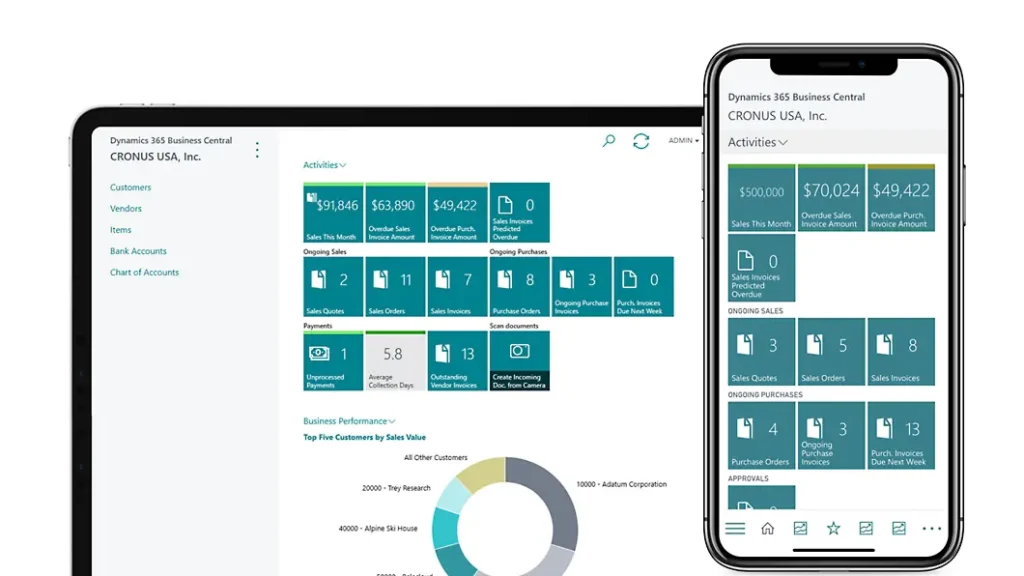
Microsoft Dynamics 365 Business Central dashboard managing finance, inventory, and business operations.

Microsoft Dynamics 365 Business Central: The All-in-One ERP Solution for Growing Businesses

Growing businesses reach a point where spreadsheets, disconnected accounting software, and manual processes stop being inconveniences and start being strategic risks. Inventory decisions made without real-time stock data. Financial close processes that take weeks instead of days. Sales teams working from customer records that do not reflect the latest service interactions. Supply chain planning that cannot see production capacity in real time. These are not just operational frustrations — they are competitive vulnerabilities in a market where speed and accuracy determine which businesses grow and which ones stall. Microsoft Dynamics 365 Business Central is built for exactly this inflection point. It is an all-in-one business management solution that connects finance, sales, supply chain, manufacturing, project management, and service operations on a single, intelligent platform — giving growing businesses the end-to-end visibility, automation depth, and real-time intelligence they need to make better decisions and accelerate growth. As the evolution of Microsoft Dynamics NAV — one of the world’s most widely deployed mid-market ERP platforms — Business Central combines the deep functional capability that NAV users trusted with the cloud-native architecture, embedded Power BI analytics, and Microsoft 365 integration that modern businesses require. Trident Information Systems is a certified Microsoft Dynamics 365 Business Central implementation partner — helping businesses across manufacturing, retail, professional services, and distribution implement, configure, and maximize the value of Business Central across India. This guide covers every major capability of Dynamics 365 Business Central — what it does, how it works, and what it delivers for growing businesses. What Is Microsoft Dynamics 365 Business Central? Microsoft Dynamics 365 Business Central is an all-in-one cloud ERP solution designed for small and mid-size businesses that need a single, integrated platform to manage their entire operation — without the complexity and cost of enterprise-grade ERP systems like Dynamics 365 Finance and Operations. The Evolution of Dynamics NAV: Built for Modern Business Business Central is the direct successor to Microsoft Dynamics NAV — one of the most successful mid-market ERP platforms in the world, with hundreds of thousands of deployments across more than 170 countries. If your organization is currently running Dynamics NAV, Business Central is your natural upgrade path — preserving the functional depth and business logic you depend on while adding cloud delivery, embedded AI, real-time analytics, and modern Microsoft 365 integration. For new implementations, Business Central offers the fastest path to a fully integrated business management platform — with preconfigured industry templates, rapid deployment methodology, and no-code customization tools that allow businesses to adapt the system to their specific processes without expensive custom development. Who Is Dynamics 365 Business Central Designed For? Business Central is designed for: Financial Management: Real-Time Intelligence Across Every Account Financial management is the operational core of Business Central — built to give finance teams the real-time visibility, automation, and control they need to close faster, report more accurately, and forecast with confidence. Make Informed Decisions With End-to-End Financial Visibility Business Central connects data across accounting, sales, purchasing, inventory, and customer interactions — creating a single, continuously updated financial picture of your business. Built-in Power BI dashboards display financial performance in real time, with drill-down capability from summary KPIs to individual transaction level: Accelerate Financial Close and Reporting Manual financial close processes consume weeks of finance team capacity every period — reconciling accounts, chasing documentation, and correcting errors that automated systems would have caught immediately. Business Central streamlines the entire close cycle: Improve Forecast Accuracy With Multi-Dimensional Analysis Business Central’s forecasting capabilities give finance and leadership teams the tools to model future performance with confidence: Core Financial Capabilities: GL, Fixed Assets, Receivables, and More Business Central’s financial module covers every dimension of business accounting: Customer Relationship Management: Deliver Value at Every Touchpoint Business Central includes integrated CRM capabilities — giving sales teams the customer intelligence, opportunity management tools, and productivity features they need to close more deals and build stronger relationships. Prioritize Leads, Track Interactions, and Close More Deals Boost Sales Productivity From Within Microsoft Outlook One of Business Central’s most practically impactful capabilities is its deep integration with Microsoft Outlook — the tool most sales professionals already spend the majority of their working day in: Dynamics 365 Business Central and Dynamics 365 Sales Integration For organizations that require deeper CRM functionality than Business Central’s native capabilities provide, Dynamics 365 for Sales integration is available natively — synchronizing sales orders, item availability, units of measure, and currencies between the two platforms in a few straightforward steps. Supply Chain Management: Automate, Optimize, and Protect Margins Business Central’s supply chain capabilities give purchasing, inventory, and operations teams the intelligence and automation to maintain optimal stock levels, avoid costly shortages, and protect margins through smarter procurement. Optimize Inventory Levels With Built-In Intelligence Avoid Stockouts and Lost Sales With Automated Replenishment Stockouts are one of the most costly and preventable operational failures in any product-based business. Business Central eliminates them through: Purchase and Sales Order Management Warehouse Management: Basic and Advanced Business Central’s warehouse management can be configured at different complexity levels — from basic order-by-order processing for simpler operations to advanced multi-order consolidation for high-volume distribution environments: Manufacturing: From Planning to Production to Delivery Business Central provides integrated manufacturing capabilities for companies that produce goods — from simple assembly operations through complex multi-level production with subcontracting. Production Planning and Capacity Optimization Subcontracting and Assembly Management Service Order Management: From After-Sales to Contract Management Business Central provides a complete service management framework — giving service operations teams the tools to manage service requests, service contracts, field technician dispatch, and pricing across the full service lifecycle: Project Management: Stay on Budget, Deliver on Time Business Central’s project management capabilities give professional services organizations and project-based businesses the tools to plan, track, and deliver customer projects profitably: Job Costing, Timesheets, and Resource Planning Analyze Project Profitability in Real Time Human Resources and Expense Management Business Central includes foundational human resources and expense management capabilities — giving HR and finance teams a single system for employee data and expense processing: Power

Microsoft Dynamics 365 Business Central: The All-in-One ERP Solution for Growing Businesses Read More »

Microsoft Dynamics 365 Connected Field Service dashboard monitoring predictive maintenance and service operations.

Microsoft Dynamics 365 Connected Field Service: How Industry Leaders Are Moving From Break-Fix to Predictive Service

What if your field technician could fix a problem before the customer even knew it existed? That is not a futuristic scenario. It is what Microsoft Dynamics 365 Connected Field Service — powered by IoT integration through Microsoft Azure — is delivering for industry leaders right now. And organizations that have made the switch are seeing return on investment in as little as four months. Field service has always been the moment of truth in customer relationships. The technician who arrives on time, with the right parts, with full knowledge of the customer’s history — or doesn’t — defines how that customer feels about your brand for years. But the traditional break-fix model of field service is no longer a viable competitive strategy. Customers today expect 100 percent uptime, hyper-speed service delivery, and proactive care that anticipates problems before they escalate. In an environment where competitive pressure is intensifying across every industry — from manufacturing and utilities to telecommunications and retail — field service has become a primary differentiator. The organizations winning are those that have moved from reactive to predictive, from disconnected to connected, and from legacy systems to intelligent, cloud-based field service platforms. This guide covers everything you need to know about Microsoft Dynamics 365 Connected Field Service — what it is, how it works, what real organizations have achieved with it, and how Trident Information Systems can implement it for your operation. The Field Service Revolution: Why the Old Model Is Failing From Break-Fix to Predictive: The New Standard for Field Service The break-fix model of field service — wait for something to fail, dispatch a technician, fix the problem, send the invoice — was the industry standard for decades. It worked adequately in a world where customers had limited alternatives and modest expectations. Neither of those conditions applies today. Modern customers expect continuous uptime, not reactive repairs. They expect service providers to know about potential failures before they occur — and to resolve them without disruption to operations. In industries like utilities, manufacturing, and facilities management, an unplanned outage or equipment failure is not just an inconvenience. It is a financial event, a safety risk, and a potential contract termination. The shift from break-fix to proactive and predictive service is not a trend — it is a market requirement. And it is only possible with the right connected technology infrastructure. Why Customer Experience Has Become the Frontline of Field Service Field service is no longer just an operational function. It is a customer experience function — and in many industries, it is the single most important touchpoint in the entire customer relationship. The field technician who arrives at a customer’s facility is representing your brand at its most direct and personal. What they know, what tools they have, how quickly they resolve the issue, and how well they communicate throughout the process determines whether that customer renews their contract, refers your company to others, or starts evaluating your competitors. This is why leading organizations across retail, telecommunications, manufacturing, utilities, and professional services are investing in connected field service — not just as an operational upgrade, but as a strategic investment in customer retention and competitive differentiation. What Is Microsoft Dynamics 365 Connected Field Service? Microsoft Dynamics 365 Connected Field Service is an intelligent, IoT-powered field service management solution that connects physical assets, field technicians, customer data, and service operations on a single platform — enabling organizations to shift from reactive maintenance to proactive, predictive service delivery. At its core, Connected Field Service integrates three technology layers that traditional field service solutions have always kept separate: When these three layers work together, something fundamental changes: your service operation stops reacting to failures and starts preventing them. IoT Integration: Knowing About Problems Before Customers Do The most powerful capability in Microsoft Dynamics 365 Connected Field Service is the integration with Microsoft Azure IoT Hub — which enables continuous monitoring of connected assets and automatic work order generation when sensor data indicates a potential failure. Here is what that means in practice: The result is not just faster service. It is service that prevents the problem from becoming a crisis — protecting the customer’s operations and your relationship simultaneously. Mobile-Connected Field Teams With a 360-Degree Customer View The value of IoT monitoring is only fully realized when the field technician who responds to it is properly equipped. Microsoft Dynamics 365 Connected Field Service gives every technician a complete, real-time view of the customer and asset before they arrive on site: When a technician arrives fully informed and properly equipped, first-time fix rates increase dramatically — and repeat visits, which are expensive for the service provider and frustrating for the customer, decrease proportionally. H3: Mixed Reality and the Future of Field Service Delivery Microsoft Dynamics 365 Connected Field Service also supports Mixed Reality technologies — including Microsoft HoloLens and Remote Assist — that are reshaping how complex field service challenges are resolved: Mixed Reality in field service is not yet universal — but for organizations managing complex, high-value assets in industries like aerospace, industrial manufacturing, and energy, it is rapidly becoming a standard capability. Real-World Proof: MacDonald Miller Facility Solutions Case Study Theory is valuable. Proof is better. The MacDonald Miller Facility Solutions case study is one of the most compelling demonstrations of what Microsoft Dynamics 365 Connected Field Service delivers in practice — and the speed at which it delivers it. The Challenge: Managing Complex, Interconnected Facility Systems MacDonald Miller Facility Solutions is a professional services company specializing in facilities management — a sector defined by complexity. Managing multiple interlocking, interdependent building systems across a large portfolio of client facilities, with the expectation of continuous uptime and proactive maintenance, requires a technology platform capable of integrating disparate data sources and coordinating rapid field response. Before adopting Connected Field Service, MacDonald Miller’s technicians were working without complete asset history when deployed to service calls. Work order creation and dispatch was reactive. The information needed to diagnose and resolve issues

Microsoft Dynamics 365 Connected Field Service: How Industry Leaders Are Moving From Break-Fix to Predictive Service Read More »

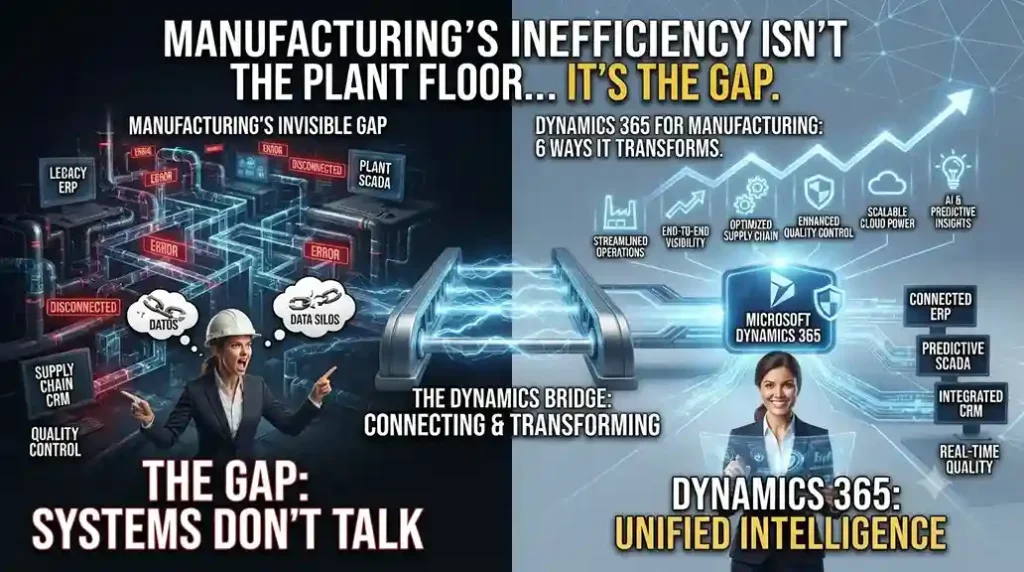
Microsoft Dynamics 365 dashboard managing electronics manufacturing production, quality, and operations.

Microsoft Dynamics 365 for Hi-Tech & Electronics Manufacturing: Faster Decisions, Leaner Operations, Higher Quality

In hi-tech and electronics manufacturing, standing still is falling behind. Product lifecycles are shrinking. Customer demands for configure-to-order, make-to-order, and assemble-to-order products are accelerating. Global sourcing networks are more complex — and more fragile — than ever before. And all of this is happening against a backdrop of tightening financial regulations, escalating environmental compliance requirements, and relentless competitive pressure on cost and quality. The manufacturers winning in this environment are not working harder. They are operating smarter — with hi-tech electronics manufacturing ERP software that gives them real-time visibility across the entire value chain, intelligent demand planning that adapts to volatile conditions, and the operational agility to respond to market changes before competitors even see them coming. Microsoft Dynamics 365 for hi-tech and electronics manufacturing — implemented by Trident Information Systems — is built precisely for this environment. Whether you are managing multi-level bills of materials across a global supplier network, coordinating complex configure-to-order production schedules, or trying to bring R&D change management under control, Trident’s industry solution gives you the tools, the intelligence, and the implementation expertise to transform operational complexity into competitive advantage. The Unique Challenges of Hi-Tech and Electronics Manufacturing Hi-tech and electronics manufacturing presents a combination of operational challenges that generic ERP platforms were never designed to handle. Understanding these challenges is the foundation of building a technology strategy capable of addressing them. Shrinking Product Lifecycles and Increasing BOM Complexity In the electronics industry, product lifecycles that once spanned five years now compress into 18 months or less. Every new product generation brings with it a new bill of materials, new component sourcing requirements, new production configurations, and new quality specifications — all of which must be managed simultaneously with the ongoing production of existing product lines. Without a comprehensive, automated MRP planning process, the higher the product and BOM complexity becomes, the greater the risk of production delays, component shortages, cost overruns, and quality failures. Manual planning processes simply cannot keep pace with the velocity of change in modern electronics manufacturing. Global Sourcing, Regulatory Compliance and Cost Pressure Global sourcing gives hi-tech manufacturers access to competitive component pricing — but it also introduces significant supply chain risk. Geopolitical disruptions, supplier quality failures, customs delays, and logistics volatility can cascade quickly into production stoppages and missed customer delivery commitments. At the same time, ever-changing financial and environmental regulations across multiple jurisdictions add compliance complexity and cost. Manufacturers operating across multiple countries need an ERP platform that handles local financial requirements, environmental reporting, and cross-border trade compliance — natively, not through expensive customization. The Configure-to-Order Imperative: Meeting Modern Customer Demands Today’s global customers no longer accept standard configurations. They demand products built to their exact specifications — configured, made, or assembled to order — delivered on time, every time, without quality compromise. Meeting this demand requires complete real-time visibility into delivery dates, component availability, production capacities, and external manufacturer capabilities — so your production team can commit to customer requirements with confidence, and execute on those commitments without scrambling. How Microsoft Dynamics 365 Solves Hi-Tech Manufacturing Challenges End-to-End Value Chain Visibility Across Every Production Stage Microsoft Dynamics 365 gives hi-tech manufacturers a unified, real-time view across every stage of the value chain — from raw material procurement and supplier management through production scheduling, quality control, inventory management, and customer delivery. When a component shortage emerges, your planning team sees it immediately — and your MRP system adjusts production schedules automatically. When a customer requests a configuration change mid-order, your system models the impact on delivery dates, inventory, and cost in real time. When a regulatory audit requires documentation across multiple production batches, every record is available instantly — without hours of manual retrieval. Rapid Implementation That Reduces Time-to-Value and Deployment Risk Every day your organization operates without the right ERP platform is a day of preventable inefficiency. Trident’s implementation processes are specifically designed to reduce deployment time and risk — getting your manufacturing operation onto Dynamics 365 rapidly, with minimal disruption to ongoing production, and with the flexibility to build out additional capabilities progressively as your business evolves. Core Capabilities of Trident’s Hi-Tech Manufacturing ERP Solution Trident’s Hi-Tech Industry Solution is a comprehensive set of software and services built on Microsoft Dynamics 365, automating and streamlining every critical business process across the electronics manufacturing operation. Materials Management and Demand Planning In hi-tech manufacturing, conditions in materials management and demand planning change rapidly and without warning. New component requirements emerge constantly, order processes must be updated in real time, and production planning needs to respond quickly — and cost-effectively — to shifting market signals. Trident’s Hi-Tech Solution provides powerful, configurable MRP planning capabilities designed for the specific complexity of electronics manufacturing: Purchasing and Inventory Management Procurement in hi-tech manufacturing is not just about finding the lowest price — it is about managing the right balance of cost, quality, lead time, and supply security across a complex global vendor ecosystem. Trident’s purchasing and inventory management capabilities give your procurement team the tools to optimize every supplier relationship and every purchasing decision: Multi-Country, Multi-Product, Multi-Level Manufacturing For electronics manufacturers operating across multiple geographies, product lines, and production tiers, manufacturing visibility and coordination is the defining operational challenge. Trident’s multi-level manufacturing capabilities give your production management team complete control: Financial Accounting and Real-Time Cost Management Financial management in hi-tech manufacturing is inseparable from operational management. When a production order runs over budget, when a component price changes, or when a customer project hits a cost threshold — your financial team needs to know immediately, not at month-end. Microsoft Dynamics 365’s financial management capabilities — as implemented by Trident — deliver full real-time integration between operational and financial data: Engineering Change Management and R&D Project Control Research and development is the lifeblood of hi-tech manufacturing — but R&D without rigorous process management is a significant financial and competitive risk. Efficient quality, time, and budget management for R&D processes directly determines whether a new product reaches market ahead of or behind the

Microsoft Dynamics 365 for Hi-Tech & Electronics Manufacturing: Faster Decisions, Leaner Operations, Higher Quality Read More »