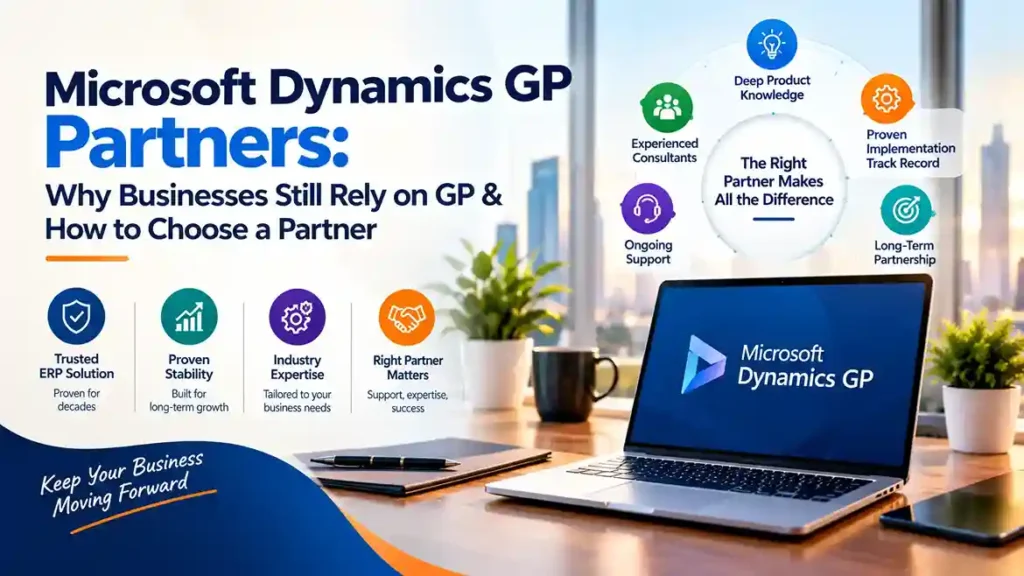
Microsoft Dynamics GP—formerly Great Plains—has been part of the Microsoft ERP family for over two decades. Despite Microsoft’s clear strategic focus on Dynamics 365 Business Central, thousands of organizations worldwide continue to run their businesses on GP.
The reason is straightforward: GP works. It handles core financials, distribution, payroll, and project accounting with reliability that businesses depend on. But the ecosystem around GP is changing, and choosing the right Microsoft Dynamics GP partners has never been more important.
This guide explains why businesses still rely on GP, what to look for in a partner, and how to plan for the future.
Why Businesses Still Rely on Microsoft Dynamics GP
Proven, Stable Functionality
Dynamics GP delivers core financial management—general ledger, accounts payable and receivable, bank reconciliation, fixed assets, and financial reporting—with maturity that comes from decades of refinement. For many mid-market businesses, GP’s functionality remains sufficient and familiar.
Deep Investment in Customization
Many GP customers have invested heavily in customizations, integrations, and third-party add-ons tailored to their operations. Replacing GP means replacing all of that—a cost that is hard to justify without a compelling business case.
Familiarity and Low Disruption
Staff know GP. Processes are built around it. Reports are designed for it. Migration carries disruption risk that many organizations are reluctant to accept without clear ROI.
Ongoing Third-Party Ecosystem
A robust community of ISVs continues to support GP with payroll, distribution, manufacturing, and industry-specific solutions. This ecosystem extends GP’s useful life for many businesses.
Continued Microsoft Support
Microsoft continues to support Dynamics GP with updates and patches, though the roadmap has narrowed. GP remains a supported product—but it is no longer receiving major functional investment.
The Reality of GP’s Roadmap
Honest guidance requires acknowledging the direction of travel. Microsoft’s ERP investment is concentrated in Dynamics 365 Business Central and Finance & Operations. Dynamics GP receives maintenance support but not new feature development.
For many businesses, GP will continue to function well for years. But the strategic question is unavoidable: what is your long-term plan?
A skilled Dynamics GP Partner helps answer that question honestly—supporting current operations while planning a sensible transition timeline.
What to Look For in Microsoft Dynamics GP Partners
1. Deep GP Product Knowledge
GP is a mature product with a long history of versions, add-ons, and customizations. Partners who have worked with GP for years understand its quirks, common integration points, and upgrade paths in ways newer partners cannot replicate.
Ask:
- How long have you supported Dynamics GP?
- Which GP versions do you actively support?
- Can you provide references from businesses using similar customizations?
2. Migration and Upgrade Experience
Whether you are upgrading your existing GP environment or planning a move to Business Central, your partner needs proven migration experience. This includes:
- GP version upgrades within the GP family
- GP to Business Central migrations using Microsoft’s tools
- Data cleansing and validation methodology
- Integration redevelopment for cloud environments
Partners with dedicated migration practices reduce risk and timeline uncertainty.
3. Third-Party Add-On Expertise
Most GP environments depend on ISV add-ons for payroll, distribution, manufacturing, or industry functionality. Your partner should understand these add-ons, their vendors, and how they translate (or do not) to cloud ERP.
Some add-ons have Business Central equivalents; others do not. Knowing the difference before migration prevents surprises.
4. Microsoft ERP Software Breadth
A partner focused only on GP may not be the best partner for your future. Look for partners with demonstrated expertise across Microsoft Dynamics ERP Software—including Business Central and Finance & Operations. This breadth means your partner can support your current GP environment and guide a confident transition when the time is right.
5. Support Responsiveness and SLAs
For businesses running critical financial operations on GP, support responsiveness matters. Confirm:
- Defined response and resolution times
- Coverage for period-end close
- Escalation paths for critical issues
- Familiarity with your specific customizations
6. Understanding of Microsoft Dynamics NAV Software Migration Patterns
Many GP customers also operate or have historically operated Microsoft Dynamics NAV Software in other divisions or through acquisitions. Partners who understand both GP and NAV migration paths to Business Central offer valuable perspective on consolidation opportunities.
Why GP Partners Matter More Than Ever
As Microsoft’s investment shifts, the pool of experienced GP consultants is gradually shrinking. Partners who remain committed to GP support are increasingly valuable—and increasingly selective about which clients they take on.
This makes partner selection more consequential. The right partner provides:
- Reliable support for your current GP investment
- Honest guidance on the GP roadmap
- A credible migration plan when you are ready
- Continuity of knowledge across your customizations
The wrong partner may underinvest in GP expertise while pushing an early migration that does not fit your business timeline.
How to Choose a Dynamics GP Partner: Practical Steps
Step 1: Document your GP environment.
Inventory your GP version, modules in use, customizations, add-ons, integrations, and reporting dependencies. This documentation is essential for evaluating any partner.
Step 2: Request GP-specific references.
Ask for clients using GP with similar customizations and add-ons. Speak with them about support quality and upgrade experiences.
Step 3: Assess migration capability.
Even if you are not migrating now, understand your partner’s migration experience. Their readiness determines your future options.
Step 4: Confirm support terms.
Review SLAs, escalation paths, and coverage during critical periods like month-end and year-end.
Step 5: Discuss the roadmap openly.
Ask directly: What is your recommendation for our GP environment over the next three to five years? Partners who avoid this conversation are not serving your interests.
When Should You Consider Migrating from GP?
Migration makes sense when:
- Your GP version approaches end of support
- Customizations no longer deliver competitive advantage
- You need cloud access, mobility, or modern analytics
- Compliance requirements exceed GP’s capabilities
- Integration with modern systems becomes essential
- Total cost of maintaining GP exceeds cloud ERP costs
Migration does not make sense purely because GP is older. It makes sense when business needs outgrow the platform.
Final Thoughts
Microsoft Dynamics GP remains a reliable ERP for thousands of businesses, and skilled Microsoft Dynamics GP partners continue to deliver value supporting it. The key is choosing a partner who combines deep GP expertise with broader Microsoft ERP software knowledge and credible migration capability.
Whether you stay on GP for years or plan a move to Business Central, the right partner provides honest guidance, dependable support, and a clear path forward.
Looking for experienced Dynamics GP support or migration planning? Contact a certified Microsoft partner to review your GP environment and discuss your options.