Welcome to Trident Information Systems!
Write us to - info@tridentinfo.com
Let's Socialize

cloud services provider

How does Microsoft Azure Cloud help to Boost Productivity & Security?  

If you are looking for a service to improve business productivity and supply security to your organizational data, then Microsoft Azure Services are for you. Take advantage of universally available, scalable, and secure cloud infrastructure with Azure, and pay only for the resources you use.   Microsoft Azure Cloud Computing helps in:    Boosting remote productivity with a seamless virtual desktop experience.   Delivering efficiency with unified security and management capabilities.   Saving money by migrating to the cloud and getting more value from existing investments.   Businesses today face significant challenges, from enabling a remote work infrastructure and responding to increasing cyberattacks to managing cash flow.   Many companies follow policies to secure customer data. However, many times they do not fulfil end-to-end security requirements. Hacking attempts might not let a business use its software. Up to 28% of organizations meet data breaches and loss of revenue. It is a grave issue that needs to be fixed.   Poor work management is one of the factors hampering your business productivity. Every organization hires managers to create strategies and implement them in the best way possible for maximum output. Lower productivity could also be an outcome of deficiency of your current technology.   How Azure Guarantees Security?   It is recommended to follow the best security practices soon as you put your data on Azure. With a built-in security control, Azure gets you faster protection across network, identity, data, and tools with threat protection and security management. Microsoft Azure Services supplies the following services:    Manages Access and Identity    With Azure Active Directory, Microsoft centrally administers access throughout your Microsoft Azure Services such as Office 365 and multiple PaaS and SaaS (Software as a Service) cloud as well as on-premises services. Active Directory is the most used directory service globally. You can also secure your access with Microsoft Azure Services Multi-Factor Authentication as recommended by Microsoft itself.   Guarantees Network Security   With the help of Azure Virtual Network (VNet), Azure builds and maintains a secured network by segmenting subnets and configuring access rules via network and application security groups. You can also extend your on-premises network with a dedicated Azure EXPRESS ROUTE connection or a VPN. It also protects your applications with its in-built Web Application security system. It has already been announced that Azure DDoS Protection Standards offers better control over your DDoS Protection for virtual networks with turnkey protection, alerting, and telemetry.   Safeguards Data and Manages Secrets   When your data is in transit, don’t worry about security as Microsoft Azure Services take care of it. It uses industry-standard protocols for data encryption in transit between devices and Microsoft datacenters. The best part is that you can even protect your data when the recent Azure confidential computing is using it.   Threat Detection with Unified Security Management   Get insights into your security issues with the Microsoft Azure security center. Scan your workload and get a picture of what you need to fix. Azure security center exceeds the agentless alternative abilities you can find in other cloud services to detect threats in virtual machines and cloud resources with the help of an agent. You can make your security posture firmer with its reach across networking, identity, data, security management, and threat protection.   Boost Productivity with Microsoft Azure   Microsoft Azure Services with other services promises a productivity boost by streamlining work processes and offering a comprehensive ecosystem for the organization. you can get the following benefits:    Various Scalability Options    Microsoft integrates industry-standard level functions in azure. Organizations do not even have to fear going out of budget if integrated advanced solutions are what they look for. With Azure’s established infrastructure, they can easily deploy and change their web apps in no time.   Comprehensive Microsoft Ecosystem   This is one of the significances of Microsoft Azure, it comes with seamless integrations with your current Microsoft database and applications. Most of the businesses use Microsoft’s legacy organizational app suite for several years. When you adopt Azure, you do not have to bother with those tedious seminars since Microsoft cloud-based services offer the same user interface and have an essence familiar with almost all the Microsoft products.   Reliable Analytical Support    Organizations form their strategies by simply engaging with advanced data analytics. Earlier, this was an easily available option for enterprise-size businesses however, with a digital boost and craving for the “big data ” even SMBs can access this feature.   You can easily manage and access your organizational data with Microsoft Azure Services and get valuable insights. With the help of machine learning abilities, managed SQL services, stream analytics, and Cortana analytics your business gets wide assistance to make more valuable decisions and reveal the latest opportunities for sustainable and continuous growth.   Widespread Data Centre    Microsoft Azure Services own more data centers than anyone else across the globe. It allows instant data access and cuts any time lag that can hamper your productivity. For a business aiming to scale, data lagging can be one of the biggest hurdles of all time. As virtual machine systems replicate data throughout various regions, each user benefits from cloud connection.   Backup and Archive    You can follow business requirements and drop expensive business disruptions with Microsoft Azure. You no longer must worry about data loss since you have azure backup storage and archive options. Minimize cost and complexity and enhance efficiency and scalability. Even if your on-premises device is damaged, you still have your data backed up within the cloud. Business operations are bound to run smoothly. You can keep up with your business expansion and reduce deployment and management costs.   Disaster Recovery    If you majorly rely on your on-premises system to process your business operations, it is essential to get a backup plan ready as a minute system outrage can cause you severe losses. With Microsoft Azure you get a disaster recovery plan which allows a complete data download; from site data to application data in one go. Therefore, you can swear by its security and continuity of your operations.   Bottom Line    Microsoft Azure Services can be a game-changer for SMBs and larger businesses. With its tremendous benefits, witness rapid scaling of your

How does Microsoft Azure Cloud help to Boost Productivity & Security?   Read More »
Cutting IT Costs: 5 Ways to Minimize Ongoing Costs  

Is your IT sector eating up a lot of your company’s time and money? It is time to say no to money drain. Instead, we have rolled out the top five tips that can help you get rid of that excessive money loss. To tackle these, businesses are opting for cloud computing like Microsoft Azure Cloud, like Microsoft Business Central.  Businesses these days are looking for every measure to reduce their costs in any way without even considering how much their IT demands investments. They keep their IT staff engaged in constant upgrade, maintenance, and other time and money-consuming jobs. Little do they realize how much they can save only if they shift their approach and embrace what the modern market has to offer.  You can save a fortune if you adopt the right strategies and invest it into something more meaningful or you can simply increase your profit margin. You need to consider if your current system provides satisfactory ROI (Return on Investment). If not, it is time for an ultimate shift because your system is not taking you anywhere else.  We have rolled out the top five strategies you can implement and save a fortune.  #1 Move to a Cloud-Based System  On-premises software is going to demand a lot of your time and monetary investment. From implementation to maintenance to upgrades it is a time and money-consuming process. The implementation itself is costly and then comes the costs of hardware and maintenance. It is all too much to handle. Instead, we recommend you switch to a cloud-based solution where you do not need to engage your IT staff in its maintenance and other activities, you can encourage them to work on something more productive. A cloud-based system has proven to provide a greater ROI than an on-premises solution. Therefore, it is wiser to invest in cloud-oriented solutions.   #2 Automate Updates   When it comes to updates, make sure you do not have to make your IT staff spend tons of hours on it. It is better to opt for services that take charge of the updates automatically, for instance: Microsoft Business Central is one of the providers who take responsibility for your system’s update, implementation, and maintenance. You do not need any hardware and you only pay for the implementation. Microsoft holds updates now and then and twice a year it conducts major updates for which you will be notified beforehand. This process will not hamper your operational fluency at all.   #3 Ditch Disparate Systems  It is best if you adopt an all-in-one ERP (Enterprise Resource Planning) solution (Enterprise Resource planning) for your business. You will no longer have to manage and maintain different systems for sales, marketing, and finances. Instead, you can get it all under the same system. Microsoft Dynamics 365 is one such software provider that collects data in a sole source and displays it through insightful reports. You have no idea how much time it saves you. This not only saves costs but also boosts your human resource potency. You can fill the labor gap, which is also a widespread issue these days.   #4 Ensure a Post-go-live Support   Make sure who-so-ever you are contacting to implement a solution, they must provide after-implementation support to your business. Because no matter how efficient a system is, it is still likely to face some downtime at least once. You do not want to be left on your own and make your business suffer when that time comes. Thus, who you prefer for the implementation is a vital process. Choose someone with a robust record of accomplishment and solid experience in your field. Trident Information Systems is a Gold Microsoft Dynamics 365 Partner with experience of more than 2 decades. Reinforced with a massive team of experts, it has managed to accomplish a robust record of accomplishment so far.   #5: Implement DevOps and Agile practices  DevOps and Agile are collaborative practices that typically break down an organization’s silos between software developers and IT operational personnel. Orienting quicker time-to-market, low failure rates, quick updates, and fixes as well as faster recovery from system issues. They deliver an application-centric infrastructure built around boosting service and application delivery rather than managing switches, servers, telecommunication lines, and firewalls.   One of the best ways to save on your IT is to switch to a cloud-based solution like Microsoft Business Central, which takes charge of your implementation, maintenance, and upgrades while making sure you are always on the latest version. If you are looking for an implementation partner, contact Trident Information Systems, one of the Gold Partners of Microsoft Dynamics.  

Cutting IT Costs: 5 Ways to Minimize Ongoing Costs   Read More »

Why is Enterprise Mobility a Must-Have for your Business?

Have you thought of considering Enterprise Mobility Services already? If not, what are you waiting for? Enterprise Mobility showers tremendous benefits while allowing businesses to work remotely from any location via their laptops, personal computers, etc.   Businesses can access their data from the cloud. There are pretty good reasons why enterprise mobility is a boom these days: you get reduced resources, IT gaps being filled, and enhanced productivity all together!   It is a massive computation of innovation and collaboration for achieving organizational goals. Some enterprises might prefer a combination of an on-premise and remote working system for their employees. Overall, it is an effective and efficient technicity to attain business goals.    What is Enterprise Mobility?  Enterprise Mobility is usually addressed to Enterprise Mobility Management (EMM). It encompasses the comprehensive operations centered around data stored in a remote location- typically a cloud. It is usually the end-point management that checks on the inputs users can access, also the devices at hand being used.   Why Enterprise Mobility?   Credited to its flexibility and efficiency, enterprise mobility generously yields organizational benefits. You reap increased productivity, minimized benefits, and increased customer satisfaction, security, etc.   You can access Enterprise Mobility Services via Mobile App for Sales Tracking, Fields Sales Tracking Apps, etc. Enterprise Mobility Management (EMM) comprises people, technology, and services responsible to take care of the organizational data within its employee’s mobile devices. This rising on-demand trend allows entrepreneurs to operate their businesses in a safe, secured, and efficient environment without any hindrances.   Enterprise Mobility: A Must-Have    If you are still holding on to the traditional paper-oriented workflow system, it is time for a shift. Due to its Dynamic adaptability, mobility offers businesses flexible and competitive tools for sustainable growth. There are “n” number of reasons to adopt Enterprise Mobility. Some of them are:    Reduced operational costs    Competitive Advantages    Data Sharing Enablement   Targeted Support    Better Cost Management    Higher Customer Engagement    Reduced Operational Costs    Shifting your paper-based approach to the cloud is the ultimate game-changer. Being able to communicate with people across various locations via web and other mobile interfaces minimizes labor efforts and saves time. Once you are on this page, get ready to embrace streamlined operations. Therefore, save time and cut operational costs as much as possible. Instead, optimize your resources on other KPIs that need manual labor.   Competitive Advantages    One of the biggest challenges for any enterprise is to surpass its competition. Enterprise Mobility provides a set of flexible tools to streamline business operations as much as possible. Getting robust technology supporting web and mobile platforms simultaneously offers a secure and reliable business operation. Thus, generate superior values for the business. With enterprise mobility, you get to digitize business flow, drive better product and customer support, produce better quality at minimum costs, manage team and operation, streamline internal practices.   Data Sharing Enablement   Enterprise mobility is the greatest boon to modern businesses. With easy data transfer, organizations are embracing maximum benefits from this technology. Enterprise Mobility allows employees to share insights, data, and screens to enlighten customers more comprehensively, and ensures seamless regulation of relevant data throughout the organization. With this advancement, the owner can establish an enterprise mobility-enabled foundation, complying with the standard to ensure secure communication or data transfer. Organizations can tremendously embrace greater transparency and greater customer engagement.   Targeted Support    Enterprise Mobility frees up IT departments by providing timely and targeted support to the end-users. It typically connects employees with the resources and the tools to attain business goals, as well as drives IT resources to develop more useful business systems. It also pilots companies to recognize the importance of technology much sooner, allowing for deeper insights derived from the collected data, enabling more logical decisions.   Better Cost Management    Enterprise mobility reduces IT costs to a considerable extent. It minimizes in-house applications and ongoing IT maintenance through regular performance management and measurement. Cost management does not only optimize business spending throughout the organization but also ensures its proper allocation. With this technology, claim cost transparency, predictability, and management as your business scales.   Higher Customer Engagement    One of the key methods to get a massive loyal customer base is to provide prompt deliveries, no strategy is better than this. This mobile application ensures immediate interactions across users via quick messages and calls. Field technicians can resolve their queries in no time utilizing robust communication of these handy.   Why Trident?   With tons of Enterprise Mobility Service Providers around, endorsing themselves to be the best, it is important to do your research first. Trident Information Systems optimizes the Xamarin platform to develop and engage cross-platform and similar apps for iOS, Android such as Sales Automation Apps, which integrate business data to your staff’s mobiles. Our Enterprise Mobility Services ensure data security, ERP (Enterprise Resource Planning), CRM, and other line-of-business systems integration, irrespective of being on-premise, on the cloud, or in a hybrid environment.  

Why is Enterprise Mobility a Must-Have for your Business? Read More »

Why You Should Move Your IT Infrastructure to the Cloud?

Cloud service defines how businesses are going to operate. It is a business model taking the world by storm. Cloud computing defines not only how a business is going to operate and access their data but also what perks they can avail themselves of by their cloud service providers. Microsoft Cloud Azure Services is one of the biggest cloud service providers, assuring multiple and unique benefits to businesses irrespective of their size and structure.   Its flexibility and easy deployment get everyone. With faster data recovery and least maintenance save the bulk of your time. In Contrast, it gets more difficult to work on-premises due to its limited features.   While working on-premise, your business might come across:  Upgrading Issues: Upgrading your on-premise system might require certain investments.   Data lock: data locked in the previous format cannot be shared easily.   Complicated Deployment: the customer must purchase, deploy, operate, and upgrade their own IT infrastructure to get the software going.   Cloud: The Ultimate Business Booster  Get an automatic virtual office you can access anytime, anywhere via the growing web-enabled devices, such as tablets, smartphones, and so on. With the flexibility and additional perks of the cloud service provider, cloud computing becomes your ultimate business booster.   Increased Security  With essential data being saved to the cloud, you no longer must worry even if your laptop gets lost or breaks down. You can still access your company’s interface via another device. Since everything is stored online, you never have to worry about losing the company’s essential data to broken hardware.   Additionally, it gets a lot harder for someone to steal yours with comprehensive encryption and a login security system. Cloud computing gets your data to a safe place. On-premise systems can hardly provide this feature. As soon as your hardware disrupts, you lose your data unless you replicate it.   Reduced IT Costs   Cloud computing reduces IT running and management costs. Since you no longer must purchase expensive hardware and equipment for your business, you can use the tools your service provider provides and reduce operating costs. Your system upgrade costs fall significantly, and you even have new software and hardware comprehended within your contract. You cut costs on IT expert wages; you may also end up reducing your energy consumption with fewer time delays.   Scalability   You may want to scale-up or scale-down your business operation howsoever your current situation demands, allowing enough flexibility for desirable customizations. With an On-premise system, this whole thing becomes tedious and expensive. However, you no longer must worry about it with cloud; your cloud computer service provider handles the process on your behalf. Cloud can save a good deal of time so that you can optimize for more profitable causes.    Collaboration Efficiency   Cloud collaborates with your staff, clients, and third-party easier. You can share files or data more easily outside of your traditional methods. Suppose you have your staff working across various locations, or there are certain files you must share with the contractor, you can easily share its cloud access with them. Additionally, you can also utilize cloud computing models to share data with your advisors. For instance, sharing accounting records with your financial advisers quickly and securely.   Automatic Updates   Automatic Update fees depend upon your cloud service provider and the package. Depending upon the cloud computing service provider your system will be updated to the latest version, which might include up-to-date versions of the software, also the servers and computer processing power.   Cloud-Based Licensing      One of the most popular cloud-based licensing is MS Azure Licensing exhibiting vast benefits. The most attractive feature has to do with ease of usage and management according to the customer’s needs and desires. Microsoft Azure Licensing allows vendors and software developers to deliver software easily and quickly and give complete control to the customers over their licenses, their analytics, and much more.   How Microsoft Azure Outshines Other Cloud Service  Moving your IT infrastructure to Azure is a massive shift in how traditionally your business thinks of IT resources. Given below are top reasons how Azure Cloud Services outshine others:   Cost:  Cloud computing eliminates the capital expenses of purchasing hardware and software, and on-site data center running costs, i.e., the server racks, round the cloud electricity costs for power and cooling, also the IT experts for running and maintaining the infrastructure.   Global Scale: one of the major benefits of Azure is its elasticity. In terms of the cloud, this means delivering the right services at the location. For instance, diverse levels of computing powers, Bandwidth, and storage – right on time at the right geographic location.   Speed: Microsoft Azure delivers automatic services as well as on-demand. Therefore, provisioning a major amount of computing resources in a few clicks. It is flexible enough to take over the capacity planning pressure within a few clicks.   Productivity: Cloud computing eliminates the “rack and stack issues” such as software patching, hardware setup, and other tedious tasks. Therefore, your IT team can engage themselves in more productive tasks.   Performance: Microsoft Azure runs on the most worldwide network of secured data centers. It is frequently upgraded to the latest generation of fast and efficient computing hardware. Thus, availing multiple benefits on a single data center incorporating minimum application network latency and vast economies of scale   Reliability: Microsoft Azure allows easier MS Azure Backup, disaster recovery, and business continuity at minimum costs since the data can easily be replicated at multiple redundant sites within the provider’s network.   Armed with 150+ technical resources and over two decades of experience, Trident Information Systems has received multiple awards and is now renowned as the Gold partner of Microsoft Azure and LS Retail. We have a strong track of providing various successful businesses with Microsoft Azure Cloud Services. For further queries, contact us.

Why You Should Move Your IT Infrastructure to the Cloud? Read More »

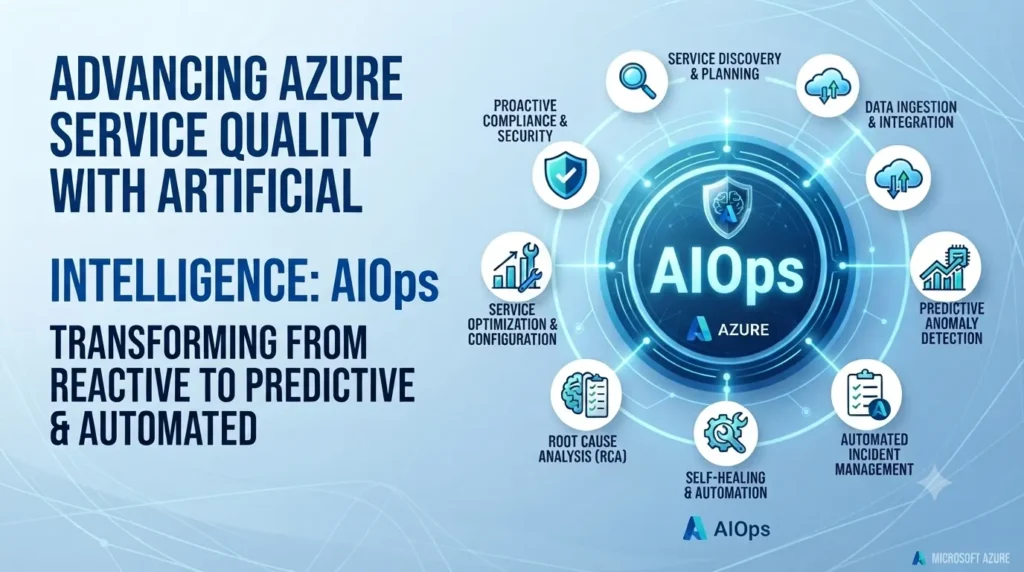
Microsoft Azure AIOps dashboard displaying AI-powered monitoring, predictive failure alerts, and real-time infrastructure health.

Advancing Azure service quality with artificial intelligence: AIOps

INTRO Somewhere on Azure’s infrastructure, a disk was predicted to fail — and your workload was migrated off it before that failure ever happened. That’s not a hypothetical. It’s Azure AIOps, Microsoft’s use of AI and machine learning to detect, predict, and fix infrastructure problems before they become customer-facing outages. For a business evaluating cloud reliability, this matters less as an engineering curiosity and more as a straight answer to a practical question: why does Azure keep improving its uptime numbers year over year? Failures Get Predicted, Not Just Detected Traditional infrastructure monitoring tells you something broke. Azure’s hardware failure prediction model tries to catch it before it does — flagging disks, memory, and networking hardware likely to fail, then automatically live-migrating affected virtual machines to healthy nodes. The customer impact of a hardware failure, in the cases this catches, is zero downtime rather than an outage ticket. Faster VM Provisioning, Powered by Prediction Azure’s pre-provisioning system uses historical deployment patterns to predict what VM configurations customers are likely to request — and creates a pool of them in advance. When a matching request comes in, it’s assigned from that pool instead of built from scratch. The practical effect for a business is faster deployment latency, without needing to know any of the prediction modeling happening behind it. Incidents Get Resolved Before They Escalate Azure tracks incident response against three metrics: time to detect, time to engage, and time to mitigate. AI-driven anomaly detection — built to catch not just obvious spikes but slow-building patterns like memory leaks — feeds directly into routing the right engineering team to an issue immediately, and in some cases triggers automated fixes with no human step at all. For a business running production workloads, that translates to shorter, less frequent disruptions. Safe Rollouts Prevent Widespread Impact Microsoft rolls out infrastructure changes constantly, which creates real risk of a bad change spreading before anyone notices. An internal system (code-named Gandalf) analyzes rollout patterns to catch issues that surface hours or days later, flagging suspicious changes before they propagate further. This is part of why platform-wide incidents from routine updates are rare rather than common. What This Actually Means for Your IT Roadmap None of this requires action on your end — it’s infrastructure Microsoft operates on your behalf. What it does mean is that Azure’s reliability improvements aren’t marketing claims; they’re the output of a systematic prediction-and-automation investment, which is a reasonable thing to weigh when comparing cloud providers on uptime and reliability, not just price. Want to know how Azure’s reliability engineering translates to SLAs for your specific workload? Talk to Trident about your cloud infrastructure options. FAQ What is Azure AIOps?Azure AIOps is Microsoft’s use of AI and machine learning to predict, detect, and resolve infrastructure issues on Azure automatically — including hardware failure prediction, faster VM provisioning, and automated incident response. Does Azure AIOps require any setup from customers?No — it operates at Microsoft’s infrastructure level. Customers benefit from improved reliability and uptime without configuring anything themselves. How does Azure predict hardware failures before they happen?Microsoft Research and Azure built models that analyze disk, memory, and networking behavior to flag components likely to fail, then automatically migrate affected virtual machines to healthy hardware.

Advancing Azure service quality with artificial intelligence: AIOps Read More »

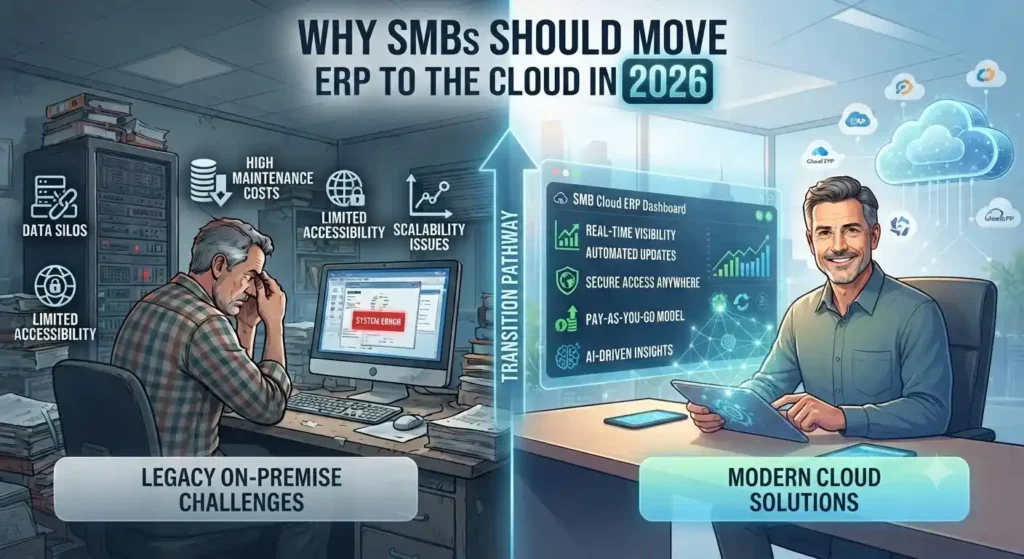
Cloud ERP dashboard helping SMBs manage finance, inventory, operations, and business performance.

Why SMBs Should Move ERP to the Cloud in 2026

Why SMBs Should Move ERP to the Cloud in 2026 Roughly 44% of small businesses now run meaningful cloud infrastructure, and that number keeps climbing. But most of that adoption is email and productivity tools — not the ERP system running finance, inventory, and operations. That gap is where SMBs quietly lose money every year. The Real Cost of Staying on Legacy ERP Companies spent 40% of their IT budgets in 2025 just keeping legacy systems running — patching, maintaining, and working around software that was outdated the day it was installed. That’s not investment; it’s maintenance debt with no return. Every year an SMB delays ERP migration, that wasted spend tends to grow, not shrink, because the gap between legacy capability and modern cloud ERP keeps widening. Global public cloud spending is projected to hit $723.4 billion in 2025, up from $595.7 billion the year before — a jump driven largely by core workloads shifting into the cloud, not just email. ERP is where legacy costs compound fastest, which is exactly why it’s driving so much of that growth. Predictable Costs Instead of Capital Surprises The CapEx-to-OpEx shift is the change SMBs feel first. Instead of a large upfront hardware and licensing spend followed by unpredictable maintenance bills, cloud ERP runs on subscription pricing tied to actual usage. For Microsoft-centric SMBs, this gets stronger. Azure Hybrid Benefit lets businesses that already own Windows Server or SQL Server licenses apply them toward cloud costs, cutting Azure VM costs by up to 40-55% compared to standard pay-as-you-go pricing. If your SMB already runs Microsoft 365 or Windows Server, that discount alone changes the ROI math on a Dynamics 365 migration. Security Concerns Are Backwards Now The instinct to keep ERP on-premises for “control” doesn’t hold up anymore. Modern cloud platforms often deliver stronger security, better uptime, and greater scalability than most SMBs can achieve running their own infrastructure. Built-in compliance frameworks and dedicated provider security teams cover ground most SMB IT teams can’t staff for — a real constraint for a five-person IT department juggling help desk tickets and server patching at the same time. Scalability Without the Hardware Gamble Legacy ERP forces a bet: buy enough server capacity for growth you haven’t hit yet, or underprovision and hit a wall mid-quarter. Cloud ERP removes that bet. Resources scale with actual transaction volume, seasonal demand, or headcount growth, with no hardware refresh cycle every three to five years. What This Means for a Dynamics 365 Decision For SMBs already in the Microsoft ecosystem, this isn’t a “should we move to the cloud” question anymore — it’s a “why are we still running Dynamics NAV or an on-prem F&O instance in 2026” question. The path to Dynamics 365 Business Central or Finance & Operations keeps the interface logic staff already know, while shifting cost structure, security posture, and scalability all at once. Still running ERP on-premises or on an older Dynamics NAV instance? Talk to Trident’s Dynamics 365 team about what a cloud migration looks like for your cost structure and timeline. FAQ Q: Is cloud ERP more secure than on-premises ERP for SMBs?A: Often yes — cloud providers invest in dedicated security teams and compliance frameworks most SMB IT departments can’t match in-house. Q: How much can SMBs save moving ERP to Azure?A: Businesses with existing Windows Server or SQL Server licenses can save 40-55% on Azure costs through Azure Hybrid Benefit. Q: What’s the cost of staying on legacy ERP systems?A: Organizations spent roughly 40% of their 2025 IT budgets just maintaining legacy systems — spend that delivers no new capability, only upkeep.

Why SMBs Should Move ERP to the Cloud in 2026 Read More »

Plan migration of physical servers using Azure Migrate

[vc_row][vc_column][vc_column_text]Previously, Azure Migrate: Server Assessment only supported VMware and Hyper-V virtual machine assessments for migration to Azure. At Ignite 2019, we added physical server support for assessment features like Azure suitability analysis, migration cost planning, performance-based rightsizing, and application dependency analysis. You can now plan at-scale, assessing up to 35K physical servers in one Azure Migrate project. If you use VMware or Hyper-V as well, you can discover and assess both physical and virtual servers in the same project. You can create groups of servers, assess by group and refine the groups further using application dependency information. While this feature is in preview, the preview is covered by customer support and can be used for production workloads. Let us look at how the assessment helps you plan migration. Azure suitability analysis The assessment checks Azure support for each server discovered and determines whether the server can be migrated as-is to Azure. If incompatibilities are found, remediation guidance is automatically provided. You can customize your assessment by changing its properties, and recomputing the assessment. Among other customizations, you can choose a virtual machine series of your choice and specify the uptime of the workloads you will run in Azure. Cost estimation and sizing Assessment also provides detailed cost estimates. Performance-based rightsizing assessments can be used to optimize on cost; the performance data of your on-premise server is used to recommend a suitable Azure Virtual Machine and disk SKU. This helps to optimize on cost and right-size as you migrate servers that might be over-provisioned in your on-premise data center. You can apply subscription offers and Reserved Instance pricing on the cost estimates. Dependency analysis Once you have established cost estimates and migration readiness, you can plan your migration phases. Using the dependency analysis feature, you can understand which workloads are interdependent and need to be migrated together. This also helps ensure you do not leave critical elements behind on-premise. You can visualize the dependencies in a map or extract the dependency data in a tabular format. You can divide your servers into groups and refine the groups for migration by reviewing the dependencies. Assess your physical servers in four simple steps Create an Azure Migrate project and add the Server Assessment solution to the project. Set up the Azure Migrate appliance and start discovery of your server. To set up discovery, the server names or IP addresses are required. Each appliance supports discovery of 250 servers. You can set up more than one appliance if required. Once you have successfully set up discovery, create assessments and review the assessment reports. Use the application dependency analysis features to create and refine server groups to phase your migration. When you are ready to migrate the servers to Azure, you can use Server Migration to carry out the migration, get in touch with us our team will help you.[/vc_column_text][/vc_column][/vc_row]

Plan migration of physical servers using Azure Migrate Read More »

Business team using CRM software to manage sales, customer data, and communication workflows.

5 Clear Signs Your Business Needs CRM Software in 2026

Here is a question most business owners ask too late: at what point does managing customer relationships in spreadsheets, email inboxes, and memory become a liability rather than a system? The honest answer is — sooner than you think. Customer Relationship Management (CRM) software is not just for large enterprises with complex sales teams. It is for any business that wants to grow its customer base, retain the customers it already has, and make sure no opportunity falls through the cracks. The challenge is recognising when the moment has arrived. Here are five clear signs that your business needs CRM software — and why Microsoft Dynamics 365 is the platform most businesses choose. What Is CRM Software and Why Does It Matter? CRM software is a centralised system that manages every interaction between your business and your customers — from the first marketing touchpoint through the sales cycle, the initial purchase, ongoing service, and renewal. Done well, CRM gives every team member a complete, real-time picture of every customer relationship. Sales knows what marketing has sent. Customer service knows what sales has promised. Management knows exactly where every opportunity stands. Without CRM, this information lives in individual inboxes, personal spreadsheets, and people’s heads — and every time someone leaves the business, some of that knowledge leaves with them. 5 Signs Your Business Needs CRM Software Now Sign 1 — You Are Losing Leads Without Knowing Why Leads come in through your website, social media, phone calls, and referrals. But if you are managing them manually, some of those leads are simply not being followed up — because they were logged in the wrong place, assigned to the wrong person, or forgotten during a busy week. A CRM captures every lead automatically, assigns it to the right team member, sets follow-up reminders, and tracks every interaction. Nothing gets lost. Every opportunity gets the attention it deserves. If you have ever discovered a warm lead that was never followed up weeks after it arrived — your business needs CRM. Sign 2 — Your Marketing and Sales Teams Work in Silos Marketing generates leads. Sales closes deals. But when these two teams work from different systems and different data, the handoff between them is where opportunities die. Marketing does not know which leads converted. Sales does not know which campaigns generated their best prospects. Neither team can make decisions based on the complete picture — because that picture does not exist in any single place. CRM creates a shared view of every customer and every lead — so marketing can see which campaigns produce sales-ready prospects and sales can engage leads with full context on their marketing journey. The result is better targeting, higher conversion rates, and a measurable improvement in revenue. If your marketing and sales teams regularly blame each other for pipeline problems — your business needs CRM. Sign 3 — You Cannot Easily Create Quotes and Track Invoices For businesses that sell through a quotation process — professional services, manufacturing, technology, or any B2B operation — the ability to create, track, and follow up on quotes directly impacts how quickly deals close. A CRM with a built-in quoting and invoicing module connects the entire opportunity-to-cash process: If your team is manually creating quotes in Word documents and tracking them in a spreadsheet — your business needs CRM. Sign 4 — Customer Service Issues Are Falling Through the Gaps Customer service quality is directly tied to information quality. When a customer calls with a problem, the speed and accuracy of the resolution depends on whether your team can instantly see their complete history — what they bought, when, what issues they have had before, and what was promised. Without CRM, this information is scattered across email threads, support tickets, and different team members’ notes. The customer ends up repeating themselves. Issues take longer to resolve. Satisfaction drops. CRM centralises customer service management: If customers regularly complain about having to repeat their issue to multiple people — your business needs CRM. Sign 5 — You Cannot See How Your Business Is Really Performing Good management decisions are built on good data. But if your sales pipeline lives in a spreadsheet, your customer data is in email, and your service records are in a helpdesk tool — getting a clear, current picture of business performance requires manual compilation that takes hours and is outdated the moment it is finished. CRM provides real-time dashboards and reports that give every level of the organisation instant visibility: If your management team regularly makes decisions based on instinct because the data is too hard to access quickly — your business needs CRM. Why Microsoft Dynamics 365 CRM Microsoft Dynamics 365 is one of the world’s most widely adopted CRM platforms — and for good reason. It covers every scenario described above in a single, unified platform: lead management, marketing automation, sales pipeline, quoting and invoicing, customer service, and real-time analytics — all connected on the same data model. Key advantages over standalone CRM tools: Why Trident Is India’s Trusted Dynamics 365 CRM Partner As a certified Microsoft Dynamics 365 partner, Trident Information Systems has helped businesses across sales, marketing, manufacturing, retail, and professional services in India implement CRM solutions that close the gaps described in this article. Our CRM implementations are configured around your specific sales process and customer management requirements — not a generic template. Ready to find out how CRM software can transform your customer relationships? Book a free Dynamics 365 CRM assessment with Trident today. For more insightful content and industry updates, follow our LinkedIn page.

5 Clear Signs Your Business Needs CRM Software in 2026 Read More »