
Welcome to Trident Information Systems!
Write us to - info@tridentinfo.com
Let's Socialize

erp for steel manufacturing

Beat the Skill Gap in Manufacturing

The manufacturing industry contributes a massive part to India’s GDP. India’s gross domestic products at current counts at Rs. 51.23 lakh crores (USD 694.93 billion). In the first quarter of FY22, according to the provisional estimates of gross domestic product for the first quarter of 2021-22. The manufacturing GVA at current prices was estimated at USD 97.41 billion in the first quarter of FY22.   This pandemic has pushed this sector back causing skill gaps. Unfortunately, various manufacturers were exposed to crisis fallouts. Despite manufacturing companies trying their hardest to strengthen and rebound in the post-COVID 19 eras, this has impacted hugely on the existing workforce. To overcome this scenario, manufacturers may opt for Manufacturing ERP Software like Microsoft Dynamics 365 which integrates every aspect of manufacturing under the same platform and hence provides a centralized and streamlined manufacturing experience.  There are multiple ways in which manufacturers have changed the way they operate their business. For example, Manufacturers all over the world had to cut budgets and let workers go to secure their bottom line. Apart from reducing the effectiveness of the remaining workforce, it fundamentally altered the functioning of the organization overall. With limited employees left behind, they have to pick up the slack. This leads to increased workload and adjusting with more than what they are assigned to. And not to mention employee safety becomes the top priority (an even bigger priority than it ever was).     Can Digitalization Address Skill Gaps As-Well-as Safety Compliance?  The manufacturing industry has been transforming even before the COVID 19 pandemic hits the world. It was so rapid that it was even tougher for your workforce to keep up with it. Rapid digital transformation contributes to the growing skill gap on the shop floor as well as brings new challenges to the worker’s safety and productivity.   In simple words, your workforce needs to transform to keep up with it. They need to embrace resilient technology like Microsoft Dynamics 365 that can attract, train, and retain the next generation of workers while embedding skills they need to recreate manufacturing and shape a sustainable future.   The talent hunt needs to be done keeping the uneven and protracted recovery environment to balance productivity and achieve desired business outcomes.   Manufacturers can rejoice now as by integrating suitable productive applications, intelligent cloud services, and security, the industry can easily set its workforce up for victory. This is how digital transformation can help employees fill the skill gap:   Connecting empowered technicians and remote assets security to troubleshoot issues, therefore dispatching technicians only when required.  Providing frontline workers with expert assistance remotely to avoid downtime while allowing them to do their best by unifying devices, relationships, processes, and data into intelligent apps, and guiding them securely through the compliance requirements and the most suitable practices.   Ensuring better productivity with team collaboration tools, remote assists, mixed-reality, AI-enhanced applications, and IoT-enables machines to keep up with the boosted process complexities and operational maintenance.   Technology Transforms Manufacturing Operations  Technology-centered agile businesses ensure business practices from anywhere. This is especially useful for businesses having a workforce scattered remotely and, in the workplace, globally. Research commissioned by Microsoft reveals that 97% of entrepreneurs require more agile and mongrel techniques for working in the longer run. With a dynamic as-well-as cohesive workforce all around the world, businesses have numerous opportunities to encompass a technology-centric approach like Microsoft Dynamics 365 for Manufacturing.  Manufacturers can balance productivity with remote work. They can reinforce their organizations and frontline workers with robust and intuitive tools delivering a remote, integrated as-well-as in resilient business experience.   COVID 19 pandemic has raised a grave concern about employee safety and health. As soon as they enter the workplace, their safety and health will be the major priority. Having such technology can help with the health and safety compliance set by the government.   With the rise of connectivity and mobility, security compliance becomes a big issue. Since the data is more prone to various malware, viruses, etc., manufacturers have to find new ways to keep their data safe. Microsoft Azure ensures bank-level security and backup.   As words, manufacturers have to deploy remote and more agile business practices and optimally boost their productivity. Microsoft Dynamics 365 allows manufacturers to grow and attain excellent customer service while:   Transforming your workforce by integrating intelligent cloud services, productive apps, and security to reimagine the way you operate your business.    Engaging more customers with innovation by delivering exponent customer experience throughout marketing, sales, and service channels.   Creating more robust, secure, and safe factories with IoT (Internet of Things), IT, and industrial IoT.   Building more flexible supply chains with intelligent supply chain planning ensures more resilient services and profitability.   The world is transforming, and therefore mounting pressure on the manufacturers to address skill gaps in their factories and deliver impeccable services. Centering trust, security, innovation, and compliance, Microsoft, ERP for Manufacturing Industry, enables the digital transformation of your business. Trident Information Systems is a Gold Microsoft Partner. If you are looking for Microsoft implementation, you may contact us.  

Beat the Skill Gap in Manufacturing Read More »
Advancing Azure service quality with artificial intelligence: AIOps

We are going to share our vision on the importance of infusing AI into our cloud platform and DevOps process. Gartner referred to something similar as AIOps (pronounced “AI Ops”) and this has become the common term that we use internally, albeit with a larger scope. Today’s post is just the start, as we intend to provide regular updates to share our adoption stories of using AI technologies to support how we build and operate Azure at scale. Why AIOps? There are two unique characteristics of cloud services: The ever-increasing scale and complexity of the cloud platform and systems The ever-changing needs of customers, partners, and their workloads To build and operate reliable cloud services during this constant state of flux, and to do so as efficiently and effectively as possible, our cloud engineers (including thousands of Azure developers, operations engineers, customer support engineers, and program managers) heavily rely on data to make decisions and take actions. Furthermore, many of these decisions and actions need to be executed automatically as an integral part of our cloud services or our DevOps processes. Streamlining the path from data to decisions to actions involves identifying patterns in the data, reasoning, and making predictions based on historical data, then recommending or even taking actions based on the insights derived from all that underlying data.   Figure 1. Infusing AI into cloud platform and DevOps. The AIOps vision AIOps has started to transform the cloud business by improving service quality and customer experience at scale while boosting engineers’ productivity with intelligent tools, driving continuous cost optimization, and ultimately improving the reliability, performance, and efficiency of the platform itself. When we invest in advancing AIOps and related technologies, we see this ultimately provides value in several ways: Higher service quality and efficiency: Cloud services will have built-in capabilities of self-monitoring, self-adapting, and self-healing, all with minimal human intervention. Platform-level automation powered by such intelligence will improve service quality (including reliability, and availability, and performance), and service efficiency to deliver the best possible customer experience. Higher DevOps productivity: With the automation power of AI and ML, engineers are released from the toil of investigating repeated issues, manually operating and supporting their services, and can instead focus on solving new problems, building new functionality, and work that more directly impacts the customer and partner experience. In practice, AIOps empowers developers and engineers with insights to avoid looking at raw data, thereby improving engineer productivity. Higher customer satisfaction: AIOps solutions play a critical role in enabling customers to use, maintain, and troubleshoot their workloads on top of our cloud services as easily as possible. We endeavor to use AIOps to understand customer needs better, in some cases to identify potential pain points and proactively reach out as needed. Data-driven insights into customer workload behavior could flag when Microsoft or the customer needs to take action to prevent issues or apply workarounds. Ultimately, the goal is to improve satisfaction by quickly identifying, mitigating, and fixing issues. Figure 2. AI for Cloud: AIOps and AI-Serving Platform. AIOps Moving beyond our vision, we wanted to start by briefly summarizing our general methodology for building AIOps solutions. A solution in this space always starts with data—measurements of systems, customers, and processes—as the key of any AIOps solution is distilling insights about system behavior, customer behaviors, and DevOps artifacts and processes. The insights could include identifying a problem that is happening now (detect), why it’s happening (diagnose), what will happen in the future (predict), and how to improve (optimize, adjust, and mitigate). Such insights should always be associated with business metrics—customer satisfaction, system quality, and DevOps productivity—and drive actions in line with prioritization determined by the business impact. The actions will also be fed back into the system and process. This feedback could be fully automated (infused into the system) or with humans in the loop (infused into the DevOps process). This overall methodology guided us to build AIOps solutions in three pillars. Figure 3. AIOps methodologies: Data, insights, and actions. AI for systems Today, we’re introducing several AIOps solutions that are already in use and supporting Azure behind the scenes. The goal is to automate system management to reduce human intervention. As a result, this helps to reduce operational costs, improve system efficiency, and increase customer satisfaction. These solutions have already contributed significantly to the Azure platform availability improvements, especially for Azure IaaS virtual machines (VMs). AIOps solutions contributed in several ways including protecting customers’ workload from host failures through hardware failure prediction and proactive actions like live migration and Project Tardigrade and pre-provisioning VMs to shorten VM creation time. Of course, engineering improvements and ongoing system innovation also play important roles in the continuous improvement of platform reliability. Hardware Failure Prediction is to protect cloud customers from interruptions caused by hardware failures.  Microsoft Research and Azure have built a disk failure prediction solution for Azure Compute, triggering the live migration of customer VMs from predicted-to-fail nodes to healthy nodes. We also expanded the prediction to other types of hardware issues including memory and networking router failures. This enables us to perform predictive maintenance for better availability. Pre-Provisioning Service in Azure brings VM deployment reliability and latency benefits by creating pre-provisioned VMs. Pre-provisioned VMs are pre-created and partially configured VMs ahead of customer requests for VMs. As we described in the IJCAI 2020 publication, As we described in the AAAI-20 keynote mentioned above,  the Pre-Provisioning Service leverages a prediction engine to predict VM configurations and the number of VMs per configuration to pre-create. This prediction engine applies dynamic models that are trained based on historical and current deployment behaviors and predicts future deployments. Pre-Provisioning Service uses this prediction to create and manage VM pools per VM configuration. Pre-Provisioning Service resizes the pool of VMs by destroying or adding VMs as prescribed by the latest predictions. Once a VM matching the customer’s request is identified, the VM is assigned from the pre-created pool to the customer’s subscription. AI for DevOps AI can boost engineering productivity and help in shipping

Advancing Azure service quality with artificial intelligence: AIOps Read More »

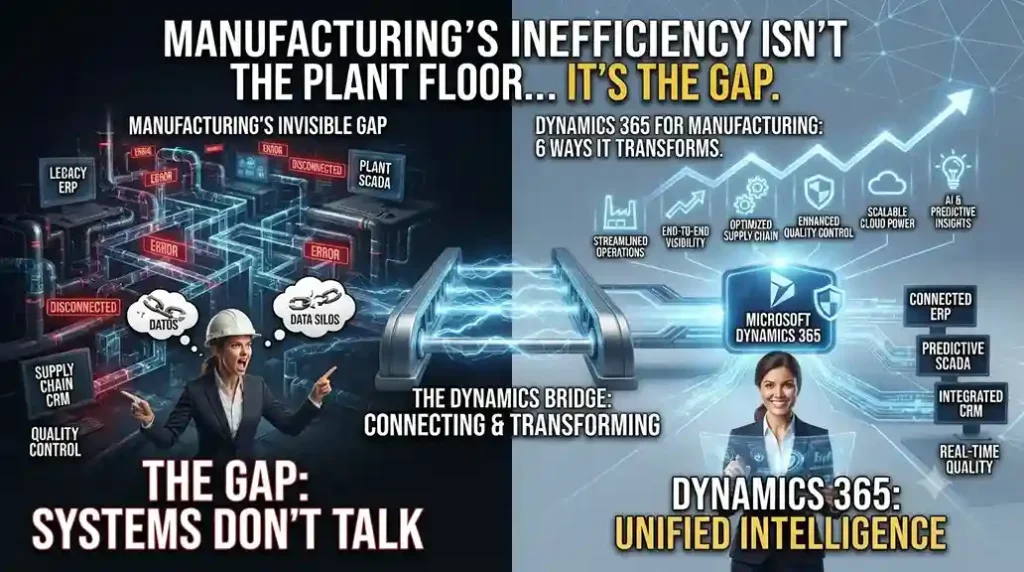
Microsoft Dynamics 365 for Manufacturing dashboard displaying production planning, inventory, supply chain management, and quality control.

Manufacturing’s Biggest Inefficiency Isn’t the Plant Floor — It’s the Gap Between Systems

INTRO A machine on the shop floor and a service technician in the field often work off completely different data — one sees production output, the other sees a support ticket, and neither sees the customer’s purchase history. Dynamics 365 for manufacturing exists to close exactly that gap, by ending the divide between CRM and ERP instead of running them as separate systems that happen to sit on the same network. Here are the six shifts that gap-closing actually produces on the ground. 1. Supply Chain Visibility That Goes Beyond a Dashboard Collecting and visualizing supply chain data across every location does more than create a nicer report — it changes how fast a disruption gets caught. Manufacturers using remote monitoring across distributed installations have shortened time-to-market by catching supply issues before they cascade into production delays, rather than discovering them after a shipment is already late. 2. Asset and Production Management, Consolidated Into One View When production oversight and real-time equipment monitoring sit in one system instead of three, manufacturers stop reacting to breakdowns and start resolving issues remotely before they cause downtime. This is the operational basis for near-continuous uptime models in equipment-heavy manufacturing — and it also opens a second revenue line: monitoring and proactive support sold as an ongoing service, not a one-time sale. 3. Customer Engagement Built on Usage Data, Not Guesswork Personalized service at scale requires predictive analytics and self-service options that are actually relevant to what a specific customer does with the product — not a generic contact form. Manufacturers with a connected sales-through-service platform can flag potential equipment issues before a customer notices a problem, while also tailoring offers based on that customer’s real purchasing and usage pattern. 4. Service Centers as a Profit Center, Not a Cost Center Falling costs for IoT sensors and mobile devices have made remote monitoring and proactive maintenance commercially viable additions to standard break/fix support — not just a premium add-on for enterprise accounts. Combining customer records, technician availability, and inventory into a single mobile-accessible system is what lets a service team actually deliver on that model instead of just theorizing it. The Data Advantage: Better Products, Not Just Better Service IoT-connected parts and equipment feed usage data back to engineering — which components fail early, which are over-built, how products actually get used in the field. That feedback loop is what shortens the cycle between a design flaw and a fix, rather than waiting for failure reports to pile up. 5. Technicians Who See the Full Job, Not Just the Ticket A 360-degree view of a customer’s asset and service history changes what a technician can do on-site — they’re working from context, not just a work order. Paired with machine learning that surfaces similar past cases, this turns troubleshooting into pattern-matching against real precedent instead of starting from zero on every call. 6. One System Connecting the Floor to the Front Office Manufacturers that unify production and project management data with CRM stop treating customer service and customer engagement as separate departments working from separate records. The practical result is service and recommendations grounded in what a customer has actually bought and experienced — not assumptions. Why Dynamics 365 Specifically Dynamics 365 for manufacturing removes the artificial line between CRM and ERP, running both on one system with embedded analytics rather than bolting a reporting layer on top of disconnected tools. For a mid-size manufacturer, this matters less as a technology upgrade and more as an operating model change — supply chain, service, and sales working from the same data instead of reconciling three versions of it. Curious what a unified CRM-ERP model would look like on your production floor? Talk to Trident about a Dynamics 365 manufacturing assessment.

Manufacturing’s Biggest Inefficiency Isn’t the Plant Floor — It’s the Gap Between Systems Read More »

Whitepaper : Four technology trends helping businesses thrive in a digital world

4 ways technology can help businesses thrive in a digital world. The good news is that the tools that help businesses capitalize on this digital transformation are more accessible than ever before. The cloud is removing barriers like high up-front costs, ongoing maintenance, and IT dependency.

Whitepaper : Four technology trends helping businesses thrive in a digital world Read More »