Welcome to Trident Information Systems!
Write us to - info@tridentinfo.com
Let's Socialize

erp software provider in south africa

How ERP Combats Short Labor Supply in Warehouses?

Call it labor shortage, exploding demands, or both, manufacturers face tumultuous stress in 2020. As factories, warehouses, and markets open, the shortage of labor is not going anywhere. As of June 2021, US Bureau of Labor Statistics data, manufacturing added up to 15,000 jobs, but employment is still down by 481,000 from the February 2020 count. Warehousing added 11,000 new jobs. However, the number is still down to 94,000 over the same period.   There are various factors driving labor shortage. Labors might leave one job for another in search of better facilities, salary, flexible working hours, and so on. Therefore, it becomes crucial to retain your existing staff.   Ensure hygiene and employee safety at your warehouse.   Establish ergonomic workstations and equipment.   Allow flexible work schedules.   Enable ongoing training support.   Equip your staff enough to handle multiple jobs.  Be receptive to your employee’s opinions.  No matter what factors are driving labor shortages, the manufacturers have to be more creative when it comes to dealing with labor. One of the best ways to deal with the labor shortage is to adopt an end-to-end ERP.   How ERP Combats Labor Shortage in Warehouses?  Digital transformation comprises all the strategies and methods that ensure optimum labor utilization. Bring a new life to your shop floor and transform your organization for the better. Apart from this, you can make complete use of your shop floor.   Centralizes Control  Keep tabs on all the warehouses from a single vision of reality. Turn big data into insightful dashboards. Identify insufficient processes and embrace growth opportunities. Generate more time and save finances with organization-wide visibility highlighting every growth-oriented opportunity. Have the comprehensive big data report at hand and build more effective processes or relocate your existing staff accordingly. Browse through current demands and available inventory and make effective strategies. Have improved communication and collaboration from top to bottom.   Automate Operations  ERP doubled with robotics automates manual and recurring tasks. It enables accelerated operations and more accuracy while helping you deliver the right services on time to your customers. Your plant and other stimulating areas get safer. While ERP focuses on the supply chain, other workers can focus on more creative or innovative tasks of the organization. With an end-to-end ERP, you can manage your back office with minimum staff working on it. Let the technology make floor plans for you so you can store your products in the most suitable locations within the warehouse.   Unifies Different Business Modules  ERP or Enterprise Resource Planning integrates and automates cynical business factors within the same technological environment, such as manufacturing, finance, inventory and order management, customer, communication, sales and marketing, project management, and human resource. You no longer need to hire multiple people to engage in these sections, the technology does the work for you. You need minimum staff with data unification.  Inventory Tracking   ERP delivers real-time inventory management. From the moment it enters the warehouse till the time it is dispatched. Some ERP service providers like Microsoft D365 enable tracking via mobile phones and other devices of your choice. It ensures inventory tracking anytime without having anyone else collecting and sharing the reports. Discard expired products and keep tabs on inventory that has already been dispatched. Make sure you never run out-of-stock and optimally locate the product within the warehouse.   Innovative Technology  Robotics helps fill labor gaps and increase productivity. As soon as you integrate robots with equipment, the staff starts getting more familiar with their uses. Some end-to-end ERP solution providers, such as Microsoft Dynamics 365, include advanced business intelligence and data analysis that transforms big data into visually actionable dashboards. Many researches conducted has shown that workers perform their tasks better with innovative technologies. The output rises as they start enjoying their jobs. A little creativity does the trick.   Better Transparency  With the advent of social media, millennials, and their younger subordinates extortionate sharing their ideas in the workplace. Microsoft Dynamics 365 fuels enterprise-extensive transparency and collaboration to meet this standard. Microsoft Dynamics 365 integrates different modules within a single system and enables organizational data through intuitive and sharp dashboards, promoting unparalleled visibility. Moreover, it has a unified platform called MS Teams, which connects employees with one another. Irrespective of their position, they can tap into a free flow of communication instantly. For instance, Warehouse staff can quickly communicate to the inventory manager about stocking-in or discarding certain products.   Final Words   The labor shortage is a worldwide issue. As soon as markets opened, the labor shortage caused grave pain. An end-to-end ERP solution can help businesses deal better with enabling centralized control, operation automation, multiple module integration, and so on. Trident Information Systems is a Gold Microsoft Partner that has served various businesses so far. Reinforced with over two decades of experience and a 150+ skillful team, Trident has accomplished a solid track record. For further queries or a demonstration, contact us.   

How ERP Combats Short Labor Supply in Warehouses? Read More »
Learn how an electronics manufacturer unifies data and gains agility using Dynamics 365 Supply Chain Management

Bel Fuse designs, manufactures, and markets electronic circuits products at 24 manufacturing locations across North America, Europe, and Asia. The company’s existing enterprise resource planning solution was highly customized and expensive to maintain, so it decided to deploy Microsoft Dynamics 365 Finance and Dynamics 365 Supply Chain Management. Bel Fuse unified data and can now more easily manage its supply chain operations and finance processes, gaining more agility to respond quickly to changes in the market or its suppliers. With Dynamics 365, we save nearly USD2 million per year in IT service and support fees compared to our previous, highly customized solution. Mark Hodkinson: Vice President of Finance for the Bel Power Solutions Group Bel Fuse Essential step in the supply chain A typical consumer might interact with Bel Fuse products and not even know it. The manufacturer makes the components that power, protect, and connect electronic circuits in products we use every day. Bel Fuse is usually in the middle of the supply chain, relying on smaller parts from its suppliers before passing components on to the manufacturers that create finished products. Founded in 1949, the company has grown significantly in the last 20 years through acquisitions. It has seven business groups, including Bel Power Solutions, which it acquired in 2014. Bel Power Solutions makes the power conversion products for server and storage networks at large server farms and in industrial products like the power sources in hybrid electric vehicles and trains. To manage its enterprise resource planning (ERP) processes, Bel Power Solutions used a legacy version of Oracle that was highly customized and difficult to update. The version was outdated and the month-to-month costs and support for the solution were expensive. With different business units using different ERP systems, Bel Fuse wanted to find an affordable solution to unify the company’s finance and operations processes, starting with Bel Power Solutions. Bel Fuse also needed a solution that would support its material requirements planning (MRP) process, a production planning, scheduling, and inventory control system to manage its manufacturing processes. “Our MRP processing goes in both directions—we require a full dataset and forecasting of what’s coming to us and what’s going out,” says Scott Hasterlik, Director Global IT at Bel Fuse. “We have power assets with 500 components and 65,000 SKUs, so we needed a robust solution to share nonstandard information quickly.” An integrated solution for finance and operations After careful evaluation, Bel Fuse found that Microsoft Dynamics 365 had the right capabilities at the right price for the company’s needs. With Dynamics 365, Bel Fuse had a single system for the first time, the ability to report globally, and a solution that was intuitive to use and easy to add users. Bel Fuse uses Dynamics 365 Finance to automate its financial operations, monitor performance in real time, predict future outcomes, and make data-driven decisions. For operations, the company deployed Dynamics 365 Supply Chain Management, which includes an MRP function and AI to improve visibility across its global supply chain and to improve manufacturing productivity. To aid the quick, seamless deployment process, Bel Fuse worked with Flintfox, a Gold competency member of the Microsoft Partner Network. “Flintfox jumped in, understood what we wanted to accomplish, and helped us move forward on budget,” says Hasterlik. “Flintfox has been a fantastic partner and is still our partner of record.” A wide range of Bel Power Solutions employees now rely on the Finance and Supply Chain Management business applications. Users include staff in customer service, quality assurance, demand and product returns, manufacturing and supply chain ordering, accounts payable, accounts receivable, and engineering. “From decision makers to factory floor managers, everyone is working in Dynamics 365, staying connected and accessing valuable data,” says Stefan Naude, General Manager, Slovakia, at Bel Fuse. Reduced costs, disparate systems eliminated Bel Fuse accomplished its central goal—to reduce the high costs of its previous ERP system while bringing data together in one solution. The company built the capacity it needed without a lot of customizations, helping ensure that the solution would stay flexible in the future. “With Dynamics 365, we save nearly USD2 million per year in IT service and support fees compared to our previous, highly customized solution,” says Mark Hodkinson, Vice President of Finance for the Bel Power Solutions Group at Bel Fuse. Bel Fuse also reduced costs because it now has the tools to fulfill more of its own finance needs internally. For example, a Bel Fuse engineering and distribution site in Italy previously paid an outside firm to do its accounting. “It was easy to move the Italy site into Dynamics 365 and transfer all that work internally to our team in Slovakia,” says Hodkinson. “Now our own team manages the facility’s day-to-day finances even though they aren’t located in Italy. With a common system, we have better access to our own internal talent.” Increased visibility and agility With Dynamics 365, Bel Fuse gained a more global view of financial data and can perform more accurate forecasting. “I always view orders and revenue from a global perspective because the locations are all connected and have so many intercompany transactions,” says Hodkinson. “I rely on Dynamics 365 to help me make sense of complex financial histories to stay on top of complicated billing and payment processes at multiple sites.” With ERP data now centralized and easy to access in the cloud, Bel Fuse can respond with more agility to complex, changing circumstances. When employees in Italy, China, and other countries needed to work from home during the COVID-19 crisis, the company was able to effectively run remote finance and supply chain operations. “We kept all our finance functions moving forward even though we don’t have anyone physically in the office,” says Hodkinson. “We were impressed that our team was able to get everything done while working from home for the first time, and I think that speaks to how intuitive Dynamics 365 Finance was for our team.” As a mid-chain supplier, Bel Fuse is committed to continuing its operations on

Learn how an electronics manufacturer unifies data and gains agility using Dynamics 365 Supply Chain Management Read More »

Reinvent business productivity with Microsoft Dynamics 365 and Microsoft Office 365

Microsoft Dynamics 365 Business Central is an all-in-one business management solution that helps businesses manage financials, sales, service and operations easier and faster from day one. This e-book explores how the solution integrates with Office 365 to connect business processes and personal productivity like never before, bringing insight and efficiency to your daily tasks[/vc_column_text][/vc_column][/vc_row]

Reinvent business productivity with Microsoft Dynamics 365 and Microsoft Office 365 Read More »

Customer Story : CRANE Worldwide Logistics centralised their sales platform with Microsoft Dynamics 365

As it approached its 10-year anniversary and its first billion in revenue, global logistics and freight company Crane Worldwide Logistics looked for a modern platform that brought all its sales tools into one place. With the Microsoft Relationship Sales solution, which brings together LinkedIn Sales Navigator and Microsoft Dynamics 365 for Sales, its salespeople have the tools to drive more meaningful engagements with customers, convert opportunities faster, and create more revenue. Just by getting the team using the platform, we’ve seen an uplift in activity in all areas. We’ve had record growth since implementing Microsoft Relationship Sales—the last quarter was excellent for us. John Jergens: Vice President of Global Sales Crane Worldwide Logistics A global sales team From a startup created in the risky business climate of the 2008 recession, Crane Worldwide Logistics has become a major player in the global transport and logistics industry, on track to hit USD1 billion in revenue in 2019. Created by former Eagle Global Logistics executives and headquartered in Houston, Texas, Crane Worldwide aims to provide customers with full transparency into its supply chains by coupling talented people with game-changing technology. But with salespeople spread across the globe, Crane Worldwide found itself with a visibility problem. “We weren’t all working on a common platform, so we were lacking in visibility,” says John Jergens, Vice President of Global Sales at Crane Worldwide. “We knew we had a vast sales pipeline out there, but there wasn’t much data available on it—so we couldn’t see how robust it was.” From data silos to connected visibility A key part of the Crane Worldwide ethos is providing customers with meaningful interactions—and that relies on having a customer relationship management (CRM) solution that salespeople can use to build and maintain relationships and convert opportunities more effectively. But, with a seven-year-old siloed CRM system that it had simply outgrown, the company lacked the tools its salespeople needed. “The previous system never had very good adoption,” Jergens adds. “It just wasn’t very functional.” So, the team went looking for a platform that could replace it. With implementation support from Microsoft Partner Network member PowerObjects, Crane Worldwide deployed the Microsoft Relationship Sales solution, a powerful combination of Microsoft Dynamics 365 for Sales and LinkedIn Sales Navigator, to support personalized, meaningful customer engagements. The team was already using LinkedIn Sales Navigator and Microsoft Office 365, so Dynamics 365 for Sales was the ideal addition to the Crane Worldwide ecosystem. “We saw how Microsoft Relationship Sales could help us focus on being easy to work with from a customer’s perspective,” explains Jergens. “So this whole deployment was part and parcel of becoming easier to do business with.” Now, just six months into deployment, Crane Worldwide has 300 Microsoft Relationship Sales users in its ranks, including 150 direct sellers along with employees from its marketing and account management teams. New processes, simpler sales Using the Microsoft Relationship Sales solution, Crane Worldwide salespeople have already changed the way they work. And they’re reaping the benefits of the visibility they’ve gained into the sales pipeline. “Once we rolled out Microsoft Relationship Sales, the overwhelming response was that it’s really easy to use, and it doesn’t take much time,” says Jergens. “We created a very simple weekly routine where our sellers spend about 30 minutes adding new data into Dynamics 365 for Sales. That’s just six minutes a day to keep everything up to date.” With faster processes freeing up more time for the sales team, sellers can focus their energy where it matters most—building the customer relationships that turn into revenue. And, at the end of each week, management can analyze activity through a global dashboard, which combines CRM and customer interaction data into detailed executive reports that show how salespeople are turning relationships into revenue. “With Microsoft Relationship Sales, we can generate KPIs that tell us what a healthy pipeline should look like. We look at the number of prospects and targets, how long the sales cycle takes, and the time from when we close an account to the time it generates revenue,” explains Jergens. “And if the pipeline isn’t where it should be, we can support the sellers with the resources that they need—it’s more productive all around.” A centralized sales platform Because Microsoft Relationship Sales brings together so many sales capabilities, Crane Worldwide sellers have everything they need to do their jobs in one place. Previously, they had to manage a relationship from scoping to sale across disconnected tools and platforms, far from an efficient process. “It’s difficult to put a number on what it’s like to manage 30 or 40 customers with an email folder and a spreadsheet,” says Jergens. “Now, once the salesperson finds a prospect using LinkedIn Sales Navigator, they use Dynamics 365 for Sales to easily track those conversations. Instead of creating and referencing a lot of notes, they can quickly link activities and discussions through Microsoft Relationship Sales.” With LinkedIn Sales Navigator and Dynamics 365 for Sales together, salespeople can start building the context they need to deliver a meaningful interaction before the first contact even occurs. Insight into potential prospects’ roles, connections, and priorities through LinkedIn Sales Navigator is fed straight into Dynamics 365 for Sales—increasing conversion chances from the very start. “It’s had a direct impact on the time it takes to develop customer relationships, because we have true visibility into those opportunities now,” explains Jergens. A built-in assistant also sends prompts to help sellers accelerate the sales cycle, reminding them to contact a lead that might go cold or nudge an opportunity as it approaches its estimated close date. A roadmap for integration In businesses the world over, sales and marketing teams struggle to communicate and collaborate effectively. As the sales team adapts to Microsoft Relationship Sales, Crane Worldwide is already adopting more of the solution’s capabilities to help sales and marketing stay on the same path. “The marketing teams are able to work in tandem with the sales team to help them understand how marketing activities can help nurture their

Customer Story : CRANE Worldwide Logistics centralised their sales platform with Microsoft Dynamics 365 Read More »

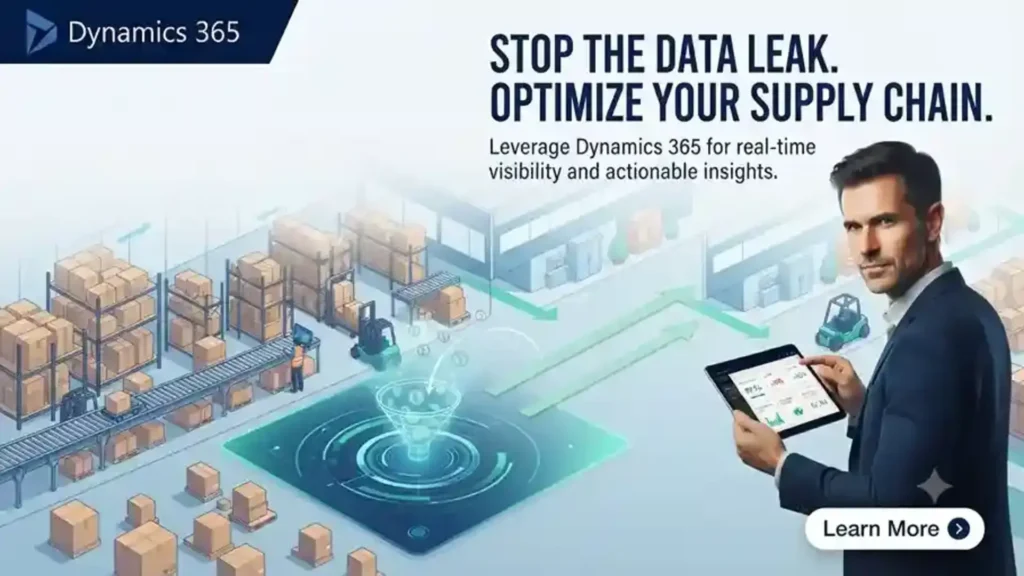
Dynamics 365 Supply Chain Management dashboard connecting IoT, analytics, inventory, logistics, and real-time supply chain data.

Dynamics 365 Supply Chain Management: What You Can’t See Is Costing You Money

INTRO Manufacturers don’t lose money on supply chain problems they can see. They lose it on the ones buried in siloed systems and manual processes — a part sourced from the same supplier out of habit rather than cost, a shipment that could’ve been consolidated but wasn’t flagged in time. Dynamics 365 supply chain management exists to surface exactly those blind spots, connecting sales, supplier, fulfillment, and product data into one system instead of five disconnected ones. IoT Is Where Supply Chain Visibility Starts Real-time visibility into how equipment and parts actually perform begins with connecting them — a single IoT-enabled platform bridging back-office and front-office processes rather than treating shop-floor data as separate from planning data. Digital twin modeling takes this further, letting manufacturers track wear on parts in real time and catch simple inefficiencies that are easy to miss otherwise: sourcing from a familiar supplier by default, for instance, when a comparable part is available elsewhere at lower cost. Analytics Turns Visibility Into Action Visibility alone doesn’t fix anything — it has to feed decisions. Built-in analytics and machine learning let a supply chain system dynamically adjust production and distribution using data most planning tools ignore, like public weather data feeding more accurate delivery forecasts. The same analytics can flag shipment consolidation or expediting opportunities automatically, catching savings a manual review would likely miss — savings that pass through directly to fulfillment cost. Real-Time, Mobile Access Closes the Loop Consolidated data still isn’t useful if the people who need it can’t see it where they’re standing. Decision-makers need the same real-time information whether they’re on the factory floor or at headquarters, with the ability to collaborate across locations without switching systems. This is less about a dashboard and more about removing the extra step of hunting for information before a problem can even be diagnosed. Why Dynamics 365 Specifically Dynamics 365 removes the traditional divide between ERP and CRM, letting employees move between supply chain and customer-facing work without switching systems entirely. Deployment flexibility — cloud, or hybrid combining on-prem and cloud — means a manufacturer can extend existing infrastructure investments rather than replacing them wholesale, which is often the difference between a deployment measured in days versus months. The practical result for a manufacturer: rich analytics, embedded intelligence, and partner-built applications running on one system, rather than reconciling ERP and CRM as two separate sources of truth. Want to see where visibility gaps might be costing your supply chain? Talk to Trident about a Dynamics 365 supply chain assessment.

Dynamics 365 Supply Chain Management: What You Can’t See Is Costing You Money Read More »

Whitepaper : Four technology trends helping businesses thrive in a digital world

4 ways technology can help businesses thrive in a digital world. The good news is that the tools that help businesses capitalize on this digital transformation are more accessible than ever before. The cloud is removing barriers like high up-front costs, ongoing maintenance, and IT dependency.

Whitepaper : Four technology trends helping businesses thrive in a digital world Read More »

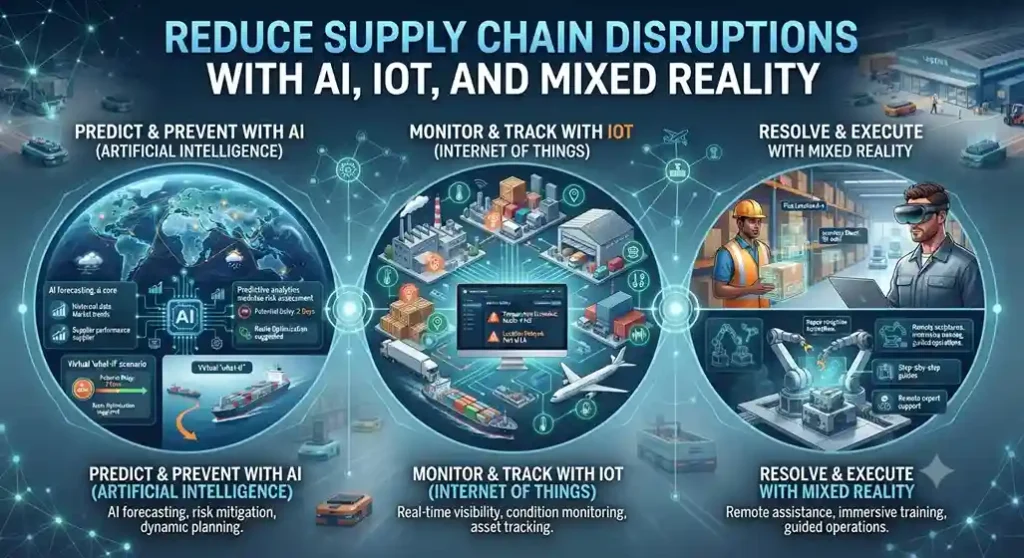
AI, IoT, and mixed reality technologies improving supply chain visibility, logistics, and warehouse operations.

Reduce supply chain disruptions with AI, IoT, and mixed reality

Reduce Supply Chain Disruptions With AI, IoT, and Mixed Reality Supply chains built on single suppliers and single locations don’t survive contact with real-world disruption — port closures, geopolitical trade shifts, or a single supplier’s factory going offline can stall production for weeks. [Flag: insert a recent disruption stat relevant to your audience’s industry — e.g., percentage of manufacturers reporting supplier delays in the past 12 months.] The response isn’t more inventory sitting idle; it’s a supply chain that senses problems early and reconfigures itself before they cascade. That’s the shift Dynamics 365 Supply Chain Management is built around — replacing static, just-in-time planning with predictive, adaptive planning powered by AI, IoT, and mixed reality across production, inventory, and warehouse operations. From “Just-in-Time” to “Just-in-Case” Planning The single-supplier, single-location model was optimized for cost, not resilience. When one link breaks, the entire chain stops. Manufacturers are now deliberately building in redundancy — multiple suppliers and locations for mission-critical parts — even where it costs more, because the cost of a stalled production line consistently outweighs the premium paid for supply flexibility. This shift also demands shorter production runs. Factories need to serve a wider range of products in smaller batches, with lower changeover time between runs. That requires planning systems that recalculate in near real time as demand shifts, not systems that lock in a monthly production plan and treat disruption as an exception to manage manually. Predictive Planning Instead of Reactive Firefighting D365 Supply Chain Management applies AI-driven demand forecasting across planning, production, inventory, warehouse, and transportation management — so a shift in demand or a supplier delay triggers a re-plan before it becomes a stockout. IoT sensor data from equipment feeds directly into this loop, flagging machine performance drift or maintenance needs before a breakdown takes a production line offline unexpectedly. For manufacturers running multi-location operations across India, UAE, or East Africa, this matters more than it might in a single-plant setup — a delay at one facility needs to trigger an automatic reallocation check against inventory and capacity at other sites, not a phone call three days later. Cut Training Time With Mixed Reality Guidance One of the more underused levers in supply chain resilience is workforce agility — how fast you can get a new or reassigned worker productive on unfamiliar equipment. D365 Supply Chain Management integrates with Dynamics 365 Guides, delivering step-by-step, hands-free instructions through a HoloLens device, walking workers through exactly which tool and part to use at each step of a task. This does two things for resilience specifically. First, it makes equipment maintenance skillset-agnostic — you’re no longer waiting on one specialist who knows a particular machine, because any trained worker can follow the holographic guide. Second, it shortens the ramp-up time when you need to redeploy staff to a different line or location during a disruption, which is exactly when you can’t afford a multi-week training cycle. Guides are authored without code — someone writes the instructions and places holographic markers directly on the machine where the work happens, which means your own team can build and update guides as processes change, not wait on an external developer. What This Means for Your Operation Resilience isn’t a single feature — it’s the combination of predictive planning that reduces reaction time, IoT visibility that catches problems before they cause downtime, and a workforce that can be redeployed without retraining bottlenecks. Manufacturers evaluating this shift should look specifically at how their current ERP handles multi-location inventory visibility and whether production re-planning happens in real time or requires manual intervention. [Flag: insert a client example or case study reference here if available — a specific implementation outcome carries more weight than a general capability claim.] Considering a resilience-focused upgrade to your supply chain platform? Talk to Trident’s Dynamics 365 Supply Chain Management team about what a multi-location, AI-driven planning setup looks like for your operation.

Reduce supply chain disruptions with AI, IoT, and mixed reality Read More »

Enterprise ERP software dashboard managing retail, hospitality, and manufacturing operations.

Enterprise ERP Software for Retail, Hospitality & Manufacturing: 6 Benefits That Transform Your Business

Running a business in retail, hospitality, or manufacturing means managing a constant flow of moving parts — staff schedules, customer orders, inventory levels, supplier deliveries, and financial transactions — all happening simultaneously, every single day. When those moving parts are managed through disconnected systems — a spreadsheet here, a separate POS there, a standalone HR tool — the gaps between them create errors, delays, and blind spots that cost real money. Enterprise ERP software brings everything together. One platform. One source of truth. Every department — finance, operations, HR, sales, and customer service — working from the same real-time data. Here is how ERP transforms operations specifically in retail, hospitality, and manufacturing — and why Microsoft Dynamics 365 Business Central is the platform Trident recommends. Why Retail, Hospitality, and Manufacturing Need ERP Most These three industries share a common challenge: high operational complexity at every level. A retail chain manages hundreds of SKUs across multiple locations. A hotel or restaurant balances reservations, kitchen operations, staff rotas, and customer satisfaction simultaneously. A manufacturer coordinates raw material procurement, production scheduling, quality control, and order fulfilment — often across multiple sites. Without a unified system connecting all these functions, management is reactive. With the right ERP, it becomes proactive — with real-time visibility that enables better decisions at every level of the organisation. 6 Key Benefits of ERP for Retail, Hospitality and Manufacturing 1. Real-Time Data Across Every Department Business data changes constantly. Inventory levels shift with every sale. Staff schedules update daily. Customer orders flow in around the clock. Financial positions move with every transaction. Without real-time visibility, managers make decisions based on yesterday’s data — and the gaps between systems mean different departments often work from different numbers. ERP solves this fundamentally. Every transaction updates the central system instantly — so whether you are checking stock levels, reviewing sales performance, or approving a purchase order, you are always working from current, accurate information. No delays. No discrepancies. No guesswork. 2. Integrated Point of Sale In retail and hospitality, the POS system is the heartbeat of the operation. Every sale, every order, every payment flows through it — and what happens to that data after the transaction determines how well the rest of the business functions. A standalone POS that does not connect to inventory, finance, and customer management creates manual work and data silos. An ERP-integrated POS changes everything: For retail chains and multi-outlet hospitality businesses, this integration is particularly powerful — giving head office a live view of every location’s performance without waiting for manual reports. 3. Smarter Customer Management Your customers are your most valuable asset — and your ERP should help you treat them that way. An ERP system captures complete customer profiles: purchase history, preferences, communication records, loyalty points, and service interactions. This data enables: In hospitality especially, knowing your guest’s preferences before they arrive is a powerful differentiator. In retail, personalised offers based on real purchase data consistently outperform generic promotions. ERP makes both possible at scale. 4. Efficient Employee Management Managing staff across retail stores, restaurant shifts, or manufacturing shifts — potentially across multiple locations — is one of the most operationally demanding functions in any of these industries. ERP centralises employee management in one system: When employee data is connected to operational data, managers can make faster and fairer staffing decisions — and compliance documentation is always complete and current. 5. Streamlined Inventory Management Inventory management is the operational function where ERP delivers the most immediate and visible impact — particularly in retail and manufacturing. Without a connected inventory system, businesses either over-order (tying up cash in excess stock) or under-order (losing sales to stockouts). Neither is acceptable in competitive markets. ERP provides: For manufacturers, ERP takes this further — connecting inventory management directly to production planning and supplier procurement, ensuring materials are always available when production needs them. 6. Unified Financial Management Every operational decision has a financial consequence — and ERP connects the two in real time. Rather than waiting for month-end reports compiled manually from multiple systems, ERP gives finance teams live visibility into revenue, costs, margins, and cash flow across every business unit. Invoices are matched automatically. Budget variances are flagged immediately. Financial close processes that once took days are completed in hours. For multi-entity businesses — retail chains, hospitality groups, or multi-site manufacturers — ERP consolidates financial data across all locations into a single, accurate picture that leadership can act on immediately. Why Microsoft Dynamics 365 Business Central Microsoft Dynamics 365 Business Central is the modern, cloud-native evolution of Dynamics NAV — one of the most widely deployed ERP platforms in retail, hospitality, and manufacturing globally. It delivers all six benefits above in a single, integrated platform — with the added advantage of: Whether you are running a single restaurant, a retail chain, or a manufacturing facility, Business Central scales with your operation — without platform replacement as you grow. Why Trident Is India’s Trusted ERP Partner As a certified Microsoft Dynamics 365 Business Central partner, Trident Information Systems has helped businesses across retail, hospitality, and manufacturing in India implement ERP solutions that deliver measurable results — from initial assessment through go-live and ongoing optimisation. Ready to unify your business on one intelligent platform? Book a free ERP assessment with Trident today.

Enterprise ERP Software for Retail, Hospitality & Manufacturing: 6 Benefits That Transform Your Business Read More »