Welcome to Trident Information Systems!
Any Query? Write us to - info@tridentinfo.com
Let's Socialize

IoT Services remote iot platform

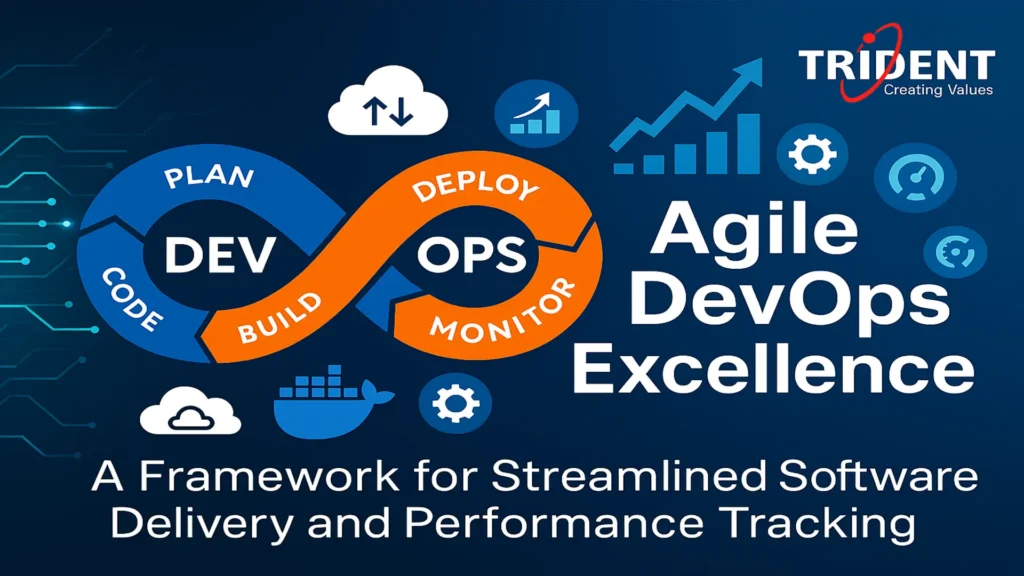
Agile DevOps workflow enabling faster releases and real-time performance tracking.

Agile DevOps Excellence: A Framework for Streamlined Software Delivery and Performance Tracking

Introduction Agile DevOps is the modern approach that unifies Agile development and DevOps practices to deliver software faster, smarter, and with greater reliability. It transforms software delivery into a continuous, automated workflow where collaboration, rapid feedback, and shared ownership drive performance. By aligning development sprints with deployment cycles, Agile DevOps enables teams to release high-quality software consistently. This model empowers organizations to scale innovation while maintaining operational stability and measurable results. Building a High-Performance DevOps Model for Modern Teams DevOps Is a Culture, Not a Job Title DevOps general practices have evolved far beyond a technical function. In modern organizations, DevOps represents a shared mindset that unifies development, operations, quality assurance, and security into a single delivery ecosystem. We no longer treat DevOps as a standalone team or a set of tools; instead, it becomes the cultural backbone of how software is built, released, and improved. This cultural shift emphasizes collaboration, transparency, accountability, and continuous learning across all roles involved in software delivery. A high-performance DevOps model breaks down silos that traditionally slowed innovation. Developers understand production realities, operations teams participate early in design decisions, and quality becomes everyone’s responsibility. This alignment reduces friction and creates faster feedback loops. Agile DevOps strengthens this culture by introducing short iterations, rapid validation, and constant reprioritization based on real-world feedback. Together, Agile and DevOps create an environment where speed and stability coexist. Organizations that embrace DevOps culture see measurable improvements in delivery reliability, employee engagement, and customer satisfaction. Instead of reacting to failures, teams proactively design systems for resilience. This cultural maturity is what differentiates elite DevOps organizations from those merely adopting DevOps tools. The Intersection of Agile and DevOps Agile DevOps is the natural convergence of iterative development and continuous delivery. Agile focuses on how teams plan and build software, while DevOps extends those principles into deployment, monitoring, and operations. When combined, they form a DevOps framework that supports rapid experimentation without sacrificing control. Agile ceremonies such as sprint planning and retrospectives feed directly into DevOps workflows. Each sprint becomes an opportunity to release, measure, and learn. This tight integration ensures that development velocity translates into real customer value rather than accumulating unfinished work. Understanding the DevOps Workflow – From Code to Customer The Continuous DevOps Workflow Explained The DevOps workflow is a continuous loop that connects every stage of software delivery into a single, automated pipeline. Unlike traditional linear models, this workflow emphasizes constant feedback and incremental improvement. The core stages include plan, build, test, release, deploy, operate, and monitor. Planning aligns business objectives with technical execution. Backlogs are refined continuously, ensuring that teams focus on high-impact work. During the build phase, standardized build tools in DevOps environments compile code and generate deployable artifacts with consistency and speed. Testing is embedded directly into the pipeline using DevOps testing tools. Automated tests validate functionality, performance, and security early and often. This reduces risk and increases confidence in every release. Release, Deploy, and Monitor Deployment tools in DevOps enable frequent, low-risk releases through automation and version control. Continuous delivery pipelines ensure that code can move to production at any time. Once deployed, monitoring tools in DevOps collect metrics, logs, and traces to provide real-time visibility into system health and user experience. This closed-loop DevOps workflow ensures that insights from production feed directly back into planning, creating a self-improving delivery system. Agile DevOps – Syncing Development Sprints with Deployment Cycles Aligning Sprints with Continuous Delivery Agile DevOps eliminates the gap between development completion and production deployment. Each sprint is structured so that completed work is potentially releasable. This requires small batch sizes, strong automation, and disciplined backlog management. DevOps automation tools play a critical role in synchronizing sprints with deployment cycles. Automated builds, tests, and deployments reduce manual effort and human error. As a result, teams can deploy multiple times per day without increasing operational risk. Shared Ownership and Accountability When sprints and deployments are aligned, teams take full ownership of their work throughout the lifecycle. DevOps engineer tools such as CI/CD platforms, infrastructure-as-code solutions, and artifact repositories support this ownership by making environments reproducible and transparent. The Modern DevOps Toolchain and Technologies DevOps Tools List Across the Lifecycle A robust DevOps toolchain integrates multiple categories of tools, each serving a specific purpose. Typical components include source control systems, build tools in DevOps, DevOps testing tools, configuration management tools in DevOps, deployment tools, and monitoring platforms. The best DevOps tools are those that integrate seamlessly and support automation at scale. Tool selection should prioritize reliability, extensibility, and ease of integration rather than individual features. Configuration Management and Automation DevOps configuration management ensures consistency across environments by treating infrastructure and configuration as code. This approach reduces configuration drift and simplifies scaling. Power platform build tools and cloud-native automation further enhance efficiency by abstracting infrastructure complexity. DevOps Testing, Security, and Reliability DevOps Testing Tools and Continuous Quality DevOps testing transforms quality assurance into a continuous activity. Automated tests run at every stage of the pipeline, validating code changes immediately. This proactive approach reduces defect rates and accelerates delivery. DevOps Security Tools and Shift-Left Security DevOps security tools integrate security checks directly into development and deployment pipelines. Vulnerability scanning, dependency analysis, and compliance checks run automatically, ensuring security without slowing delivery. This shift-left approach embeds security into daily workflows. Monitoring Tools in DevOps and Observability From Monitoring to Observability Monitoring tools in DevOps provide visibility into system performance, availability, and reliability. Modern observability platforms go further by correlating logs, metrics, and traces to uncover root causes quickly. This performance intelligence enables teams to respond proactively, reduce downtime, and continuously optimize user experience. Key DevOps KPIs for Performance Tracking Core DevOps KPIs Explained DevOps KPI tracking provides objective insights into delivery performance. Deployment Frequency measures how often value reaches customers. Lead Time for Changes reflects how quickly ideas are delivered. Mean Time to Recovery evaluates resilience, while Change Failure Rate balances speed with stability. Tracking these KPIs aligns teams around outcomes and supports data-driven decision-making. Choosing the

Agile DevOps Excellence: A Framework for Streamlined Software Delivery and Performance Tracking Read More »

IoT solutions improving visibility and automation in retail and manufacturing.

The Ultimate Guide to IoT Across Retail and Manufacturing in 2026

The Internet of Things is no longer a futuristic concept—it’s the quiet engine driving some of the biggest transformations in retail and manufacturing today. In 2026, IoT for retail and IoT for manufacturing are not optional upgrades. They’re core business strategies. Whether it’s smart retail IoT reshaping how customers shop or smart manufacturing IoT redefining how products are made, connected devices are everywhere. Think about it: stores that know what customers want before they ask, factories that fix machines before they break, and cloud platforms that let you manage thousands of devices from a single dashboard. That’s not science fiction—that’s IoT in action. This guide takes a deep, practical look at how IoT applications in retail, manufacturing, and cloud services work together. We’ll explore real-world retail IoT applications, internet of things manufacturing systems, remote IoT platforms, and the cloud infrastructure that ties everything together. No jargon overload—just clear, useful insight you can actually apply. Understanding IoT: The Digital Backbone of Modern Industries At its simplest, IoT connects physical devices to digital systems. Sensors, machines, cameras, shelves, robots—all of them collect data and communicate through an IoT cloud. But in 2026, IoT is less about devices and more about decisions. What makes IoT powerful today is context. Data isn’t just collected—it’s analyzed, correlated, and acted upon in real time. A temperature sensor in a supermarket freezer can trigger alerts, adjust cooling systems, and notify maintenance teams automatically. A vibration sensor in a factory can predict equipment failure weeks in advance. For industries like retail and manufacturing, IoT becomes the nervous system of operations. It senses what’s happening on the ground and sends that information to the brain—the cloud—where smarter decisions are made. This shift from reactive to proactive operations is why IoT in retail industry and IoT in manufacturing industry continue to grow at record speed. IoT for Retail: Transforming the Customer Experience IoT for retail has completely changed how stores operate and how customers interact with brands. Smart retail IoT solutions turn physical stores into data-rich environments where every interaction tells a story. Imagine walking into a store where digital shelves update prices automatically, smart cameras analyze foot traffic, and personalized offers appear on your phone in real time. That’s smart retail using IoT. Retailers gain visibility into customer behavior, while shoppers enjoy convenience and personalization. IoT for retailing industry success comes from connecting everything—point-of-sale systems, inventory, lighting, HVAC, and security—into one intelligent ecosystem. Retail IoT applications don’t just boost sales; they reduce waste, cut operational costs, and improve employee productivity. In 2026, the best retail experiences are built as much with sensors and software as with shelves and products. IoT in Supermarkets: From Shelves to Supply Chains IoT in supermarkets is one of the clearest examples of practical IoT value. Supermarkets deal with thousands of products, tight margins, and constant customer demand. IoT applications in retail solve these challenges head-on. Smart shelves track inventory levels in real time. When stock runs low, the system automatically triggers restocking workflows. Cold-chain sensors monitor temperature for perishable goods, reducing spoilage and ensuring compliance. Cameras and weight sensors help prevent theft and reduce checkout friction. Beyond the store, IoT connects supermarkets to suppliers and distribution centers. This end-to-end visibility allows better forecasting, fewer out-of-stock situations, and smoother logistics. The result? Lower costs, fresher products, and happier customers—all driven by retail IoT applications working quietly in the background. Retail IoT Applications That Are Redefining Operations Retail IoT applications go far beyond inventory tracking. They touch every part of the business, from marketing to maintenance. One powerful application of IoT in retail is personalized engagement. Beacons and mobile apps detect customer preferences and deliver targeted offers. Another is energy optimization—smart lighting and climate systems reduce costs without sacrificing comfort. Loss prevention is also evolving. AI-powered cameras and sensors detect suspicious behavior without invasive monitoring. Combined with IoT cloud analytics, retailers gain actionable insights rather than raw footage. These iot retail applications don’t just improve efficiency—they fundamentally change how stores operate, making them smarter, leaner, and more responsive. Retail IoT Solutions: Building Smarter, Faster Stores Retail IoT solutions work best when built on a strong foundation. That foundation includes connected devices, a reliable IoT cloud, and scalable analytics. A typical retail IoT solution includes sensors, gateways, connectivity, cloud storage, and dashboards. The real magic happens when these components work together seamlessly. Cloud-based platforms allow retailers to deploy updates, monitor performance, and analyze trends across hundreds of locations. Choosing the right IoT cloud is critical. It determines scalability, security, and integration with existing systems. In 2026, successful retail brands treat IoT not as a one-time project, but as a long-term platform for innovation. IoT Services Powering Modern Businesses Behind every successful IoT deployment are specialized IoT services. These include IoT installation services, platform configuration, and ongoing support. A remote IoT platform allows businesses to monitor and control devices from anywhere. Whether it’s a smart shelf in a supermarket or a sensor in a factory, everything connects through the same cloud interface. This centralization reduces complexity and accelerates decision-making. IoT installation services ensure devices are deployed correctly, securely, and efficiently. With the right services in place, businesses can focus on outcomes instead of infrastructure. IoT services turn complex technology into usable business tools. Remote Management IoT: Controlling Devices at Scale Remote management IoT is the backbone of large-scale deployments. Managing thousands of devices manually simply isn’t realistic. IoT remote management software enables real-time monitoring, remote configuration, and over-the-air updates. If a device fails, the system detects it instantly. If firmware needs updating, it happens automatically—no site visits required. Remote IoT device management also improves security. Devices can be isolated, patched, or decommissioned instantly. In 2026, remote management IoT isn’t just about convenience—it’s about resilience and control in a connected world. IoT Device Management Companies and Ecosystems IoT device management companies play a crucial role in simplifying complexity. They provide platforms, tools, and expertise that help businesses scale faster and safer. The best providers offer device onboarding, monitoring,

The Ultimate Guide to IoT Across Retail and Manufacturing in 2026 Read More »

Smart supermarket with IoT-enabled shelves, automated checkout, and real-time inventory management, enhancing the shopping experience

IoT in Supermarkets: Enhancing the Retail Experience with Smart Technology

Introduction IoT in Supermarkets is at the heart of the retail industry’s digital transformation. Supermarkets are leveraging smart technology to improve efficiency, enhance customer experience, and optimize inventory management. But how exactly is IoT shaping the supermarket experience? Let’s explore. Understanding IoT in Retail IoT refers to a network of interconnected devices that collect and exchange data. In supermarkets, this means smart shelves, automated checkouts, real-time inventory tracking, and even AI-driven customer interactions. The goal? A seamless and personalized shopping experience. How IoT is Transforming Supermarkets Smart Shelves Smart shelves use RFID (Radio Frequency Identification) and weight sensors to detect when an item is running low. They can alert store staff for restocking and even adjust pricing dynamically. Automated Checkout Systems IoT-enabled self-checkout kiosks and cashier-less stores (like Amazon Go) streamline the shopping process. Cameras, sensors, and AI track purchases, allowing customers to walk out with their items and get billed automatically. Real-Time Inventory Management With IoT, supermarkets can monitor stock levels in real time. This reduces waste, prevents stockouts, and ensures customers always find what they need. Enhancing Customer Experience with IoT Personalized Shopping Assistance IoT-enabled mobile apps guide customers to their desired products, offer real-time discounts, and even suggest recipes based on shopping history. Smart Shopping Carts Smart carts with built-in scanners and screens help shoppers track their spending, find products easily, and check out without waiting in line. AI-Powered Recommendations By analyzing shopping habits, IoT devices provide personalized product suggestions, creating a tailored shopping experience. Operational Benefits of IoT in Supermarkets Energy Efficiency Smart refrigeration systems and lighting control reduce energy consumption, leading to significant cost savings. Supply Chain Optimization IoT devices track shipments, monitor storage conditions, and predict demand, ensuring a smooth supply chain process. Security Enhancements IoT-powered security cameras, smart alarms, and theft detection systems help protect both customers and inventory. Data Analytics and Insights for Retailers With IoT-generated data, retailers gain insights into customer behavior, peak shopping times, and product preferences. This information enables better decision-making and marketing strategies. Challenges of Implementing IoT in Supermarkets Despite its benefits, IoT adoption comes with challenges such as high initial costs, cybersecurity risks, and the need for staff training. However, the long-term advantages far outweigh these obstacles. High Initial Investment – Setting up IoT infrastructure requires significant costs for sensors, software, and integration with existing systems. Data Security & Privacy Concerns – IoT devices collect vast amounts of customer and operational data, making supermarkets vulnerable to cyber threats. Integration with Legacy Systems – Many supermarkets use outdated POS and inventory systems that may not seamlessly connect with modern IoT solutions. Maintenance & Downtime Issues – IoT devices require regular maintenance, and system failures can disrupt operations, leading to lost sales and inefficiencies. Staff Training & Adaptation – Employees need proper training to operate and manage IoT systems effectively, which can be time-consuming and costly. Future Trends in IoT for Retail Conclusion IoT is revolutionizing supermarkets, making shopping more efficient, personalized, and data-driven. As technology evolves, we can expect even more innovations that will redefine the retail experience. Supermarkets that embrace IoT now will be the leaders of tomorrow. In conclusion, for those in search of a reliable partner in the realm of IoT solutions, look no further than Trident Information Systems. As a distinguished Gold Microsoft Partner, LS Central Diamond Partner, and an IBM Gold Partner, we boast a proven track record of successfully serving diverse and thriving businesses. Don’t hesitate to reach out to us with any inquiries! Stay abreast of the latest trends and advancements in IoT by following our LinkedIn page. FAQs 1. How does IoT help in reducing supermarket losses?IoT prevents losses by monitoring inventory, reducing theft through smart security systems, and optimizing supply chain management. 2. Are IoT-enabled supermarkets more expensive to operate?Initially, implementation costs can be high, but long-term savings in energy efficiency, reduced waste, and improved sales make it cost-effective. 3. Can IoT improve customer loyalty?Yes! Personalized recommendations, seamless shopping experiences, and targeted discounts help improve customer satisfaction and retention. 4. What are the security concerns with IoT in supermarkets?Cybersecurity threats like data breaches can be a concern, but strong encryption and secure networks mitigate these risks. 5. How soon will all supermarkets adopt IoT?Many large retailers are already implementing IoT, and adoption will continue to grow as technology becomes more affordable.

IoT in Supermarkets: Enhancing the Retail Experience with Smart Technology Read More »

Top DevOps Tools for DevOps Lifecycle

Top DevOps Tools for Each Phase of the DevOps Lifecycle

Introduction to the DevOps Lifecycle In the fast-paced world of software development, speed, quality, and collaboration are essential. DevOps Tools provides a structured approach to achieving these goals, enabling seamless integration of development and operations. With the right tools, like those offered by IBM, teams can optimize every phase of the DevOps lifecycle to deliver high-quality software faster and more efficiently. Let’s explore the Top DevOps Tools that can optimize every phase of the lifecycle, with a focus on IBM’s cutting-edge solutions. What is DevOps? DevOps is a methodology that merges development (Dev) and operations (Ops) into a unified process. It fosters a culture of collaboration, continuous improvement, and automation. By breaking down traditional silos, DevOps ensures that teams can deliver software updates and new features faster, with fewer errors. The Evolution of DevOps DevOps emerged as a response to the inefficiencies of traditional software development models. Today, it has become the cornerstone of modern software delivery, with organizations adopting it to remain competitive in the digital age. The Role of Automation in DevOps Automation is the heart of DevOps. It eliminates repetitive manual tasks, accelerates workflows, and ensures consistency across processes, enabling teams to focus on innovation. Why Tools Are Essential in DevOps Without the right tools, achieving the goals of DevOps is almost impossible. Tools enable automation, foster communication, and ensure that every phase of the lifecycle is optimized for success. Ensuring Consistency Across Teams DevOps tools ensure that all team members—whether in development, testing, or operations—work with the same data, reducing discrepancies and enhancing collaboration. Reducing Time-to-Market By automating tasks such as testing and deployment, DevOps tools significantly shorten the time required to deliver new features or updates. Detailed Overview of the DevOps Lifecycle The DevOps lifecycle isn’t a linear process; it’s a continuous loop of phases that work together to ensure the success of software projects. Planning Phase In this phase, teams gather requirements, outline objectives, and map out a strategy for development and deployment. Tools that facilitate agile planning are critical for setting the foundation of a successful project. Development Phase The development phase focuses on coding and creating the actual product. Teams use collaborative coding tools to ensure clean, reusable, and efficient code. Build Phase During the build phase, source code is compiled into executable files. Continuous integration tools are essential here to identify and fix issues early in the process. Testing Phase Quality assurance ensures that the software is functional, secure, and meets performance benchmarks. Automated testing tools save time and catch bugs that might slip through manual processes. Release Phase The release phase is all about getting the software ready for deployment. Tools that coordinate multi-application releases make this phase more efficient and less error-prone. Deployment Phase Deployment involves delivering the product to live environments. Automated deployment tools minimize downtime and ensure a smooth user experience. Operation Phase Post-deployment, the operations team ensures the software runs efficiently. This includes managing resources, handling user feedback, and addressing operational challenges. Monitoring Phase Continuous monitoring provides real-time insights into system performance, enabling proactive issue resolution and continuous improvement. IBM DevOps Tools for Every Phase IBM’s suite of tools is designed to address the unique challenges of each phase in the DevOps lifecycle. IBM Engineering Workflow Management for Planning This tool supports agile planning, task management, and requirement tracking. Teams can streamline workflows and ensure everyone is aligned on project goals. IBM UrbanCode Deploy for Development With this tool, developers can automate the integration and deployment of code across multiple environments. It reduces manual errors and accelerates delivery. IBM Cloud Continuous Delivery for Building This tool automates build processes and integrates seamlessly with coding platforms. It’s ideal for teams looking to enhance efficiency and maintain consistency. IBM Rational Test Workbench for Testing Comprehensive testing, including functional and performance testing, is simplified with this tool. It’s an excellent choice for ensuring software quality before deployment. IBM UrbanCode Release for Releasing This tool automates release planning and coordination, reducing errors and ensuring timely rollouts. IBM Instana for Operations Instana provides real-time monitoring and insights, helping teams proactively address issues and maintain performance. IBM Cloud Monitoring for Monitoring This tool offers detailed analytics, tracks performance metrics, and generates alerts, keeping applications running smoothly. Advanced IBM Tools for Specialized Needs IBM also offers tools that address specific challenges, providing additional layers of efficiency and security. IBM Watson AI for Predictive Analytics Using AI, Watson can predict bottlenecks and recommend solutions, enhancing decision-making across teams. IBM CodeRisk Analyzer for Security This tool identifies potential vulnerabilities in the code, ensuring compliance with security standards and protecting sensitive data. IBM Z DevOps for Legacy Systems IBM Z DevOps solutions modernize mainframe applications, ensuring they align with contemporary DevOps practices. Benefits of Using IBM DevOps Tools IBM’s tools are designed to maximize the benefits of DevOps practices while minimizing common challenges. Increased Productivity Automation and streamlined workflows allow teams to focus on high-value tasks rather than repetitive manual work. Enhanced Collaboration Shared dashboards and integrated Devops tools ensure seamless communication across teams, reducing silos and improving overall efficiency. Scalability and Flexibility IBM tools are adaptable to various environments, whether on-premises, cloud-based, or hybrid setups, making them suitable for businesses of all sizes. Comprehensive Monitoring With real-time insights and advanced analytics, IBM tools help teams identify and resolve issues quickly, ensuring reliable performance. Conclusion Mastering the DevOps lifecycle requires more than just adopting a methodology—it requires the right set of tools. IBM’s robust suite of DevOps solutions provides everything needed to streamline workflows, enhance collaboration, and deliver high-quality software. By integrating these tools into your DevOps practices, your team can achieve unmatched efficiency and reliability. Lastly, if you’re seeking a trusted partner in the realm of DevOps & IoT solutions, look no further than Trident Information Systems. As a distinguished Gold Microsoft Partner, LS Central Diamond Partner, and an IBM Gold Partner, we have a proven track record of successfully serving diverse and thriving businesses. Our commitment extends to the seamless integration of DevOps practices, ensuring the highest efficiency in your

Top DevOps Tools for Each Phase of the DevOps Lifecycle Read More »

ERP for Retail

How Does ERP for Retail Help You Cut down Retail Queues?

Did you know that long queues can make customers not want to come back to your store? About 70% of customers in a poll even said that they will not want to return to a particular store where they had to stand in long queues. LS Retail is a cloud-based ERP for Retail that helps retailers to manage their stores efficiently. It provides an end-to-end solution for managing all aspects of retail operations, including inventory, sales channels, and Customer Relationship Management.   LS Retail ERP helps retailers to connect with their customers efficiently using a real-time interface. The product has been designed in such a way that it can easily be integrated into existing ERP systems or any other applications that you might have deployed on your business premises.  In this blog, we will further discuss how LS Retail helps cut down queues in your retail store.   How Can You Reduce Queues in Retail Stores?  Customer service is one of the most important aspects of the retail business. It is a crucial part of your business and can help you to achieve success in it. Given below are some tips to help you eliminate queues and make customers happy:  Install More Mobile POS  Without having to construct additional checkout lines or pay for additional software features, wouldn’t it be convenient to have more POS machines available during peak hours? This is now possible because sophisticated point-of-sale (POS) software can run on tablets and smartphones, allowing you the ability to add mobile point-of-sale (mPOS) devices as needed and then store them away when business is slow. With mobile POS, your workers can scan things and take card payments right away, reducing wait times at the register. Anywhere on the shop floor, mobile POS can be used to give services, such as checking an item’s availability or description.  Set up a Different Space for Complex Transitions  Simple transactions such as buying and paying for the same usually flow smoothly. However, they are not the only transaction types that can be seen in retail stores. Some customers would want to exchange an item, redeem their loyalty points, sign up for a subscription, and so on. For such transactions, it is always smarter to set up a dedicated counter for the customers. An ERP for Retail can help you manage everything on the same platform. It becomes easier to manage everything when you have the same database.   Choose an Intuitive POS   Expect irritated personnel, unhappy customers, and long queues in your store if your checkout system is difficult to understand and difficult to operate. Because the (sometimes very young) employees have to use a booklet with codes to register things without a barcode, there is a supermarket chain They avoid on the weekends. Processing a cartload of various veggies can take a while at the register since the cashier must first try to identify the item in the plastic bag before looking up the relevant code in the booklet. And guess what if he’s wrong? Oh, he must call for a manager.  You may speed up processes at the register and reduce training periods by selecting an ERP for Retail with an intuitive Point of Sale system with a simple-to-use interface and quick learning curve (a great plus, especially if staff turnover is high in your store). Learn what qualities to look for in a retail point of sale and choose software that can help your company.  A single line has several benefits: first, no server is idle while there are still customers waiting; second, the waiting time is the same for everyone, even if one register gets stuck for any reason; and finally, a single line feels “fairer” to those waiting because they know they will be served in the order of arrival.  Get an ERP for Retail   When choosing new software, search for platforms that have a reputation for being dependable and quick to process transactions. You don’t want to end up in long lines or lose clients because of technical difficulties or because “the computer is stuck again!” One of our customers told us a horrifying tale about their old point-of-sale system failing in the middle of the Christmas Eve rush. The systems in their main store went down due to one of our cash registers locking up. They had to manually handle each transaction by writing it down, which resulted in long lineups outside the store. That day, they easily lost $20,000, and who knows how it will affect repeat business in the future. They concluded that reliability is the most crucial factor to consider while selecting a system. The business is now content to use LS Central  ERP for Retail.  Summing Up  Long lines could be a wonderful problem to have since they indicate how well-liked your store is. However, this translates to delayed service, boredom, and stressed-out staff members for your customers. Customers wait eagerly for establishments without cashiers and lines, but you may move things forward by cutting down on wait times by following the tips above and getting an ERP for Retail. Please get in touch with us if you need assistance identifying the appropriate technology to enhance the shopping experience in your establishments. Trident Information Systems is a D365 Gold Partner and LS Central Diamond Partner.

How Does ERP for Retail Help You Cut down Retail Queues? Read More »

ls retail implementation partner

How Can Trident Assist You in Getting Happy and Returning Customers in Your Restaurant?  

Running a restaurant is not easy. Especially, if you are running multiple chains. Many restaurants choose to work on disparate systems as it seems “easy” to them. However, what they don’t know are the complexities that tag along. You may feel you have saved a bunch of money but that is never the case. Siloes systems cannot provide accurate and timely insights, nor do they help you manage all your chains centrally. Instead, you should always opt for Supermarket Software such as LS Central. Nevertheless, even the best Restaurant Management Software cannot be optimized if you can’t get a suitable LS Retail Implementation Partner.   After implementing a Restaurant Application, you need Customer Support to keep it running smoothly. Being an extension of Microsoft Dynamics 365, LS Central is one of the most agile Restaurant Management System around the world. With its robust analytics, visibility, and favorable tools, any restaurant can see a significant positive change in its business environment. Moreover, Trident Information Systems is a Diamond LS Retail Implementation Partner and a Gold D365 Implementation Partner who has helped several restaurants grow and reach their ultimate profit goals.   Get Repeated Business with Trident Information Systems!  Trident Information Systems is one of the most renowned LS Retail Diamond Partner in India. We provide a set of services designed especially for your restaurants. Whether you have 5 chains or 10 chains, Trident offers the best solution to support your needs. Further, it offers:   Complete Customization with LS Retail Implementation Partner  Every restaurant is different and so are its needs. Trident is one of the most recognized LS Retail Implementation Partner that thoroughly researches your business needs and finds gaps. Sometimes, even the business doesn’t know its hidden needs. Hence, we scan them and suggest suitable tools for them. From installing LS Retail POS to managing loyalty to installing software and hardware, Trident takes everything into the account.   According to your business size and needs, we customize a set of functionalities designed just for you. Trident is perfect if your business is scaling even further as we are equipped with agile resources to manage just that. Having the right equipment, tools, and functionalities at hand will ensure you optimize your resources and maximize profit.   Attract More Customers and Retain Existing with Accurate Insights   You can only attract customers when you know what they want. With Power BI Services, you can get accurate and real-time insights. And therefore, understand their spending pattern and purchasing habits. You need accurate and on-time customer insights to make successful strategies.   Guesswork can often be risky. Therefore, it is recommended to choose LS Central Software Solution which guarantees real-time insights in the shape of insightful dashboards. It further makes it easy for you to create loyalty programs for individuals, groups, or everyone.  Moreover, you can find the most popular dishes and make variations. It will become easier to do successful experiments and they will be based on insights. For instance, your dashboard suggests lobster rolls are your most loved dish. Hence, you can introduce more lobster dishes or lobster roll variations.   Control Every Chain in Different Location from the Headquarters  If you have multiple chains, you need an extremely agile Hospitality Management System. Imagine having to manage different businesses in different locations manually. How will you make time to enhance your services for your customers? It would become extremely easy if you could sit at a place and gain real-time visibility throughout your ventures and impose new policies. And likewise, abolishing the ones not that are surviving you anymore.   Controlling everything from the same spot using the same database saves a ton of your time. Consecutively, you get enough time to make your services better while making your customers want to revisit your restaurant.  After Go-Live Support  Uninterrupted services are all that customers want. After implementing the agile Microsoft Restaurant ERP Software, your LS Retail Implementation Partner will ensure you get smoothly flowing tools. Trident ensures you get 24/7 support, so your business remains operated all the time. It deals with any error or issue arising in your Restaurant Inventory Management Software  . Furthermore, the support executives will guide you on how to use the tools like inventory tools, insight tools, and so on. This will ensure you get smooth enough operations to get delighted customers.   Training   Your LS Retail Implementation Partner will then train your staff thoroughly. However, it may not take too long for them to learn due to its user-friendly interface. Your trained employees will ensure your customers get smooth services. With hand-held devices, they can take orders straight from the table and send them to the KDS (Kitchen Display System) to the right chef. Similarly, they can use their mobile device to take orders from one table and bills from the other.   If you are looking for an LS Retail Implementation Partner, you can contact Trident Information Systems. We are a Gold D365 Implementation Partner and LS Retail Diamond Partner. With years of experience, we have managed to help various businesses thrive in the market with powerful insights and customized solutions. For further information, Contact Us Today. 

How Can Trident Assist You in Getting Happy and Returning Customers in Your Restaurant?   Read More »

Microsoft Dynamics for Restaurant

Why Does Analytics Play a Huge Role in the Journey of a Restaurant’s CIO?

Restaurants that fear changes cannot make it too far in the competition. The past few years have taught every industry the importance of speed and agility for survival. Restaurant industries are fast-paced, and a little slowdown can end up collapsing massive profit-earning opportunities for them. With unexpected lockdowns, staff shortages, and a lack of ingredients, many restaurants reached the verge of shutting down in the past. Only those with a Unified Restaurant Management System, like Microsoft Dynamics for Restaurant, had enough resources to keep them surviving and innovating new ideas to make a profit even during the most hopeless hours. They could do it with the agile analytics that LS Retail Restaurant Software offers.  There are still many food service businesses that fear changes; they dread the complications that hang around the process, and therefore, choose to work in silos. Little do they realize how many steps it pushes them back and we are not even talking about the uncertain threats they cannot see.   Traditional technology often fails to support agile methods. It is time to introduce a digital transformation into your restaurant and invest in reliable Intelligence technology. As per a study by IDC, companies that focus their digital transformation on intelligence technology boost their productivity, earn 8 times more revenue, and drive twice cost efficiency as compared to a non-digitally transformed restaurant.   How Analytics in Microsoft Dynamics for Restaurant Benefits Your Restaurant Business?  With the latest technology driven by intelligence, it does not demand a team of data scientists to bring market analytics. Microsoft Dynamics for Restaurant is an AI and Intelligence based unified Hospitality Management Solution that provides the following benefits:   Find the Relevant Patterns   Microsoft Dynamics for Restaurant provides detailed insights into your market where you can notice patterns and plan strategies accordingly. You can notice that a particular mall in your downtown location sells more wine than beer. Or people in a certain area look for a particular restaurant during a rainy day. Noticing patterns like these can change the whole game. You will make strategies more consciously keeping such information as the base. Also, with historical consumption patterns, you can predict how much you can sell in the next week.  Optimized Inventory Ordering While Cutting Waste  With agile intelligence, you can record and notice your previous ingredient management pattern and find methods to minimize waste. Maybe you know that from the past few times, your tomato sauce is in excess and ends up in a can. Or you may see that customers are not finishing the red wine and it’s getting wasted. Waste cannot be eliminated but minimized. Microsoft Dynamics for Restaurant helps you do just that. With robust analytics and real-time visibility, you can easily minimize costs and add to your profit margin.   Manage Stock Usage and Distribution   Managing stock and distributing it throughout your chains is not as easy as it sounds. Distributing inventory across different locations needs strategic planning where the response from customers has already been observed. For instance, you can distribute more pork sausages in your Rochester chain where customers choose it for breakfast, and chicken wings in Syracuse for lunch. The vigor of a plan entirely depends upon the accuracy of the information they can access. Microsoft Dynamics for Restaurant fosters robust business intelligence tools such as Power BI. Since the data is stored in a single source of truth, it extracts information from multiple sources and turns them into actionable reports.   Design an Impactful Menu   Have you noticed some dishes on your menu are very costly to make and are not even popular among customers? If they can’t provide you with healthy margins, cut them off from your menu. With deep insights into the customer, you can see how your menu is performing. Study customer feedback and try adding more variations in the most liked meals. You can launch special offers where you may sell free fries with peri-peri chicken wings. Or you may cross-sell dishes as well. Make exciting combinations of different dishes and form a meal. Insights allow exponential opportunities to make good variations in your existing menu.  If you are looking to implement Microsoft Dynamics for Restaurant, you must contact a Microsoft Restaurant ERP Software Implementation Partner. Your partner must have a robust track of accomplishments and robust resources to manage your restaurant needs. Trident is a D365 Gold Implementation Partner and LS Retail Diamond Partner. With 22+ years of experience, we have acquired a massive clientage and maximum customer retention rate. Our team of experts ensures your Restaurant Application keep working with their 24/7 support. Contact us for further information.

Why Does Analytics Play a Huge Role in the Journey of a Restaurant’s CIO? Read More »

Why Are SMBs Around the World Now Moving Their Traditional ERP to Cloud?

In a world where businesses must maintain their agility while working remotely, there is an urgent need for the right solution to cope with the market dynamics. IT managers do not have time to spend on maintaining infrastructure anymore; instead, they focus more on developing processes and applications which will help the organization remain competitive. It is best to implement a unified ERP and CRM like Microsoft Business Central which frees the user from its maintenance and upgrades. Instead, the Business Central ERP Implementation partner handles everything.   Traditionally, ERP software designed for manufacturing companies would be hosted on the local server, on the company’s premises. At this stage, the company needs more storage and a faster processor that comes at a cost. Additionally, the pressure to produce more efficiently and effectively would be there automatically. As a result, various businesses had to approach the cloud for a solution like Dynamics 365 Business Central.   Between 2010-2015, between 21-36%. EU businesses using ERP moved to the cloud. By 2017, the latest cloud-based ERP software covered 2/3rd of the global market share. As the ERP becomes more prominent in the business mainstream, the associated technology keeps advancing while offering tremendous benefits to a business.   Why Would You Choose Microsoft Business Central as a Cloud ERP?  Microsoft Business Central is a Unified Cloud Erp and CRM which is designed for SMBs of different verticals across the world. It provides the agility of Microsoft Azure cloud and deep analytics using Business Intelligence. It comes with various benefits such as:  Cuts Unnecessary Costs  Microsoft Business Central serves at a low establishment cost, unlike traditional ERP. There is no need for hardware set-up that concludes with instant implementation and no downtime. No server maintenance is required. Therefore, it elevates the IT department from specific tasks and allows enough space to work on other areas of business development. Software upgrades happen on the cloud automatically without downtime. Hence, going to the clouds saves a lot of time.   Non-setup also means no balloon investments. Businesscentral runs at a monthly subscription with immediately operational software. There is no need to weigh your ROI with the most technically advanced software; you no longer have to push every bit of the software when the update or a new software switch is hardware-free.   Easy Updates   Working with ERP requires frequent updates to improve performance, fix security threats, and so on. The process will be even more tedious and frustrating if you work on an on-premises ERP demanding a lot of your IT resources. Have you thought of the worst-case scenario? Incorrect or unfulfilled upgrades, sometimes even installing the wrong version of the software.   Microsoft Business Central saves you from all this. The responsibility for upgrades is on the provider. Minor upgrades happen automatically without disturbing the usual ecosystem of your business. Whereas for major upgrades, the provider sends notifications in advance.   Improved Security  Data security is one of the major concerns when businesses opt for ERP services. Many business owners believe on-premises ERP is safer as everything is happening in-house. However, vendors like Microsoft Dynamics 365 Business Central have built-in security protections that safeguard your data. Avoiding cloud-based technology is one of the biggest mistakes that businesses make. Little do they realize it is even riskier to rely on the outdated or mismanaged in-house system which is at more risk than those Cloud systems.   Cloud security comes with data encryption, response time monitoring, secure network and key logs, malware protection, security of physical locations where the servers are based, frequent back-ups, intrusion prevention, and failover capabilities. Such security measures help prevent data loss. Cloud-based ERP systems like Microsoft Business Central deliver a robust backup and recovery plan.   Better Accessibility, Agility, and Collaboration   Microsoft Business Central offers more usability, accessibility, and mobility as compared to the on-premises ERPs. During this time, it is essentially relevant when every business is becoming decentralized. If you have a managed cloud ERP, your corporate agility improves. Therefore, your employees can more easily access tools once they are connected to the internet, anywhere on their devices. This is especially useful for companies having their business in multiple geographic locations.   Apart from this, it provides real-time visibility into the current business processes. Greater accessibility drives higher cross-departmental productivity and collaborations. Integrated data sharing becomes easier, and so does critical decision-making while complying with mobility.   Tap Into More Business Intelligence Capabilities  It is much easier for Microsoft Business Central to compile and store data in a single system. It is crucial for accurate data analysis. The best part is that it delivers a built-in analytic feature driven by real-time data called Power BI. This way your team can easily identify real-time changing business conditions, potential strategies, enhanced business operations, and low risks in decision-making.   Moving your ERP to Microsoft Business Central can reap tremendous benefits. Data encryption, response time monitoring, secure networks, and key logs, malware protection, security of physical locations where the servers are based, frequent back-ups, intrusion prevention, and failover capabilities are what come along with cloud security. However, this is not it. Finding the right Business Central Partner is as important as the ERP software itself. Trident Information Systems is a Gold Partner of Microsoft Dynamics 365 and LS Retail Diamond Partner. Contact us for further information.  

Why Are SMBs Around the World Now Moving Their Traditional ERP to Cloud? Read More »

ERP for Electronics Manufacturing

5 Powerful Ways to Boost Hi-tech Manufacturing Production Instantly!

Electronics get sold and outdated quite easily in the market. A trend quickly starts and finishes in the blink of an eye. This keeps Hi-tech electronic manufacturers under utter pressure to produce just what customers will buy. According to IBISWorld, global electronics is a $1.6tr industry that has grown 4.6 % in the year 2022 itself. Being highly lucrative, new plants emerge but many shut down because they fail to keep up with the pace. Many succeed with the right ERP for Electronics Manufacturing.   Strong and accurate analytics play a key role in deciding what to produce and what not to produce. However, often, manufacturers don’t know how to plan their resources and manage their productions due to a lack of visibility. Many work with traditional disparate systems of management which further adds to their complexities. What to do? It is highly recommended to invest in a Unified Electric Manufacturing Software Solution which provides all the necessities on the same platform. One of the finest and most renowned examples of this cause is Microsoft Dynamics 365 Finance and Operations. It is a unified ERP and CRM which combines a unique set of tools to match your business requirements. Furthermore, you can access its robust analytics to plan your production.   Incredible Hacks to Boost Your High-tech and Electronics Production   Whether it’s make-to-order, assemble-to-order, and configure-to-order, you can fulfill these orders with excellence. Despite having fluctuating challenges, you can still win the race with the following hacks:   Invest in the Latest ERP for Electronics Manufacturing  Modern problems need a modern solution. In this case, you must invest in an extensive technology that fulfills all your needs. If you are still working on silos, you are draining 40% of your resource potential. It’s best to invest in ERP for Electronics Manufacturing. Look through your options and find the best. This is critical to immune you from current and upcoming challenges. The latest technology is designed to have all the features you need to thrive rather than just survive. You can either invest in an ERP and CRM separately or employ a unified software like MSD 365 which supports ERP and CRM capabilities at once.   Automation is the Key to Maximum Productivity   These days rapid financial and regulation changes are common, and so are shrinking product life cycles and global sourcing challenges. With automation, you can reduce errors and time in an operation. With analytics tools like Power BI, you get accurate reports in minutes. You can further manage material and plan demands effectively, purchase and manage inventory, and a lot more. If you choose ERP for Electronics Manufacturing by Microsoft, you can manage multi-country, multi-management, and multi-level manufacturing from one place. Multinational Financial account becomes a piece of cake with no human error.   Reinforce Your Staff with Hand-held Gadgets to Boost Their Productivity  Allow your staff to access real-time information on inventory with hand-held devices providing real-time inventory information. Let your staff plan inventory replenishment strategies. Such devices not just save their time but also boost their confidence. They can plan faster and communicate requirements to the person concerned quickly. Since they do not have to work too much on this part, they have enough time and energy to follow other critical aspects of your business. They can manage and place inventory in the right place. With Dynamics 365 F&O they can plan your warehouse’s floor-space utilization. Find the best way to store your hi-tech inventory.   Read the Market Carefully  This is one of the most critical aspects of any manufacturing plant. What is the point if you are not clear about what to produce and how much to produce? How much raw material should you order according to current or future demands? Make sure you use robust analytics to predict current and future demands. You must also foresee the upcoming challenges and plan a way out already. Analyze your previous interactions with customers and check what they liked. You can and must take their feedback to find shortcomings in your electronic items and how you can develop a better product. You can read market news, analyze various data and create reports but there is a high chance of errors. You can give this task to an automated technology like Microsoft ERP for Electronics Manufacturing and let it create reports for you.   Engage your IT Team in Developing More Valuable Assets  Make sure you make full use of your IT team. Do not engage them in monotonous management and maintenance of your system software. Instead, engage them in developing new and effective applications to serve your business. They can create an application to bridge the communication gap between you and your customers, or an application targeting a specific need like attendance. You can optimally utilize your IT team when they do not have to worry about constant management and maintenance of your business management software. It’s best to employ an ERP for Electronics Manufacturing like Microsoft Dynamics 365 where your implementation partner is entirely responsible for your system’s maintenance and upgrade.   Grow with Microsoft Dynamics 365 Finance and Operations   Microsoft Dynamics 365 has something for SMEs and enterprises. You can customize a unique set of tools assembled just for your business and let the Implementation partner manage all the related chores. It is important to find the right D365 Implementation Partner with a strong track of accomplishments. That’s why Trident is the best partner in the market. With 20+ years of serving various business ventures, we have gained an excellent reputation and a high customer retention rate.   We are Microsoft Dynamics 365 Gold Implementation Partner and LS Retail Diamond Partner. If you wish to implement Microsoft ERP for Electronics Manufacturing, Contact Us Today! 

5 Powerful Ways to Boost Hi-tech Manufacturing Production Instantly! Read More »