Welcome to Trident Information Systems!
Write us to - info@tridentinfo.com
Let's Socialize

warehouse management software solution

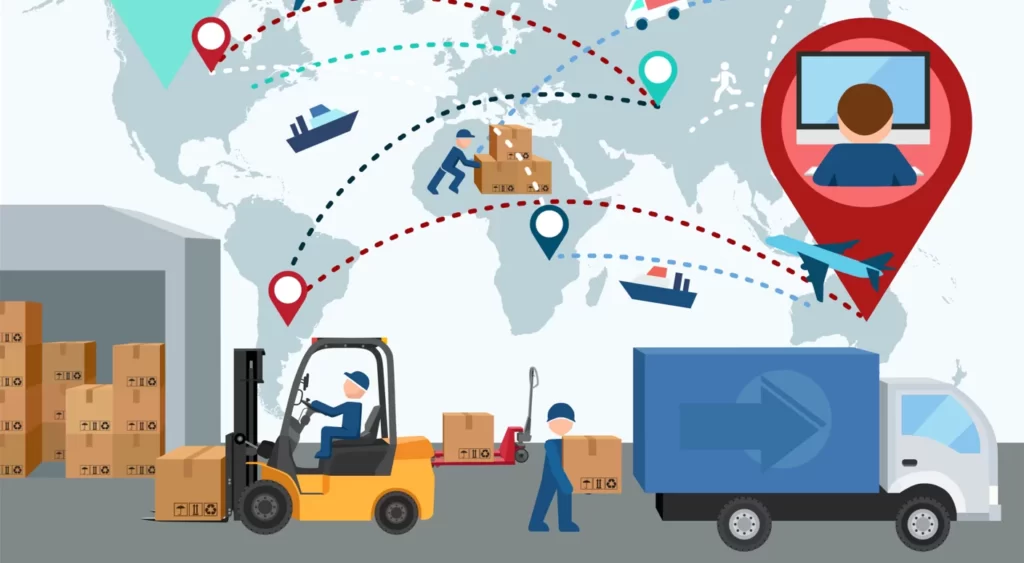
How to Optimize Transportation and Logistics with Microsoft Dynamics 365?

Need an ideal solution to manage your transportation and logistics? Microsoft Dynamics is just for you. This software showers tremendous benefits like routing, vehicle tracking, temperature tracking, and warehousing within a unified platform. You can identify vendors and routings to cover inbound and outbound orders or get the cheapest shipping rates.   Cutting Transportation costs holds the top position as far as the logistics industry is concerned, other pain points do not add any less to the challenges. Microsoft Dynamics 365 offers solutions to bust pain points such as:    Fuel Costs: When it comes to cost-cutting, fuel cost is the major concern of all time. Increased fuel rates add up to higher transportation costs and escalate surcharges, resulting in hiked freight rates and other included charges.   Economic Crisis: Hyped fuel prices bring greater credit issues and raise inflationary demands that take a greater toll on an economy. The industry is mounted by complying with regulations, additional capacity, and declining demands with the increase in key cost centers.   Technological Issues: Even though this industry recognizes the need for advanced technology, business owners fail to find the right solution to manage their transportation and logistics. Most of them either work in silos or adopt multiple software, which might even complicate their operations.   Why Microsoft Dynamics 365 is the perfect solution for Your Transportation or logistics business?  Work smarter and embrace greater flexibility in your daily operations. With a suitable service provider, having over a decade of experience such as Trident Information Systems, you can easily plan routes and identify vendors for inbound and outbound orders. Apart from this, you can claim other benefits like:   Efficient Inbound and Outbound Planning   As soon as you are in the game, you cannot avoid extreme pricing. Therefore, it becomes even more essential to drive down your operational costs by enhancing inbound and outbound operations. Microsoft Dynamics 365 helps in optimizing the shipping process when you order items from the vendors and transfer them to the end customers. Get end-to-end visibility from order to payment, claim substantial lead time reduction and enhance the overall manufacturing process.   On-Time Delivery   When you have an item to accept or dispatch from/to the vendor or customer, you get multiple shipping options on your plate which show up with delivery restrictions such as delivery time, costs, or distance. With Microsoft Dynamics 365, you can ensure timely delivery no matter what route you choose. It identifies all the factors that have a direct or indirect impact on the final delivery and ensures the fastest route possible.  Real-Time Visibility  Transportation management exceeds transportation concerns and includes real-time visibility into the entire order and delivery process to every individual who needs it, from procurement, production scheduling, warehousing to supply chain and staff. Real-time visibility classified under individual departments within a unified platform helps you cut costs and make more logical decisions. Apart from this, you can use this data to fill the process gaps causing variability in the supply chain.   Warehouse Management  Integrate supply chain with Microsoft Dynamics 365 and stay agile while receiving, picking, staging, and loading. Cut down on excess inventory and get visibility when the item was shipped, how much was shipped, and when it will arrive in real-time. End-to-end data on orders and shipments help you plan and maintain optimum inventory levels.   Accurate Replenishment  Inventory replenishment is one of the most crucial operations in transportation management. Microsoft Dynamics 365 optimizes this task and allows you to set up replenishment strategies based on the minimum/maximum criteria. Identify when you need to add up more inventory as soon as it hits the minimum level. Additionally, you can also set up demand-driven replenishments.   Yard and Terminal Management  With Microsoft Dynamics 365, you can eliminate manual processing that slows your progress down. Get real-time visibility in your yard and terminal to minimize waiting times, increase outputs and reinforce regulations. Claim a secured, safe, and optimally productive yard.   Spot the Most Appropriate Carrier   With cutting-edge business intelligence, access the large network of suppliers and carriers existing right now. Browse through thousands of vendors and suppliers and pick up the one that suits you the best. Get a unified view of all carriers and identify where they stand against one another, also analyze their performance over time.   Why Would You Choose Trident Amongst All the Partners?  Trident Information Systems, being the gold partner of Microsoft Dynamics 365, boasts decades of experience with various transportation and logistics firms. We research your business and assemble tools to customize the perfect solution. We assist in managing schedules, analysis, errors, integrations, capacity plans, and workflow.   Trident’s Logistics suite includes Rail Operations, Yard Management, transportation management, warehouse management, billing solutions, and fleet management. Additionally, this suite collaborates with our globally recognized HCM and Finance Modules. It integrates with your organization’s operational aspects and provides a smooth workflow.  

How to Optimize Transportation and Logistics with Microsoft Dynamics 365? Read More »
Customer Story : CRANE Worldwide Logistics centralised their sales platform with Microsoft Dynamics 365

As it approached its 10-year anniversary and its first billion in revenue, global logistics and freight company Crane Worldwide Logistics looked for a modern platform that brought all its sales tools into one place. With the Microsoft Relationship Sales solution, which brings together LinkedIn Sales Navigator and Microsoft Dynamics 365 for Sales, its salespeople have the tools to drive more meaningful engagements with customers, convert opportunities faster, and create more revenue. Just by getting the team using the platform, we’ve seen an uplift in activity in all areas. We’ve had record growth since implementing Microsoft Relationship Sales—the last quarter was excellent for us. John Jergens: Vice President of Global Sales Crane Worldwide Logistics A global sales team From a startup created in the risky business climate of the 2008 recession, Crane Worldwide Logistics has become a major player in the global transport and logistics industry, on track to hit USD1 billion in revenue in 2019. Created by former Eagle Global Logistics executives and headquartered in Houston, Texas, Crane Worldwide aims to provide customers with full transparency into its supply chains by coupling talented people with game-changing technology. But with salespeople spread across the globe, Crane Worldwide found itself with a visibility problem. “We weren’t all working on a common platform, so we were lacking in visibility,” says John Jergens, Vice President of Global Sales at Crane Worldwide. “We knew we had a vast sales pipeline out there, but there wasn’t much data available on it—so we couldn’t see how robust it was.” From data silos to connected visibility A key part of the Crane Worldwide ethos is providing customers with meaningful interactions—and that relies on having a customer relationship management (CRM) solution that salespeople can use to build and maintain relationships and convert opportunities more effectively. But, with a seven-year-old siloed CRM system that it had simply outgrown, the company lacked the tools its salespeople needed. “The previous system never had very good adoption,” Jergens adds. “It just wasn’t very functional.” So, the team went looking for a platform that could replace it. With implementation support from Microsoft Partner Network member PowerObjects, Crane Worldwide deployed the Microsoft Relationship Sales solution, a powerful combination of Microsoft Dynamics 365 for Sales and LinkedIn Sales Navigator, to support personalized, meaningful customer engagements. The team was already using LinkedIn Sales Navigator and Microsoft Office 365, so Dynamics 365 for Sales was the ideal addition to the Crane Worldwide ecosystem. “We saw how Microsoft Relationship Sales could help us focus on being easy to work with from a customer’s perspective,” explains Jergens. “So this whole deployment was part and parcel of becoming easier to do business with.” Now, just six months into deployment, Crane Worldwide has 300 Microsoft Relationship Sales users in its ranks, including 150 direct sellers along with employees from its marketing and account management teams. New processes, simpler sales Using the Microsoft Relationship Sales solution, Crane Worldwide salespeople have already changed the way they work. And they’re reaping the benefits of the visibility they’ve gained into the sales pipeline. “Once we rolled out Microsoft Relationship Sales, the overwhelming response was that it’s really easy to use, and it doesn’t take much time,” says Jergens. “We created a very simple weekly routine where our sellers spend about 30 minutes adding new data into Dynamics 365 for Sales. That’s just six minutes a day to keep everything up to date.” With faster processes freeing up more time for the sales team, sellers can focus their energy where it matters most—building the customer relationships that turn into revenue. And, at the end of each week, management can analyze activity through a global dashboard, which combines CRM and customer interaction data into detailed executive reports that show how salespeople are turning relationships into revenue. “With Microsoft Relationship Sales, we can generate KPIs that tell us what a healthy pipeline should look like. We look at the number of prospects and targets, how long the sales cycle takes, and the time from when we close an account to the time it generates revenue,” explains Jergens. “And if the pipeline isn’t where it should be, we can support the sellers with the resources that they need—it’s more productive all around.” A centralized sales platform Because Microsoft Relationship Sales brings together so many sales capabilities, Crane Worldwide sellers have everything they need to do their jobs in one place. Previously, they had to manage a relationship from scoping to sale across disconnected tools and platforms, far from an efficient process. “It’s difficult to put a number on what it’s like to manage 30 or 40 customers with an email folder and a spreadsheet,” says Jergens. “Now, once the salesperson finds a prospect using LinkedIn Sales Navigator, they use Dynamics 365 for Sales to easily track those conversations. Instead of creating and referencing a lot of notes, they can quickly link activities and discussions through Microsoft Relationship Sales.” With LinkedIn Sales Navigator and Dynamics 365 for Sales together, salespeople can start building the context they need to deliver a meaningful interaction before the first contact even occurs. Insight into potential prospects’ roles, connections, and priorities through LinkedIn Sales Navigator is fed straight into Dynamics 365 for Sales—increasing conversion chances from the very start. “It’s had a direct impact on the time it takes to develop customer relationships, because we have true visibility into those opportunities now,” explains Jergens. A built-in assistant also sends prompts to help sellers accelerate the sales cycle, reminding them to contact a lead that might go cold or nudge an opportunity as it approaches its estimated close date. A roadmap for integration In businesses the world over, sales and marketing teams struggle to communicate and collaborate effectively. As the sales team adapts to Microsoft Relationship Sales, Crane Worldwide is already adopting more of the solution’s capabilities to help sales and marketing stay on the same path. “The marketing teams are able to work in tandem with the sales team to help them understand how marketing activities can help nurture their

Customer Story : CRANE Worldwide Logistics centralised their sales platform with Microsoft Dynamics 365 Read More »

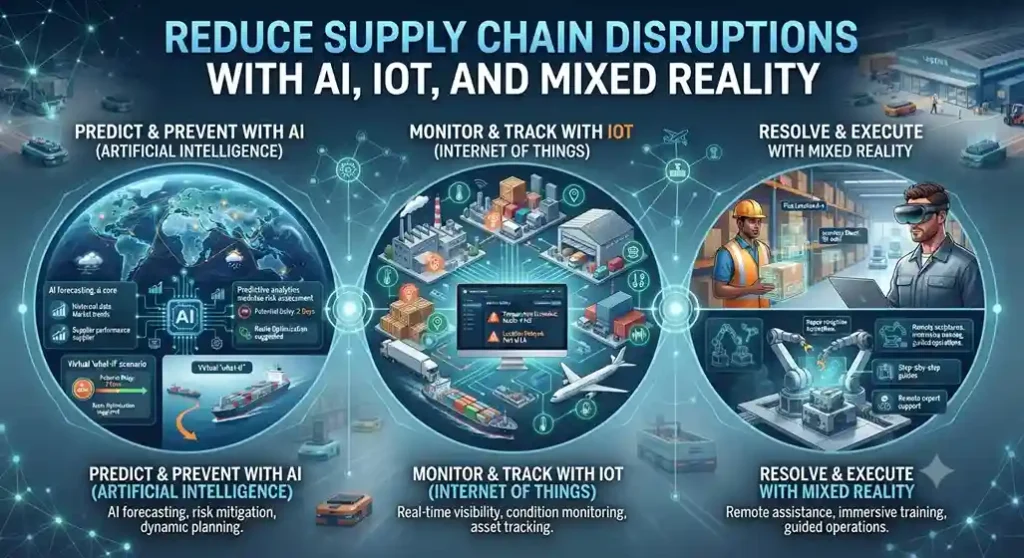
AI, IoT, and mixed reality technologies improving supply chain visibility, logistics, and warehouse operations.

Reduce supply chain disruptions with AI, IoT, and mixed reality

Reduce Supply Chain Disruptions With AI, IoT, and Mixed Reality Supply chains built on single suppliers and single locations don’t survive contact with real-world disruption — port closures, geopolitical trade shifts, or a single supplier’s factory going offline can stall production for weeks. [Flag: insert a recent disruption stat relevant to your audience’s industry — e.g., percentage of manufacturers reporting supplier delays in the past 12 months.] The response isn’t more inventory sitting idle; it’s a supply chain that senses problems early and reconfigures itself before they cascade. That’s the shift Dynamics 365 Supply Chain Management is built around — replacing static, just-in-time planning with predictive, adaptive planning powered by AI, IoT, and mixed reality across production, inventory, and warehouse operations. From “Just-in-Time” to “Just-in-Case” Planning The single-supplier, single-location model was optimized for cost, not resilience. When one link breaks, the entire chain stops. Manufacturers are now deliberately building in redundancy — multiple suppliers and locations for mission-critical parts — even where it costs more, because the cost of a stalled production line consistently outweighs the premium paid for supply flexibility. This shift also demands shorter production runs. Factories need to serve a wider range of products in smaller batches, with lower changeover time between runs. That requires planning systems that recalculate in near real time as demand shifts, not systems that lock in a monthly production plan and treat disruption as an exception to manage manually. Predictive Planning Instead of Reactive Firefighting D365 Supply Chain Management applies AI-driven demand forecasting across planning, production, inventory, warehouse, and transportation management — so a shift in demand or a supplier delay triggers a re-plan before it becomes a stockout. IoT sensor data from equipment feeds directly into this loop, flagging machine performance drift or maintenance needs before a breakdown takes a production line offline unexpectedly. For manufacturers running multi-location operations across India, UAE, or East Africa, this matters more than it might in a single-plant setup — a delay at one facility needs to trigger an automatic reallocation check against inventory and capacity at other sites, not a phone call three days later. Cut Training Time With Mixed Reality Guidance One of the more underused levers in supply chain resilience is workforce agility — how fast you can get a new or reassigned worker productive on unfamiliar equipment. D365 Supply Chain Management integrates with Dynamics 365 Guides, delivering step-by-step, hands-free instructions through a HoloLens device, walking workers through exactly which tool and part to use at each step of a task. This does two things for resilience specifically. First, it makes equipment maintenance skillset-agnostic — you’re no longer waiting on one specialist who knows a particular machine, because any trained worker can follow the holographic guide. Second, it shortens the ramp-up time when you need to redeploy staff to a different line or location during a disruption, which is exactly when you can’t afford a multi-week training cycle. Guides are authored without code — someone writes the instructions and places holographic markers directly on the machine where the work happens, which means your own team can build and update guides as processes change, not wait on an external developer. What This Means for Your Operation Resilience isn’t a single feature — it’s the combination of predictive planning that reduces reaction time, IoT visibility that catches problems before they cause downtime, and a workforce that can be redeployed without retraining bottlenecks. Manufacturers evaluating this shift should look specifically at how their current ERP handles multi-location inventory visibility and whether production re-planning happens in real time or requires manual intervention. [Flag: insert a client example or case study reference here if available — a specific implementation outcome carries more weight than a general capability claim.] Considering a resilience-focused upgrade to your supply chain platform? Talk to Trident’s Dynamics 365 Supply Chain Management team about what a multi-location, AI-driven planning setup looks like for your operation.

Reduce supply chain disruptions with AI, IoT, and mixed reality Read More »