6 strategies to boost sales productivity – Microsoft Dynamics 365
Read here How Microsoft Dynamics 365 helps in Sales, Read 6 strategies to boost sales productivity.
6 strategies to boost sales productivity – Microsoft Dynamics 365 Read More »


Read here How Microsoft Dynamics 365 helps in Sales, Read 6 strategies to boost sales productivity.
6 strategies to boost sales productivity – Microsoft Dynamics 365 Read More »
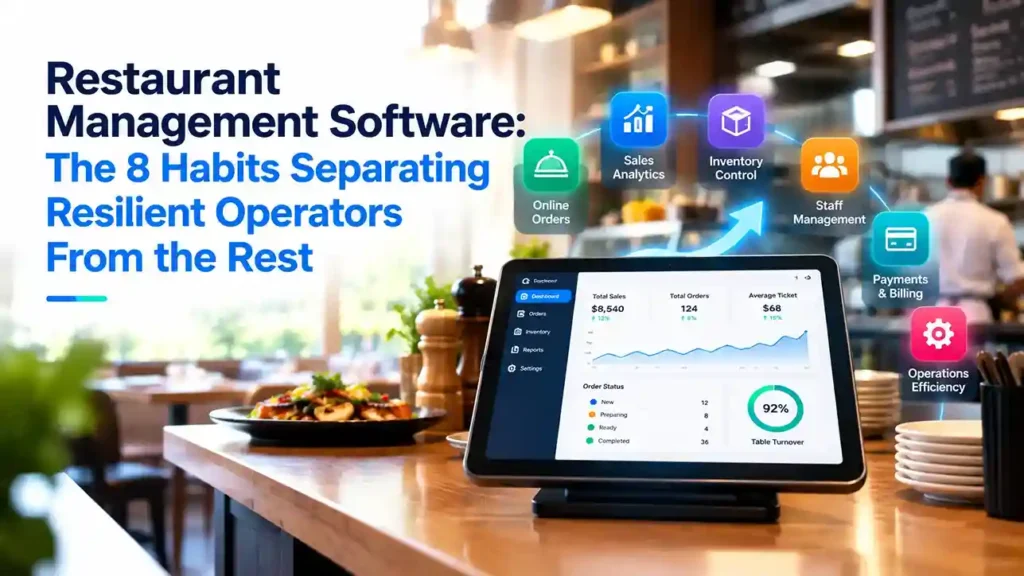
INTRODUCTION Contactless payments, curbside pickup, QR code menus—none of these options were commonplace in restaurants just a few years ago. Today, they are standard expectations. The restaurants that adapted most successfully weren’t necessarily the ones that adopted the most technology, but rather those that managed it through a single, integrated platform instead of a disjointed array of tools. This distinction separates operators who achieved lasting resilience from those who implemented stopgap solutions that didn’t stand the test of time. Design the entire experience, not just a stopgap solution A payment terminal wrapped in plastic is a patch, not a solution; in fact, it often negates the very contactless functionality it was meant to protect. The shift toward contactless payments, delivery, drive-thru service, and curbside pickup is here to stay; therefore, it pays to build a robust infrastructure around these practices rather than relying on makeshift fixes. QR code menus are a prime example: they are useful right now for hygiene reasons, but they offer long-term value by allowing restaurants to instantly update prices or menu items without incurring reprinting costs. Table management software follows the same logic: it is useful today for maintaining social distancing and facilitating contact tracing, and it will remain valuable indefinitely for optimizing occupancy and speeding up table turnover. Take your POS system mobile When a server relies on a fixed terminal, customers are kept waiting, staff waste time walking back and forth, and lines form at the register. A mobile POS system allows servers to take orders, process payments, and close out checks without leaving the dining area; this results in faster service, less unnecessary movement, and the elimination of shared terminals among staff. The greatest advantage arises when the mobile POS connects directly to kitchen display systems: an order taken at the table is automatically sent to the appropriate kitchen station, eliminating the back-and-forth between the dining area and the kitchen that slows down service and leads to order errors. Opt for a single platform rather than multiple disconnected solutions Fragmented systems—standalone tools for point-of-sale (POS), inventory management, and reporting—entail higher integration and maintenance costs while offering managers only a partial view of the business. A unified platform provides a comprehensive, real-time view of operations and customer data, enables faster access to actionable reports, and lowers total costs by eliminating the need for ongoing integration work. Cloud-based implementation proved crucial during times of rapid change: restaurants without legacy on-premise infrastructure could quickly roll out delivery, pickup, and curbside services, whereas those reliant on local systems moved much more slowly. Furthermore, software-hardware compatibility is just as important as the individual components themselves; a system that looks good on paper but fails to integrate properly with existing hardware will fail in practice, regardless of its features. Analyze how customer behavior is actually changing Consumption patterns shift—new customers arrive, and regulars visit at different times or with different needs—and a restaurant that fails to collect this data lacks a solid foundation for designing a loyalty strategy. Reliable, up-to-date data enables actionable decisions, such as creating predictive cost models to set menu prices when ingredient sourcing becomes difficult, or redistributing inventory among locations based on foot traffic. Rethink which metrics truly matter A metric like table turnover rate is meaningless if there aren’t enough customers to fill the tables. Traditional key performance indicators (KPIs) should be reviewed periodically—not just once—since current customer behavior cannot reliably predict what the situation will look like a few months down the line. The goal is not to discard metrics, but to ensure that the ones being monitored continue to reflect the reality of the business. Use predictive analytics, not just historical reports Most restaurant analytics still look to the past: what happened and why. The real value lies in predictive analytics—finding correlations across large, disparate datasets that reveal where the business is heading before it gets there. Combining internal data with external context—local events, weather patterns, general market trends—refines that insight; even a small process adjustment based on this type of information can yield disproportionately large results. Technology is no substitute for the human touch Social distancing and digital ordering changed the dining-out experience, but customers still seek warm, personal service—and it is empowered staff with decision-making authority who truly deliver that. Genuine loyalty stems from a real connection, not just a points program: knowing a customer well enough to offer something relevant is what keeps them coming back, and that starts with how the restaurant treats its own staff. View technology as infrastructure, not a reaction Curbside delivery wasn’t the industry norm until, suddenly, it was. Investing in restaurant management technology requires the same long-term vision as investing in essential kitchen equipment: it is infrastructure that should be implemented before demand forces action, not after. A feature that doesn’t offer an immediate return on investment (ROI) can still be valuable simply because it prepares the business to respond quickly when conditions shift again—and conditions will keep changing. Are you ready to move beyond fragmented systems and adopt a unified platform? Contact Trident to discuss what this transition would look like for your restaurant.
As it approached its 10-year anniversary and its first billion in revenue, global logistics and freight company Crane Worldwide Logistics looked for a modern platform that brought all its sales tools into one place. With the Microsoft Relationship Sales solution, which brings together LinkedIn Sales Navigator and Microsoft Dynamics 365 for Sales, its salespeople have the tools to drive more meaningful engagements with customers, convert opportunities faster, and create more revenue. Just by getting the team using the platform, we’ve seen an uplift in activity in all areas. We’ve had record growth since implementing Microsoft Relationship Sales—the last quarter was excellent for us. John Jergens: Vice President of Global Sales Crane Worldwide Logistics A global sales team From a startup created in the risky business climate of the 2008 recession, Crane Worldwide Logistics has become a major player in the global transport and logistics industry, on track to hit USD1 billion in revenue in 2019. Created by former Eagle Global Logistics executives and headquartered in Houston, Texas, Crane Worldwide aims to provide customers with full transparency into its supply chains by coupling talented people with game-changing technology. But with salespeople spread across the globe, Crane Worldwide found itself with a visibility problem. “We weren’t all working on a common platform, so we were lacking in visibility,” says John Jergens, Vice President of Global Sales at Crane Worldwide. “We knew we had a vast sales pipeline out there, but there wasn’t much data available on it—so we couldn’t see how robust it was.” From data silos to connected visibility A key part of the Crane Worldwide ethos is providing customers with meaningful interactions—and that relies on having a customer relationship management (CRM) solution that salespeople can use to build and maintain relationships and convert opportunities more effectively. But, with a seven-year-old siloed CRM system that it had simply outgrown, the company lacked the tools its salespeople needed. “The previous system never had very good adoption,” Jergens adds. “It just wasn’t very functional.” So, the team went looking for a platform that could replace it. With implementation support from Microsoft Partner Network member PowerObjects, Crane Worldwide deployed the Microsoft Relationship Sales solution, a powerful combination of Microsoft Dynamics 365 for Sales and LinkedIn Sales Navigator, to support personalized, meaningful customer engagements. The team was already using LinkedIn Sales Navigator and Microsoft Office 365, so Dynamics 365 for Sales was the ideal addition to the Crane Worldwide ecosystem. “We saw how Microsoft Relationship Sales could help us focus on being easy to work with from a customer’s perspective,” explains Jergens. “So this whole deployment was part and parcel of becoming easier to do business with.” Now, just six months into deployment, Crane Worldwide has 300 Microsoft Relationship Sales users in its ranks, including 150 direct sellers along with employees from its marketing and account management teams. New processes, simpler sales Using the Microsoft Relationship Sales solution, Crane Worldwide salespeople have already changed the way they work. And they’re reaping the benefits of the visibility they’ve gained into the sales pipeline. “Once we rolled out Microsoft Relationship Sales, the overwhelming response was that it’s really easy to use, and it doesn’t take much time,” says Jergens. “We created a very simple weekly routine where our sellers spend about 30 minutes adding new data into Dynamics 365 for Sales. That’s just six minutes a day to keep everything up to date.” With faster processes freeing up more time for the sales team, sellers can focus their energy where it matters most—building the customer relationships that turn into revenue. And, at the end of each week, management can analyze activity through a global dashboard, which combines CRM and customer interaction data into detailed executive reports that show how salespeople are turning relationships into revenue. “With Microsoft Relationship Sales, we can generate KPIs that tell us what a healthy pipeline should look like. We look at the number of prospects and targets, how long the sales cycle takes, and the time from when we close an account to the time it generates revenue,” explains Jergens. “And if the pipeline isn’t where it should be, we can support the sellers with the resources that they need—it’s more productive all around.” A centralized sales platform Because Microsoft Relationship Sales brings together so many sales capabilities, Crane Worldwide sellers have everything they need to do their jobs in one place. Previously, they had to manage a relationship from scoping to sale across disconnected tools and platforms, far from an efficient process. “It’s difficult to put a number on what it’s like to manage 30 or 40 customers with an email folder and a spreadsheet,” says Jergens. “Now, once the salesperson finds a prospect using LinkedIn Sales Navigator, they use Dynamics 365 for Sales to easily track those conversations. Instead of creating and referencing a lot of notes, they can quickly link activities and discussions through Microsoft Relationship Sales.” With LinkedIn Sales Navigator and Dynamics 365 for Sales together, salespeople can start building the context they need to deliver a meaningful interaction before the first contact even occurs. Insight into potential prospects’ roles, connections, and priorities through LinkedIn Sales Navigator is fed straight into Dynamics 365 for Sales—increasing conversion chances from the very start. “It’s had a direct impact on the time it takes to develop customer relationships, because we have true visibility into those opportunities now,” explains Jergens. A built-in assistant also sends prompts to help sellers accelerate the sales cycle, reminding them to contact a lead that might go cold or nudge an opportunity as it approaches its estimated close date. A roadmap for integration In businesses the world over, sales and marketing teams struggle to communicate and collaborate effectively. As the sales team adapts to Microsoft Relationship Sales, Crane Worldwide is already adopting more of the solution’s capabilities to help sales and marketing stay on the same path. “The marketing teams are able to work in tandem with the sales team to help them understand how marketing activities can help nurture their
The Dynamics 365 release plan for the 2020 release wave 2 describes all new features releasing from October 2020 through March 2021. You can either browse the release plan online or download the document as a PDF file. The PDF file also includes information about Power Apps, Power Automate, Power Virtual Agents, Power Platform governance and administration, and Common Data Model and data integration. The Microsoft Power Platform features coming in the 2020 release wave 2 have been summarized in a separate release plan as well as a downloadable PDF. 2020 release wave 2 overview The 2020 release wave 2 for Dynamics 365 brings new innovations that provide you with significant capabilities to transform your business. The release contains hundreds of new features across Dynamics 365 applications including Marketing, Sales, Customer Service, Field Service, Finance, Supply Chain Management, Human Resources, Commerce, Fraud Protection, and Business Central. Marketing Dynamics 365 Marketing improves the customer journey canvas experience and adds integration with Microsoft Teams for virtual events. Segmentation is enhanced with a new natural language experience to create and consume segments, helping eliminate the specialized skills needed to build complex segments. Sales Dynamics 365 Sales continues emphasis on simplified experiences, app integrations, gamification, a new mobile experience for quick access to customer information, and new enhancements to forecasting to natively create and manage bottom-up sales forecast processes. Dynamics 365 Sales Insights continues investments across multiple areas: sales acceleration, conversation intelligence, relationship intelligence, and advanced forecasting and pipeline intelligence with predictive lead and opportunity scoring to help sales teams uncover top deals. Dynamics 365 Product Visualize empowers sellers and accelerates complex sales processes by showcasing and customizing products in their real-world environment. Sellers can place a 3D digital twin of a product in their customer’s environment and make detailed notes about their requirements. Service Dynamics 365 Customer Service expands agent productivity capabilities enabling agents to engage in multiple sessions simultaneously. Omnichannel for Customer Service is enhanced with additional extensibility options to enable integration with mobile applications, Microsoft bot framework, and outbound messaging channels. Dynamics 365 Customer Service Insights adds new capabilities to help agents using similar case suggestions to resolve customer issues quickly and easily. A new analytical view for customer service managers helps them focus on key support areas that need attention. These highlights will also be included directly in the core Customer Service Hub app so that users can get insights in context without having to switch between applications. Dynamics 365 Field Service continues to add intelligence capabilities including a new Field Service dashboard for monitoring key KPIs and work order completion metrics. There are many user experience enhancements to enable proactive service delivery. The Field Service mobile app is enhanced with capabilities such as push notifications and real-time location sharing. This release wave also includes scheduling enhancements such as multiday manual scheduling and enhanced skill-based matching. Dynamics 365 Remote Assist expands its range of scenarios beyond calls, allowing technicians to perform activities such as capture service and repairs data, perform surveys and walk-throughs independently, and derive service insights from their service operations. Finance and Operations Dynamics 365 Finance continues to focus on automating common tasks to reduce the number of manual processes and add insights and intelligence in Finance. Asset leasing enhances the core capabilities of Finance and the global coverage for Finance continues to expand in this release wave. Dynamics 365 Supply Chain Management expands planning optimization for Manufacturing to perform supply and production planning in near real time with in-memory services. Enhancements to Product Information Management include engineering change management and product versioning capabilities. Cost Management includes new features that will enable global companies maintain multiple cost accounting ledgers by allowing dual currency and dual valuation. Enhancements to the job card device include a new user experience and a new feature to enable reporting serial numbers. Dynamics 365 Guides is focusing on intelligent workflows in this release wave. By taking advantage of data and AI innovations, work instructions can be configured to adjust on the fly based on operator inputs. In addition, insights will make it easier to use time-tracking data and connect that data to your business. Dynamics 365 Project Operations unifies operational workflows to provide the visibility, collaboration, and insights needed to drive success across teams from sales to finance. Project Operations connects your sales, resourcing, project management, and finance teams within a single application to win more deals, accelerate delivery, empower employees, and maximize profitability. Human Resources Dynamics 365 Human Resources expands leave and absence and benefits management capabilities to transform the employee experience. Employees and managers will be able to manage leave and absence directly from Microsoft Teams. This release wave enables streamlined integrations to recruiting and payroll partners, thereby building a Human Capital Management (HCM) ecosystem. Commerce Dynamics 365 Commerce continues to expand capabilities enabling non-developers to easily design and manage digital commerce experiences. Customers can increase lift online and in store with “Shop similar looks” for recommendations. Customers can discover and deploy third-party services, connectors, modules, and themes from Microsoft AppSource. Dynamics 365 Connected Store adds a number of new capabilities such as integration with Dynamics 365 Commerce, front-line worker task assignment and tracing with Microsoft Teams, integrated workflows with Microsoft Power Platform, intelligent command center, store analytics, and store insights solutions such as anomaly detection, inventory recommendations, and shift management recommendations. Fraud Protection Dynamics 365 Fraud Protection adds integration with Dynamics 365 Commerce and a new “manual review” capability that allows customers to use the Fraud Protection rules experience to flag transactions for review, and then allow expert human agents to consume and adjudicate those transactions. SMB Dynamics 365 Business Central investments for this release wave include service enhancements to meet the demands of a rapidly growing customer base, improved performance, handling of file storage, geographic expansion together with support for Group VAT, top customer-requested features, and deeper integration with Microsoft Teams. Customer data platform Dynamics 365 Customer Insights enables every organization to unify disparate data—be it transactional, observational or behavioral sources—to gain a single view of customers and derive intelligent insights that drive key business processes. Dynamics 365 Product Insights enables organizations to understand their customers’ journey, usage,
Dynamics 365: 2020 release wave 2 plan Read More »
As a successful retailer, chances are you are already running some of your IT functions in the cloud. That’s smart. The next logical step is to move your entire retail management system to the cloud, and go from the on-premises version to its software as a service (SaaS) one. But even if you know that the cloud is experiencing exponential growth, and that you will, one day, take the leap, you may be hesitant to do it now. Perhaps you are afraid you’re not ready for the change. Perhaps you have security concerns. Maybe you can’t clearly identify which practical, day-to-day benefits you’d get from moving to the cloud. Whichever your reasons, you want the best for your business, and you care about staying competitive. You want to make the right decision, and employ technology that will propel you forward today and tomorrow. While you are debating whether the cloud is for you, here are 8 good reasons why you should consider migrating your system. 1. Stay up to date, automatically With traditional on-premises software, businesses are responsible of keeping their hardware and software up to date. In order to stay current (and safe), they’d need to purchase new hardware every few years, and to update their software every few months. But in reality, retailers usually have more pressing concerns than keeping track of the latest software patch or upgrade. And if the company is using multiple software solutions and there are integrations in place, a system upgrade can become a costly and lengthy project. As a result, many companies end up with outdated IT environments that work, but don’t really support the business, and may even hinder it. In the worst cases, this old tech might reduce the company’s ability to grow and take on new projects, or stay on top of consumer demands. When you are using SaaS in the cloud, all these concerns belong to the past. You don’t need to worry about periodic maintenance, or to budget for expensive and complicated software upgrades. Instead, your supplier takes care of updating your software regularly. And if you have configured your add-ons correctly, you can maintain all your extensions, and even your configurations. SaaS software guarantees that you are always, automatically, on the latest version, and can use all the new functionality that comes with it. 2. Enhance productivity with intelligence One of the biggest advantages of the cloud is the advanced computational power it offers. Tasks that until yesterday were too complex for even the most powerful computer, for example predicting future sales patterns, are now within reach of any retailer. Businesses can run their data into Artificial Intelligence (AI) and machine learning (ML) powered tools available in the cloud, and without having to pay for extra servers or data scientists, they can get the answers they need, with minimal effort, very rapidly, and at a fraction of the cost than comparable on-prem technology. There is a wide variety of AI tools available in the cloud, giving businesses infinite possibilities to improve their effectiveness and productivity. AI can also help make smarter decisions, and deliver more personalized, to the point customer service. Would you like to send personalized promotions and special deals to your customers based on their shopping history and specific tastes? Are you thinking about adding a chatbot or virtual agent as a first-line customer support? Or perhaps you’d like to offer intelligent search on your e-commerce site? When you run your software in the cloud, all these initiatives are accessible to you, and can be started within a very short timeframe. But AI can do much more than help deliver bespoke customer experiences. You can use optimize your inventory with advanced forecasting that can factor seasonality, promotions, trends, and product substitutes and complements into your forecasts. You can refine your hiring practices with intelligent talent acquisition solutions. You can simplify searches across your catalog for both staff and customers using AI-powered accurate product tagging applied to images. When you infuse your business with intelligence, you also make it more proactive, agile, and profitable. 3. Guarantee business continuity with a reliable infrastructure With traditional in-house IT setups, businesses are at constant risk of downtimes and failures. On-site servers can’t usually guarantee a consistent performance, and if a key piece of your hardware breaks down, you may be left unable to serve customers or close sales – and could even risk losing your business data. As regards reliability, a traditional infrastructure usually necessitates a disaster recovery plan, requiring you to build redundancy, carefully monitor conditions, having dual firewalls and more – in short, you need to budget for time-consuming, expensive, complex monitoring. Switch to SaaS software, and you can step away from all of these problems. Even if you experience a hardware failure – say your computers or servers break down – you won’t lose your data, as it is safely stored in the cloud and can be accessed when and as you need to. The cloud also guarantees higher reliability. Large cloud services like Microsoft Azure, with expansive resources and entire dedicated teams, have already built in redundancy, from failover hardware to datacenters located across the world. As a result, Azure, the service where the cloud-based version of LS Central resides, can guarantee 99,995% uptime, and top security features. 4. Respond quickly to changing market conditions You know how important speed of action is in the retail industry. Yet, traditional IT environments are all but agile: even a project as simple as adding new servers or applications can be very time consuming. First, your IT staff needs time to procure the hardware or software that will fit within the current infrastructure. Then they have to set it up and test it, and finally, they’ll have to go through implementing it. In the past, this process was the only way to implement change. Today, this is an outdated and ineffective way of operating – especially when the businesses you are competing against are agile and unburdened by traditional infrastructure, such as e-commerce players. To stay
Why it makes sense to move your retail management software to the cloud Read More »
Established to lead excellence in government services, Abu Dhabi Digital Authority (ADDA) strives to lead the digital future of Abu Dhabi. Taking advantage of Microsoft Dynamics 365, Power BI, and Azure solutions, TAMM integrates Abu Dhabi government services to provide communities and businesses with a seamless, proactive, and personalized customer experience, one that promises to change the way UAE citizens and residents interact with their government for the better. [/vc_column_text][vc_column_text][/vc_column_text][vc_column_text] Abu Dhabi as a digital innovation destination Abu Dhabi Digital Authority (ADDA) has a vision that offers a new way of interacting with the citizens and residents in Abu Dhabi and throughout the world. ADDA’s vision embraces technology that delivers value through innovation and service excellence. ADDA is building a digital hub that integrates Abu Dhabi’s 1,600 government and business services with over 55 entities into one central platform. This modernizing journey toward global competitiveness means citizens can look forward to a smarter, happier future with better quality of life—all thanks to the TAMM integrated services platform. Digital smart government, powered by Microsoft The TAMM integrated service platform is an intelligent customer support center. Taking advantage of Microsoft Dynamics 365, Power BI, and Azure solutions, TAMM unifies Abu Dhabi’s government and business services into 80 integrated journeys. This integration merges a 360-degree view of customers’ information and their interactions across the government into a seamless, proactive, and personalized customer experience. It promises to completely revolutionize the way citizens interact with the government. Dynamics 365 creates a seamless omni-channel experience. The portal provides United Arab Emirates (UAE) citizens, residents, and visitors with a range of government services through one access point. Operating with Azure and AI increases efficiency and improve customer experience through fast, agile responses to citizen information requests. It provides stakeholders and field workers with decision-making capabilities through in-depth business intelligence on customer behavior. “Through Power BI, we are now able to ensure that all government data is viewed, including our services that are unified and user-centric,” explains Fatima Al Obeidli, Director – Contact Center Business Management Department at ADDA. “This drives our commitment to superior customer service. The Power BI unified dashboard replaces the multiple reports of the past, ensuring one-of-a-kind customer service experience.” Microsoft’s customer-first approach has been proven by its profound understanding of ADDA’s vision. “The aim is to establish a unique service model for Abu Dhabi government. Microsoft is a trusted partner, providing us with tools and mechanisms that empower us to lead the digital future of Abu Dhabi,” explains H.E. Saeed Al Mulla, Director, Government Services at ADDA. Powered by innovation, inspired by society “By leading with a modern, reliable, and integrated digital system that serves all walks of life in society, ADDA supports the business environment, attracts more investments into Abu Dhabi, and enhances the Emirate’s global competitiveness,“ says Ali Nimer, Strategy Advisor to the Director General and Head of Digital Excellence Office at ADDA. Through Power BI, we are now able to ensure that all government data is viewed, including our services that are unified and user-centric. This drives our commitment to superior customer service. The Power BI unified dashboard replaces the multiple reports of the past, ensuring one of a kind customer service experience. – Fatima Al Obeidli: Contact Center Business Management Department
New IT installations often fail. At least that’s the widespread belief surrounding organizational change initiatives today. One frequently cited study from the 1993 book Reengineering the Corporation goes as far as saying that as many as 70% of the organizations that undertake a reengineering effort do not achieve the dramatic results they intended. A more recent McKinsey survey of more than 1,500 executives who had undertaken a significant change effort in the past five years found that only 38% of respondents said “the transformation was ‘completely’ or ‘mostly’ successful at improving performance. After two decades of hearing about high failure rates related to change, it’s unsurprising that business leaders are wary of organizational change projects. Organizational psychologist Nick Tasler explained that these negative biases can create a toxic self-fulfilling prophecy. “When a change project falls a day behind schedule, if leaders and employees believe that successful change is an unlikely outcome, they will regard this momentary setback as the dead canary in the coalmine of their change initiative. (Never mind the fact that three other initiatives are still on time or ahead of schedule),” he wrote in an article for Harvard Business Review. “Suddenly, employees disengage en masse and then the change engine begins to sputter in both perception and reality.” Yes, change is hard, and complex IT implementation projects, particularly ERP installations, can be particularly challenging. But it doesn’t mean they are doomed to failure. So where do you start? How can you choose the right technology for your retail business, and ensure that the implementation project runs as smoothly as possible and you get the most from your investment? Here are some of the main causes for failure in any organizational change initiative, and how can you prevent them from happening: Mistake #1: Failure to plan Issue: An outdated legacy system is impacting business performance, and it needs replacing quickly. In their rush to get the project going, business management jump straight into the implementation without taking the time to develop a well thought-out organizational change management plan. Solution: Don’t be tempted to cut corners in your planning. Analyze your business, decide what should be prioritized, and understand all the different ways the project will impact your routines at every stage of the process. “Companies should start by analyzing their current and future requirements and processes,” says Gunnar Ingimundarson, Chief Consulting Officer at LS Retail. “How many software solutions are they currently using, and what are they used for? Map out the disparate solutions in the stack, alongside their dependencies and interconnections. The next step is to figure out where they can draw the biggest – or quickest – benefits. Is your POS system not generating the information you need on stock levels and product visibility? Or, are there integrations that repeatedly cause problems or break down? Do you experience missing data? Identify the area(s) where a new system would bring immediate value in terms of savings or returns. That’s where you should start, and that should determine your priorities.” Once the priorities are set, break the project down into manageable chunks, from pilot phase to initial implementation to company-wide rollout. Consider when it’s most appropriate to start each phase of the installation so you won’t place unnecessary strain on your business during busy times. Mistake #2: Key stakeholders aren’t onboard, or have unrealistic expectations Issue: Management want the new technology in place quickly and only focus on the end goals. They get frustrated by how long the project is taking and threaten to pull the plug. Or they wonder why the new software isn’t being adopted widely and successfully when they failed to communicate the changes to everybody in the business and get company-wide buy in. Solution: All stakeholders need to be committed to the project’s success right from the beginning, and to clearly understand the project’s scope and goals. “Internal resistance can kill even the best implementation project,” says Eric Miller, Regional Director for the Americas at LS Retail, building on his 13 years of experience in software implementations. “Get the buy-in from all stakeholders from the start, and make sure that the goals, objectives and expected end results of the project are clear and communicated from you to the stakeholders, and from the stakeholders to all the customer parties involved. It never pays off to sell a dream you can’t deliver on.” Bring together personnel from different departments to understand their requirements and what outcomes they hope to achieve from the implementation. Similarly, they need to understand how much time should be devoted to a project like this and ensure project teams are given sufficient time to carry out the work. Set realistic timeframes from the start, and ensure everyone knows exactly what’s required of them. Mistake #3: Unforeseen changes throw the project off track Issue: Even the best prepared projects encounter hurdles along the way, but if unforeseen issues arise and major milestones are missed, it can be tempting to throw in the towel and deem the entire project a failure. Solution: Know that when you’re dealing with a large-scale IT implementation, it’s hard to plan for every eventuality. Be willing to adapt and take a different approach if it ultimately means the project will be a success. “What was deemed to be the best approach initially may need to change – this might even happen after the pilot is completed. I have seen companies that went through multiple pilots before finding the right balance. It’s a learning process, and it’s never over,” says Miller. It’s worth learning everything you can from the pilot implementation. Instead of rushing on to roll out store #2, take a moment to see how the system is working and to identify any issues that you couldn’t have planned for in your testing environment. Success comes to those who take a considered approach. Mistake #4: Picking the wrong technology partner Issue: It may be tempting to go for the cheapest technology provider, but cheapest upfront may not necessarily deliver the long-term business value you hoped for. You quickly realize they can’t help you achieve your outcomes, because they lack drive,
Why organizational change projects fail and how to prevent implementation disaster Read More »
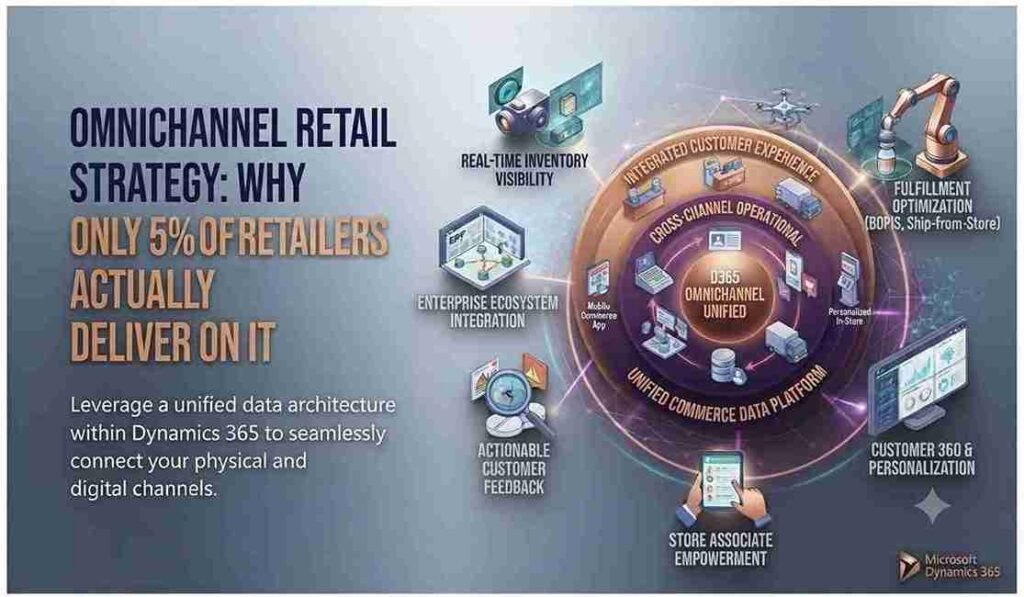
INTRODUCTION Retailers have been talking about omnichannel for more than a decade. However, only about 5% actually allow a customer to initiate a purchase on one channel and complete it on another. Meanwhile, customers aren’t waiting: The vast majority research and select products online before setting foot in a physical store, and half of in-store shoppers check their phone during the visit to check specifications, compare prices or confirm a decision. The gap between what customers expect and what most retail systems can deliver is where sales are lost. Make all channels reflect the same brand A disjointed brand experience—slick in-store, clunky in-app, and slow on social—quietly erodes trust with each inconsistency. Nespresso is a great example of how to do it right: the same visual language is maintained on their e-commerce site, mobile app, order confirmation emails and even on the physical packaging; Thus, the brand is perceived identical at each touch point, instead of reinventing itself channel by channel. Unify your sales channels, not just your brand image Customers expect basic cross-channel functionality: checking if a specific store is in stock, adding an item they saw in person to their online cart, or making a hassle-free return on an in-store purchase. Most retailers cannot yet reliably offer this, as their systems have been assembled from separate, poorly integrated tools rather than being built as a single platform; This often results in the inability to see real-time inventory across locations, difficulty accepting returns across channels, and the risk of selling items that are no longer available. A unified commerce platform like LS Central solves this at the root: centralized inventory and location visibility allows exchanges and returns to work the same way, regardless of the channel where the original purchase was made. Be transparent about shipping costs and conditions Approximately 70% of online shopping carts are abandoned before completing the order, with unclear or unexpectedly high shipping costs being the most common reason. Retailers who clearly list delivery time, shipping cost, and return conditions next to each product—rather than revealing them at the final checkout step—allow customers to make an informed decision from the start, building the kind of trust that reduces cart abandonment. Show real inventory, not just a product catalog Most customers expect to see product availability online before visiting a store; some retailers, like IKEA, even go so far as to display exact stock quantities at each location. At a minimum, product catalogs should be kept up-to-date across all channels (a unified system allows e-commerce, point-of-sale and back-office to use the same data in real time), include detailed product information to compensate for the inability to physically touch or try it, use high-quality images and videos, and display customer reviews; All of these factors directly influence confidence when purchasing and decision-making. Design thinking about what the customer really needs The retailers who succeed are not those who insist most on selling, but those who solve a real problem. CVS’s pharmacy app is a useful example: it helps customers manage complex medication schedules with reminders and notifies them when a prescription is ready for pickup. The value is not promotional, but functional; Precisely because of this, it generates the type of trust that translates into recurring purchases. Turn collected data into actions, not just reports Retailers collect huge amounts of behavioral data (pages viewed, items abandoned in cart, return patterns, top customer preferences), but collecting it is not the same as using it. GameStop’s loyalty program, with tens of millions of members, is a clear example of how to do it right: Analysis of member data revealed that rewards alone don’t drive engagement, but personalized offers do. This change reportedly allowed email open rates to more than double when GameStop moved to using hyper-segmented messages based on purchase history. Turn collected data into action, not just reports Retailers gather vast amounts of behavioral data—pages visited, items abandoned in carts, return patterns, and the preferences of key customers—but collecting data is not the same as using it. GameStop’s loyalty program, with its tens of millions of members, is a prime example of getting this right: analysis of member data revealed that rewards alone do not drive engagement, whereas personalized offers do. This shift more than doubled email open rates when GameStop switched to using hyper-segmented messages based on purchase history. For most retailers, the obstacle isn’t a lack of data, but rather data fragmentation. Having data scattered across disconnected systems means most companies can only meaningfully analyze a small fraction of the information they collect. A unified commerce platform that consolidates data from all channels into a single location is what truly enables a comprehensive view of the customer. Want to see what a unified omnichannel platform would look like for your retail business? Contact the Trident team to discover the possibilities offered by LS Central.
Omnichannel Retail Strategy: Why Only 5% of Retailers Actually Deliver On It Read More »
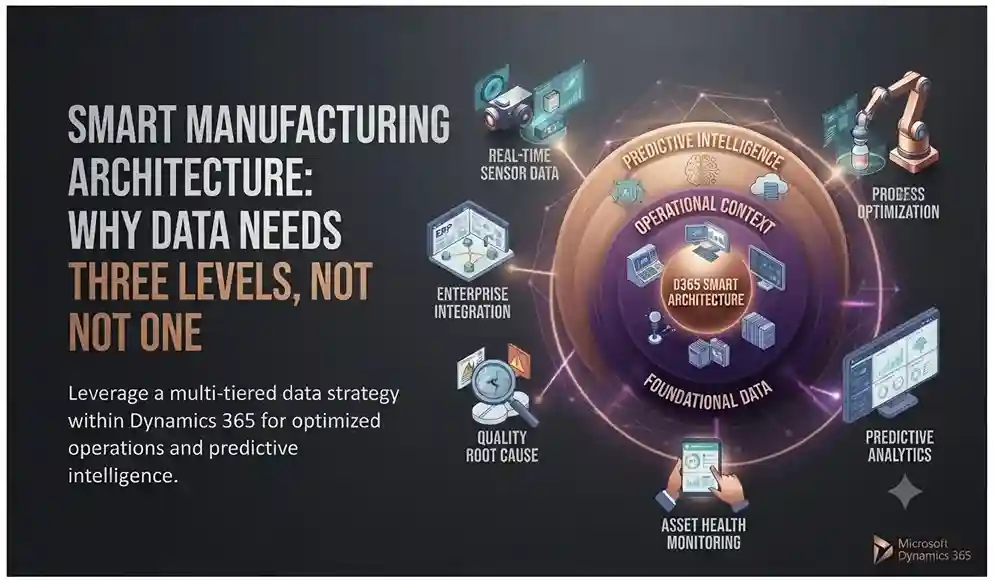
INTRODUCTION A sensor on the production floor that generates data no one analyzes does not constitute smart manufacturing; it is simply noise with an Internet connection. Real value emerges when that data follows a structured path: it is captured at the machine level, coordinated at the plant level, and analyzed at the enterprise level, where patterns are truly transformed into predictions. That three-tier architecture is what distinguishes functional Industry 4.0 implementations from costly sensor installations that never generate a return on investment (ROI). Why the convergence of OT and IT is the true starting point Most factories operate using operational technology (OT)—machines, equipment lines, robotic devices—that was historically not designed to connect to anything. Smart manufacturing relies on connecting that OT layer with IT systems, enabling real-time data capture, predictive maintenance, and cognitive analytics. Without that convergence, investments in “smart” factories often result in isolated dashboards rather than enabling connected decision-making. The three levels through which data must flow Edge level: where the physical work takes place. Machines and sensors generate raw data on the factory floor in real time as production progresses. Plant level: where local activity is coordinated. Data from multiple sources at the edge is aggregated and orchestrated at the facility level, offering plant managers a unified view rather than dozens of disconnected sensor data streams. Enterprise level: where the actual analysis takes place. Data from all plants is stored, visualized, and analyzed at scale; this is where genuine predictive insights become possible, moving beyond simple monitoring. Skipping any of these levels often leads to a specific failure: omitting coordination between the edge and the plant results in disconnected local systems; If the connection between the plant floor and the enterprise level is omitted, the result is plants incapable of learning from one another’s failure patterns. What predictive maintenance really requires Predictive maintenance is often discussed as a standalone capability, but its effectiveness relies on an end-to-end data chain. To predict a failure before it occurs—rather than simply detecting it after the fact—production quality data must identify the issue at the edge, transmit it to the plant level, and analyze it against historical patterns at the enterprise level. That is the difference between saying “the machine broke down” and “this machine will likely require maintenance within the next two weeks”; only the latter allows for the prevention of unplanned downtime. The role of Dynamics 365 and Azure IoT in this architecture Instead of treating the edge environment, the plant floor, and the corporate level as three independent systems requiring separate integration efforts, Azure IoT Hub and Azure IoT Edge natively manage the flow of data from the edge to the cloud. Meanwhile, Dynamics 365 Supply Chain Management and Power BI operate at the corporate level, transforming aggregated data into maintenance plans, quality alerts, and inventory decisions that a plant manager can actually act upon. This architectural concept holds true regardless of the vendor; the difference lies in whether the manufacturer must integrate three distinct platforms or utilizes a unified, connected system—spanning everything from the sensor to the dashboard. Are you designing a smart manufacturing architecture for your plant? Consult Trident on how Dynamics 365 and Azure IoT can integrate with your existing systems.
Smart Manufacturing Architecture: Why Data Needs Three Levels, Not One Read More »