Welcome to Trident Information Systems!
Write us to - info@tridentinfo.com
Let's Socialize

business central partner in UAE

8 tips to build a successful restaurant experience in times of crisis and beyond

Digital transformation is no longer a choice. That’s the key message from the experts who spoke at “How to build a successful restaurant experience in Covid times,” an online event organized by LS Retail and Microsoft. The panel included industry experts from Microsoft and LS Retail as well as Leon DeWet, a CIO with decades of experiences in the F&B industry. The group discussed how restaurants can build competences and resilience to maintain customer loyalty and thrive, now and through the next crisis. This blog is mainly for Restaurant management software & tips for Successful restaurant  experience Restaurant Management Software Here are 8 tips from the experts to help you approach this digital transformation, so that you can ride the next wave of change instead of being crushed by it. 1. Rethink every step of the journey Yesterday, you had to deliver convenience and hospitality; today, you must also guarantee customer and employee safety. Many restaurants have added quick fixes, such as covering payment devices in plastic, so they can easily be sanitized. “How often does the reader on the contactless device not work, now that it’s covered in plastic?,” Minicola asked attendees, adding “And how often do restaurants ask me to touch the screen anyway to provide a tip?” The boom of contactless payments, home delivery, drive-thru and curbside is not temporary. Restaurants must step back, rethink the whole journey, and implement solutions that are effective and designed to last long-term. Two examples that were mentioned of additions that will bring a benefit now and tomorrow: Menus that can be accessed via a QR code are useful now – paper menus are hard to sanitize – and will provide a value later on, as they enable restaurants to make quick menu changes without wasting time or printing costs. Software to manage tables and seating plans can help you easily redesign your floor plan, with safely distanced tables and clear tracking of who is seating where and when for contact tracing purposes. In the future, table management software can help you optimize seating space, track the status of each table (who is waiting to order, who has been served) and easily accommodate last-minute guests, all the while keeping your service flawless. 2. Focus on mobility Mobility should be a priority in any digitization project. Running your Point of Sale on mobile devices helps you manage the flow of guests and staff inside the restaurant premises. Your server can take an order from a group sitting on the terrace, and then go to another table, take their card payment and see them out. Service is faster and more convenient for your guests, who can stay seated throughout. At the same time, you reduce the risk of contagion by reducing needless walking around and queuing at the till, and by letting servers using a personal device instead of sharing a standard till. And if your POS offers a two-way connection to the display systems in the kitchen, you get a whole set of extra benefits. “With our restaurant software, when you punch in an order at the POS, the order is sent automatically to a digital display at the correct kitchen station. Your front-of-house staff is spared all the needless back and forth from the table to the kitchen and to the register. The result is less risk of contact, and less time wasted,” said Eric Miller, Regional Director at LS Retail. But this is just scratching the surface. Mobile POS, especially when part of an interconnected technology platform, also enables more precise communication between front of house and kitchen, reduces the risk of production mistakes, and helps speed up table turns. Michael Mento, Surface specialist at Microsoft, described how eagerly restaurants have adopted the Surface tablet devices, which also come with accessories specifically designed for use on the restaurant floor. 3. Build your experiences on a strong technology platform Customers demand consistent experiences, and these can only be achieved through a unified approach to technology. Unified software solutions are increasingly replacing traditional fragmented IT setups. The benefits are well known: Managers geta 360-degree view of the organisation, with all business and customer data accessible in one place. Decision making is faster, as managers can get actionable reports, accounts and statistics exactly when they need them. Implementation and management costs are lower, as you don’t need to integrate separate systems and to maintain these integrations. You can transmit information quickly across the company, from the dishes on today’s menu to recipes, prices and nutritional content. So everyone can always perform at the top of their abilities. And if you run your unified software in the cloud, you can grab opportunities as they arise. As the pandemic hit, companies that run their software in the cloud, and who were not burdened by traditional on-prem infrastructure, investments and timelines, have been able to add innovative technology and transform their business models faster. “For many restaurants, the ability to add systems for pickup, delivery, and curbside made the difference between success and closing up doors,” Miller pointed out. Leon DeWet, former CIO at F&B enterprises Cracker Barrel and O’Charley’s, reminded business to consider how well the selected software and hardware work together. “If one works, but the other one doesn’t deliver, the project fails,” he noted. “Look for a solution that is proven for software and hardware working together.” Mento, from the Microsoft Surface team, echoed DeWet’s words. 4. Track changes in customer behavior With people working from home and stuck in lockdowns, restaurants have seen tremendous changes. They have lost old customers, gained new ones, and seen regulars approach them at different times, with new needs. These are changes businesses must pay attention to. “You need to capture this data, or you have no way to build your strategy on driving loyalty now and into the future,” said Minicola. “You cannot establish and foster loyalty without data,” she added. Access to data that is both reliable and timely is necessary for action. You need to clearly see what is happening to react, and prevent issues and waste. “During the pandemic, many restaurants have had problems sourcing specific ingredients,” said Miller. “With our software, you can do predictive cost analysis, and experiment varying prices, menus and recipes. The system helps you find the sweet spot with optimum benefits. You can then use this knowledge to

8 tips to build a successful restaurant experience in times of crisis and beyond Read More »
Customer Story : CRANE Worldwide Logistics centralised their sales platform with Microsoft Dynamics 365

As it approached its 10-year anniversary and its first billion in revenue, global logistics and freight company Crane Worldwide Logistics looked for a modern platform that brought all its sales tools into one place. With the Microsoft Relationship Sales solution, which brings together LinkedIn Sales Navigator and Microsoft Dynamics 365 for Sales, its salespeople have the tools to drive more meaningful engagements with customers, convert opportunities faster, and create more revenue. Just by getting the team using the platform, we’ve seen an uplift in activity in all areas. We’ve had record growth since implementing Microsoft Relationship Sales—the last quarter was excellent for us. John Jergens: Vice President of Global Sales Crane Worldwide Logistics A global sales team From a startup created in the risky business climate of the 2008 recession, Crane Worldwide Logistics has become a major player in the global transport and logistics industry, on track to hit USD1 billion in revenue in 2019. Created by former Eagle Global Logistics executives and headquartered in Houston, Texas, Crane Worldwide aims to provide customers with full transparency into its supply chains by coupling talented people with game-changing technology. But with salespeople spread across the globe, Crane Worldwide found itself with a visibility problem. “We weren’t all working on a common platform, so we were lacking in visibility,” says John Jergens, Vice President of Global Sales at Crane Worldwide. “We knew we had a vast sales pipeline out there, but there wasn’t much data available on it—so we couldn’t see how robust it was.” From data silos to connected visibility A key part of the Crane Worldwide ethos is providing customers with meaningful interactions—and that relies on having a customer relationship management (CRM) solution that salespeople can use to build and maintain relationships and convert opportunities more effectively. But, with a seven-year-old siloed CRM system that it had simply outgrown, the company lacked the tools its salespeople needed. “The previous system never had very good adoption,” Jergens adds. “It just wasn’t very functional.” So, the team went looking for a platform that could replace it. With implementation support from Microsoft Partner Network member PowerObjects, Crane Worldwide deployed the Microsoft Relationship Sales solution, a powerful combination of Microsoft Dynamics 365 for Sales and LinkedIn Sales Navigator, to support personalized, meaningful customer engagements. The team was already using LinkedIn Sales Navigator and Microsoft Office 365, so Dynamics 365 for Sales was the ideal addition to the Crane Worldwide ecosystem. “We saw how Microsoft Relationship Sales could help us focus on being easy to work with from a customer’s perspective,” explains Jergens. “So this whole deployment was part and parcel of becoming easier to do business with.” Now, just six months into deployment, Crane Worldwide has 300 Microsoft Relationship Sales users in its ranks, including 150 direct sellers along with employees from its marketing and account management teams. New processes, simpler sales Using the Microsoft Relationship Sales solution, Crane Worldwide salespeople have already changed the way they work. And they’re reaping the benefits of the visibility they’ve gained into the sales pipeline. “Once we rolled out Microsoft Relationship Sales, the overwhelming response was that it’s really easy to use, and it doesn’t take much time,” says Jergens. “We created a very simple weekly routine where our sellers spend about 30 minutes adding new data into Dynamics 365 for Sales. That’s just six minutes a day to keep everything up to date.” With faster processes freeing up more time for the sales team, sellers can focus their energy where it matters most—building the customer relationships that turn into revenue. And, at the end of each week, management can analyze activity through a global dashboard, which combines CRM and customer interaction data into detailed executive reports that show how salespeople are turning relationships into revenue. “With Microsoft Relationship Sales, we can generate KPIs that tell us what a healthy pipeline should look like. We look at the number of prospects and targets, how long the sales cycle takes, and the time from when we close an account to the time it generates revenue,” explains Jergens. “And if the pipeline isn’t where it should be, we can support the sellers with the resources that they need—it’s more productive all around.” A centralized sales platform Because Microsoft Relationship Sales brings together so many sales capabilities, Crane Worldwide sellers have everything they need to do their jobs in one place. Previously, they had to manage a relationship from scoping to sale across disconnected tools and platforms, far from an efficient process. “It’s difficult to put a number on what it’s like to manage 30 or 40 customers with an email folder and a spreadsheet,” says Jergens. “Now, once the salesperson finds a prospect using LinkedIn Sales Navigator, they use Dynamics 365 for Sales to easily track those conversations. Instead of creating and referencing a lot of notes, they can quickly link activities and discussions through Microsoft Relationship Sales.” With LinkedIn Sales Navigator and Dynamics 365 for Sales together, salespeople can start building the context they need to deliver a meaningful interaction before the first contact even occurs. Insight into potential prospects’ roles, connections, and priorities through LinkedIn Sales Navigator is fed straight into Dynamics 365 for Sales—increasing conversion chances from the very start. “It’s had a direct impact on the time it takes to develop customer relationships, because we have true visibility into those opportunities now,” explains Jergens. A built-in assistant also sends prompts to help sellers accelerate the sales cycle, reminding them to contact a lead that might go cold or nudge an opportunity as it approaches its estimated close date. A roadmap for integration In businesses the world over, sales and marketing teams struggle to communicate and collaborate effectively. As the sales team adapts to Microsoft Relationship Sales, Crane Worldwide is already adopting more of the solution’s capabilities to help sales and marketing stay on the same path. “The marketing teams are able to work in tandem with the sales team to help them understand how marketing activities can help nurture their

Customer Story : CRANE Worldwide Logistics centralised their sales platform with Microsoft Dynamics 365 Read More »

Dynamics 365: 2020 release wave 2 plan

The Dynamics 365 release plan for the 2020 release wave 2 describes all new features releasing from October 2020 through March 2021. You can either browse the release plan online or download the document as a PDF file. The PDF file also includes information about Power Apps, Power Automate, Power Virtual Agents, Power Platform governance and administration, and Common Data Model and data integration. The Microsoft Power Platform features coming in the 2020 release wave 2 have been summarized in a separate release plan as well as a downloadable PDF. 2020 release wave 2 overview The 2020 release wave 2 for Dynamics 365 brings new innovations that provide you with significant capabilities to transform your business. The release contains hundreds of new features across Dynamics 365 applications including Marketing, Sales, Customer Service, Field Service, Finance, Supply Chain Management, Human Resources, Commerce, Fraud Protection, and Business Central. Marketing Dynamics 365 Marketing improves the customer journey canvas experience and adds integration with Microsoft Teams for virtual events. Segmentation is enhanced with a new natural language experience to create and consume segments, helping eliminate the specialized skills needed to build complex segments. Sales Dynamics 365 Sales continues emphasis on simplified experiences, app integrations, gamification, a new mobile experience for quick access to customer information, and new enhancements to forecasting to natively create and manage bottom-up sales forecast processes. Dynamics 365 Sales Insights continues investments across multiple areas: sales acceleration, conversation intelligence, relationship intelligence, and advanced forecasting and pipeline intelligence with predictive lead and opportunity scoring to help sales teams uncover top deals. Dynamics 365 Product Visualize empowers sellers and accelerates complex sales processes by showcasing and customizing products in their real-world environment. Sellers can place a 3D digital twin of a product in their customer’s environment and make detailed notes about their requirements. Service Dynamics 365 Customer Service expands agent productivity capabilities enabling agents to engage in multiple sessions simultaneously. Omnichannel for Customer Service is enhanced with additional extensibility options to enable integration with mobile applications, Microsoft bot framework, and outbound messaging channels. Dynamics 365 Customer Service Insights adds new capabilities to help agents using similar case suggestions to resolve customer issues quickly and easily. A new analytical view for customer service managers helps them focus on key support areas that need attention. These highlights will also be included directly in the core Customer Service Hub app so that users can get insights in context without having to switch between applications. Dynamics 365 Field Service continues to add intelligence capabilities including a new Field Service dashboard for monitoring key KPIs and work order completion metrics. There are many user experience enhancements to enable proactive service delivery. The Field Service mobile app is enhanced with capabilities such as push notifications and real-time location sharing. This release wave also includes scheduling enhancements such as multiday manual scheduling and enhanced skill-based matching. Dynamics 365 Remote Assist expands its range of scenarios beyond calls, allowing technicians to perform activities such as capture service and repairs data, perform surveys and walk-throughs independently, and derive service insights from their service operations. Finance and Operations Dynamics 365 Finance continues to focus on automating common tasks to reduce the number of manual processes and add insights and intelligence in Finance. Asset leasing enhances the core capabilities of Finance and the global coverage for Finance continues to expand in this release wave. Dynamics 365 Supply Chain Management expands planning optimization for Manufacturing to perform supply and production planning in near real time with in-memory services. Enhancements to Product Information Management include engineering change management and product versioning capabilities. Cost Management includes new features that will enable global companies maintain multiple cost accounting ledgers by allowing dual currency and dual valuation. Enhancements to the job card device include a new user experience and a new feature to enable reporting serial numbers. Dynamics 365 Guides is focusing on intelligent workflows in this release wave. By taking advantage of data and AI innovations, work instructions can be configured to adjust on the fly based on operator inputs. In addition, insights will make it easier to use time-tracking data and connect that data to your business. Dynamics 365 Project Operations unifies operational workflows to provide the visibility, collaboration, and insights needed to drive success across teams from sales to finance. Project Operations connects your sales, resourcing, project management, and finance teams within a single application to win more deals, accelerate delivery, empower employees, and maximize profitability. Human Resources Dynamics 365 Human Resources expands leave and absence and benefits management capabilities to transform the employee experience. Employees and managers will be able to manage leave and absence directly from Microsoft Teams. This release wave enables streamlined integrations to recruiting and payroll partners, thereby building a Human Capital Management (HCM) ecosystem. Commerce Dynamics 365 Commerce continues to expand capabilities enabling non-developers to easily design and manage digital commerce experiences. Customers can increase lift online and in store with “Shop similar looks” for recommendations. Customers can discover and deploy third-party services, connectors, modules, and themes from Microsoft AppSource. Dynamics 365 Connected Store adds a number of new capabilities such as integration with Dynamics 365 Commerce, front-line worker task assignment and tracing with Microsoft Teams, integrated workflows with Microsoft Power Platform, intelligent command center, store analytics, and store insights solutions such as anomaly detection, inventory recommendations, and shift management recommendations. Fraud Protection Dynamics 365 Fraud Protection adds integration with Dynamics 365 Commerce and a new “manual review” capability that allows customers to use the Fraud Protection rules experience to flag transactions for review, and then allow expert human agents to consume and adjudicate those transactions. SMB Dynamics 365 Business Central investments for this release wave include service enhancements to meet the demands of a rapidly growing customer base, improved performance, handling of file storage, geographic expansion together with support for Group VAT, top customer-requested features, and deeper integration with Microsoft Teams. Customer data platform Dynamics 365 Customer Insights enables every organization to unify disparate data—be it transactional, observational or behavioral sources—to gain a single view of customers and derive intelligent insights that drive key business processes. Dynamics 365 Product Insights enables organizations to understand their customers’ journey, usage,

Dynamics 365: 2020 release wave 2 plan Read More »

Business team using CRM software to manage sales, customer data, and communication workflows.

5 Clear Signs Your Business Needs CRM Software in 2026

Here is a question most business owners ask too late: at what point does managing customer relationships in spreadsheets, email inboxes, and memory become a liability rather than a system? The honest answer is — sooner than you think. Customer Relationship Management (CRM) software is not just for large enterprises with complex sales teams. It is for any business that wants to grow its customer base, retain the customers it already has, and make sure no opportunity falls through the cracks. The challenge is recognising when the moment has arrived. Here are five clear signs that your business needs CRM software — and why Microsoft Dynamics 365 is the platform most businesses choose. What Is CRM Software and Why Does It Matter? CRM software is a centralised system that manages every interaction between your business and your customers — from the first marketing touchpoint through the sales cycle, the initial purchase, ongoing service, and renewal. Done well, CRM gives every team member a complete, real-time picture of every customer relationship. Sales knows what marketing has sent. Customer service knows what sales has promised. Management knows exactly where every opportunity stands. Without CRM, this information lives in individual inboxes, personal spreadsheets, and people’s heads — and every time someone leaves the business, some of that knowledge leaves with them. 5 Signs Your Business Needs CRM Software Now Sign 1 — You Are Losing Leads Without Knowing Why Leads come in through your website, social media, phone calls, and referrals. But if you are managing them manually, some of those leads are simply not being followed up — because they were logged in the wrong place, assigned to the wrong person, or forgotten during a busy week. A CRM captures every lead automatically, assigns it to the right team member, sets follow-up reminders, and tracks every interaction. Nothing gets lost. Every opportunity gets the attention it deserves. If you have ever discovered a warm lead that was never followed up weeks after it arrived — your business needs CRM. Sign 2 — Your Marketing and Sales Teams Work in Silos Marketing generates leads. Sales closes deals. But when these two teams work from different systems and different data, the handoff between them is where opportunities die. Marketing does not know which leads converted. Sales does not know which campaigns generated their best prospects. Neither team can make decisions based on the complete picture — because that picture does not exist in any single place. CRM creates a shared view of every customer and every lead — so marketing can see which campaigns produce sales-ready prospects and sales can engage leads with full context on their marketing journey. The result is better targeting, higher conversion rates, and a measurable improvement in revenue. If your marketing and sales teams regularly blame each other for pipeline problems — your business needs CRM. Sign 3 — You Cannot Easily Create Quotes and Track Invoices For businesses that sell through a quotation process — professional services, manufacturing, technology, or any B2B operation — the ability to create, track, and follow up on quotes directly impacts how quickly deals close. A CRM with a built-in quoting and invoicing module connects the entire opportunity-to-cash process: If your team is manually creating quotes in Word documents and tracking them in a spreadsheet — your business needs CRM. Sign 4 — Customer Service Issues Are Falling Through the Gaps Customer service quality is directly tied to information quality. When a customer calls with a problem, the speed and accuracy of the resolution depends on whether your team can instantly see their complete history — what they bought, when, what issues they have had before, and what was promised. Without CRM, this information is scattered across email threads, support tickets, and different team members’ notes. The customer ends up repeating themselves. Issues take longer to resolve. Satisfaction drops. CRM centralises customer service management: If customers regularly complain about having to repeat their issue to multiple people — your business needs CRM. Sign 5 — You Cannot See How Your Business Is Really Performing Good management decisions are built on good data. But if your sales pipeline lives in a spreadsheet, your customer data is in email, and your service records are in a helpdesk tool — getting a clear, current picture of business performance requires manual compilation that takes hours and is outdated the moment it is finished. CRM provides real-time dashboards and reports that give every level of the organisation instant visibility: If your management team regularly makes decisions based on instinct because the data is too hard to access quickly — your business needs CRM. Why Microsoft Dynamics 365 CRM Microsoft Dynamics 365 is one of the world’s most widely adopted CRM platforms — and for good reason. It covers every scenario described above in a single, unified platform: lead management, marketing automation, sales pipeline, quoting and invoicing, customer service, and real-time analytics — all connected on the same data model. Key advantages over standalone CRM tools: Why Trident Is India’s Trusted Dynamics 365 CRM Partner As a certified Microsoft Dynamics 365 partner, Trident Information Systems has helped businesses across sales, marketing, manufacturing, retail, and professional services in India implement CRM solutions that close the gaps described in this article. Our CRM implementations are configured around your specific sales process and customer management requirements — not a generic template. Ready to find out how CRM software can transform your customer relationships? Book a free Dynamics 365 CRM assessment with Trident today. For more insightful content and industry updates, follow our LinkedIn page.

5 Clear Signs Your Business Needs CRM Software in 2026 Read More »

Enterprise ERP software dashboard managing retail, hospitality, and manufacturing operations.

Enterprise ERP Software for Retail, Hospitality & Manufacturing: 6 Benefits That Transform Your Business

Running a business in retail, hospitality, or manufacturing means managing a constant flow of moving parts — staff schedules, customer orders, inventory levels, supplier deliveries, and financial transactions — all happening simultaneously, every single day. When those moving parts are managed through disconnected systems — a spreadsheet here, a separate POS there, a standalone HR tool — the gaps between them create errors, delays, and blind spots that cost real money. Enterprise ERP software brings everything together. One platform. One source of truth. Every department — finance, operations, HR, sales, and customer service — working from the same real-time data. Here is how ERP transforms operations specifically in retail, hospitality, and manufacturing — and why Microsoft Dynamics 365 Business Central is the platform Trident recommends. Why Retail, Hospitality, and Manufacturing Need ERP Most These three industries share a common challenge: high operational complexity at every level. A retail chain manages hundreds of SKUs across multiple locations. A hotel or restaurant balances reservations, kitchen operations, staff rotas, and customer satisfaction simultaneously. A manufacturer coordinates raw material procurement, production scheduling, quality control, and order fulfilment — often across multiple sites. Without a unified system connecting all these functions, management is reactive. With the right ERP, it becomes proactive — with real-time visibility that enables better decisions at every level of the organisation. 6 Key Benefits of ERP for Retail, Hospitality and Manufacturing 1. Real-Time Data Across Every Department Business data changes constantly. Inventory levels shift with every sale. Staff schedules update daily. Customer orders flow in around the clock. Financial positions move with every transaction. Without real-time visibility, managers make decisions based on yesterday’s data — and the gaps between systems mean different departments often work from different numbers. ERP solves this fundamentally. Every transaction updates the central system instantly — so whether you are checking stock levels, reviewing sales performance, or approving a purchase order, you are always working from current, accurate information. No delays. No discrepancies. No guesswork. 2. Integrated Point of Sale In retail and hospitality, the POS system is the heartbeat of the operation. Every sale, every order, every payment flows through it — and what happens to that data after the transaction determines how well the rest of the business functions. A standalone POS that does not connect to inventory, finance, and customer management creates manual work and data silos. An ERP-integrated POS changes everything: For retail chains and multi-outlet hospitality businesses, this integration is particularly powerful — giving head office a live view of every location’s performance without waiting for manual reports. 3. Smarter Customer Management Your customers are your most valuable asset — and your ERP should help you treat them that way. An ERP system captures complete customer profiles: purchase history, preferences, communication records, loyalty points, and service interactions. This data enables: In hospitality especially, knowing your guest’s preferences before they arrive is a powerful differentiator. In retail, personalised offers based on real purchase data consistently outperform generic promotions. ERP makes both possible at scale. 4. Efficient Employee Management Managing staff across retail stores, restaurant shifts, or manufacturing shifts — potentially across multiple locations — is one of the most operationally demanding functions in any of these industries. ERP centralises employee management in one system: When employee data is connected to operational data, managers can make faster and fairer staffing decisions — and compliance documentation is always complete and current. 5. Streamlined Inventory Management Inventory management is the operational function where ERP delivers the most immediate and visible impact — particularly in retail and manufacturing. Without a connected inventory system, businesses either over-order (tying up cash in excess stock) or under-order (losing sales to stockouts). Neither is acceptable in competitive markets. ERP provides: For manufacturers, ERP takes this further — connecting inventory management directly to production planning and supplier procurement, ensuring materials are always available when production needs them. 6. Unified Financial Management Every operational decision has a financial consequence — and ERP connects the two in real time. Rather than waiting for month-end reports compiled manually from multiple systems, ERP gives finance teams live visibility into revenue, costs, margins, and cash flow across every business unit. Invoices are matched automatically. Budget variances are flagged immediately. Financial close processes that once took days are completed in hours. For multi-entity businesses — retail chains, hospitality groups, or multi-site manufacturers — ERP consolidates financial data across all locations into a single, accurate picture that leadership can act on immediately. Why Microsoft Dynamics 365 Business Central Microsoft Dynamics 365 Business Central is the modern, cloud-native evolution of Dynamics NAV — one of the most widely deployed ERP platforms in retail, hospitality, and manufacturing globally. It delivers all six benefits above in a single, integrated platform — with the added advantage of: Whether you are running a single restaurant, a retail chain, or a manufacturing facility, Business Central scales with your operation — without platform replacement as you grow. Why Trident Is India’s Trusted ERP Partner As a certified Microsoft Dynamics 365 Business Central partner, Trident Information Systems has helped businesses across retail, hospitality, and manufacturing in India implement ERP solutions that deliver measurable results — from initial assessment through go-live and ongoing optimisation. Ready to unify your business on one intelligent platform? Book a free ERP assessment with Trident today.

Enterprise ERP Software for Retail, Hospitality & Manufacturing: 6 Benefits That Transform Your Business Read More »

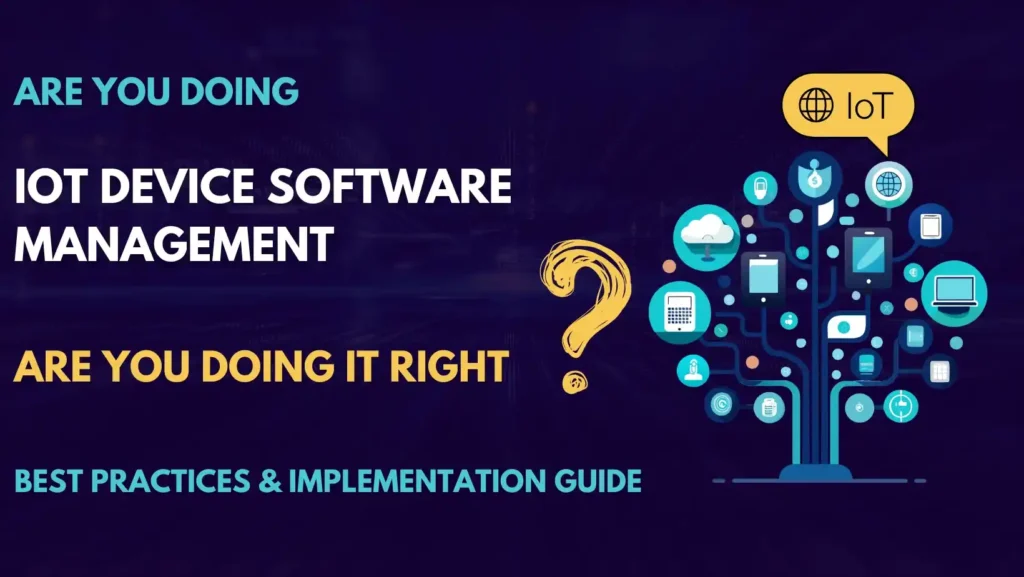
IoT device management dashboard monitoring software updates, device status, and security in real time.

IoT Device Software Management: Are You Doing It Right?

Every enterprise today runs on software – and nowhere is that pressure more intense than in IoT device software management. As connected devices multiply across factories, hospitals, logistics networks, and smart infrastructure, the stakes for getting software delivery right have never been higher. Yet most organizations are still managing IoT device software the way they managed desktop applications a decade ago – slow release cycles, siloed teams, reactive testing, and little visibility across the device lifecycle. That approach no longer works. Industry disruptors are not waiting. They are shipping faster, patching smarter, and scaling IoT fleets without proportional cost increases. Meanwhile, enterprises clinging to outdated development practices face a widening gap – in speed, in quality, and in customer satisfaction. The choice is now binary: modernize your IoT device software management strategy, or watch competitors who already have pull further ahead. Organizations that embrace lean, agile, and DevOps-driven approaches to IoT software delivery are not just keeping up – they are setting the new benchmark. What Is IoT Device Software Management? IoT device software management refers to the processes, tools, and strategies used to deploy, monitor, update, and maintain software across a fleet of connected devices – from sensors and edge nodes to industrial controllers. Unlike traditional software environments, IoT ecosystems introduce unique challenges: devices operate in remote locations, run on constrained hardware, and require Over-the-Air (OTA) update capabilities to stay secure and functional. Without a structured management approach, enterprises risk firmware drift, security vulnerabilities, and costly manual interventions at scale. As it pertains to the “new normal” DevOps standards, organizations now face many challenges such as cost overruns, software development projects that don’t scale in line with the enterprise growth, and increased market demands for speed. On top of that, the available outdated testing tools don’t offer visibility to ensure the right specifications get tested in the right time. How Lean and Agile Principles Transform IoT Software Delivery So, how can you make sure your organization is ready to manage unexpected changes, and deal with any dependencies that you already have under the hood? How do you ensure a strong balance between the existing business and the new development? Many of you may already be familiar with lean and agile principles and have probably even tried applying them in smaller teams. But what we’ve seen so far in the market is that many of you struggle to apply these principles across the entire organization. Lean and agile principles can help you reach your goals in today’s hyper-competitive world of digital product delivery. By becoming a lean and agile enterprise your organization will be able to adapt faster to the needs of the market by improving internal collaboration and communication. You will be able to learn in real-time from your clients to ensure that you are producing the prioritized set of features that drive economic value. By managing test labs, test planning, and ensuring the tight linkage between product demand and delivery, your organization will be able to reduce waste (time, effort, resources), while ensuring that your business strategy is aligned with the investment and development goals. The Numbers Don’t Lie: Agile IoT Transformation Results Let’s have a look at a few examples of what some of the industry leaders have achieved, using lean and agile processes. Nationwide achieved 50 percent improvement in code quality and 70 percent reduction in system downtime by applying lean principles to transform the software delivery lifecycle. Diagnostic Grifols, a world-leading healthcare enterprise headquartered in Barcelona Spain, increased the efficiency of development documentation by 30 percent-facilitating compliance, ensuring consistency of records across all product lines, and reducing operational costs. IoT Software Security: The Risk You Can’t Ignore A lean and agile development lifecycle isn’t just about speed – it’s about building security into every release cycle. According to industry research, over 57% of IoT devices are vulnerable to medium- or high-severity attacks due to unpatched firmware. Integrating automated security testing within your DevOps pipeline ensures vulnerabilities are caught before deployment, not after a breach. If your current IoT software management process doesn’t include continuous security validation, it’s time to close that gap. Start Managing IoT Software the Right Way — Here’s How It’s time to transform your organization into a lean and agile enterprise. It’s time to ensure that your firm can adjust to any market change, predict the unpredictable, keep costs low, deliver new features and offerings faster, and never lose a beat with your customers. If you would like to learn more, let’s get connected! Our IBM solution enables companies to improve visibility and transparency across the product delivery lifecycle by providing a single source of truth. It also enables enterprises to define a process custom to each organization, and it ensures quality and compliance. All using lean and agile processes.

IoT Device Software Management: Are You Doing It Right? Read More »