Welcome to Trident Information Systems!
Write us to - info@tridentinfo.com
Let's Socialize

dynamics 365 partner in south africa

Dynamics 365: 2020 release wave 2 plan

The Dynamics 365 release plan for the 2020 release wave 2 describes all new features releasing from October 2020 through March 2021. You can either browse the release plan online or download the document as a PDF file. The PDF file also includes information about Power Apps, Power Automate, Power Virtual Agents, Power Platform governance and administration, and Common Data Model and data integration. The Microsoft Power Platform features coming in the 2020 release wave 2 have been summarized in a separate release plan as well as a downloadable PDF. 2020 release wave 2 overview The 2020 release wave 2 for Dynamics 365 brings new innovations that provide you with significant capabilities to transform your business. The release contains hundreds of new features across Dynamics 365 applications including Marketing, Sales, Customer Service, Field Service, Finance, Supply Chain Management, Human Resources, Commerce, Fraud Protection, and Business Central. Marketing Dynamics 365 Marketing improves the customer journey canvas experience and adds integration with Microsoft Teams for virtual events. Segmentation is enhanced with a new natural language experience to create and consume segments, helping eliminate the specialized skills needed to build complex segments. Sales Dynamics 365 Sales continues emphasis on simplified experiences, app integrations, gamification, a new mobile experience for quick access to customer information, and new enhancements to forecasting to natively create and manage bottom-up sales forecast processes. Dynamics 365 Sales Insights continues investments across multiple areas: sales acceleration, conversation intelligence, relationship intelligence, and advanced forecasting and pipeline intelligence with predictive lead and opportunity scoring to help sales teams uncover top deals. Dynamics 365 Product Visualize empowers sellers and accelerates complex sales processes by showcasing and customizing products in their real-world environment. Sellers can place a 3D digital twin of a product in their customer’s environment and make detailed notes about their requirements. Service Dynamics 365 Customer Service expands agent productivity capabilities enabling agents to engage in multiple sessions simultaneously. Omnichannel for Customer Service is enhanced with additional extensibility options to enable integration with mobile applications, Microsoft bot framework, and outbound messaging channels. Dynamics 365 Customer Service Insights adds new capabilities to help agents using similar case suggestions to resolve customer issues quickly and easily. A new analytical view for customer service managers helps them focus on key support areas that need attention. These highlights will also be included directly in the core Customer Service Hub app so that users can get insights in context without having to switch between applications. Dynamics 365 Field Service continues to add intelligence capabilities including a new Field Service dashboard for monitoring key KPIs and work order completion metrics. There are many user experience enhancements to enable proactive service delivery. The Field Service mobile app is enhanced with capabilities such as push notifications and real-time location sharing. This release wave also includes scheduling enhancements such as multiday manual scheduling and enhanced skill-based matching. Dynamics 365 Remote Assist expands its range of scenarios beyond calls, allowing technicians to perform activities such as capture service and repairs data, perform surveys and walk-throughs independently, and derive service insights from their service operations. Finance and Operations Dynamics 365 Finance continues to focus on automating common tasks to reduce the number of manual processes and add insights and intelligence in Finance. Asset leasing enhances the core capabilities of Finance and the global coverage for Finance continues to expand in this release wave. Dynamics 365 Supply Chain Management expands planning optimization for Manufacturing to perform supply and production planning in near real time with in-memory services. Enhancements to Product Information Management include engineering change management and product versioning capabilities. Cost Management includes new features that will enable global companies maintain multiple cost accounting ledgers by allowing dual currency and dual valuation. Enhancements to the job card device include a new user experience and a new feature to enable reporting serial numbers. Dynamics 365 Guides is focusing on intelligent workflows in this release wave. By taking advantage of data and AI innovations, work instructions can be configured to adjust on the fly based on operator inputs. In addition, insights will make it easier to use time-tracking data and connect that data to your business. Dynamics 365 Project Operations unifies operational workflows to provide the visibility, collaboration, and insights needed to drive success across teams from sales to finance. Project Operations connects your sales, resourcing, project management, and finance teams within a single application to win more deals, accelerate delivery, empower employees, and maximize profitability. Human Resources Dynamics 365 Human Resources expands leave and absence and benefits management capabilities to transform the employee experience. Employees and managers will be able to manage leave and absence directly from Microsoft Teams. This release wave enables streamlined integrations to recruiting and payroll partners, thereby building a Human Capital Management (HCM) ecosystem. Commerce Dynamics 365 Commerce continues to expand capabilities enabling non-developers to easily design and manage digital commerce experiences. Customers can increase lift online and in store with “Shop similar looks” for recommendations. Customers can discover and deploy third-party services, connectors, modules, and themes from Microsoft AppSource. Dynamics 365 Connected Store adds a number of new capabilities such as integration with Dynamics 365 Commerce, front-line worker task assignment and tracing with Microsoft Teams, integrated workflows with Microsoft Power Platform, intelligent command center, store analytics, and store insights solutions such as anomaly detection, inventory recommendations, and shift management recommendations. Fraud Protection Dynamics 365 Fraud Protection adds integration with Dynamics 365 Commerce and a new “manual review” capability that allows customers to use the Fraud Protection rules experience to flag transactions for review, and then allow expert human agents to consume and adjudicate those transactions. SMB Dynamics 365 Business Central investments for this release wave include service enhancements to meet the demands of a rapidly growing customer base, improved performance, handling of file storage, geographic expansion together with support for Group VAT, top customer-requested features, and deeper integration with Microsoft Teams. Customer data platform Dynamics 365 Customer Insights enables every organization to unify disparate data—be it transactional, observational or behavioral sources—to gain a single view of customers and derive intelligent insights that drive key business processes. Dynamics 365 Product Insights enables organizations to understand their customers’ journey, usage,

Dynamics 365: 2020 release wave 2 plan Read More »
Case Study : Abu Dhabi government builds one-of-a-kind integrated customer service platform using Microsoft Dynamics 365

Established to lead excellence in government services, Abu Dhabi Digital Authority (ADDA) strives to lead the digital future of Abu Dhabi. Taking advantage of Microsoft Dynamics 365, Power BI, and Azure solutions, TAMM integrates Abu Dhabi government services to provide communities and businesses with a seamless, proactive, and personalized customer experience, one that promises to change the way UAE citizens and residents interact with their government for the better. [/vc_column_text][vc_column_text][/vc_column_text][vc_column_text] Abu Dhabi as a digital innovation destination Abu Dhabi Digital Authority (ADDA) has a vision that offers a new way of interacting with the citizens and residents in Abu Dhabi and throughout the world. ADDA’s vision embraces technology that delivers value through innovation and service excellence. ADDA is building a digital hub that integrates Abu Dhabi’s 1,600 government and business services with over 55 entities into one central platform. This modernizing journey toward global competitiveness means citizens can look forward to a smarter, happier future with better quality of life—all thanks to the TAMM integrated services platform. Digital smart government, powered by Microsoft The TAMM integrated service platform is an intelligent customer support center. Taking advantage of Microsoft Dynamics 365, Power BI, and Azure solutions, TAMM unifies Abu Dhabi’s government and business services into 80 integrated journeys. This integration merges a 360-degree view of customers’ information and their interactions across the government into a seamless, proactive, and personalized customer experience. It promises to completely revolutionize the way citizens interact with the government. Dynamics 365 creates a seamless omni-channel experience. The portal provides United Arab Emirates (UAE) citizens, residents, and visitors with a range of government services through one access point. Operating with Azure and AI increases efficiency and improve customer experience through fast, agile responses to citizen information requests. It provides stakeholders and field workers with decision-making capabilities through in-depth business intelligence on customer behavior. “Through Power BI, we are now able to ensure that all government data is viewed, including our services that are unified and user-centric,” explains Fatima Al Obeidli, Director – Contact Center Business Management Department at ADDA. “This drives our commitment to superior customer service. The Power BI unified dashboard replaces the multiple reports of the past, ensuring one-of-a-kind customer service experience.” Microsoft’s customer-first approach has been proven by its profound understanding of ADDA’s vision. “The aim is to establish a unique service model for Abu Dhabi government. Microsoft is a trusted partner, providing us with tools and mechanisms that empower us to lead the digital future of Abu Dhabi,” explains H.E. Saeed Al Mulla, Director, Government Services at ADDA. Powered by innovation, inspired by society “By leading with a modern, reliable, and integrated digital system that serves all walks of life in society, ADDA supports the business environment, attracts more investments into Abu Dhabi, and enhances the Emirate’s global competitiveness,“ says Ali Nimer, Strategy Advisor to the Director General and Head of Digital Excellence Office at ADDA. Through Power BI, we are now able to ensure that all government data is viewed, including our services that are unified and user-centric. This drives our commitment to superior customer service. The Power BI unified dashboard replaces the multiple reports of the past, ensuring one of a kind customer service experience.                                                                –  Fatima Al Obeidli: Contact Center Business Management Department

Case Study : Abu Dhabi government builds one-of-a-kind integrated customer service platform using Microsoft Dynamics 365 Read More »

Why organizational change projects fail and how to prevent implementation disaster

New IT installations often fail. At least that’s the widespread belief surrounding organizational change initiatives today. One frequently cited study from the 1993 book Reengineering the Corporation goes as far as saying that as many as 70% of the organizations that undertake a reengineering effort do not achieve the dramatic results they intended. A more recent McKinsey survey of more than 1,500 executives who had undertaken a significant change effort in the past five years found that only 38% of respondents said “the transformation was ‘completely’ or ‘mostly’ successful at improving performance. After two decades of hearing about high failure rates related to change, it’s unsurprising that business leaders are wary of organizational change projects. Organizational psychologist Nick Tasler explained that these negative biases can create a toxic self-fulfilling prophecy. “When a change project falls a day behind schedule, if leaders and employees believe that successful change is an unlikely outcome, they will regard this momentary setback as the dead canary in the coalmine of their change initiative. (Never mind the fact that three other initiatives are still on time or ahead of schedule),” he wrote in an article for Harvard Business Review. “Suddenly, employees disengage en masse and then the change engine begins to sputter in both perception and reality.” Yes, change is hard, and complex IT implementation projects, particularly ERP installations, can be particularly challenging. But it doesn’t mean they are doomed to failure. So where do you start? How can you choose the right technology for your retail business, and ensure that the implementation project runs as smoothly as possible and you get the most from your investment? Here are some of the main causes for failure in any organizational change initiative, and how can you prevent them from happening: Mistake #1: Failure to plan Issue: An outdated legacy system is impacting business performance, and it needs replacing quickly. In their rush to get the project going, business management jump straight into the implementation without taking the time to develop a well thought-out organizational change management plan. Solution: Don’t be tempted to cut corners in your planning. Analyze your business, decide what should be prioritized, and understand all the different ways the project will impact your routines at every stage of the process. “Companies should start by analyzing their current and future requirements and processes,” says Gunnar Ingimundarson, Chief Consulting Officer at LS Retail. “How many software solutions are they currently using, and what are they used for? Map out the disparate solutions in the stack, alongside their dependencies and interconnections. The next step is to figure out where they can draw the biggest – or quickest – benefits. Is your POS system not generating the information you need on stock levels and product visibility? Or, are there integrations that repeatedly cause problems or break down? Do you experience missing data? Identify the area(s) where a new system would bring immediate value in terms of savings or returns. That’s where you should start, and that should determine your priorities.” Once the priorities are set, break the project down into manageable chunks, from pilot phase to initial implementation to company-wide rollout. Consider when it’s most appropriate to start each phase of the installation so you won’t place unnecessary strain on your business during busy times. Mistake #2: Key stakeholders aren’t onboard, or have unrealistic expectations Issue: Management want the new technology in place quickly and only focus on the end goals. They get frustrated by how long the project is taking and threaten to pull the plug. Or they wonder why the new software isn’t being adopted widely and successfully when they failed to communicate the changes to everybody in the business and get company-wide buy in. Solution: All stakeholders need to be committed to the project’s success right from the beginning, and to clearly understand the project’s scope and goals. “Internal resistance can kill even the best implementation project,” says Eric Miller, Regional Director for the Americas at LS Retail, building on his 13 years of experience in software implementations. “Get the buy-in from all stakeholders from the start, and make sure that the goals, objectives and expected end results of the project are clear and communicated from you to the stakeholders, and from the stakeholders to all the customer parties involved. It never pays off to sell a dream you can’t deliver on.” Bring together personnel from different departments to understand their requirements and what outcomes they hope to achieve from the implementation. Similarly, they need to understand how much time should be devoted to a project like this and ensure project teams are given sufficient time to carry out the work. Set realistic timeframes from the start, and ensure everyone knows exactly what’s required of them. Mistake #3: Unforeseen changes throw the project off track Issue: Even the best prepared projects encounter hurdles along the way, but if unforeseen issues arise and major milestones are missed, it can be tempting to throw in the towel and deem the entire project a failure. Solution: Know that when you’re dealing with a large-scale IT implementation, it’s hard to plan for every eventuality. Be willing to adapt and take a different approach if it ultimately means the project will be a success. “What was deemed to be the best approach initially may need to change – this might even happen after the pilot is completed. I have seen companies that went through multiple pilots before finding the right balance. It’s a learning process, and it’s never over,” says Miller. It’s worth learning everything you can from the pilot implementation. Instead of rushing on to roll out store #2, take a moment to see how the system is working and to identify any issues that you couldn’t have planned for in your testing environment. Success comes to those who take a considered approach. Mistake #4: Picking the wrong technology partner Issue: It may be tempting to go for the cheapest technology provider, but cheapest upfront may not necessarily deliver the long-term business value you hoped for. You quickly realize they can’t help you achieve your outcomes, because they lack drive,

Why organizational change projects fail and how to prevent implementation disaster Read More »

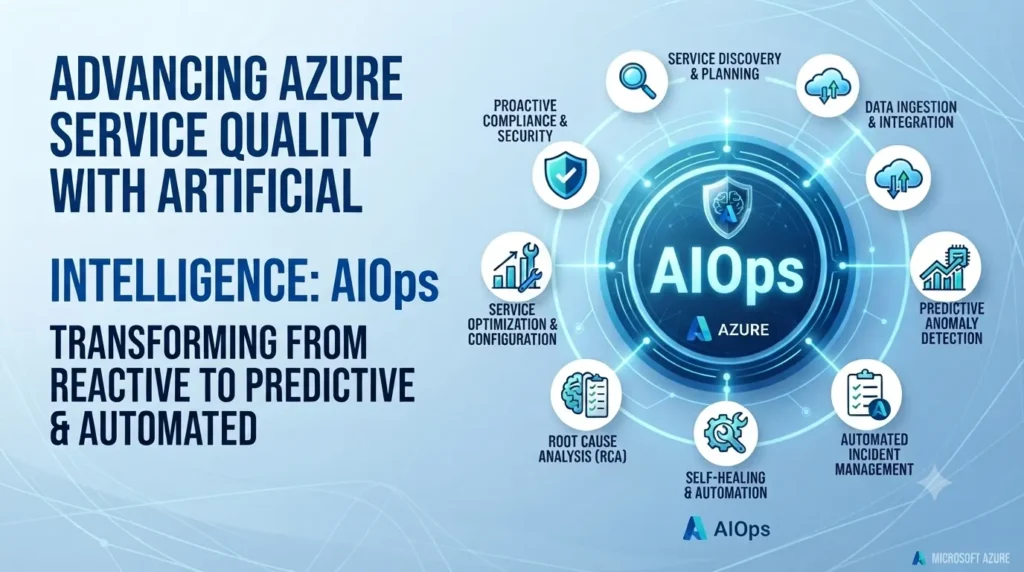
Microsoft Azure AIOps dashboard displaying AI-powered monitoring, predictive failure alerts, and real-time infrastructure health.

Advancing Azure service quality with artificial intelligence: AIOps

INTRO Somewhere on Azure’s infrastructure, a disk was predicted to fail — and your workload was migrated off it before that failure ever happened. That’s not a hypothetical. It’s Azure AIOps, Microsoft’s use of AI and machine learning to detect, predict, and fix infrastructure problems before they become customer-facing outages. For a business evaluating cloud reliability, this matters less as an engineering curiosity and more as a straight answer to a practical question: why does Azure keep improving its uptime numbers year over year? Failures Get Predicted, Not Just Detected Traditional infrastructure monitoring tells you something broke. Azure’s hardware failure prediction model tries to catch it before it does — flagging disks, memory, and networking hardware likely to fail, then automatically live-migrating affected virtual machines to healthy nodes. The customer impact of a hardware failure, in the cases this catches, is zero downtime rather than an outage ticket. Faster VM Provisioning, Powered by Prediction Azure’s pre-provisioning system uses historical deployment patterns to predict what VM configurations customers are likely to request — and creates a pool of them in advance. When a matching request comes in, it’s assigned from that pool instead of built from scratch. The practical effect for a business is faster deployment latency, without needing to know any of the prediction modeling happening behind it. Incidents Get Resolved Before They Escalate Azure tracks incident response against three metrics: time to detect, time to engage, and time to mitigate. AI-driven anomaly detection — built to catch not just obvious spikes but slow-building patterns like memory leaks — feeds directly into routing the right engineering team to an issue immediately, and in some cases triggers automated fixes with no human step at all. For a business running production workloads, that translates to shorter, less frequent disruptions. Safe Rollouts Prevent Widespread Impact Microsoft rolls out infrastructure changes constantly, which creates real risk of a bad change spreading before anyone notices. An internal system (code-named Gandalf) analyzes rollout patterns to catch issues that surface hours or days later, flagging suspicious changes before they propagate further. This is part of why platform-wide incidents from routine updates are rare rather than common. What This Actually Means for Your IT Roadmap None of this requires action on your end — it’s infrastructure Microsoft operates on your behalf. What it does mean is that Azure’s reliability improvements aren’t marketing claims; they’re the output of a systematic prediction-and-automation investment, which is a reasonable thing to weigh when comparing cloud providers on uptime and reliability, not just price. Want to know how Azure’s reliability engineering translates to SLAs for your specific workload? Talk to Trident about your cloud infrastructure options. FAQ What is Azure AIOps?Azure AIOps is Microsoft’s use of AI and machine learning to predict, detect, and resolve infrastructure issues on Azure automatically — including hardware failure prediction, faster VM provisioning, and automated incident response. Does Azure AIOps require any setup from customers?No — it operates at Microsoft’s infrastructure level. Customers benefit from improved reliability and uptime without configuring anything themselves. How does Azure predict hardware failures before they happen?Microsoft Research and Azure built models that analyze disk, memory, and networking behavior to flag components likely to fail, then automatically migrate affected virtual machines to healthy hardware.

Advancing Azure service quality with artificial intelligence: AIOps Read More »

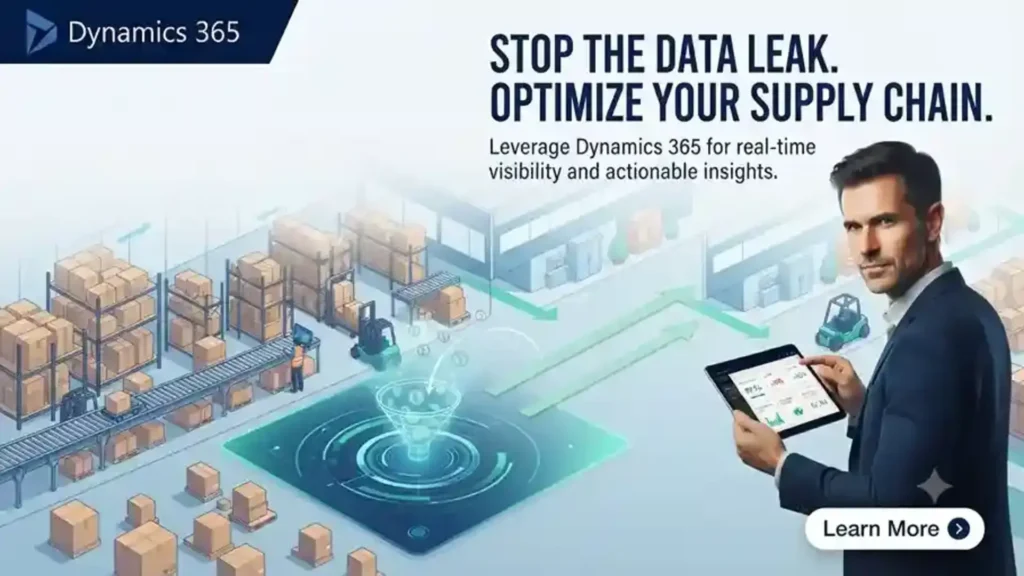
Dynamics 365 Supply Chain Management dashboard connecting IoT, analytics, inventory, logistics, and real-time supply chain data.

Dynamics 365 Supply Chain Management: What You Can’t See Is Costing You Money

INTRO Manufacturers don’t lose money on supply chain problems they can see. They lose it on the ones buried in siloed systems and manual processes — a part sourced from the same supplier out of habit rather than cost, a shipment that could’ve been consolidated but wasn’t flagged in time. Dynamics 365 supply chain management exists to surface exactly those blind spots, connecting sales, supplier, fulfillment, and product data into one system instead of five disconnected ones. IoT Is Where Supply Chain Visibility Starts Real-time visibility into how equipment and parts actually perform begins with connecting them — a single IoT-enabled platform bridging back-office and front-office processes rather than treating shop-floor data as separate from planning data. Digital twin modeling takes this further, letting manufacturers track wear on parts in real time and catch simple inefficiencies that are easy to miss otherwise: sourcing from a familiar supplier by default, for instance, when a comparable part is available elsewhere at lower cost. Analytics Turns Visibility Into Action Visibility alone doesn’t fix anything — it has to feed decisions. Built-in analytics and machine learning let a supply chain system dynamically adjust production and distribution using data most planning tools ignore, like public weather data feeding more accurate delivery forecasts. The same analytics can flag shipment consolidation or expediting opportunities automatically, catching savings a manual review would likely miss — savings that pass through directly to fulfillment cost. Real-Time, Mobile Access Closes the Loop Consolidated data still isn’t useful if the people who need it can’t see it where they’re standing. Decision-makers need the same real-time information whether they’re on the factory floor or at headquarters, with the ability to collaborate across locations without switching systems. This is less about a dashboard and more about removing the extra step of hunting for information before a problem can even be diagnosed. Why Dynamics 365 Specifically Dynamics 365 removes the traditional divide between ERP and CRM, letting employees move between supply chain and customer-facing work without switching systems entirely. Deployment flexibility — cloud, or hybrid combining on-prem and cloud — means a manufacturer can extend existing infrastructure investments rather than replacing them wholesale, which is often the difference between a deployment measured in days versus months. The practical result for a manufacturer: rich analytics, embedded intelligence, and partner-built applications running on one system, rather than reconciling ERP and CRM as two separate sources of truth. Want to see where visibility gaps might be costing your supply chain? Talk to Trident about a Dynamics 365 supply chain assessment.

Dynamics 365 Supply Chain Management: What You Can’t See Is Costing You Money Read More »

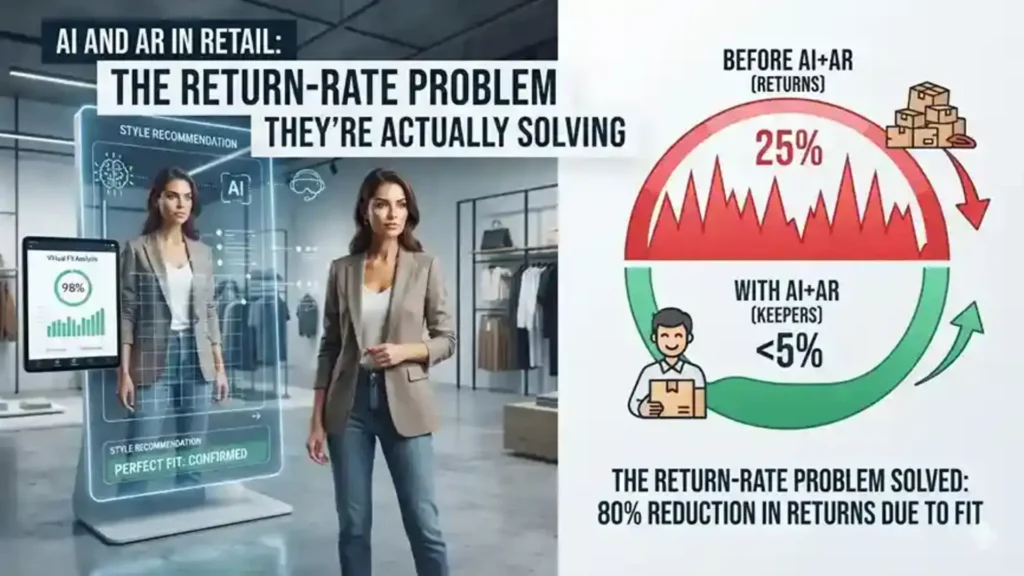
AI and AR retail technology helping customers visualize products and make confident purchasing decisions.

AI and AR in Retail: The Return-Rate Problem They’re Actually Solving

INTRODUCTION Each returned item represents a double cost for the retailer: once when shipping it and once when processing its return. AI and augmented reality (AR) in retail largely exist to avoid that round trip in the first place, helping the shopper choose the right product the first time. Virtual try-on technology alone has been shown to significantly increase conversion rates in e-commerce and reduce returns by over 8%; figures that explain why beauty, fashion and home goods retailers were the first to adopt it. Take the fitting room to the client’s living room Opticians were pioneers in this area for an obvious reason: glasses are a product that people do not buy without seeing how they look on their own face. The virtual try-on solved this problem entirely online, and some retailers have gone further by using AI to recommend frame shapes suitable for the customer’s face, rather than forcing them to guess which one will fit them. The same logic applies to any situation where excess options are the true barrier to purchase. A beauty catalog with hundreds of thousands of products is impossible for a human being to explore; However, an AI-based recommendation service can reduce that number to a few relevant options based on the user’s search and purchase history, transforming an overwhelming catalog into a short, personalized selection. Make the “infinite hallway” truly navigable A larger online catalog is only useful if customers can find what fits their tastes. Wayfair’s approach is a clear example: its search algorithm interprets style preferences from a customer’s search history to show furniture that is likely to fit their tastes; Additionally, a visual search feature allows the shopper to photograph an item they like and find matches among millions of products in inventory. Augmented reality expands this concept: it goes from “will I like it?” to “Will it fit in my space?” It allows the buyer to view a digitally recreated piece of furniture in their own room before purchasing it, which goes a long way to explaining why this category has seen measurable improvements in conversion and a reduction in returns. In the fashion sector, the question of sizes works in a similar way. Levi’s uses an AI chatbot that asks for fit, rise and stretch preferences—in addition to the size the customer wears in other brands—to recommend the right size, addressing the leading cause of fashion returns: a garment not fitting as expected. H2: 3. Turn purchasing behavior into better forecasts Turn Shopping Behavior Into Better Forecasts Every interaction with an AI-powered shopping tool—a search, a virtual product try-on, or a completed purchase—generates data that retailers didn’t previously have. Used correctly, this data refines inventory and demand forecasts far beyond what historical sales data alone allows, and facilitates truly relevant follow-up marketing: A shopper who has just purchased kitten supplies is an ideal candidate for a cat food subscription offer, not a mass generic newsletter. This same data allows retailers to target their promotions more precisely, tailoring the discount type and channel to what a specific customer actually responds to based on their history, rather than launching a one-size-fits-all promotion. Keep shelves stocked before customers notice they are empty AI-based forecasting is increasingly used to anticipate not only typical demand, but also disruptions to it; This involves recalculating replenishment quantities and adjusting supply in response to real changes, and not simply historical averages. Some retailers have piloted robots that scan shelves to automatically detect out-of-stocks; Likewise, real-time replenishment signaling systems in selected stores seek to solve a basic but persistent problem: the customer who comes expecting to find an item and finds an empty shelf. What does this mean for retailers who don’t have Wayfair’s budget? None of this requires developing AI and computer vision capabilities internally. ERP platforms for the retail sector increasingly integrate AI-based demand forecasting and customer data unification as standard functionality; This is what really puts personalization and smarter inventory management within reach of a mid-sized retailer, not a multimillion-dollar in-house AI team. Curious what AI-powered forecasting and personalization would look like on your retail platform? Contact Trident to request a demo of your retail ERP.

AI and AR in Retail: The Return-Rate Problem They’re Actually Solving Read More »

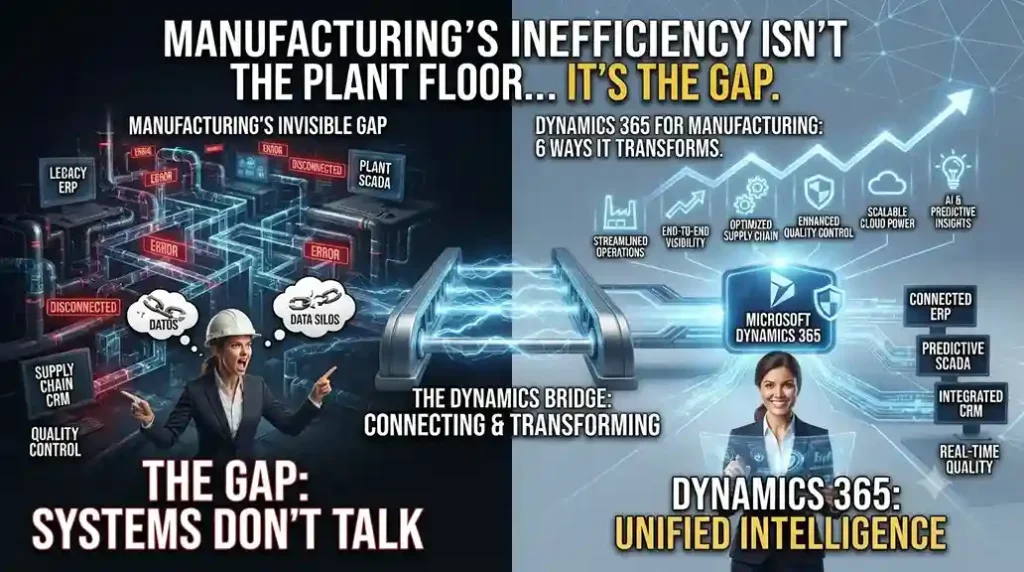
Microsoft Dynamics 365 for Manufacturing dashboard displaying production planning, inventory, supply chain management, and quality control.

Manufacturing’s Biggest Inefficiency Isn’t the Plant Floor — It’s the Gap Between Systems

INTRO A machine on the shop floor and a service technician in the field often work off completely different data — one sees production output, the other sees a support ticket, and neither sees the customer’s purchase history. Dynamics 365 for manufacturing exists to close exactly that gap, by ending the divide between CRM and ERP instead of running them as separate systems that happen to sit on the same network. Here are the six shifts that gap-closing actually produces on the ground. 1. Supply Chain Visibility That Goes Beyond a Dashboard Collecting and visualizing supply chain data across every location does more than create a nicer report — it changes how fast a disruption gets caught. Manufacturers using remote monitoring across distributed installations have shortened time-to-market by catching supply issues before they cascade into production delays, rather than discovering them after a shipment is already late. 2. Asset and Production Management, Consolidated Into One View When production oversight and real-time equipment monitoring sit in one system instead of three, manufacturers stop reacting to breakdowns and start resolving issues remotely before they cause downtime. This is the operational basis for near-continuous uptime models in equipment-heavy manufacturing — and it also opens a second revenue line: monitoring and proactive support sold as an ongoing service, not a one-time sale. 3. Customer Engagement Built on Usage Data, Not Guesswork Personalized service at scale requires predictive analytics and self-service options that are actually relevant to what a specific customer does with the product — not a generic contact form. Manufacturers with a connected sales-through-service platform can flag potential equipment issues before a customer notices a problem, while also tailoring offers based on that customer’s real purchasing and usage pattern. 4. Service Centers as a Profit Center, Not a Cost Center Falling costs for IoT sensors and mobile devices have made remote monitoring and proactive maintenance commercially viable additions to standard break/fix support — not just a premium add-on for enterprise accounts. Combining customer records, technician availability, and inventory into a single mobile-accessible system is what lets a service team actually deliver on that model instead of just theorizing it. The Data Advantage: Better Products, Not Just Better Service IoT-connected parts and equipment feed usage data back to engineering — which components fail early, which are over-built, how products actually get used in the field. That feedback loop is what shortens the cycle between a design flaw and a fix, rather than waiting for failure reports to pile up. 5. Technicians Who See the Full Job, Not Just the Ticket A 360-degree view of a customer’s asset and service history changes what a technician can do on-site — they’re working from context, not just a work order. Paired with machine learning that surfaces similar past cases, this turns troubleshooting into pattern-matching against real precedent instead of starting from zero on every call. 6. One System Connecting the Floor to the Front Office Manufacturers that unify production and project management data with CRM stop treating customer service and customer engagement as separate departments working from separate records. The practical result is service and recommendations grounded in what a customer has actually bought and experienced — not assumptions. Why Dynamics 365 Specifically Dynamics 365 for manufacturing removes the artificial line between CRM and ERP, running both on one system with embedded analytics rather than bolting a reporting layer on top of disconnected tools. For a mid-size manufacturer, this matters less as a technology upgrade and more as an operating model change — supply chain, service, and sales working from the same data instead of reconciling three versions of it. Curious what a unified CRM-ERP model would look like on your production floor? Talk to Trident about a Dynamics 365 manufacturing assessment.

Manufacturing’s Biggest Inefficiency Isn’t the Plant Floor — It’s the Gap Between Systems Read More »

Whitepaper: The business owner’s guide for replacing accounting software

Replacing your accounting software is easier and more affordable than you may think. Use this guide to learn about the benefits of a modern technology platform, better understand the advantages of a cloud-based solution, and know what questions to ask when evaluating your options.

Whitepaper: The business owner’s guide for replacing accounting software Read More »

Whitepaper : Four technology trends helping businesses thrive in a digital world

4 ways technology can help businesses thrive in a digital world. The good news is that the tools that help businesses capitalize on this digital transformation are more accessible than ever before. The cloud is removing barriers like high up-front costs, ongoing maintenance, and IT dependency.

Whitepaper : Four technology trends helping businesses thrive in a digital world Read More »

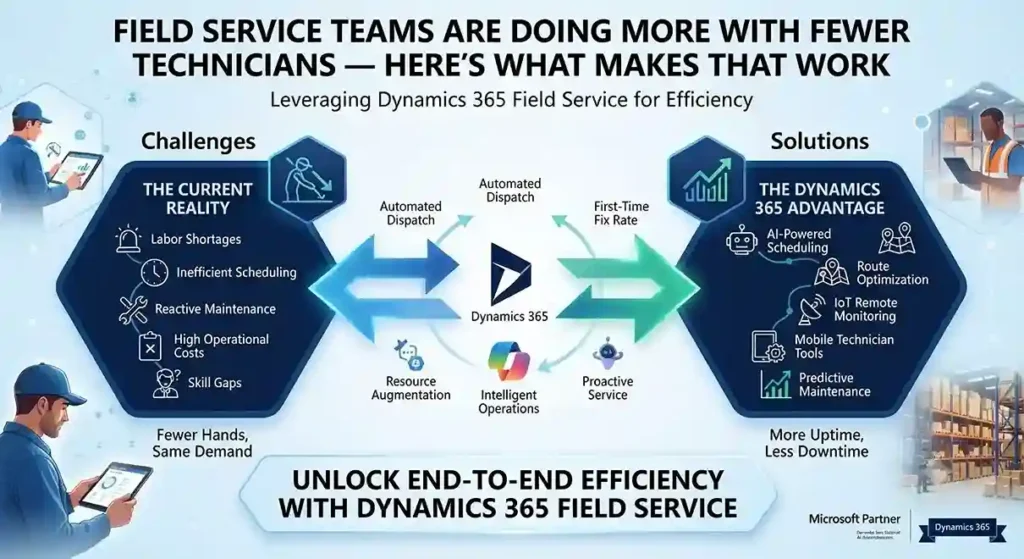
Dynamics 365 Field Service dashboard using AI scheduling and IoT alerts to optimize technicians and reduce onsite service visits.

Field Service Teams Are Doing More With Fewer Technicians — Here’s What Makes That Work

INTRO Fewer onsite technicians. Less face-to-face customer contact. The same expectation of fast, reliable service. That’s the operating reality most field service teams are managing now, and it’s forcing a shift from reactive dispatch to genuinely proactive service — sending the right person, with the right parts, before a customer even calls. Dynamics 365 Field Service is built around that shift, with AI-driven scheduling, remote collaboration tools, and IoT-based alerting doing the work that used to require more people on the road. First-Time Fix Rate Is the Metric That Actually Matters A technician’s onsite time is expensive — every callback for a missed fix compounds that cost. Field Service’s Inspections feature lets technicians capture structured data during a visit, improving quality and safety documentation without extra paperwork afterward. Built-in time tracking — automated where possible, manual where needed — feeds precise data back into scheduling, so utilization decisions are based on what visits actually take, not estimates. Remote Expertise, Without the Travel Dynamics 365 Remote Assist lets a technician using a HoloLens headset record and share a live session with an expert elsewhere — someone who can guide a fix in real time instead of the technician calling it in and waiting for a callback. That’s a direct lever on first-time fix rates: the technician gets specialist input on-site, in the moment, instead of after a second visit gets scheduled. AI Alerting Turns IoT Data Into Action, Not Noise Connected equipment generates a constant stream of telemetry — the hard part has never been collecting it, it’s knowing which alerts actually predict a failure worth dispatching for. Field Service uses AI-generated suggestions based on historical service data to surface the IoT alerts most likely to matter, paired with time-series views that let a dispatcher see an asset’s alert history at a glance rather than piecing it together manually. The practical effect: better incident categorization feeds directly into parts inventory planning and technician scheduling, which is where a lot of avoidable service cost actually lives. One System, Not Five Disconnected Tools Field Service now integrates more tightly with the rest of the Microsoft stack: Scheduling Is Where Efficiency Either Happens or Doesn’t Resource Scheduling Optimization automatically matches jobs to the technicians, equipment, and facilities actually equipped to handle them. The current scheduling board adds drag-and-drop functionality and materially better performance over the previous version — which matters more than it sounds, since a slow scheduling tool pushes dispatchers toward manual overrides that undo the optimization in the first place. Manager and dispatcher dashboards surface utilization data directly, so schedule adjustments come from visible patterns instead of guesswork. What This Looks Like at Scale Siemens Smart Infrastructure — which connects energy systems and building infrastructure across industries — runs Dynamics 365 Field Service to support over 12,000 employees, including 7,500 service technicians. Proactive service delivery, AI-driven scheduling, and real-time coordination are what let an organization at that scale stay responsive to disruption instead of falling back on manual dispatch when volume spikes. Want to see Dynamics 365 Field Service against your current dispatch process? Contact Trident Information Systems for a demo. FAQ What is Dynamics 365 Field Service used for?It’s Microsoft’s platform for managing onsite and remote service operations — scheduling technicians, tracking work orders, and using AI and IoT data to shift from reactive to proactive service delivery. Does Dynamics 365 Field Service work with IoT devices?Yes — it uses AI to analyze IoT alerts from connected equipment and prioritize which ones are most likely to require a technician dispatch, based on historical service data. Can Dynamics 365 Field Service integrate with Business Central?Yes — Field Service integrates with Business Central and Supply Chain Management to connect asset management and inventory data directly into the field service workflow.

Field Service Teams Are Doing More With Fewer Technicians — Here’s What Makes That Work Read More »