Welcome to Trident Information Systems!
Write us to - info@tridentinfo.com
Let's Socialize

dynamics nav partner

Maintain business continuity with Dynamics 365 Field Service

In today’s dynamic business climate, field service teams are still expected to maintain infrastructure and customer equipment, often with fewer onsite technicians and limited face-to-face interaction with customers. That means adjusting one’s field service model to continue providing proactive service—sending in the right people and tools at the right time—while being prepared with the processes and technology to do more with less from the field. Microsoft Dynamics 365 Field Service and Microsoft Dynamics 365 Remote Assist can help organizations provide proactive service at the speed, volume, and quality customers expect, while reducing latency and cost burdens of onsite service. To drive these key business outcomes, we’ve invested in the following areas for the 2020 release wave 1: Increasing technician success by enabling field service inspections, technician time tracking capabilities, and Dynamics 365 Remote Assist AI-infused insights to improve incident categorization and connected IoT capabilities Enhanced proactive service delivery with tighter integration between Field Service and Microsoft Power Automate, Microsoft Dynamics 365 Supply Chain Management, and Intune for Field Service Mobile Optimized resource scheduling with the new, next generation scheduling board Increasing technician success We know that for onsite visits, enabling technicians to achieve a first-time fix is the ultimate goal, while also leveraging the technician’s valuable onsite time to drive increased proactive customer service. To that end, we’ve added the following capabilities: Now in preview, the new Inspections feature allows technicians to analyze and capture essential data while performing Field Service inspections, which can better assure quality, safety, and end-customer visibility. Enhanced the technician’s ability to track their time in both automated and manual ways, directly within Field Service rather than in separate applications. In addition to the ability to track time, we’ve enhanced it with time capture precision to ensure the most granular data is available to derive the insights that can help to ensure better scheduling and utilization. We have updated Dynamics 365 Remote Assist with enhanced data capture and sharing. When technicians use a Microsoft HoloLens headset when performing inspections or fixing equipment, they can record and share the session with experts located elsewhere, enhancing real-time team collaboration with the ability to review onsite work, helping to improve quality of service and first-time fix rates. These new Field Service and Remote Assist features help ensure technician success and optimize resource utilization, creating confidence in an uncertain business landscape. AI-infused insights We’re enhancing Field Service with AI to help technicians properly categorize incidents, which leads to improved business metrics like parts inventory and availability, technician scheduling, and increased first-time fix rates—driving down the overall cost of service for customers. Device telemetry and service maintenance data helps to make intelligent decisions around dispatching technicians, however analyzing and prioritizing IoT alerts can be challenging. To address this, we’ve enhanced IoT alerting in several ways to increase proactive service delivery. Using AI-generated suggestions (preview) based on the past service history data, organizations can easily identify which IoT alerts are most important and can drive the biggest impact to increased proactive service delivery through connected field service. We’ve also added time series insights and a summary of the measures for the alert making it quick and easy to view and analyze the service history and take action. Enhancing proactive service delivery Improving proactive service with remote delivery helps to increase customer satisfaction and reduce overall service costs. We’re enhancing proactive service delivery with tighter integration between Field Service and several enabling Microsoft technologies, including: Integration with Power Automate (preview) to expand the automation workflow capabilities to the massive library of connectors and robust logic building user experience. Aligning asset management capabilities and integration with Dynamics 365 Supply Chain Management to complete the field service workflow scenarios, end to end, all in Microsoft Dynamics 365. Intune for Field Service Mobile to enable IT organizations to easily manage the Field Service Mobile app. Optimizing resource scheduling Resource Scheduling Optimization (RSO) automatically schedules jobs to the people, equipment, and facilities best equipped to complete them. Updates include: new, next generation schedule board (preview) and resource management features to help service teams more quickly and efficiently manage technicians at all stages of the service journey. The new schedule board has a modern user experience with greatly improved performance and a fluid drag and drop functionality. A simplified and improved experience for managing technician work hours and time off, including a Microsoft Power Apps control that lets customers modify technician time through even more simplified app experiences. In addition, we’ve added requirement dependencies to schedule work orders in sequence increasing first-time fix rates and technician and customer satisfaction. A new dashboard for managers and dispatchers to surface insights that can help them monitor utilization and identify optimizations for time utilization. Delivering more agile, simplified, and proactive field service Siemens Smart Infrastructure intelligently connects energy systems, buildings, and industries to adapt and evolve the way people live and work, helping companies make buildings safe, comfortable, energy-efficient, and economical. Siemens is deploying Dynamics 365 Field Service to support more than 12,000 employees—including 7,500 service technicians—with the tools, processes, and agility they need to quickly and proactively handle customer issues and ensure smooth communication. Now, by taking advantage of capabilities such as proactive service delivery, resource scheduling, AI-infused insights, and more, Siemens is empowered to be more nimble and able to react to disruptive changes while continuing to provide high quality service to their customers. To learn more about the Siemens journey, read the customer story. Like Siemens, Microsoft can help you and your service teams continue to meet ongoing demand for service despite new challenges. Explore the resources below to learn how Dynamics 365 Field Service and  Dynamics 365 Remote Assist help ensure your ongoing success so you and your team continue to flourish long after this crisis. You can contact Trident Information Systems for Demo of Dynamics 365 for Fields Services Blog Source : https://cloudblogs.microsoft.com/dynamics365/bdm/2020/04/28/maintain-business-continuity-with-dynamics-365-field-service/

Maintain business continuity with Dynamics 365 Field Service Read More »
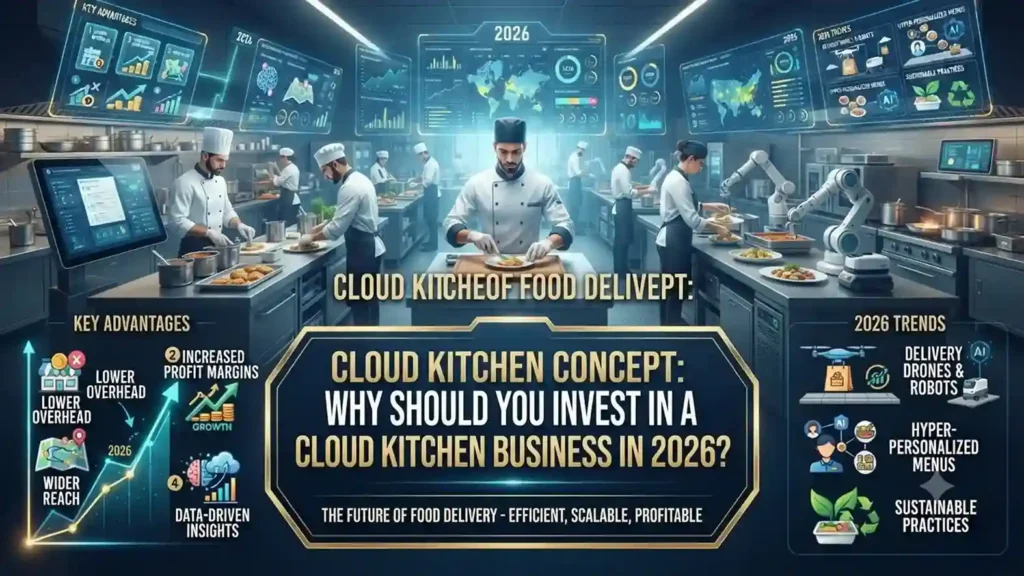
Cloud kitchen management system handling online orders, kitchen operations, and food delivery in 2026.

Cloud Kitchen Concept: Why Should You Invest in a Cloud Kitchen Business in 2026?

The food industry has changed forever — and cloud kitchens are leading that change. What started as a pandemic-era workaround has become one of the most profitable and fastest-growing business models in the food service industry. In 2026, cloud kitchens aren’t a trend. They’re a permanent, mainstream pillar of how food gets made and delivered — and the opportunity for entrepreneurs has never been bigger. The global cloud kitchen market was valued at USD 85.5 billion in 2025 and is projected to reach USD 185.7 billion by 2034. In India specifically, the market reached USD 1.24 billion in 2025 and is growing at a CAGR of 12.28% — projected to hit USD 3.69 billion by 2034. India is now the second-largest cloud kitchen market in Asia, after China. If you’ve been thinking about entering the food business — or expanding your existing restaurant operation — here’s everything you need to understand about the cloud kitchen concept and why 2026 is the right time to invest. What Is a Cloud Kitchen? A cloud kitchen — also called a ghost kitchen, dark kitchen, or virtual restaurant — is a food preparation facility built exclusively for delivery. There is no dine-in space, no waitstaff, no fancy interiors, and no walk-in customers. Everything operates digitally. Orders come in through food delivery apps like Swiggy, Zomato, and ONDC, or through the brand’s own website and app. Food is prepared in the kitchen and dispatched directly to the customer’s door. The result: lower overhead, faster operations, and the ability to serve more customers with significantly less investment than a traditional restaurant. How Does the Cloud Kitchen Business Model Work? Cloud kitchens typically operate in one of three formats: Independent Cloud Kitchen — A single brand operates from a dedicated kitchen space, taking orders from delivery platforms and its own channels. This is the most common model, holding 63% of global market share in 2025. Hub & Spoke Model — A central kitchen (the hub) handles bulk preparation and distributes to smaller satellite kitchens (the spokes) located closer to customers. This model maximizes delivery speed and coverage across a city. Shared / Commissary Kitchen — Multiple food brands share a single kitchen facility, splitting infrastructure costs. Ideal for startups and first-time food entrepreneurs wanting to test their concept with minimal investment. In all three models, the core operational flow is the same: online order received → kitchen prepares → delivery partner dispatches → customer receives. No tables. No waiting. No overheads that don’t contribute to revenue. 6 Powerful Reasons to Invest in a Cloud Kitchen Business 1. Dramatically Lower Investment to Start Starting a traditional dine-in restaurant in India typically requires significant capital — location fit-out, furniture, décor, kitchen equipment, staff, and months of losses before hitting profitability. Cloud kitchens slash that entry cost by 70–80%. You need a kitchen space, equipment, a few delivery registrations, and an FSSAI licence. In metro cities, rental costs for a cloud kitchen space can be as low as ₹15,000–30,000 per month. The capital you save goes directly into product quality, marketing, and growth. 2. Faster Return on Investment Lower startup costs mean your break-even point arrives much sooner. Because cloud kitchens have no dine-in overheads — no ambience spending, no waitstaff salary bill, no front-of-house maintenance — a significantly higher percentage of every order contributes directly to profit. This is why entrepreneurs increasingly prefer the cloud kitchen model as their first or next outlet. The ROI timeline that takes a traditional restaurant 2–3 years can be achieved by a well-run cloud kitchen in 6–12 months. 3. Unlimited Scalability Traditional restaurants scale by opening new locations — each requiring full investment, fit-out, and months of ramp-up. Cloud kitchens scale differently. From one kitchen space, you can operate multiple virtual brands simultaneously — each with its own menu, pricing, identity, and target audience. A single kitchen in Delhi can run a biryani brand, a burger brand, and a healthy meal brand at the same time. When one brand gains traction, you expand it to the next city using the hub-and-spoke model — without the capital burden of a traditional rollout. Kitchen pods — micro-format cloud kitchens deployable in apartment basements, mall food courts, and office parks — are growing at a 14.6% CAGR and represent the next frontier of scalable cloud kitchen expansion across India’s Tier-2 cities. 4. Brand Exclusivity and Menu Innovation Cloud kitchens give food entrepreneurs something traditional restaurants rarely can — the freedom to be bold. With no physical space to maintain and no walk-in customer expectations to manage, you can launch niche concepts, test new menus, and pivot quickly based on delivery data. Think Netflix Originals — exclusive content that keeps audiences engaged. Cloud kitchens work the same way: unique, delivery-first food concepts that customers can only order from you. In 2026, India’s demand for international cuisine, premium healthy food, and hyperlocal regional dishes is surging. Cloud kitchens are perfectly positioned to capture these niche segments faster than any dine-in restaurant ever could. 5. Competitive Pricing Power When you eliminate spending on ambience, signage, furniture, and front-of-house staff — you free up capital that goes directly into what actually drives customer loyalty: food quality, packaging, and digital presence. Cloud kitchens can offer better food at lower prices than comparable dine-in restaurants while still maintaining healthy margins. This pricing advantage, combined with the convenience of home delivery, is a powerful combination in India’s price-sensitive food market. 6. Access to a Massive and Growing Digital Customer Base India has over 820 million active internet users. Swiggy and Zomato together process millions of orders every day. ONDC is now disrupting the delivery platform duopoly and reducing commission costs for cloud kitchen operators — improving unit economics further. By registering across multiple delivery platforms and building your own direct ordering channel, a cloud kitchen can access an enormous customer base from day one — without the geographic limitations that cap a dine-in restaurant’s growth. The Technology Behind a Successful Cloud Kitchen

Cloud Kitchen Concept: Why Should You Invest in a Cloud Kitchen Business in 2026? Read More »

Your Online Grocery Store Isn’t Losing Customers to Competitors — It’s Losing Them to Friction

INTRO Online grocery sales are growing at roughly 28% a year — more than ten times the rate of total grocery sales. That growth is also exposing which retailers built their online grocery ERP software around real shopping behavior, and which bolted e-commerce onto a system that was never designed for it. The seven gaps below are the ones costing retailers carts, not competitors. Each one is a system problem before it’s a customer-experience problem. Slow Search Costs You the Sale Before Checkout A shopper hunting through a hundred-item bread category for one product doesn’t file a complaint — they just leave. Category filtering, predictive search (“did you mean coriander?”), and complete product data — pack size, allergens, expiry — aren’t UX polish. They’re inventory data problems, and they trace back to whether your ERP actually feeds structured product data to your storefront or leaves your web team entering it by hand. Hidden Delivery Restrictions Kill Orders After the Cart Is Full Nothing costs a sale faster than a shopper spending 20 minutes filling a cart, then discovering their postcode isn’t serviceable. Delivery zones, pricing, and timing need to be visible before checkout starts — which means your delivery logic needs to be connected to your commerce platform in real time, not a static page someone forgot to update last quarter. Fix This With a Clear Checkout FlowLabel every step (Details → Shipping → Payment → Review), show a progress bar, and confirm the order with a summary — items, delivery window, and what happens next. Ambiguity at checkout is where carts get abandoned. Mobile Is Already Majority Traffic — Is Your Platform Built for It? Mobile drives the majority of e-commerce traffic and sales for most retailers now. If your site isn’t fully responsive — large tap targets, zoomable product images, a cart that persists across devices — you’re optimizing for the smaller slice of your audience. Cart persistence in particular matters: a shopper who starts on their phone and finishes on a laptop shouldn’t have to rebuild their order. “Endless Aisle” Only Works With Real Navigation Online stores can carry far more SKUs than a physical location — but only if customers can actually find them. Top-level categories, sort-and-filter by price or brand, and a visibly confirmed “add to cart” action are baseline. Without them, a bigger catalog just means a worse search experience. Delivery Precision Drives Conversion More Than Delivery Speed Nielsen’s Global Connected Commerce research points to 30-minute delivery windows as the benchmark shoppers respond to — not same-day delivery in the abstract, but a specific window they can plan around. Whether you deliver direct, via locker pickup, curbside, or through a partner like Instacart depends on your infrastructure. What matters is picking one you can reliably hit. Freshness Anxiety Is a Solvable Data Problem Spoilage risk is one of the top reasons shoppers hesitate to buy fresh groceries online. Freshness labels showing remaining shelf life after delivery, visible customer reviews per product, and a clear return or refund policy for produce that doesn’t meet expectations all directly address that hesitation — but only if your system tracks expiry data at the SKU level to begin with. One Broken Link in the Chain Becomes the Whole Brand’s Problem A late delivery, a wrong product description, or a broken cold-storage locker doesn’t read to the customer as “a vendor issue” — it reads as your failure. This is why online grocery ERP software has to unify inventory, POS, delivery logistics, and product data on one system. Disconnected point solutions are where these failures start. Running your online grocery operation on disconnected systems? Talk to Trident about an ERP assessment built for grocery retail. FAQ What ERP features matter most for online grocery retailers?Real-time inventory sync, SKU-level expiry tracking, and integration between POS, e-commerce, and delivery logistics matter most — these directly address the stockout, freshness, and delivery-accuracy issues that cause cart abandonment. Why do online grocery shoppers abandon their carts?The most common causes are hidden delivery restrictions discovered late in checkout, slow or unclear search, and lack of trust in product freshness — all of which trace back to system-level data gaps, not just website design. What delivery window works best for online grocery?Research from Nielsen points to 30-minute delivery windows as the standard shoppers respond to best, provided the retailer can consistently meet that window.

Your Online Grocery Store Isn’t Losing Customers to Competitors — It’s Losing Them to Friction Read More »

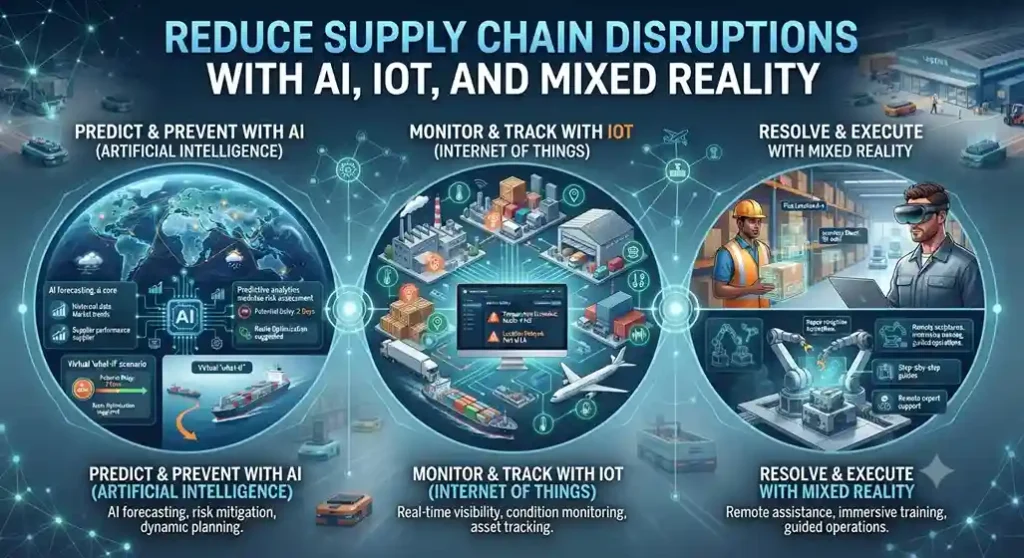
AI, IoT, and mixed reality technologies improving supply chain visibility, logistics, and warehouse operations.

Reduce supply chain disruptions with AI, IoT, and mixed reality

Reduce Supply Chain Disruptions With AI, IoT, and Mixed Reality Supply chains built on single suppliers and single locations don’t survive contact with real-world disruption — port closures, geopolitical trade shifts, or a single supplier’s factory going offline can stall production for weeks. [Flag: insert a recent disruption stat relevant to your audience’s industry — e.g., percentage of manufacturers reporting supplier delays in the past 12 months.] The response isn’t more inventory sitting idle; it’s a supply chain that senses problems early and reconfigures itself before they cascade. That’s the shift Dynamics 365 Supply Chain Management is built around — replacing static, just-in-time planning with predictive, adaptive planning powered by AI, IoT, and mixed reality across production, inventory, and warehouse operations. From “Just-in-Time” to “Just-in-Case” Planning The single-supplier, single-location model was optimized for cost, not resilience. When one link breaks, the entire chain stops. Manufacturers are now deliberately building in redundancy — multiple suppliers and locations for mission-critical parts — even where it costs more, because the cost of a stalled production line consistently outweighs the premium paid for supply flexibility. This shift also demands shorter production runs. Factories need to serve a wider range of products in smaller batches, with lower changeover time between runs. That requires planning systems that recalculate in near real time as demand shifts, not systems that lock in a monthly production plan and treat disruption as an exception to manage manually. Predictive Planning Instead of Reactive Firefighting D365 Supply Chain Management applies AI-driven demand forecasting across planning, production, inventory, warehouse, and transportation management — so a shift in demand or a supplier delay triggers a re-plan before it becomes a stockout. IoT sensor data from equipment feeds directly into this loop, flagging machine performance drift or maintenance needs before a breakdown takes a production line offline unexpectedly. For manufacturers running multi-location operations across India, UAE, or East Africa, this matters more than it might in a single-plant setup — a delay at one facility needs to trigger an automatic reallocation check against inventory and capacity at other sites, not a phone call three days later. Cut Training Time With Mixed Reality Guidance One of the more underused levers in supply chain resilience is workforce agility — how fast you can get a new or reassigned worker productive on unfamiliar equipment. D365 Supply Chain Management integrates with Dynamics 365 Guides, delivering step-by-step, hands-free instructions through a HoloLens device, walking workers through exactly which tool and part to use at each step of a task. This does two things for resilience specifically. First, it makes equipment maintenance skillset-agnostic — you’re no longer waiting on one specialist who knows a particular machine, because any trained worker can follow the holographic guide. Second, it shortens the ramp-up time when you need to redeploy staff to a different line or location during a disruption, which is exactly when you can’t afford a multi-week training cycle. Guides are authored without code — someone writes the instructions and places holographic markers directly on the machine where the work happens, which means your own team can build and update guides as processes change, not wait on an external developer. What This Means for Your Operation Resilience isn’t a single feature — it’s the combination of predictive planning that reduces reaction time, IoT visibility that catches problems before they cause downtime, and a workforce that can be redeployed without retraining bottlenecks. Manufacturers evaluating this shift should look specifically at how their current ERP handles multi-location inventory visibility and whether production re-planning happens in real time or requires manual intervention. [Flag: insert a client example or case study reference here if available — a specific implementation outcome carries more weight than a general capability claim.] Considering a resilience-focused upgrade to your supply chain platform? Talk to Trident’s Dynamics 365 Supply Chain Management team about what a multi-location, AI-driven planning setup looks like for your operation.

Reduce supply chain disruptions with AI, IoT, and mixed reality Read More »

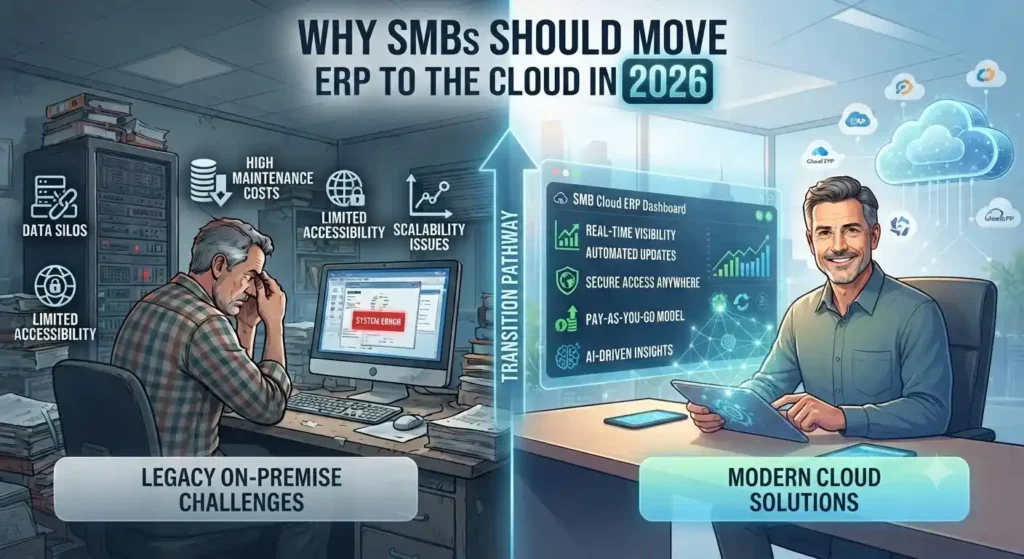
Cloud ERP dashboard helping SMBs manage finance, inventory, operations, and business performance.

Why SMBs Should Move ERP to the Cloud in 2026

Why SMBs Should Move ERP to the Cloud in 2026 Roughly 44% of small businesses now run meaningful cloud infrastructure, and that number keeps climbing. But most of that adoption is email and productivity tools — not the ERP system running finance, inventory, and operations. That gap is where SMBs quietly lose money every year. The Real Cost of Staying on Legacy ERP Companies spent 40% of their IT budgets in 2025 just keeping legacy systems running — patching, maintaining, and working around software that was outdated the day it was installed. That’s not investment; it’s maintenance debt with no return. Every year an SMB delays ERP migration, that wasted spend tends to grow, not shrink, because the gap between legacy capability and modern cloud ERP keeps widening. Global public cloud spending is projected to hit $723.4 billion in 2025, up from $595.7 billion the year before — a jump driven largely by core workloads shifting into the cloud, not just email. ERP is where legacy costs compound fastest, which is exactly why it’s driving so much of that growth. Predictable Costs Instead of Capital Surprises The CapEx-to-OpEx shift is the change SMBs feel first. Instead of a large upfront hardware and licensing spend followed by unpredictable maintenance bills, cloud ERP runs on subscription pricing tied to actual usage. For Microsoft-centric SMBs, this gets stronger. Azure Hybrid Benefit lets businesses that already own Windows Server or SQL Server licenses apply them toward cloud costs, cutting Azure VM costs by up to 40-55% compared to standard pay-as-you-go pricing. If your SMB already runs Microsoft 365 or Windows Server, that discount alone changes the ROI math on a Dynamics 365 migration. Security Concerns Are Backwards Now The instinct to keep ERP on-premises for “control” doesn’t hold up anymore. Modern cloud platforms often deliver stronger security, better uptime, and greater scalability than most SMBs can achieve running their own infrastructure. Built-in compliance frameworks and dedicated provider security teams cover ground most SMB IT teams can’t staff for — a real constraint for a five-person IT department juggling help desk tickets and server patching at the same time. Scalability Without the Hardware Gamble Legacy ERP forces a bet: buy enough server capacity for growth you haven’t hit yet, or underprovision and hit a wall mid-quarter. Cloud ERP removes that bet. Resources scale with actual transaction volume, seasonal demand, or headcount growth, with no hardware refresh cycle every three to five years. What This Means for a Dynamics 365 Decision For SMBs already in the Microsoft ecosystem, this isn’t a “should we move to the cloud” question anymore — it’s a “why are we still running Dynamics NAV or an on-prem F&O instance in 2026” question. The path to Dynamics 365 Business Central or Finance & Operations keeps the interface logic staff already know, while shifting cost structure, security posture, and scalability all at once. Still running ERP on-premises or on an older Dynamics NAV instance? Talk to Trident’s Dynamics 365 team about what a cloud migration looks like for your cost structure and timeline. FAQ Q: Is cloud ERP more secure than on-premises ERP for SMBs?A: Often yes — cloud providers invest in dedicated security teams and compliance frameworks most SMB IT departments can’t match in-house. Q: How much can SMBs save moving ERP to Azure?A: Businesses with existing Windows Server or SQL Server licenses can save 40-55% on Azure costs through Azure Hybrid Benefit. Q: What’s the cost of staying on legacy ERP systems?A: Organizations spent roughly 40% of their 2025 IT budgets just maintaining legacy systems — spend that delivers no new capability, only upkeep.

Why SMBs Should Move ERP to the Cloud in 2026 Read More »

New AI features connect and extend insights across the organization

Today we’re unveiling new and enhanced artificial intelligence (AI) capabilities across Dynamics 365 applications, as well as a new solution to help project-centric services organizations transform their operations. Joining more than 400 new and updated features in the 2020 wave 1 release, these new capabilities expand a fast-growing set of applications powered by AI-driven insights, and further propel our vision to empower every organization to unify data across the business and use it to power personalized customer experiences and processes. Personalize customer experiences with unified data and unmatched time to insight Customers expect personalized and consistent experiences across every touchpoint. Many organizations, however, struggle to modernize the customer experience, often due to disconnected systems and data siloes that can’t deliver the full picture of the customer’s journey across websites, purchases, service calls, and mobile apps. Updates to Microsoft Dynamics 365 Customer Insights, Microsoft’s customer data platform (CDP), will help solve these issues. We’re introducing new first and third-party data connections to further enrich customer profiles that can be updated and activated in real-time, as well as enabling deeper insights with Microsoft Azure Synapse Analytics. Customer Insights will now uniquely enrich profiles with a combination of proprietary audience intelligence and 3rd party data sources such as demographics and interests, firmographics, market trends, and product and service usage data. Customers can also integrate Microsoft Forms Pro, the simple, powerful enterprise survey solution, to bring in the valuable voice of the customer across channels, allowing organizations to act on insights based on changing customer behavior and perception. All of this comes together to create a holistic, 360-degree view of a customer and to update those customer profiles and activities in real-time enabling organizations to know their customers and improve engagement. Customer Insights is built on a powerful and flexible platform that enables full extensibility. Organizations can derive deeper insights by using Azure Synapse Analytics, which combines customer data with enterprise and streaming data to improve data completeness, run high-speed analytical processing, and build custom machine learning models. This allows organizations to predict customer needs with insights and get guidance on the next best action to reduce churn and capitalize on revenue opportunities for the lifetime of a customer relationship. Organizations can act upon these insights in real-time across multiple destinations through prebuilt APIs to enable onsite clienteling, website personalization, dynamic marketing campaigns, and effective ad targeting. As part of the wave 1 release, we’re expanding the availability of Customer Insights to government cloud computing (GCC) environments helping to improve the citizen experiences essential to modern government. This means our government and public customers with higher compliance needs can now leverage Customer Insights to better understand and interact with citizens, empower employees, and transform cities at scale. Automate sales forecasting with predictive analytics In addition to expanded AI capabilities on our customer data platform, we’re extending the ability for sales professionals to forecast sales more accurately and introducing a new, unified engagement center for inside sales representatives. Available now for Dynamics 365 Sales and for Dynamics 365 Sales Insights, new manual and predictive forecasting capabilities empower sales organizations to have a better understanding of the pipeline, more accurately predict results, and gain visibility into future performance. The predictive forecasting capabilities enable the proactive decision-making needed to meet sales goals. Dynamics 365 does this by extracting patterns from customer relationship management (CRM) data, current and historical leads, won or lost opportunities, contacts, accounts, customer interactions such as emails and calls, and more data sources, and then projecting these patterns into the future. Best of all, anyone can access the insights, no data scientists or tech experts needed (a big change from some other forecasting systems). With a new engagement center designed to accelerate sales, we’re giving each inside seller a streamlined way to quickly triage, research, and engage new leads or opportunities. This provides them with their own prioritized work queue to take action on the highest priority leads and tasks based on built-in predictive scoring from Dynamics 365 Sales Insights and new, configurable sales cadences. The experience helps sellers stay in the context of Dynamics 365 and quickly move from one lead or opportunity to the next in an AI-prioritized work queue, without needing to switch views to take the next best action. Additional embedded AI capabilities offer sellers a path to a warm introduction, and guidance from the assistant. Transform the back office with AI-infused finance insights Not only are we expanding AI capabilities for customer and sales insights, we’re also bringing the power of AI to the finance department. Microsoft Dynamics 365 Finance Insights, coming to preview in May, accelerates your digital transformation by bringing the power of AI into your finance processes. As organizations look to make decisions rapidly, reduce risk, and focus on strategic initiatives, it’s critical to free finance from repetitive, time consuming and low value daily activities. Leveraging the power of AI, Finance Insights enables you to not only quickly understand and act on your company’s cash position, but also to take proactive action to improve it. Menial tasks are automated or removed, the barrier of developing or hiring AI-expertise is bypassed, and you’re left with insights to move your business forward. Our continued investment in expanding AI capabilities across Dynamics 365 helps your organization accelerate digital transformation initiatives while empowering employees with insights to drive better business outcomes every day. Optimize project success and profitability with the ability to drive operational excellence across service-centric organizations How people work today has changed, as has the way organizations run their business operations. Companies across all industries are innovating business models to support project-centric service offerings. And while business optimization has gotten easier with the rise of mobile and cloud technology, organizations continue to stitch together systems and struggle with managing data across disparate systems. These data silos within project-centric businesses and teams are negatively impacting business model transformation, customer acquisition, employee retention, project delivery, and business profitability. Today we’re announcing a new Dynamics 365 application that connects cross-functional project teams, providing the visibility, collaboration, and insight needed to drive the success of project-centric organizations. Microsoft Dynamics 365 Project Operations, which will be generally available on October 1,

New AI features connect and extend insights across the organization Read More »

Business team using CRM software to manage sales, customer data, and communication workflows.

5 Clear Signs Your Business Needs CRM Software in 2026

Here is a question most business owners ask too late: at what point does managing customer relationships in spreadsheets, email inboxes, and memory become a liability rather than a system? The honest answer is — sooner than you think. Customer Relationship Management (CRM) software is not just for large enterprises with complex sales teams. It is for any business that wants to grow its customer base, retain the customers it already has, and make sure no opportunity falls through the cracks. The challenge is recognising when the moment has arrived. Here are five clear signs that your business needs CRM software — and why Microsoft Dynamics 365 is the platform most businesses choose. What Is CRM Software and Why Does It Matter? CRM software is a centralised system that manages every interaction between your business and your customers — from the first marketing touchpoint through the sales cycle, the initial purchase, ongoing service, and renewal. Done well, CRM gives every team member a complete, real-time picture of every customer relationship. Sales knows what marketing has sent. Customer service knows what sales has promised. Management knows exactly where every opportunity stands. Without CRM, this information lives in individual inboxes, personal spreadsheets, and people’s heads — and every time someone leaves the business, some of that knowledge leaves with them. 5 Signs Your Business Needs CRM Software Now Sign 1 — You Are Losing Leads Without Knowing Why Leads come in through your website, social media, phone calls, and referrals. But if you are managing them manually, some of those leads are simply not being followed up — because they were logged in the wrong place, assigned to the wrong person, or forgotten during a busy week. A CRM captures every lead automatically, assigns it to the right team member, sets follow-up reminders, and tracks every interaction. Nothing gets lost. Every opportunity gets the attention it deserves. If you have ever discovered a warm lead that was never followed up weeks after it arrived — your business needs CRM. Sign 2 — Your Marketing and Sales Teams Work in Silos Marketing generates leads. Sales closes deals. But when these two teams work from different systems and different data, the handoff between them is where opportunities die. Marketing does not know which leads converted. Sales does not know which campaigns generated their best prospects. Neither team can make decisions based on the complete picture — because that picture does not exist in any single place. CRM creates a shared view of every customer and every lead — so marketing can see which campaigns produce sales-ready prospects and sales can engage leads with full context on their marketing journey. The result is better targeting, higher conversion rates, and a measurable improvement in revenue. If your marketing and sales teams regularly blame each other for pipeline problems — your business needs CRM. Sign 3 — You Cannot Easily Create Quotes and Track Invoices For businesses that sell through a quotation process — professional services, manufacturing, technology, or any B2B operation — the ability to create, track, and follow up on quotes directly impacts how quickly deals close. A CRM with a built-in quoting and invoicing module connects the entire opportunity-to-cash process: If your team is manually creating quotes in Word documents and tracking them in a spreadsheet — your business needs CRM. Sign 4 — Customer Service Issues Are Falling Through the Gaps Customer service quality is directly tied to information quality. When a customer calls with a problem, the speed and accuracy of the resolution depends on whether your team can instantly see their complete history — what they bought, when, what issues they have had before, and what was promised. Without CRM, this information is scattered across email threads, support tickets, and different team members’ notes. The customer ends up repeating themselves. Issues take longer to resolve. Satisfaction drops. CRM centralises customer service management: If customers regularly complain about having to repeat their issue to multiple people — your business needs CRM. Sign 5 — You Cannot See How Your Business Is Really Performing Good management decisions are built on good data. But if your sales pipeline lives in a spreadsheet, your customer data is in email, and your service records are in a helpdesk tool — getting a clear, current picture of business performance requires manual compilation that takes hours and is outdated the moment it is finished. CRM provides real-time dashboards and reports that give every level of the organisation instant visibility: If your management team regularly makes decisions based on instinct because the data is too hard to access quickly — your business needs CRM. Why Microsoft Dynamics 365 CRM Microsoft Dynamics 365 is one of the world’s most widely adopted CRM platforms — and for good reason. It covers every scenario described above in a single, unified platform: lead management, marketing automation, sales pipeline, quoting and invoicing, customer service, and real-time analytics — all connected on the same data model. Key advantages over standalone CRM tools: Why Trident Is India’s Trusted Dynamics 365 CRM Partner As a certified Microsoft Dynamics 365 partner, Trident Information Systems has helped businesses across sales, marketing, manufacturing, retail, and professional services in India implement CRM solutions that close the gaps described in this article. Our CRM implementations are configured around your specific sales process and customer management requirements — not a generic template. Ready to find out how CRM software can transform your customer relationships? Book a free Dynamics 365 CRM assessment with Trident today. For more insightful content and industry updates, follow our LinkedIn page.

5 Clear Signs Your Business Needs CRM Software in 2026 Read More »

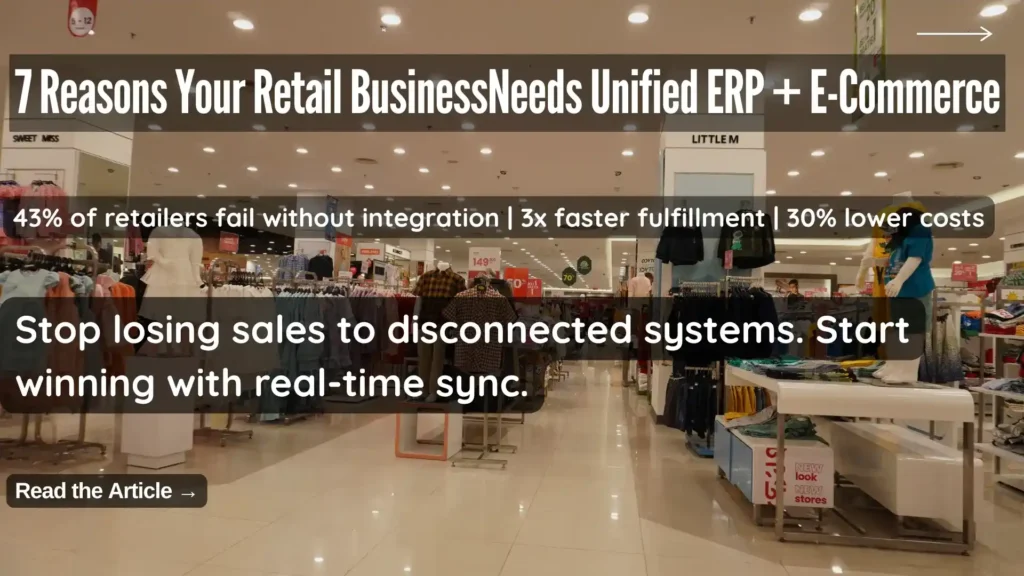
Retail ERP and e-commerce integration dashboard managing inventory, orders, and online sales.

7 Reasons Your Retail Business Needs a Unified ERP and E-Commerce Integration Solution

Here is a scenario that will feel familiar to most retail operators: a customer visits your website, sees a product marked as available, drives to your store to buy it, and finds out the shelf is empty. Your website still shows it in stock. Nobody knows why. Or this one: a loyal customer who buys from you in-store every week places their first online order — and receives a “welcome, new customer” email. No recognition of their purchase history. No loyalty points applied. No sense that the business they have been giving you for two years means anything in the digital channel. These are not technology failures. They are integration failures — and they happen every day in retail businesses running separate, loosely connected systems for their physical stores and online channels. The solution is retail ERP and e-commerce integration — specifically, a retail-oriented integration solution designed from the ground up for the way retail businesses actually operate, rather than a generic middleware tool that treats your retail operation like any other business. This article covers the seven concrete reasons why retail-specific ERP and e-commerce integration delivers outcomes that generic solutions simply cannot match — and what to look for when evaluating your options. Why Separate Retail Systems Are Now a Competitive Liability Brick-and-mortar retail is not dead — but purely physical retail without a connected online presence is becoming increasingly rare. Today’s retail customer moves fluidly between channels. They discover products on social media, research them on your website, check availability through your app, visit your store to see them in person, and expect to complete the purchase on whichever channel is most convenient at that moment. Research consistently shows that 81% of consumers use mobile devices as part of their shopping research — and the majority of purchasing journeys now involve at least two channels before a transaction is completed. For retail businesses, every additional sales channel represents a potential revenue stream. But it also represents a new source of operational complexity — unless every channel shares the same data, the same inventory, the same customer records, and the same pricing. When they do not, the experience falls apart. And in a market where customers have endless alternatives, an experience that falls apart drives them to a competitor without a second thought. The Real Cost of Running Disconnected ERP and E-Commerce The cost of disconnected retail systems is distributed across every channel, every function, and every customer interaction — making it easy to underestimate until you try to measure it: Why Generic Integration Tools Fall Short for Retail Many businesses attempt to solve the integration challenge with general-purpose middleware tools — platforms designed to connect any two applications regardless of industry. Generic integration tools can technically connect a retail ERP with an e-commerce platform. The problem is that retail has specific operational requirements — BOPIS fulfilment logic, zip-code-based inventory routing, loyalty program data synchronization, multi-currency retail pricing rules — that generic tools are not built to handle natively. The result is months of expensive custom development to configure a generic tool for retail-specific scenarios, followed by ongoing maintenance overhead every time either connected system updates. A retail-specific integration solution — or better, a unified retail platform — delivers all of this functionality out of the box. 7 Reasons to Choose a Retail-Specific ERP and E-Commerce Integration Reason 1: Consistent Products and Pricing Across Every Sales Channel The most fundamental requirement of a unified retail operation is consistency — every channel showing the same products, the same prices, and the same promotions at the same time. When your product catalog, pricing structure, and promotional mechanics live in your ERP and distribute automatically to every connected channel, consistency is structural — it happens automatically rather than requiring manual synchronization. A retail-specific integration solution enables: For retailers managing hundreds or thousands of SKUs across multiple channels, centralized product management is not just a convenience — it is a necessity. Reason 2: True Omnichannel Fulfilment — Buy Anywhere, Deliver Anywhere The modern retail customer expects to complete their shopping journey on their own terms — and that means the fulfilment model needs to be as flexible as they are. Buy Online, Pick Up In-Store (BOPIS) is now a baseline expectation for omnichannel retailers — customers order online and collect from their preferred store, combining the convenience of online shopping with the immediacy of in-store collection. But executing BOPIS reliably requires real-time integration between your e-commerce platform, your ERP, and your in-store systems. A retail-specific integration solution enables the full range of omnichannel fulfilment scenarios: Each of these scenarios requires real-time data sharing between the e-commerce platform, the ERP, and store-level inventory — which only a retail-specific integration solution delivers reliably. Reason 3: Real-Time Inventory Visibility Across Every Location Inventory accuracy is the operational foundation on which everything else in omnichannel retail depends. Without accurate, real-time inventory data across every location, BOPIS fails, online availability is unreliable, and customer trust erodes. A retail-specific integration solution delivers inventory visibility that generic tools cannot: The business impact of real-time inventory accuracy extends beyond customer experience. Buyers make better purchasing decisions. Markdowns are more targeted. Overstock and out-of-stock situations are identified earlier and resolved faster. Reason 4: Unified Customer Data Across Digital and Physical Channels A customer who has shopped with you for five years should feel known — regardless of which channel they use. Their purchase history, preferences, loyalty status, and contact information should follow them seamlessly across every interaction with your brand. This only happens when your ERP and every connected channel share a single customer database — updated in real time by every transaction, regardless of where it occurs. A retail-specific integration solution delivers: Reason 5: A Single Loyalty Program That Works Everywhere Loyalty programs are one of the most powerful customer retention tools available to retailers — but only when they work seamlessly across every channel a customer uses. A loyalty program that earns points in-store but cannot redeem them online,

7 Reasons Your Retail Business Needs a Unified ERP and E-Commerce Integration Solution Read More »

Turn prospects into engaged customers with intelligent sales and marketing

[vc_row][vc_column][vc_column_text] The selling landscape is undergoing fundamental changes, many of them driven by the effects of B2B customers’ experience as everyday consumers. Many retailers have created personalized, nearly immersive, online experiences for each customer. Consumers shopping for goods and services continually experience fresh and delightful interactions, from highly customized offers and recommendations to frictionless channels to 24/7 interactions. Using Microsoft Dynamics 365 for Marketing and Microsoft Dynamics 365 for Sales organisations are improving  their profit margins. The impact of B2C on B2B Today’s B2B buyers have high expectations, and those expectations will not be met if B2B buyers are accustomed to sophisticated consumer interactions in their personal lives. Executive B2B buyers are not impressed by marketing driven by large, relatively impersonal data analysis that leads to inconsistent and conflicting interactions or sales outreach that doesn’t cater specifically to their needs at the right time. The source of the problem may be largely invisible to the companies perpetuating this issue. Many organizations believe themselves to be customer-centric, while their buyers may not agree. That’s a significant disconnect. Clearly, B2B has much to learn from B2C companies. Customer experience – the rewards for getting it right Many B2C organizations have strategically embraced modern technologies like customer data platforms (CDP) and artificial intelligence (AI) to gain a 360-degree view of their customers and follow through on those insights to optimize customer engagement. The rewards for getting this engagement right are substantial. Many buyers are willing to pay more for a better customer experience. In terms of the potential benefits a great experience can have on sales success, a McKinsey study reported that organizations can expect: 10-15 percent lower customer churn 20-40 percent increase in the win rate of offers Up to 50 percent lower service costs Take a new approach B2B companies must move away from their legacy approaches based on large, relatively impersonal data analysis and move to solutions that unify relationship data across the full customer lifecycle. That way, they can gain insights that help build credibility and trust with buyers. They can run multi-channel campaigns to increase sales-ready leads, create personal experiences, and use guided process and AI to anticipate and respond faster to customer needs. They can build the ongoing, high-quality relationships that are necessary for long-term success. Four principal goals Turning prospects into engaged customers is a process. In order to achieve these goals, organizations must focus on 4 key priorities: Nurture more demand Personalize buyer experiences Build relationships at scale Make insight-driven decisions Each of these drives results by using deep reservoirs of data in making technology feel more human. Nurture more demand Relying only on conventional, basic email marketing as the primary source of leads is simply not effective enough. In fact, the more focused and demanding the customer universe is, the more essential it is to gain deep insights into what those customers expect. Northrop & Johnson,  a leading global yacht brokerage, competes for multi-million dollar customers using technology its industry has been slow to adopt. Using Microsoft Dynamics 365 for Marketing has created a decided competitive advantage: Vital insights into their customer base have helped to drive a 70 percent increase in charter sales. In any industry, companies need to generate leads across multiple channels, nurture large numbers of leads while prioritizing each one, and use data-driven insights to deliver leads that are sales-ready. Nurturing more demand is critical to growth. Personalize buyer experiences It’s time to end friction, inconsistencies, and the “do you know who I am?” part of the customer experience. Companies can acquire a holistic view of buyers, predict buyer intent, and orchestrate a connected, personalized journey for customers. In an era where guests have more choices than ever for leisure and entertainment, Tivoli delights its guests by using Dynamics 365 Customer Insights to stay one step ahead of expectations and transform the guest experience. With its deeper understanding of guests, it can add new chapters to its long tradition of imagination and innovation. Build relationships at scale Mutually beneficial relationships don’t simply happen with more data. Companies need to build credibility to establish and grow relationships with customers. Together, Dynamics 365 and LinkedIn enable the company to have increased information about, and impact on the sales relationships that are added to its sales pipeline, even as that pipeline experiences exponential growth month over month. Make insight-driven decisions Here’s where sales and marketing can truly align: utilizing data to uncover insights that lead to better-informed decisions throughout the sales process. This can improve performance, empower employees, and enable the company to gain increasingly effective strategic insights. With more than 1,500 pubs serving guests throughout the UK, Marston’s launched a business transition by bringing together guest data that was scattered across multiple systems into Dynamics 365. With their locations’ guest data now unified, Marston’s will gain a complete view of guests, which can be harnessed to generate customer satisfaction and strategic insights. This approach helps drive improved performance throughout the company, including the opportunity to empower employees – an often-overlooked aspect of a company’s success. Aligning sales and marketing: The intelligent way to succeed It’s possible to create exceptional experiences, drive more qualified leads, and increase revenue if an organization has the vision, process, and technology to harness all the data available. This requires high-level technology with well-defined business goals and sales and marketing applications fueled by keen intelligence. We have a compelling offering to accomplish just that with Microsoft Dynamics 365. Get in touch with our representative to request a demo for Microsoft Dynamics 365 for Sales & Microsoft Dynamics 365 for Marketing Blog Reference : https://cloudblogs.microsoft.com/dynamics365/bdm/2019/09/19/turn-prospects-into-engaged-customers-with-intelligent-sales-and-marketing/[/vc_column_text][/vc_column][/vc_row]

Turn prospects into engaged customers with intelligent sales and marketing Read More »

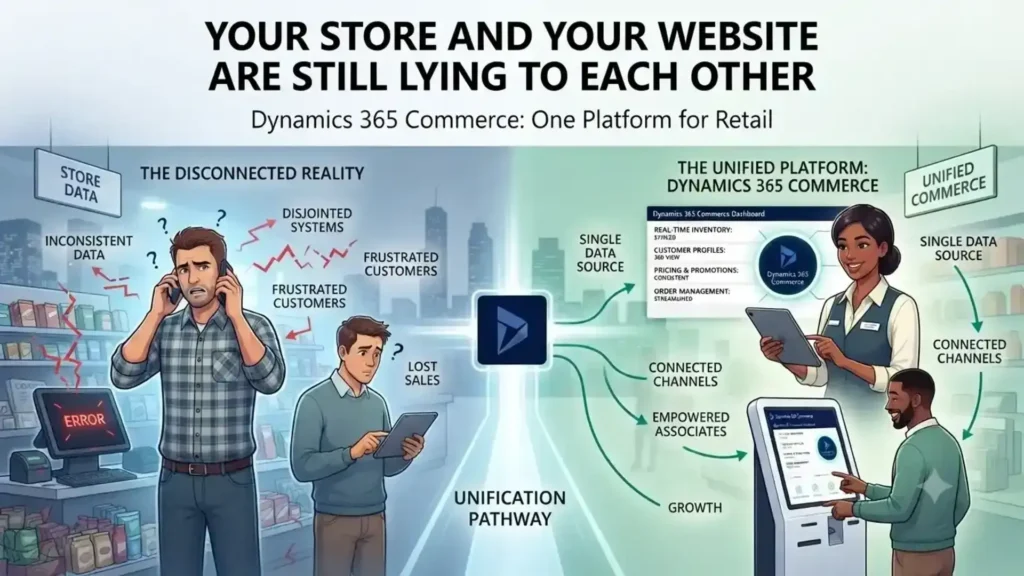
Retail store and eCommerce website displaying mismatched inventory and customer data, highlighting the need for unified commerce.

Your Store and Your Website Are Still Lying to Each Other

A customer checks stock online, drives to the store, and finds the shelf empty — because the website and the POS were never talking to each other. Dynamics 365 Commerce closes that gap, running e-commerce, POS, and inventory on one shared data model instead of three disconnected systems. The result: what the customer sees online is what’s actually on the shelf. A customer checks stock online, drives to the store, and finds the shelf empty. The website said 12 in stock. The POS system never told it otherwise. This is the gap that kills conversion — not a lack of channels, but channels that don’t talk to each other. Physical retail isn’t dying. US retail storefronts have kept expanding even as e-commerce grows in double digits, and most large online retailers still run physical stores alongside their digital ones. The real shift isn’t online-versus-offline. It’s whether a retailer’s systems present one version of the truth across both. Why Omnichannel Keeps Failing on the Back End Most retailers don’t lack an omnichannel strategy. They lack an omnichannel database. Inventory sits in one system, POS transactions in another, e-commerce orders in a third — and “click and collect” becomes a manual reconciliation problem instead of a feature. Dynamics 365 Commerce solves this by running POS, e-commerce, call center, and back-office inventory on a single data model. A sale on the shop floor and an order placed on the app update the same stock ledger in real time. There’s no overnight batch sync, no separate inventory feed that drifts out of date by midafternoon. What Changes for the Store Team Store associates stop being the last to know. With real-time inventory visibility built into the POS, an associate can check stock at another location and place a transfer or a customer order without calling around. Paired with Dynamics 365 Customer Insights, they can also pull up a shopper’s purchase history and preferences mid-conversation — turning a routine sale into something closer to how a regular customer at a neighborhood store gets treated, at chain scale. Personalization Is a Retention Lever, Not a Nice-to-Have Younger shoppers in particular respond to retailers that recognize repeat behavior instead of treating every visit as anonymous. [Verify with a current source — this stat should reflect the latest data, not be carried over from the original piece.] Recommendation logic built on unified purchase data — not guesswork — is what makes that personalization operationally possible instead of aspirational. Where This Matters Most: Mid-Size Chains Enterprise retailers can afford to bolt together five vendors and a systems-integration team to keep it running. Mid-size retail chains usually can’t. That’s where a single-platform approach pays off fastest — fewer integration points to maintain, one vendor accountable for uptime across channels, and IT teams that aren’t stitching together POS, ERP, and e-commerce patches every quarter. The Real Competitive Line Isn’t Online vs. In-Store E-commerce alone won’t differentiate a retailer for much longer — most competitors have it. What separates retailers now is whether a customer gets the same accurate stock count, price, and service history whether they’re on the app, on the phone with support, or standing at the register. That consistency is an infrastructure decision, not a marketing one. Ready to see it on your own store’s data? Talk to Trident about a Dynamics 365 Commerce assessment for your retail environment. FAQ What is Dynamics 365 Commerce used for?It’s Microsoft’s unified retail platform that runs POS, e-commerce, call center, and inventory management on one data model, so stock and order data stay consistent across every sales channel. Is Dynamics 365 Commerce the same as Dynamics 365 for Marketing?No — they’re different products. Commerce handles retail operations and omnichannel sales; Marketing handles campaign management. Retailers evaluating an ERP should look at Commerce. Can Dynamics 365 Commerce support click-and-collect?Yes. Because inventory updates in real time across channels, a “buy online, pick up in store” order reflects accurate stock without manual reconciliation between systems.

Your Store and Your Website Are Still Lying to Each Other Read More »