Welcome to Trident Information Systems!
Write us to - info@tridentinfo.com
Let's Socialize

Ls retail partner

4 Reasons to choose Retail apps to reshaping customer experience & loyalty programs

[vc_row][vc_column width=”1/2″][vc_column_text]Smartphones are no more a luxury, and the convention means of shopping are not the only means. Research revealed that in the US, sales that occurred via smartphones swelled by 126 percent in 2018’s first quarter. The basis of any mobile app development company is to rebuild the traditional shopping exercise consequently improving the model of mobile marketing. A mobile app, for now, is not just the way to e-commerce but also for retail. For clients to satisfy their gratification as what they want, smartphone apps serve as a personal browsing and comparison tool in their hands. Mobile shopping is increasing its horizon for the convenience it provides. As an outcome, Trident Information Systems Pvt Ltd offer high-quality and cost-effective technology solutions[/vc_column_text][/vc_column][vc_column width=”1/2″][vc_single_image image=”7071″ img_size=”full”][/vc_column][/vc_row][vc_row][vc_column][vc_column_text]It’s m-commerce, not e-commerce. A recently conducted survey, e-commerce carries more of 30 percent of the entire e-commerce and will grow exponentially. Mobile utilization is increasing at a lightning-speed rate than any of Google’s internal forecasts. The most paramount benefit of m-commerce to users is that it takes few seconds in transacting. Also, users can do transactions from remote area and at any time of the day. Users prefer more in swiping the relevant curated images as retailers make several kinds of offers for the business promotion. This is all because mobile app developers recognize the end-user needs and create customized apps that fulfil user expectations. People spend more time on Mobiles Apps than PCs. The m-commerce is thriving at an escape velocity that provides a platform for this kind of technology shift. As per statistic, 90 percent of all buyers spent most of their time on mobile apps. Buyers get access to ample of information about the business products or services quickly. 63% of Americans today like to use a mobile app for the smooth convenience that it offers. More engaging user experience UI-UX are key element of retail app development. User’s value using apps as each of them has their unique features, which often follow industry standards. Research reveals that most of the buyers and customers give an app a chance once or twice. Creating a feature-rich retail app by the developers is growing increasingly successful as it delivers an instant contact on the first-time users. Plethora of apps are available in the play store, but only a few of them make a difference. Mobile App growth is flaming There is a regular switch from mobile web to mobile app-based buying, which means that apps are more accessible and acceptable. The growth is increasing day by day, inspired by a massive ballooning in the number of mobile devices. Buyers use their smartphones to analyse what is around them, and retailers today needs to be smarter on efficient application of mobile app and satisfying the needs of mobile-empowered buyers Conclusion Developing successful and high-traffic mobile apps is the end-purpose of the development companies like Trident Information Systems Pvt Ltd. Numerous buyers still relish the in-store experience as they consider touch, see, and try products that they can’t do online – but that’s a less number of users. Retail app development benefits buyers with up-to-date market era. Mobile retail is entirely replacing the traditional retail as the favoured shopping means.[/vc_column_text][/vc_column][/vc_row]

4 Reasons to choose Retail apps to reshaping customer experience & loyalty programs Read More »

IoT dashboard monitoring connected devices, real-time analytics, and business operations.

IoT Applications for Business: How the Internet of Things Is Transforming Operations Across Every Industry

Every physical object in your business — every machine, vehicle, sensor, package, and piece of equipment — is generating data. The question is whether your organization is capturing it, analyzing it, and acting on it. The Internet of Things (IoT) is the technology infrastructure that makes this possible. By embedding sensors, connectivity, and software into physical devices and environments, IoT creates a continuous stream of real-world data that organizations can use to operate more efficiently, respond faster to problems, serve customers better, and make decisions based on what is actually happening — not what someone reported happening yesterday. The business case for IoT is no longer theoretical. Organizations across agriculture, e-commerce, healthcare, manufacturing, transportation, and enterprise operations are deploying IoT applications to solve specific operational problems — and achieving measurable, documented results. Farmers are optimizing water usage through soil moisture sensors. Manufacturers are predicting equipment failures before they happen. Transport operators are tracking goods in real time across global supply chains. This guide covers the practical reality of IoT applications for business — what IoT is, how it works, where it is delivering the most significant value across six major industries, and how Microsoft Azure IoT provides the enterprise-grade platform that makes business IoT scalable and secure. What Is IoT and Why Does It Matter for Business? The Internet of Things refers to the network of physical devices — machines, vehicles, sensors, appliances, wearables, and infrastructure — that are embedded with software, sensors, and connectivity to collect and exchange data over the internet or a private network. In practical terms, IoT is about closing the gap between the physical world and the digital world. In a traditional business environment, data about physical operations — machine performance, vehicle location, inventory levels, environmental conditions — had to be collected manually, which meant it was always delayed, often inaccurate, and expensive to gather at scale. IoT eliminates this gap by making physical assets continuously self-reporting — feeding real-time operational data into business systems automatically, without human intervention. The Core Components of an IoT System Every IoT deployment, regardless of industry or application, consists of four fundamental components: 1. Devices and sensors — the physical layer that collects data from the real world. Temperature sensors, motion detectors, GPS trackers, RFID readers, smart meters, industrial monitoring equipment, and thousands of other device types. 2. Connectivity — the communication layer that transmits data from devices to processing systems. Wi-Fi, cellular (4G/5G), Bluetooth, LoRaWAN, Zigbee, and satellite connectivity are all used depending on the application’s range, power, and bandwidth requirements. 3. Data processing and analytics — the intelligence layer that receives raw sensor data, processes it, applies business rules and analytical models, and generates actionable insights. Cloud platforms like Microsoft Azure IoT Hub provide this capability at enterprise scale. 4. Applications and interfaces — the user layer where insights and controls are made accessible to the people and systems that need them. Mobile applications, dashboards, automated alerts, and integration with ERP and CRM systems like Microsoft Dynamics 365 all operate at this layer. How IoT Creates Competitive Advantage for Organizations Organizations that deploy IoT effectively gain advantages that compound over time — because the data generated by IoT systems becomes progressively more valuable as it accumulates and as analytical models are refined: IoT Business Applications Across 6 Major Industries 1. IoT in Agriculture: Precision Farming and Resource Optimization Agriculture is one of the sectors most profoundly transformed by IoT — moving from experience-based farming practices to data-driven precision agriculture that optimizes every input for maximum yield and minimum waste. Key IoT applications in agriculture: For a sector historically characterized by low technology adoption, IoT is delivering some of the most dramatic productivity and sustainability gains of any industry — with direct implications for food security at a global scale. 2. IoT in E-Commerce: Smarter Inventory, Logistics, and Customer Insights E-commerce businesses compete on speed, accuracy, and the quality of the customer experience — and IoT is a critical enabler of all three at scale. Key IoT applications in e-commerce: 3. IoT in Healthcare: Remote Patient Monitoring and Equipment Management Healthcare is one of the highest-impact domains for IoT — where connected devices can directly improve patient outcomes, reduce the cost of care, and enable healthcare delivery models that were previously impossible. Key IoT applications in healthcare: The growing market for IoT-based healthcare applications reflects both the scale of the opportunity and the maturity of the technology — with remote patient monitoring alone projected to be one of the fastest-growing segments of digital health investment globally. 4. IoT in Enterprise Operations: Connected Workforce and Process Intelligence For enterprises across every sector, IoT provides the visibility and automation capability to optimize operations, reduce costs, and improve employee productivity through connected workplace technologies. Key IoT applications in enterprise operations: 5. IoT in Transportation and Logistics: Real-Time Tracking and Fleet Management Transportation and logistics is one of the earliest and most mature IoT application domains — with GPS tracking and telematics predating the broader IoT movement. Modern IoT capabilities have dramatically extended what is possible. Key IoT applications in transportation and logistics: 6. IoT in Manufacturing: Industry 4.0, AI, and Machine Learning Manufacturing is the industry where IoT delivers the most direct and measurable ROI — and where the convergence of IoT with artificial intelligence and machine learning is creating the most transformative operational improvements. Key IoT applications in manufacturing: IoT and Mobile Applications: How They Work Together The relationship between IoT and mobile applications is increasingly central to how both technologies deliver value — particularly in enterprise and field service contexts. Mobile as the Interface for IoT Data and Control For many IoT deployments, the mobile application is the primary user interface — the means by which workers, managers, and customers interact with the data and control capabilities that IoT sensors and systems generate: Enterprise Mobile IoT Applications in Practice The convergence of IoT and mobile is particularly powerful in enterprise environments where workers are mobile and operations are

IoT Applications for Business: How the Internet of Things Is Transforming Operations Across Every Industry Read More »

AI-powered visual inspection system detecting product defects on a manufacturing production line.

The Retail Customer Experience Gap Is Costing You Sales — Here’s Exactly How to Close It

Let me ask you something honestly: when did you last have a genuinely great shopping experience in a physical store? Not just a transaction that went smoothly. A genuinely great experience — where a staff member knew their products inside out, where the item you wanted online was available in-store without drama, where the offer you received felt like it was actually meant for you. If you are struggling to remember one, you are not alone. And if you are a retailer, that memory gap is a commercial problem — because it is exactly what your customers are experiencing when they shop in your store. The retail customer experience gap — the distance between what shoppers expect and what most retailers actually deliver — is widening. Not because customers are becoming harder to please, but because the standard has been reset by the best digital experiences, and physical retail has not kept up. The good news? The technology to close this gap is available, proven, and more accessible than most retailers realize. You do not need virtual reality fitting rooms or AI-powered holograms. You need to get three fundamentals right — and this guide covers exactly how. The Uncomfortable Truth About Retail Customer Experience Today Brick-and-Mortar’s Hidden Advantage — and Why Most Retailers Are Wasting It Here is the thing that keeps getting lost in all the “retail is dying” conversation: physical stores have an advantage that no e-commerce operation can fully replicate. Real human connection. The ability to touch, feel, and try a product. The spontaneous discovery of something you did not know you needed. Immediate gratification — you pay, you take it home. These are genuinely powerful experiences. They are the reason that, despite the relentless growth of online retail, physical stores still account for the majority of retail transactions globally. But that advantage only exists if you actually deliver on it. And right now, too many retailers are squandering it — offering an in-store experience that is worse than shopping online, not better. What the Research Actually Says About How Shoppers Feel The statistics on retail customer experience are sobering for anyone running a physical retail operation: These are not statistics about the occasional bad day. They are consistent patterns — describing an industry-wide gap between what customers expect and what most retailers deliver. The question is not whether your retail experience has gaps. The question is which gaps are hurting you most — and what you are going to do about them. The 3 Experience Gaps That Are Driving Your Customers Away Every frustrating retail experience can be traced back to one of three root causes. Get these three things right, and you will deliver an in-store experience that genuinely competes with the convenience of online shopping. Get them wrong, and you will continue losing customers to retailers who have figured them out. Gap 1: Unhelpful Sales Associates — The Trust Problem on Your Shop Floor Picture this: a customer walks into your store looking for running shoes. They find two pairs they like and want to understand the difference — which sole is better for trail running, which has better arch support for high-mileage training. They look around for help. A sales associate approaches. What happens next determines whether you make the sale, earn a loyal customer, and get a five-star Google review — or lose all three. Why Your Staff Think They’re Doing Great (And Why Customers Disagree) Here is a striking disconnect that Forrester research has consistently uncovered: 61% of retailers are confident their store associates deliver great service. But 51% of shoppers disagree — saying that sales associates simply are not knowledgeable enough about the products they sell. That gap between retailer confidence and customer reality is not a training failure in isolation. It is a systems failure. Staff who want to be helpful cannot be helpful if they do not have the information they need — about products, stock levels, specifications, and availability — at the moment the customer needs it. Training: Build the Product Knowledge That Earns Customer Trust Great customer service starts with genuine product knowledge — and genuine product knowledge requires ongoing investment in staff training, not just an onboarding day. Think about what actually earns a customer’s trust in a retail interaction. It is not enthusiasm. It is not a well-memorized sales script. It is the ability to answer specific questions accurately — to say “the trail shoe has a Vibram outsole that grips loose terrain, but if you’re mostly running on tarmac, this one has significantly better cushioning” — and to mean it. Building that level of knowledge takes consistent investment: The retailers whose staff genuinely know their products are the ones whose customers come back — because trust, once earned, is sticky. Mobile POS: The Technology That Turns Every Associate Into an Expert Training builds the foundation. Technology fills the gaps — in real time, on the shop floor, in front of the customer. A mobile Point of Sale system puts a complete product database, live stock visibility, and customer history into the hands of every associate on your shop floor. Instead of retreating to a back-office terminal — or worse, saying “I’ll have to check” and never coming back — your staff can: The mobile POS is not just a technology upgrade. It is a fundamental shift in the service model — from reactive assistance to proactive, informed, personalized engagement. Gap 2: Inconsistent Cross-Channel Experiences — The Biggest Retail Frustration Here is how a customer’s day can go wrong without a single person making a deliberate mistake. They see a product on your Instagram and save it for later. They check your website that evening — it shows as available. They drive to your store on Saturday morning to buy it. The store says it is out of stock. Your website still shows it as available. Nobody can explain the discrepancy. The customer drives home empty-handed, buys it from a competitor online, and

The Retail Customer Experience Gap Is Costing You Sales — Here’s Exactly How to Close It Read More »
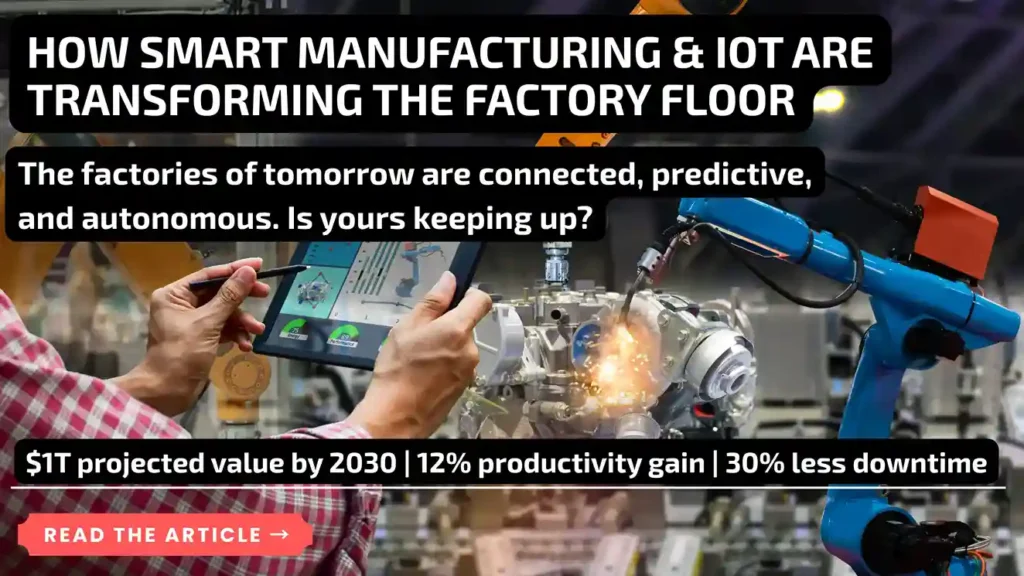
Smart factory using IoT devices and automation for real-time manufacturing monitoring.

How Smart Manufacturing and IoT Are Transforming the Factory Floor

Introduction Every unplanned machine breakdown costs a manufacturer time, money, and customer trust. Every quality defect that slips through costs even more. The hard truth is that most of these losses are preventable — if you have the right data at the right time. That is exactly what Smart Manufacturing and the Industrial Internet of Things (IIoT) are built to deliver. When machines, sensors, and systems are connected and sharing data in real time, manufacturers stop reacting to problems and start preventing them. Production lines run leaner. Quality becomes consistent. And the gap between what the factory floor produces and what management can actually see shrinks to almost nothing. This article breaks down how that works in practice — and why manufacturers who are not already investing in connected systems are falling behind those who are. What Is Smart Manufacturing? (And Why the Definition Matters) The term “IoT” was coined by Peter T. Lewis to describe “the integration of people, processes, and technology with connectable devices and sensors to enable remote monitoring, real-time control, and data-driven decision-making.” But here is the part most explainers skip: smart manufacturing is not about adding technology for its own sake. It is about closing the gap between what is happening on the shop floor and what decision-makers know about it. In a traditional factory, that gap is wide. A machine can be underperforming for weeks before a supervisor notices. A quality issue can affect hundreds of units before it is caught. A maintenance window gets scheduled on gut instinct, not data. In a smart factory, that gap is nearly zero. The Core Engine: Sensors, Connectivity, and Real-Time Data Smart manufacturing is built on three layers that work together: 1. Sensors — the factory’s nervous system Sensors attached to machines, conveyor belts, assembly stations, and environmental systems continuously collect data — temperature, vibration, pressure, speed, output rate, energy consumption, and dozens of other variables. They do this 24/7, without human involvement. The moment a reading drifts outside a set parameter, the system knows. Even if no one is watching. 2. Connectivity — getting data where it needs to go Raw sensor data is useless if it stays on the machine. Connectivity — whether via Wi-Fi, MQTT protocols, edge gateways, or cloud pipelines — moves data from individual devices to a central system where it can be processed and analysed. Every connected device on the floor contributes to a shared, factory-wide picture. Every disconnected device is a blind spot. For manufacturers managing sensitive production data, this also raises a critical question: where does the data live? On-premises, in a private cloud, or a hybrid setup? The answer depends on your security requirements, your IT infrastructure, and how quickly you need to act on the data. There is no universal right answer — but there is definitely a wrong one, which is not thinking about it at all. 3. Data analysis — where the value actually lives Collected data means nothing without interpretation. Modern smart manufacturing platforms apply analytics — and increasingly, machine learning — to turn streams of sensor readings into actionable intelligence: This is the shift from descriptive reporting (“here is what happened”) to predictive and prescriptive intelligence (“here is what will happen, and here is what to do about it”). Key Benefits of Smart Manufacturing — What Manufacturers Actually Gain Predictive maintenance that prevents unplanned downtime Unplanned downtime is one of the most expensive problems in manufacturing. Industry estimates put the average cost at thousands of dollars per hour — and in some sectors, far more. Smart manufacturing flips the model. Instead of waiting for a machine to break and then fixing it (reactive), or scheduling maintenance on a fixed calendar (preventive), predictive maintenance uses real-time sensor data to detect the early warning signs of failure — unusual vibration patterns, rising temperatures, changes in motor current — and flags them before they cause a breakdown. The result: maintenance teams intervene exactly when they need to, not before (wasted resource) and not after (costly downtime). Consistent quality and fewer defects Every production process has variables. Raw material variations, temperature fluctuations, operator differences, tool wear — any of these can push output outside acceptable tolerances. In a smart factory, quality monitoring happens continuously, at every stage of production. Statistical process control systems track output quality in real time and alert operators the moment a process starts drifting. Defects get caught at the source, not at final inspection — or worse, at the customer. For manufacturers in precision-sensitive sectors like automotive components, medical devices, or electronics, this is not a nice-to-have. It is a competitive requirement. End-to-end production visibility Smart manufacturing gives plant managers, production supervisors, and customers something that has historically been surprisingly difficult to obtain: an accurate, real-time picture of what is actually happening. When this information is available instantly — on a dashboard, on a mobile device, from anywhere — decision-making speeds up dramatically. Problems get escalated in minutes, not hours. Smart Manufacturing in Automotive Component Manufacturing Automotive component manufacturing deserves specific attention. It is one of the largest and most demanding sectors in global manufacturing, and it illustrates the value of smart manufacturing particularly well. Automotive components are complex, high-precision, and produced at scale. Tolerances are tight. Quality requirements are strict. And the supply chain consequences of a defect reaching an OEM can be severe. Smart manufacturing addresses this in two directions: For the manufacturer: Connected sensors and real-time analytics ensure maximum process consistency. Predictive maintenance reduces the risk of unplanned stoppages mid-production run. Data on machine performance, cycle times, and output quality gives plant managers the visibility to optimise continuously rather than periodically. For the customer: Real-time production data means customers are no longer in the dark about order status. Production milestones, completion estimates, and quality sign-offs can be communicated proactively, not reactively. That visibility strengthens the commercial relationship. What Needs to Be in Place Before You Connect the Factory Smart manufacturing does not require ripping out existing infrastructure and starting

How Smart Manufacturing and IoT Are Transforming the Factory Floor Read More »

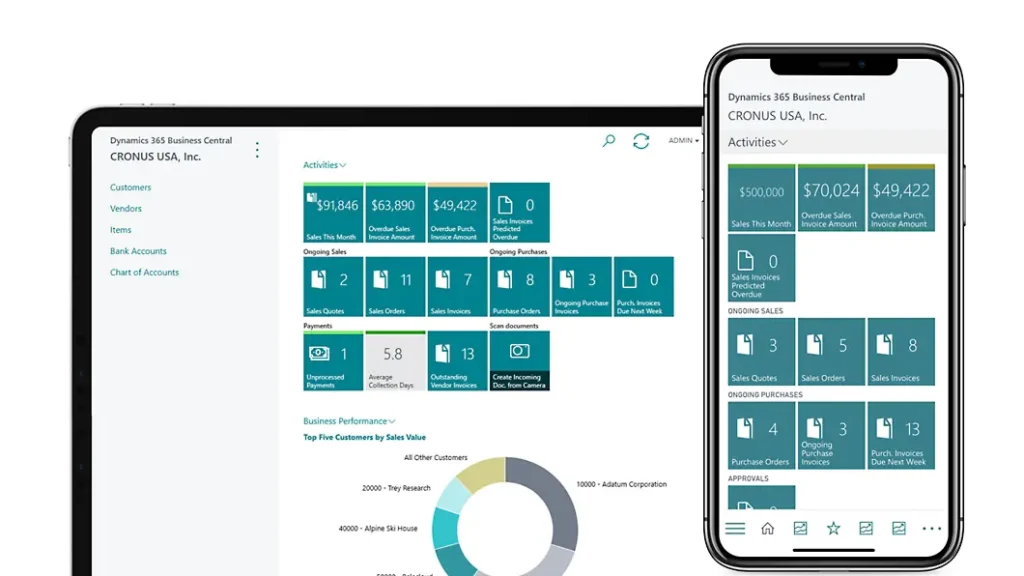
Microsoft Dynamics 365 Business Central dashboard managing finance, inventory, and business operations.

Microsoft Dynamics 365 Business Central: The All-in-One ERP Solution for Growing Businesses

Growing businesses reach a point where spreadsheets, disconnected accounting software, and manual processes stop being inconveniences and start being strategic risks. Inventory decisions made without real-time stock data. Financial close processes that take weeks instead of days. Sales teams working from customer records that do not reflect the latest service interactions. Supply chain planning that cannot see production capacity in real time. These are not just operational frustrations — they are competitive vulnerabilities in a market where speed and accuracy determine which businesses grow and which ones stall. Microsoft Dynamics 365 Business Central is built for exactly this inflection point. It is an all-in-one business management solution that connects finance, sales, supply chain, manufacturing, project management, and service operations on a single, intelligent platform — giving growing businesses the end-to-end visibility, automation depth, and real-time intelligence they need to make better decisions and accelerate growth. As the evolution of Microsoft Dynamics NAV — one of the world’s most widely deployed mid-market ERP platforms — Business Central combines the deep functional capability that NAV users trusted with the cloud-native architecture, embedded Power BI analytics, and Microsoft 365 integration that modern businesses require. Trident Information Systems is a certified Microsoft Dynamics 365 Business Central implementation partner — helping businesses across manufacturing, retail, professional services, and distribution implement, configure, and maximize the value of Business Central across India. This guide covers every major capability of Dynamics 365 Business Central — what it does, how it works, and what it delivers for growing businesses. What Is Microsoft Dynamics 365 Business Central? Microsoft Dynamics 365 Business Central is an all-in-one cloud ERP solution designed for small and mid-size businesses that need a single, integrated platform to manage their entire operation — without the complexity and cost of enterprise-grade ERP systems like Dynamics 365 Finance and Operations. The Evolution of Dynamics NAV: Built for Modern Business Business Central is the direct successor to Microsoft Dynamics NAV — one of the most successful mid-market ERP platforms in the world, with hundreds of thousands of deployments across more than 170 countries. If your organization is currently running Dynamics NAV, Business Central is your natural upgrade path — preserving the functional depth and business logic you depend on while adding cloud delivery, embedded AI, real-time analytics, and modern Microsoft 365 integration. For new implementations, Business Central offers the fastest path to a fully integrated business management platform — with preconfigured industry templates, rapid deployment methodology, and no-code customization tools that allow businesses to adapt the system to their specific processes without expensive custom development. Who Is Dynamics 365 Business Central Designed For? Business Central is designed for: Financial Management: Real-Time Intelligence Across Every Account Financial management is the operational core of Business Central — built to give finance teams the real-time visibility, automation, and control they need to close faster, report more accurately, and forecast with confidence. Make Informed Decisions With End-to-End Financial Visibility Business Central connects data across accounting, sales, purchasing, inventory, and customer interactions — creating a single, continuously updated financial picture of your business. Built-in Power BI dashboards display financial performance in real time, with drill-down capability from summary KPIs to individual transaction level: Accelerate Financial Close and Reporting Manual financial close processes consume weeks of finance team capacity every period — reconciling accounts, chasing documentation, and correcting errors that automated systems would have caught immediately. Business Central streamlines the entire close cycle: Improve Forecast Accuracy With Multi-Dimensional Analysis Business Central’s forecasting capabilities give finance and leadership teams the tools to model future performance with confidence: Core Financial Capabilities: GL, Fixed Assets, Receivables, and More Business Central’s financial module covers every dimension of business accounting: Customer Relationship Management: Deliver Value at Every Touchpoint Business Central includes integrated CRM capabilities — giving sales teams the customer intelligence, opportunity management tools, and productivity features they need to close more deals and build stronger relationships. Prioritize Leads, Track Interactions, and Close More Deals Boost Sales Productivity From Within Microsoft Outlook One of Business Central’s most practically impactful capabilities is its deep integration with Microsoft Outlook — the tool most sales professionals already spend the majority of their working day in: Dynamics 365 Business Central and Dynamics 365 Sales Integration For organizations that require deeper CRM functionality than Business Central’s native capabilities provide, Dynamics 365 for Sales integration is available natively — synchronizing sales orders, item availability, units of measure, and currencies between the two platforms in a few straightforward steps. Supply Chain Management: Automate, Optimize, and Protect Margins Business Central’s supply chain capabilities give purchasing, inventory, and operations teams the intelligence and automation to maintain optimal stock levels, avoid costly shortages, and protect margins through smarter procurement. Optimize Inventory Levels With Built-In Intelligence Avoid Stockouts and Lost Sales With Automated Replenishment Stockouts are one of the most costly and preventable operational failures in any product-based business. Business Central eliminates them through: Purchase and Sales Order Management Warehouse Management: Basic and Advanced Business Central’s warehouse management can be configured at different complexity levels — from basic order-by-order processing for simpler operations to advanced multi-order consolidation for high-volume distribution environments: Manufacturing: From Planning to Production to Delivery Business Central provides integrated manufacturing capabilities for companies that produce goods — from simple assembly operations through complex multi-level production with subcontracting. Production Planning and Capacity Optimization Subcontracting and Assembly Management Service Order Management: From After-Sales to Contract Management Business Central provides a complete service management framework — giving service operations teams the tools to manage service requests, service contracts, field technician dispatch, and pricing across the full service lifecycle: Project Management: Stay on Budget, Deliver on Time Business Central’s project management capabilities give professional services organizations and project-based businesses the tools to plan, track, and deliver customer projects profitably: Job Costing, Timesheets, and Resource Planning Analyze Project Profitability in Real Time Human Resources and Expense Management Business Central includes foundational human resources and expense management capabilities — giving HR and finance teams a single system for employee data and expense processing: Power

Microsoft Dynamics 365 Business Central: The All-in-One ERP Solution for Growing Businesses Read More »

Microsoft Dynamics 365 Integration Services connecting business applications, data, and workflows.

Microsoft Dynamics 365 Integration Services: Connect Your Applications, Data, and Processes — Seamlessly

Every enterprise runs on more applications than it can easily count. A CRM here. An ERP there. A website that does not talk to either. A mobile app that syncs to a database once a night. A marketing platform that receives a weekly export. A finance system that requires manual reconciliation with the sales data that should be feeding it automatically. This is not a technology problem. It is a strategy problem — and it compounds with every new system your business adds. Microsoft Dynamics 365 integration services solve this at the architectural level. By connecting your Dynamics 365 environment — and every other application, data source, and process in your business ecosystem — through Microsoft Azure, Power Automate, and Microsoft Dataverse, Trident enables your organization to operate with the speed, accuracy, and agility that modern business demands. Whether you are implementing Dynamics 365 for the first time, upgrading from a legacy ERP, or trying to rationalize a complex multi-system environment that has grown organically over years — Trident’s integration consultants will architect a solution that ensures your data flows where it needs to, when it needs to, without manual intervention, without data loss, and without the security risks that come from poorly designed integration architectures. This is not about connecting systems. It is about connecting your business. Why Seamless Integration Is Now a Business Imperative The Hidden Cost of Disconnected Systems and Data Silos Most businesses underestimate the cost of their disconnected systems — because the cost is distributed across dozens of daily processes that have been manual for so long, nobody questions them anymore. The sales team copies data from the CRM into a spreadsheet to send to operations. The finance team waits for the month-end export from the sales system to reconcile revenue. The warehouse team checks inventory in one system and updates orders in another. The marketing team sends campaigns to a list that was last synchronized three days ago. Each of these manual steps is a cost: time spent, errors introduced, decisions delayed, and opportunities missed. At enterprise scale, the aggregate cost of data silos is enormous — and entirely preventable with the right integration architecture. What True Integration Looks Like in a Modern Business True integration is not connecting two systems with a point-to-point API that breaks every time either system updates. It is a resilient, scalable integration architecture that: This is the integration architecture that Trident designs, builds, and maintains for organizations running Microsoft Dynamics 365 across India. Trident’s Microsoft Dynamics 365 Integration Approach Right Data, Right Place, Right Time — Every Time The success of any ERP or CRM implementation depends fundamentally on data quality and data availability. A Dynamics 365 deployment that does not receive accurate, timely data from every connected system is a Dynamics 365 deployment that is not delivering its full value. Trident’s integration philosophy is built around a simple principle: the right data, in the right place, at the right time. Our integration consultants work with your team to understand every data flow your business depends on — and architect an integration solution that makes those flows automatic, reliable, and auditable. Our most common integration scenarios include: On-Premises, Cloud, and Hybrid Integration Capabilities Not every business is ready to move everything to the cloud simultaneously — and not every system can be. Trident’s integration capabilities cover the full deployment spectrum: Microsoft Azure: The Integration Foundation Azure Integration Services: Power, Security, and Global Scale Microsoft Azure is the cloud platform that powers Trident’s integration solutions — providing the security, scalability, and global infrastructure that enterprise integration requires. Azure’s integration services give organizations access to: Hybrid Cloud Connectivity: Maximize Value From Existing Investments One of the most compelling capabilities of Azure’s integration platform is its hybrid connectivity — allowing organizations to connect on-premises systems to cloud services without replacing existing infrastructure. The Azure On-Premises Data Gateway enables secure, encrypted connectivity between cloud-based Power Automate workflows and on-premises data sources — including databases, file systems, and legacy applications — without opening inbound firewall ports or compromising on-premises security posture. For organizations managing a mixed environment of legacy on-premises systems and modern cloud applications during a digital transformation journey, this hybrid connectivity is the bridge that makes a phased approach viable. Microsoft Power Automate: Automate Workflows Without Code Microsoft Power Automate (formerly Microsoft Flow) is the workflow automation layer that connects everyday business applications and automates repetitive processes — without requiring any code. For business users who need to automate a specific process and for IT teams building enterprise integration workflows, Power Automate provides a no-code interface for creating automated workflows between hundreds of supported applications and services. Multi-Step Workflows and Conditional Logic Power Automate’s workflow engine goes far beyond simple “if this then that” automation. Enterprise-grade workflows can include: Practical examples of Power Automate integration for Dynamics 365: Secure Data Management and Loss Prevention Data security is not an afterthought in Power Automate — it is built into the architecture: On-Premises Data Gateway: Connect Legacy Systems to the Cloud The On-Premises Data Gateway for Power Automate enables secure connectivity to on-premises data sources — including SQL Server, Oracle, SharePoint on-premises, and file system sources — without exposing those systems directly to the internet. This capability is critical for organizations in the middle of a digital transformation journey — where some systems have moved to the cloud but others remain on-premises for operational, compliance, or cost reasons. The gateway acts as a secure bridge — enabling cloud-based workflows to access on-premises data as if it were a cloud service. Microsoft Dataverse: The Single Source of Truth for Your Business Data Microsoft Dataverse (formerly Common Data Service) is the unified data platform at the heart of the Microsoft Dynamics 365 and Power Platform ecosystem — providing a standardized, secure, and governed data layer that every connected application can use as a shared source of truth. A Unified Data Layer Across Every Business Application Rather than each application maintaining its own separate database

Microsoft Dynamics 365 Integration Services: Connect Your Applications, Data, and Processes — Seamlessly Read More »

LS Retail software dashboard managing POS, inventory, sales, and retail operations in real time.

LS Retail Software Solution: The All-in-One Retail ERP and POS Platform That Sharpens Your Competitive Edge

The retailers growing fastest right now are not the ones with the most stores or the biggest marketing budgets. They are the ones with the best technology — and specifically, the best-connected technology. When your POS system, inventory management, loyalty program, e-commerce platform, and head office operations run on separate, loosely integrated systems, you are not just managing inefficiency. You are making every strategic decision with incomplete, delayed, or conflicting data. You are losing sales to stockouts that a connected inventory system would have prevented. You are losing customers to competitors whose personalized offers are powered by data you are collecting but cannot use. LS Retail — the industry-leading end-to-end retail management solution built on Microsoft Dynamics 365 Business Central — solves this at the architectural level. Rather than patching together multiple applications, LS Retail gives retailers a single platform that covers every aspect of the retail operation: from the POS terminal on the shop floor to the head office dashboard, from online store management to supplier replenishment, from loyalty program management to loss prevention. One application. One database. One unified view of your entire retail business — in real time. Trident Information Systems is a certified LS Retail and Microsoft Dynamics 365 implementation partner, helping retail businesses across India implement, configure, and maximize the competitive value of LS Retail. Why Retail Competition Demands a Smarter Technology Platform The Real Cost of Running Retail on Disconnected Systems Most retail businesses grow into their technology problems gradually. A standalone POS system here. An inventory management tool there. An e-commerce platform that syncs to the ERP once a night. A loyalty program that does not talk to the in-store system. By the time the fragmentation becomes visible, it is deeply embedded in daily operations. The cost of this disconnection is significant — and largely invisible until you try to measure it: Every one of these costs is preventable — with the right unified retail platform. What Today’s Shoppers Expect — and What Legacy Systems Cannot Deliver The modern retail customer moves fluidly between channels. They browse online, check in-store availability on their phone, visit the store, and expect the sales associate to know their purchase history and loyalty status instantly. They want personalized offers based on what they actually buy. They want flexible fulfillment — buy online, collect in-store, or return anywhere. Legacy retail systems — designed when online and offline were separate channels — cannot deliver this experience. Only a platform that unifies every channel on a single application can give customers the seamless, personalized experience that earns loyalty and repeat business in today’s market. What Is LS Retail? The End-to-End Retail Management Solution LS Retail is an internationally deployed, end-to-end retail software solution designed for independent stores, retail chains, and multi-format retail operations of every size. It is one of the world’s most widely used retail management platforms — covering POS, store management, inventory, merchandising, demand planning, loyalty, and all head office functions within a single, unified application. Single Application From POS Terminal to Head Office The defining characteristic of LS Retail is its single-application architecture. Unlike retail technology stacks built from multiple integrated products, LS Retail operates on a single database and a single application framework — meaning: This architecture is what makes true omnichannel retail — and true real-time retail management — operationally achievable. LS Retail on Microsoft Dynamics 365 Business Central LS Retail is built on and powered by Microsoft Dynamics 365 Business Central — giving retailers the combined benefit of LS Retail’s deep retail-specific functionality and the enterprise-grade financial management, supply chain, and analytics capabilities of Business Central. This means your retail operation runs on a platform that: Why Retailers Choose LS Retail Software Solutions Fully Integrated All-in-One Software: No More Disconnected Systems LS Retail eliminates the technology fragmentation that plagues most retail operations by delivering every retail management function within a single, centrally managed platform: Omnichannel Retail Strategy: One Experience Across Every Channel Consumer behavior changes faster than most retail systems can adapt. LS Retail’s omnichannel capabilities ensure your business can deliver a consistent, personalized customer experience across every touchpoint — without rebuilding your technology for each new channel: Superior Customer Experience That Builds Loyalty and Repeat Business The competitive advantage in retail increasingly comes down to the quality of the customer experience — and that experience is only as good as the data and technology powering it. LS Retail gives your team the tools to deliver outstanding service at every touchpoint: LS Retail Head Office Capabilities The head office module is the operational brain of the LS Retail platform — giving merchandising, buying, marketing, and operations teams centralized control over every aspect of the retail business. Product Lifecycle and Item Management Pricing, Promotions, Campaigns, and Loyalty Pricing and promotional management is one of the most operationally demanding functions in retail — particularly for chains managing multiple price zones, complex promotional mechanics, and loyalty reward structures simultaneously. LS Retail delivers: Replenishment, Vendor Performance, and Loss Prevention LS Retail Back Office Capabilities The back office module gives store managers and operations teams the tools to run their specific location efficiently — with full visibility into store performance, inventory, and cash position. Store Operations Dashboard and POS Management Cash Management, Stock Control, and End-of-Day Processing LS Retail Store Front Office and POS Capabilities The POS module is where LS Retail’s integration advantage is most immediately visible to customers — and most commercially valuable to retailers. A fast, reliable, feature-rich POS that is connected to real-time inventory, loyalty, and product data transforms the checkout experience from a transaction into a service touchpoint. Fast Checkout and Flexible Payment Options Loyalty Programs, Cross-Selling, and Special Orders at POS LS Retail Mobile Device Capabilities Mobile capability in LS Retail extends the power of the platform beyond fixed POS terminals and back office workstations — giving store staff the tools they need anywhere on the shop floor or in the stockroom: LS Retail for Retail Chain Management: Multi-Site Control From One

LS Retail Software Solution: The All-in-One Retail ERP and POS Platform That Sharpens Your Competitive Edge Read More »

Customer service team using Microsoft Dynamics 365 to improve productivity and response times.

How SMRT Doubled Customer Service Productivity With Microsoft Dynamics 365: A Real-World Case Study

What does it look like when Microsoft Dynamics 365 Customer Service genuinely transforms an organization’s service capability? Not in theory — but in practice, at scale, with measurable outcomes that can be independently verified? It looks like SMRT — Singapore’s largest transport network operator, managing over one billion rail and bus journeys per year — handling 2.3 times more customer service cases with the same team after implementing Dynamics 365. It looks like new innovation projects going from concept to live deployment in under three months. And it looks like over 1,000 customer service staff moving from manual case sorting to automated, dashboard-driven service management — delivering faster, more personal service across email, calls, WhatsApp, Facebook, SMS, fax, and letters simultaneously. The SMRT case study is one of the most compelling documented proofs of what Microsoft Dynamics 365 Customer Service can deliver when implemented correctly — and it remains highly relevant today, because the core challenge SMRT faced in 2016 is the same challenge that customer service organizations across every industry face in 2026: managing rising contact volumes across an ever-expanding range of channels, with the need for real-time visibility, automated case management, and the agility to launch new service initiatives quickly. This article covers the full SMRT story — the challenge, the solution, and the results — and contextualizes it against what Microsoft Dynamics 365 Customer Service delivers in 2026, with the addition of AI-powered Copilot capabilities that make those 2016 results a baseline rather than a ceiling. About SMRT: Singapore’s Largest Transport Network Operator One Billion Journeys Per Year — and the Customer Service Challenge Behind Them SMRT is Singapore’s principal public transport network operator — responsible for the rail and bus infrastructure that keeps one of the world’s most efficient cities moving. With 102 train stations and over 1,400 buses, SMRT delivers more than one billion journeys per year — making it one of the highest-volume public transport operations in Southeast Asia. Behind that operational scale sits an equally significant customer service operation. Every day, more than 1,000 employees are involved in managing customer enquiries, complaints, compliments, and feedback — across multiple channels, in real time, with the expectation of world-class responsiveness that Singapore’s residents and visitors demand. For Dave Ong, Head of Passenger Service at SMRT, the mission is clearly defined: “Our mission is to enhance the lives of Singapore citizens with a transport system that is safe, reliable and customer-centric.” Delivering on that mission — consistently, at scale, across every channel a customer might use — required a technology transformation. The Challenge: Managing 1,000+ Customer Service Staff Across Fragmented Channels Multi-Channel Complexity: Email, Calls, WhatsApp, Facebook, SMS and More By 2016, SMRT’s customers were contacting the organization through a wide and growing range of channels — email, phone calls, fax, letters, WhatsApp, Facebook, and SMS. Each channel represented a different queue, a different workflow, and a different set of management challenges. Without a unified system to aggregate all of these interactions, SMRT’s customer service team faced the challenge that faces every organization managing multi-channel contact at scale: the risk that cases fall through the cracks, response times vary by channel, and management has no real-time visibility into how the overall operation is performing. “Today, customers contact us through many different ways — emails, calls, faxes, letters, WhatsApp, Facebook and SMS,” says Dave Ong. “We need a case-handling system that helps us manage new processes for handling all these interactions, and a reporting system that helps us visualize our performance in real time.” The manual effort involved in sorting, routing, and tracking cases across all these channels was consuming staff capacity that should have been directed toward actual customer service. Hundreds of lost-and-found cases added further complexity — requiring dedicated workflows and tracking across multiple teams and locations. The Innovation Problem: New Projects Taking Too Long to Deploy Beyond day-to-day customer service management, SMRT had an ambition to launch a series of innovation projects — new service initiatives that required custom business applications, document management, stakeholder engagement workflows, and reporting capabilities. Under the old approach, each new project required SMRT to source, evaluate, procure, and deploy new technology — a process that was slow, expensive, and required capital investment in new infrastructure. The organization needed a platform that would let them build, test, and deploy new applications quickly, without infrastructure overhead. “When setting up an innovation project, we want a system that would allow us to adapt and be more creative,” says Mr. Ong. The Solution: Microsoft Dynamics 365 Customer Service in the Cloud Why SMRT Chose Dynamics 365 Over Other CRM Platforms In late 2016, SMRT selected Dynamics CRM Online — now part of Microsoft Dynamics 365 Customer Service — as the foundation for its enterprise customer service and engagement transformation. The cloud-based deployment provided three critical advantages that on-premises alternatives could not: With implementation support from Customer Capital Consulting, SMRT configured Dynamics 365 to serve as the single, integrated system for all customer interaction management across the organization. One Unified System for Every Customer Interaction The implementation transformed how SMRT’s customer service operation handled the full volume of interactions it received every day. The new Dynamics 365 environment: Results: How Dynamics 365 Transformed SMRT’s Customer Service Operation 2.3x Productivity Increase: Managing More Cases With the Same Team The headline result from SMRT’s Dynamics 365 implementation is one of the most compelling productivity metrics documented in any CRM case study: a 2.3-times increase in the volume of customer cases managed by the same team. “Our ability to handle public feedback volume has increased 2.3 times,” says Dave Ong. “Dynamics 365 reduces manual effort and frees up customer-service staff to handle cases with a personal touch. This helps us achieve our strategic goal of making all interactions with our contact centre more personal.” This result is not primarily about working faster — it is about eliminating the non-productive overhead that was consuming staff capacity before the implementation. When automated workflows handle case sorting, routing, reminders,

How SMRT Doubled Customer Service Productivity With Microsoft Dynamics 365: A Real-World Case Study Read More »

Retail customer using a loyalty program at checkout for a personalized shopping experience.

How to Use Your Loyalty Program to Create a Standout In-Store Customer Experience

Loyalty programs are one of the most powerful — and most underused — tools in retail. The data is unambiguous: 81 percent of consumers say loyalty programs make them more likely to continue doing business with a brand, and 66 percent actively adjust their spending habits to maximize loyalty benefits. These are not passive participants — they are your most engaged, highest-value customers. And yet, despite that enormous goodwill, only 22 percent of loyalty program members currently feel they receive a better experience than non-members. That means nearly eight out of ten of your most loyal customers — the people who have opted in, shared their data, and demonstrated their commitment to your brand — cannot tell the difference between being a member and not being one. That gap is not just a missed opportunity. It is a competitive vulnerability. Because the retailers who are closing it — who are using loyalty program data to create genuinely personalized, memorable in-store customer experiences — are building the kind of deep brand affinity that no promotional discount can replicate. This guide covers three proven strategies for using your loyalty program to create an in-store experience that makes your best customers feel exactly what they are: truly valued. Why Your Loyalty Program Is Your Most Underused In-Store Asset The Loyalty Gap: Why 78% of Members Feel No Different From Regular Shoppers Most retail loyalty programs are built around a simple value exchange: spend money, earn points, redeem rewards. And while that model generates enrollment numbers, it rarely generates the deeper emotional connection that drives genuine long-term loyalty. The problem is that points and discounts are table stakes — not differentiators. When every retailer in your category offers a similar earn-and-burn structure, membership in your program stops feeling special. Customers collect points, but they do not feel seen, recognized, or valued in any way that a non-member would not experience. The loyalty program members who stay loyal longest — who spend more, visit more frequently, and refer others — are those who feel a genuine personal connection to the brand. And that connection is built through personalized experiences, exclusive privileges, and meaningful recognition — not just through reward points. What Closing the Loyalty Experience Gap Is Worth to Your Business The business case for investing in loyalty experience is compelling. Research consistently shows that increasing customer retention by just 5 percent can increase profits by 25 to 95 percent. Loyalty program members who feel genuinely valued spend more per visit, respond more positively to new product launches, and are significantly less likely to defect to a competitor — even when that competitor offers a lower price. Your loyalty program already gives you everything you need to close the gap: the data, the permission, and the direct communication channel. What most retailers are missing is the strategy and the technology to activate it effectively in-store. 3 Proven Strategies to Use Your Loyalty Program In-Store 1: Deliver Personalized Rewards That Feel Made for Each Customer Personalization is the single most powerful driver of in-store loyalty experience — and it starts with the data your loyalty program already collects. Every purchase, every browse, every interaction your customer has across your touchpoints is a signal that, when analyzed correctly, tells you exactly what that customer values, what they are likely to want next, and how to make them feel understood. How to implement personalized in-store loyalty rewards: The key ingredient that makes all of this possible at scale is artificial intelligence. AI-powered loyalty platforms can analyze thousands of data points per customer in real time — surfacing the right offer, for the right person, at the right moment — without requiring your team to manually configure individual customer journeys. 2: Make Loyalty Members Feel Genuinely Privileged The most effective loyalty programs do more than reward spending — they confer status. When loyalty membership feels like belonging to an exclusive group — not just enrolling in a discount scheme — the emotional bond between customer and brand deepens significantly. How to make loyalty program members feel privileged in-store: 3: Create Exclusive In-Store Events That Loyal Customers Remember Nothing creates an emotional connection to a brand faster than a genuinely memorable shared experience. Exclusive in-store events for loyalty program members transform a transactional relationship into a social one — and social connections to a brand are among the most durable forms of loyalty that exist. How to create in-store loyalty events that members talk about: The Technology That Makes In-Store Loyalty Personalization Possible AI-Powered Loyalty Apps: From Data to Real-Time Personalization The strategies above are only achievable at scale with the right technology. Manually creating personalized offers for thousands of loyalty members is not operationally viable — but AI-powered loyalty platforms make it not just viable, but automatic. An AI-enabled loyalty system continuously analyzes each member’s purchase history, browsing behavior, redemption patterns, and cross-channel interactions — and uses that analysis to generate personalized offers, product recommendations, and engagement triggers in real time. The result is a loyalty experience that feels genuinely individual to each customer, delivered consistently across thousands of members simultaneously. GPS and Mobile Loyalty: Reaching Customers Before They Walk Through the Door Location-based loyalty technology is one of the most underutilized capabilities in retail. When a customer has your loyalty app installed and location permissions enabled, you have the ability to engage them at the precise moment when a visit to your store is most likely — when they are physically nearby. GPS-triggered loyalty notifications that surface personalized, time-sensitive in-store offers create a sense of immediacy and relevance that generic email campaigns cannot match. And when your staff are briefed in advance with a customer’s preferences and loyalty status before they arrive, the in-store greeting feels less like a sales interaction and more like being welcomed by someone who genuinely knows you. Tying It All Together: The Unified Platform Behind a Great Loyalty Experience Delivering a consistently excellent in-store loyalty experience is not possible when your loyalty

How to Use Your Loyalty Program to Create a Standout In-Store Customer Experience Read More »

Retail CEO analyzing unified commerce dashboard integrating data, strategy, and technology.

The Retail CEO’s Guide to Unified Commerce: Data, Strategy and the Technology That Ties It All Together

Only 31% of retail industry experts believe that today’s retail CEOs have the technical skills needed to lead a data-driven, unified commerce operation. That means nearly seven out of ten retail leaders are navigating one of the most complex, fast-moving industries in the world without the technology literacy or strategic tools they need to make confident, informed decisions. That gap is not just a personal challenge — it is a competitive vulnerability. According to the World Retail Congress’s DNA of the Future Retail CEO, the two most critical technical competencies for retail leaders — today and in the future — are a deep understanding of digital commerce and omnichannel strategy, and a genuinely data-driven approach to decision-making. Not data-aware. Not data-informed. Data-driven in the extreme. The good news is that no retail CEO has to master every technology trend personally. The right unified commerce platform does the heavy lifting — connecting every sales channel, every business function, and every data source into a single system that gives retail leaders the real-time intelligence they need to set strategy, track performance, and pivot confidently when the market demands it. This guide covers exactly what retail CEOs need to know — and do — to lead their organizations into a unified commerce future. What the Data Says About the Future Retail CEO The Two Technical Skills Every Retail CEO Needs Right Now Two independent bodies of research point to the same conclusion about what separates tomorrow’s retail leaders from today’s: The World Retail Congress identifies the top two technical skills for retail CEOs as understanding of digital commerce and omnichannel operations, and a data and insight-driven approach to strategy and decision-making. These are not IT skills — they are leadership skills, because the decisions that flow from digital commerce and data intelligence are ultimately strategic, not technical. The Korn Ferry Institute’s study of UK retail CEOs reinforces this, finding that the new retail CEO must be experienced across both budget management and strategic planning — a combination that is only possible when financial and operational data are fully visible, accurate, and real-time. Research at Harvard Business School adds a third dimension: the ability to cope with change and lead organizational adaptation is the defining characteristic of high-performing CEOs — and it is directly linked to better business outcomes. In retail, where technology, consumer behavior, and competitive dynamics shift constantly, this capacity for agile leadership is not optional. Why Only 31% of Retail CEOs Are Prepared — And How to Be in That Group The 31% statistic from the World Retail Congress is not just a data point — it is a strategic warning. The retail CEOs who are building unified commerce capabilities now are creating a compounding advantage: better data leads to better decisions, which leads to better performance, which creates the financial headroom to invest in further capability. The 69% who are not yet there are not necessarily failing — but they are accumulating a technology debt that will become increasingly costly to address as the gap between digital commerce leaders and laggards continues to widen. The path forward starts with the right technology platform — and the strategic clarity to use it. Why Unified Commerce Is Now a CEO-Level Priority What Unified Commerce Actually Means (And How It Differs From Omnichannel) Omnichannel retail means giving customers a consistent experience across multiple channels — online, in-store, mobile, social. It is a customer experience standard, and it is now the baseline expectation in most retail categories. Unified commerce goes further. It is not just about the customer-facing experience — it is about the technology architecture that powers it. A true unified commerce platform brings every sales channel, every business function, and every data source together on a single integrated system — eliminating the silos, the data lags, and the reconciliation headaches that plague retailers running separate e-commerce, POS, ERP, and inventory platforms. When your systems are unified, data flows freely across channels. When a customer returns an online purchase in-store, the inventory updates instantly. When a promotion launches on your mobile app, the margin impact is visible in your financial reporting in real time. That is what unified commerce delivers — and it is why it is now a CEO-level strategic priority, not just an IT project. The Real Cost of Pieced-Together Retail Systems Many retailers are operating on a patchwork of integrated-but-separate systems — an e-commerce platform here, a POS system there, an ERP that talks to both of them most of the time. The integrations work, mostly. But “mostly” is not good enough when strategic decisions depend on accurate, real-time data. Pieced-together systems cost more than a unified platform in ways that are easy to underestimate: A unified commerce platform eliminates every one of these costs — and replaces them with the real-time, reliable intelligence that enables genuine data-driven leadership. 4 Things Every Data-Driven Retail CEO Must Do in 2025 1. Unify Your Sales Channels on a Single Commerce Platform No matter what your retail business sells or where it sells it — physical stores, e-commerce, mobile commerce, marketplace, or social commerce — your technology should be a single-platform solution that manages every channel simultaneously. A unified sales channel platform gives your leadership team: 2. Connect Front-End and Back-End Operations Seamlessly Unified commerce is not just a customer-facing concept. The most powerful version of it connects your customer-facing sales operations directly to your back-office business functions — financials, inventory, supply chain, HR, and analytics — in a single, seamless system. What feels almost impossible when a business is running separate ERP, POS, and inventory platforms — consistent, real-time financial and operational reporting — becomes straightforward with the right unified technology. Data flows freely between functions. Financial results reflect operational reality instantly. And the retail CEO has a complete, accurate picture of business performance at any given moment, without waiting for someone to compile a report. 3. Set a Clear Vision — But Build in the Agility to Pivot Richard Branson,

The Retail CEO’s Guide to Unified Commerce: Data, Strategy and the Technology That Ties It All Together Read More »