Welcome to Trident Information Systems!
Write us to - info@tridentinfo.com
Let's Socialize

Search Results for: Supply chain

India ‘s Leading Food service provider leverages Microsoft Power BI to gain insights and manage Retail Operation and Supply Chain Operations efficiently

Our Customer is a major Indian sweets and snacks manufacturer based in Nagpur, Maharashtra, India. The company has manufacturing plants in Nagpur, New Delhi, Kolkata, Bikaner. It has has its own retail chain stores and a range of restaurants in Nagpur, Kolkata, Patna, Lucknow, Noida and Delhi. Download Case Study

India ‘s Leading Food service provider leverages Microsoft Power BI to gain insights and manage Retail Operation and Supply Chain Operations efficiently Read More »

India ‘s Leading Food service provider leverages Microsoft Power BI to gain insights and manage Retail Operation and Supply Chain Operations efficiently

Our Customer is a major Indian sweets and snacks manufacturer based in Nagpur, Maharashtra, India. The company has manufacturing plants in Nagpur, New Delhi, Kolkata, Bikaner. It has has its own retail chain stores and a range of restaurants in Nagpur, Kolkata, Patna, Lucknow, Noida and Delhi. Download Case Study

India ‘s Leading Food service provider leverages Microsoft Power BI to gain insights and manage Retail Operation and Supply Chain Operations efficiently Read More »

Learn how an electronics manufacturer unifies data and gains agility using Dynamics 365 Supply Chain Management

Bel Fuse designs, manufactures, and markets electronic circuits products at 24 manufacturing locations across North America, Europe, and Asia. The company’s existing enterprise resource planning solution was highly customized and expensive to maintain, so it decided to deploy Microsoft Dynamics 365 Finance and Dynamics 365 Supply Chain Management. Bel Fuse unified data and can now more easily manage its supply chain operations and finance processes, gaining more agility to respond quickly to changes in the market or its suppliers. With Dynamics 365, we save nearly USD2 million per year in IT service and support fees compared to our previous, highly customized solution. Mark Hodkinson: Vice President of Finance for the Bel Power Solutions Group Bel Fuse Essential step in the supply chain A typical consumer might interact with Bel Fuse products and not even know it. The manufacturer makes the components that power, protect, and connect electronic circuits in products we use every day. Bel Fuse is usually in the middle of the supply chain, relying on smaller parts from its suppliers before passing components on to the manufacturers that create finished products. Founded in 1949, the company has grown significantly in the last 20 years through acquisitions. It has seven business groups, including Bel Power Solutions, which it acquired in 2014. Bel Power Solutions makes the power conversion products for server and storage networks at large server farms and in industrial products like the power sources in hybrid electric vehicles and trains. To manage its enterprise resource planning (ERP) processes, Bel Power Solutions used a legacy version of Oracle that was highly customized and difficult to update. The version was outdated and the month-to-month costs and support for the solution were expensive. With different business units using different ERP systems, Bel Fuse wanted to find an affordable solution to unify the company’s finance and operations processes, starting with Bel Power Solutions. Bel Fuse also needed a solution that would support its material requirements planning (MRP) process, a production planning, scheduling, and inventory control system to manage its manufacturing processes. “Our MRP processing goes in both directions—we require a full dataset and forecasting of what’s coming to us and what’s going out,” says Scott Hasterlik, Director Global IT at Bel Fuse. “We have power assets with 500 components and 65,000 SKUs, so we needed a robust solution to share nonstandard information quickly.” An integrated solution for finance and operations After careful evaluation, Bel Fuse found that Microsoft Dynamics 365 had the right capabilities at the right price for the company’s needs. With Dynamics 365, Bel Fuse had a single system for the first time, the ability to report globally, and a solution that was intuitive to use and easy to add users. Bel Fuse uses Dynamics 365 Finance to automate its financial operations, monitor performance in real time, predict future outcomes, and make data-driven decisions. For operations, the company deployed Dynamics 365 Supply Chain Management, which includes an MRP function and AI to improve visibility across its global supply chain and to improve manufacturing productivity. To aid the quick, seamless deployment process, Bel Fuse worked with Flintfox, a Gold competency member of the Microsoft Partner Network. “Flintfox jumped in, understood what we wanted to accomplish, and helped us move forward on budget,” says Hasterlik. “Flintfox has been a fantastic partner and is still our partner of record.” A wide range of Bel Power Solutions employees now rely on the Finance and Supply Chain Management business applications. Users include staff in customer service, quality assurance, demand and product returns, manufacturing and supply chain ordering, accounts payable, accounts receivable, and engineering. “From decision makers to factory floor managers, everyone is working in Dynamics 365, staying connected and accessing valuable data,” says Stefan Naude, General Manager, Slovakia, at Bel Fuse. Reduced costs, disparate systems eliminated Bel Fuse accomplished its central goal—to reduce the high costs of its previous ERP system while bringing data together in one solution. The company built the capacity it needed without a lot of customizations, helping ensure that the solution would stay flexible in the future. “With Dynamics 365, we save nearly USD2 million per year in IT service and support fees compared to our previous, highly customized solution,” says Mark Hodkinson, Vice President of Finance for the Bel Power Solutions Group at Bel Fuse. Bel Fuse also reduced costs because it now has the tools to fulfill more of its own finance needs internally. For example, a Bel Fuse engineering and distribution site in Italy previously paid an outside firm to do its accounting. “It was easy to move the Italy site into Dynamics 365 and transfer all that work internally to our team in Slovakia,” says Hodkinson. “Now our own team manages the facility’s day-to-day finances even though they aren’t located in Italy. With a common system, we have better access to our own internal talent.” Increased visibility and agility With Dynamics 365, Bel Fuse gained a more global view of financial data and can perform more accurate forecasting. “I always view orders and revenue from a global perspective because the locations are all connected and have so many intercompany transactions,” says Hodkinson. “I rely on Dynamics 365 to help me make sense of complex financial histories to stay on top of complicated billing and payment processes at multiple sites.” With ERP data now centralized and easy to access in the cloud, Bel Fuse can respond with more agility to complex, changing circumstances. When employees in Italy, China, and other countries needed to work from home during the COVID-19 crisis, the company was able to effectively run remote finance and supply chain operations. “We kept all our finance functions moving forward even though we don’t have anyone physically in the office,” says Hodkinson. “We were impressed that our team was able to get everything done while working from home for the first time, and I think that speaks to how intuitive Dynamics 365 Finance was for our team.” As a mid-chain supplier, Bel Fuse is committed to continuing its operations on


Learn how an electronics manufacturer unifies data and gains agility using Dynamics 365 Supply Chain Management Read More »

Is your business ready to take supply chain management to the next level?

When you lack deep visibility and insight into your supply chain, you leave money on the table It turns out what you don’t know as a manufacturer can and will hurt you. For too long, manufacturers have settled for siloed and inconsistent information, as well as manual processes, to understand and manage their supply chain. Why? Because for a long time, these systems were good enough to keep production going. But plenty of manufacturers don’t want to settle for good enough. IDC predicts that by 2019, 50% of manufacturing supply chains will have benefited from digital transformation, and the remainder will be held back by outdated business models or functional structures. Smart manufacturers understand that supply chain transformation is necessary. They are connecting assets across their factories, gaining visibility into their supply chain, and acting on insights from increased visibility to address inefficiency, as well as increase customer satisfaction and margins. Don’t accept operational inefficiencies as a limit on your business Supply chain management is complex, so doing it right requires a solution that simplifies and consolidates disparate information, while retaining flexibility. Data from the sales process, suppliers, order fulfillment, product performance, and customer service all matter for a full understanding of the supply chain. The core tools for accomplishing this fall into three categories: IoT-enabled visibility and services, powerful analytics, and cloud-delivered data visualizations. Like many aspects of manufacturing, IoT is the starting point. The best way to lower production costs is by using a single IoT-friendly platform to integrate back and front office processes. Using IoT-based modeling to create digital twins, manufacturers can understand in real-time the amount of wear and tear on parts and adjust designs in response. This insight can help identify simple inefficiencies like sourcing a part from the company that’s always supplied it, rather than buying a similarly-performing part at a lower cost from another supplier. Powerful analytics is the next step in transforming your supply chain. A truly intelligent system for supply chain management dynamically adjusts distribution, as well as production, to accelerate the speed of delivery. By using built-in analytics and machine learning, public data like weather conditions can be used to create richer, more accurate schedules and delivery forecasts. On top of that, opportunities to consolidate or expedite shipments can be automatically identified using artificial intelligence—passing lower shipping and order fulfillment costs on to customers. Finally, consolidating all this information won’t completely optimize your supply chain without the ability to easily visualize and manage it. That’s why a real-time and mobile-delivered view is so crucial. Understanding how to solve problems is hard enough; there’s no need to complicate it further by using different systems to identify where problems are occurring. Decision makers on the factory floor or in global headquarters need instant access to relevant information, and the collaborative power to communicate with or work alongside employees anywhere in the world. These investments in operations put manufacturers in position to embrace new technology and adjust to whatever business challenges they may be facing. Get the tools to transform with Microsoft Dynamics 365 The power of a supply chain management and operations platform that combines all these capabilities at cloud speed and scale is obvious. Companies positioned to digitally transform their supply chains will see accelerated time to market and reduced cost to enter new markets or scale new lines of business. Microsoft supports flexibility in deployment, enabling you to leverage existing investments while expanding with either a cloud or a hybrid model that includes both on-prem and cloud systems. That can shorten deployment from months to days and ensure security and analytics capabilities are consistent across every location and tuned appropriately for every team. Microsoft Dynamics 365 ends the artificial separation of ERP and CRM and makes it easy for employees to collaborate and even role-switch to engage customers or address supply chain issues. Only Dynamics 365 unites the front office and the back office with a single end-to-end system for managing every aspect of your business, all backed by industry-leading enterprise cloud. That means manufacturers can develop at the pace and scale that’s right for them, while taking advantage of current investments such as existing productivity and technology stacks. With Microsoft, consistent development practices and R&D investments combine to offer manufacturers rich analytics, embedded intelligence, partner-created applications, and the ability to collaborate worldwide.

Is your business ready to take supply chain management to the next level? Read More »

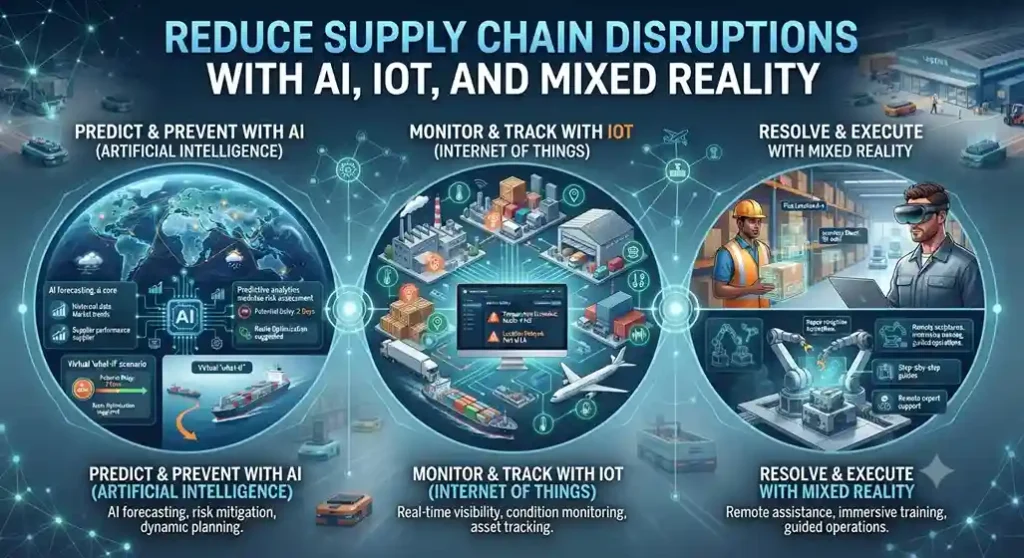
AI, IoT, and mixed reality technologies improving supply chain visibility, logistics, and warehouse operations.

Reduce supply chain disruptions with AI, IoT, and mixed reality

Reduce Supply Chain Disruptions With AI, IoT, and Mixed Reality Supply chains built on single suppliers and single locations don’t survive contact with real-world disruption — port closures, geopolitical trade shifts, or a single supplier’s factory going offline can stall production for weeks. [Flag: insert a recent disruption stat relevant to your audience’s industry — e.g., percentage of manufacturers reporting supplier delays in the past 12 months.] The response isn’t more inventory sitting idle; it’s a supply chain that senses problems early and reconfigures itself before they cascade. That’s the shift Dynamics 365 Supply Chain Management is built around — replacing static, just-in-time planning with predictive, adaptive planning powered by AI, IoT, and mixed reality across production, inventory, and warehouse operations. From “Just-in-Time” to “Just-in-Case” Planning The single-supplier, single-location model was optimized for cost, not resilience. When one link breaks, the entire chain stops. Manufacturers are now deliberately building in redundancy — multiple suppliers and locations for mission-critical parts — even where it costs more, because the cost of a stalled production line consistently outweighs the premium paid for supply flexibility. This shift also demands shorter production runs. Factories need to serve a wider range of products in smaller batches, with lower changeover time between runs. That requires planning systems that recalculate in near real time as demand shifts, not systems that lock in a monthly production plan and treat disruption as an exception to manage manually. Predictive Planning Instead of Reactive Firefighting D365 Supply Chain Management applies AI-driven demand forecasting across planning, production, inventory, warehouse, and transportation management — so a shift in demand or a supplier delay triggers a re-plan before it becomes a stockout. IoT sensor data from equipment feeds directly into this loop, flagging machine performance drift or maintenance needs before a breakdown takes a production line offline unexpectedly. For manufacturers running multi-location operations across India, UAE, or East Africa, this matters more than it might in a single-plant setup — a delay at one facility needs to trigger an automatic reallocation check against inventory and capacity at other sites, not a phone call three days later. Cut Training Time With Mixed Reality Guidance One of the more underused levers in supply chain resilience is workforce agility — how fast you can get a new or reassigned worker productive on unfamiliar equipment. D365 Supply Chain Management integrates with Dynamics 365 Guides, delivering step-by-step, hands-free instructions through a HoloLens device, walking workers through exactly which tool and part to use at each step of a task. This does two things for resilience specifically. First, it makes equipment maintenance skillset-agnostic — you’re no longer waiting on one specialist who knows a particular machine, because any trained worker can follow the holographic guide. Second, it shortens the ramp-up time when you need to redeploy staff to a different line or location during a disruption, which is exactly when you can’t afford a multi-week training cycle. Guides are authored without code — someone writes the instructions and places holographic markers directly on the machine where the work happens, which means your own team can build and update guides as processes change, not wait on an external developer. What This Means for Your Operation Resilience isn’t a single feature — it’s the combination of predictive planning that reduces reaction time, IoT visibility that catches problems before they cause downtime, and a workforce that can be redeployed without retraining bottlenecks. Manufacturers evaluating this shift should look specifically at how their current ERP handles multi-location inventory visibility and whether production re-planning happens in real time or requires manual intervention. [Flag: insert a client example or case study reference here if available — a specific implementation outcome carries more weight than a general capability claim.] Considering a resilience-focused upgrade to your supply chain platform? Talk to Trident’s Dynamics 365 Supply Chain Management team about what a multi-location, AI-driven planning setup looks like for your operation.

Reduce supply chain disruptions with AI, IoT, and mixed reality Read More »

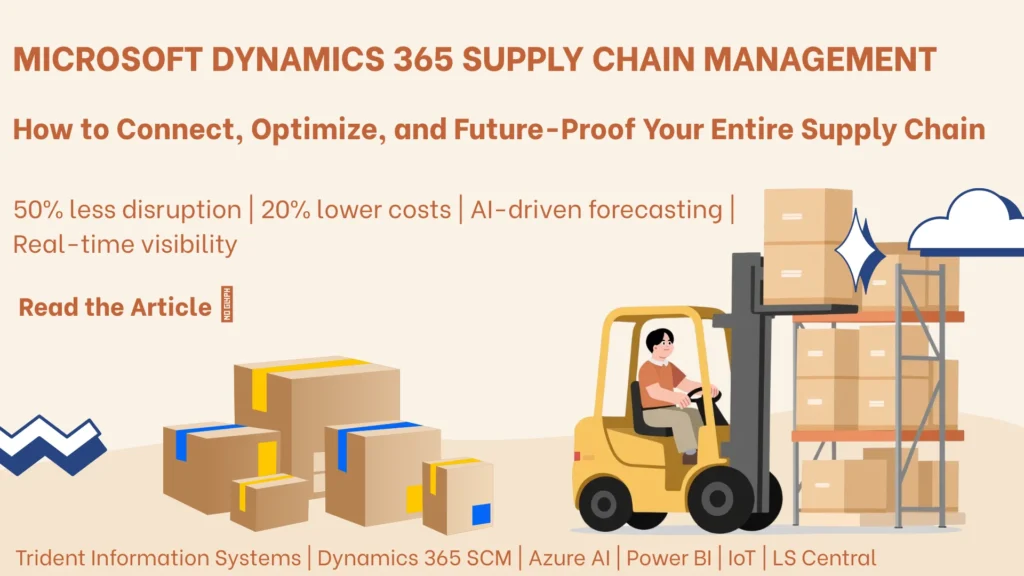
Microsoft Dynamics 365 Supply Chain Management dashboard tracking inventory, logistics, and operations.

Microsoft Dynamics 365 Supply Chain Management: How to Connect, Optimize, and Future-Proof Your Entire Supply Chain

Think about how your supply chain works today. Raw materials arrive — hopefully on time, hopefully in the right quantities. Production is planned — hopefully matching actual demand. Finished goods move to warehouses — hopefully with accurate inventory records. Orders are fulfilled and delivered — hopefully within the window your customers expect. The problem with a supply chain built on “hopefully” is that it becomes visible in the worst possible moments: the stockout that loses you a major order, the warehouse error that sends the wrong product to the wrong customer, the demand spike that catches you under-prepared, or the supplier failure that creates a production shutdown nobody saw coming. Microsoft Dynamics 365 Supply Chain Management replaces “hopefully” with certainty — connecting every function in your supply chain on a single intelligent platform, powered by real-time data, AI-driven forecasting, and automated processes that respond to change faster than any manual system can. From inventory management and demand forecasting through warehouse operations, transportation, procurement, and quality control — Dynamics 365 Supply Chain Management gives organizations the unified visibility and operational control to run a supply chain that is not just efficient today, but resilient and adaptable for whatever tomorrow brings. This guide covers the full scope of what Dynamics 365 Supply Chain Management delivers — the core capabilities, the business benefits, and how Trident Information Systems implements it for organizations across India. What Is Supply Chain Management and Why Does It Need Modernizing? Supply chain management encompasses every process involved in getting a product from raw material to customer — procurement, production planning, inventory management, warehousing, transportation, and order fulfilment. When these processes work together seamlessly, organizations can deliver products faster, at lower cost, with higher quality and greater customer satisfaction. When they do not — when each function operates on its own system, its own data, and its own timeline — the gaps between functions become the primary source of supply chain cost, delay, and risk. The Real Cost of an Outdated Supply Chain in 2026 Supply chain inefficiency is not abstract. It shows up in measurable, bottom-line costs that compound over time: Post-pandemic supply chain disruption has made these vulnerabilities more visible and more costly than ever before. Organizations that invested in supply chain technology before the disruptions were significantly better positioned to adapt — and those that did not are catching up under pressure. What a Modern, Connected Supply Chain Actually Looks Like A modern supply chain does not just move goods from A to B more efficiently. It anticipates, adapts, and learns. It uses AI to predict demand before it becomes obvious. It uses IoT to monitor assets and inventory in real time. It uses automation to execute routine decisions instantly, freeing human judgment for the decisions that actually require it. Microsoft Dynamics 365 Supply Chain Management is the platform that makes this possible — connecting every supply chain function on a single system, with real-time data and embedded intelligence that transforms reactive operations into proactive, resilient ones. How Microsoft Dynamics 365 Supply Chain Management Works A Single Platform Connecting Every Supply Chain Function The foundational design principle of Dynamics 365 Supply Chain Management is unification. Rather than operating inventory management, warehouse management, transportation, and procurement on separate systems that exchange data through scheduled integrations — Dynamics 365 connects all of these functions on a single platform and a single data model. This means: When every function operates from the same data, the decisions made in each function are automatically informed by the context of every other function. That alignment — which manual systems and siloed applications can never reliably achieve — is the foundation of supply chain competitive advantage. Built on Microsoft Azure: Cloud-Native Supply Chain Intelligence Microsoft Dynamics 365 Supply Chain Management is built on Microsoft Azure — providing the cloud infrastructure, data processing, and AI capabilities that modern supply chain intelligence requires: Core Capabilities of Microsoft Dynamics 365 Supply Chain Management 1. Intelligent Inventory Management Inventory management is the function where supply chain technology delivers some of its most immediate and visible business impact — because inventory is both a major cost driver and a direct enabler of customer satisfaction. Microsoft Dynamics 365 Supply Chain Management transforms inventory management from a reactive, manual process into an intelligent, automated one: The business impact of intelligent inventory management is direct and measurable: lower safety stock requirements, fewer stockouts, reduced carrying costs, and better cash flow — all without sacrificing service levels. 2. Advanced Warehouse Management Your warehouse is the operational heartbeat of your supply chain — and how efficiently it operates directly determines your ability to fulfil orders accurately, quickly, and cost-effectively. Microsoft Dynamics 365 Supply Chain Management includes a comprehensive advanced warehouse management system (WMS) that gives operations teams the tools to optimize every movement of goods through the facility: 3. End-to-End Tracking and Traceability In industries where product quality, safety, and regulatory compliance are critical — pharmaceuticals, food and beverage, medical devices, chemicals, electronics — the ability to trace every product through every stage of the supply chain is not a nice-to-have. It is a legal and commercial requirement. Microsoft Dynamics 365 Supply Chain Management provides comprehensive end-to-end tracking and traceability: 4. AI-Powered Demand Forecasting The most expensive supply chain decisions are made in response to demand — how much to produce, how much to stock, what to order from suppliers. When those decisions are based on accurate demand forecasts, costs are minimized and service levels are maximized. When they are based on inaccurate forecasts or gut instinct, the result is either costly overstock or damaging stockouts. Microsoft Dynamics 365 Supply Chain Management integrates with Azure Machine Learning to deliver AI-powered demand forecasting that goes far beyond traditional historical averaging: The business impact of accurate demand forecasting compounds across the supply chain: lower safety stock requirements, better supplier order timing, more efficient production scheduling, and higher service levels — all simultaneously. 5. Warehouse and Material Handling Automation As warehouse operations scale, the efficiency

Microsoft Dynamics 365 Supply Chain Management: How to Connect, Optimize, and Future-Proof Your Entire Supply Chain Read More »

Benefits of Dynamics 365 Finance and Supply for your Business

As you may already know, D365 AX Support for Dynamics AX 2012 and Dynamics AX R2 will no longer be available after April 12, 2022. Hence, obligating businesses to upgrade their Microsoft AX to D365 For Finance & Operation (which is also known as D365 Finance and Supply Chain Management).   Furthermore, D365 Finance and Supply Chain possess every feature and functionality that Microsoft Dynamics AX has to offer, builds upon them, and transforms into a full-fledged platform a 21st-century business need.  Dynamics AX on the other hand will soon terminate Dynamics AX Support while leaving you on your own.  While Dynamics AX is merely a desktop-based application with massive infrastructure footprints, D365 Finance and Supply Chain is a comprehensive web and cloud-based software that the user can access from anywhere on different devices whenever they want.   There is a lot of D365 For Finance & Operation has to offer, such as an Advanced user-friendly interface, web-based login, Free updates, additional integrations, better quality service, better Excel integration, LinkedIn integration, and so on.   This version has a lot to offer a business such as:   Integrations  These integrations are highly impactful for a business to understand its current situation better and project prospects. D365 Finance and Supply Chain endorses a very tight integration to Dynamics 365 products like Marketing, Sales, Service, Office, Excel, and a lot more. Via these integrations, the user can access end-to-end data in a single platform and unlock information from various sources.   Updates  As D365 For Finance & Operations is a Cloud-based system, Microsoft frequently schedules its updates and major updates twice a year, hence the user does not have to worry about being on the latest version as the update is done automatically. All you have to do is accept them and off you go.   Flexibility   Dynamics 365 Finance and Operations provides more flexibility which lets the user save money on licensing and user. Workspaces have now replaced Role Centers while allowing multiple Dynamics 365 features to be used simultaneously through tailored dashboards. The workspace makes things simpler for the user while making inexperienced users more productive.   Power BI   This is certainly one of the major additions made in D365 Finance and Supply Chain. With Power BI the user can create insightful reports inD365 interface. They can unlock and leverage crucial information and create reports instantly.   Search Capabilities   In addition, the search capabilities in the system have become even more robust while making it simpler to find needed data no matter where it is stored in the system. The strong integration to Excel enables bi-directional data importing and exporting to D365 Finance and Supply Chain Management to Excel.   Custom Extensions   This is one of the new tools. It enables product extension by constructing solutions on D365 without impacting the core coding of the application. This means adding the functionality is easier and will not harm any future upgrades.   What can D365 Finance and Supply Chain do For Your Business?  It improves financial performance by obtaining new business opportunities through centralized management and in-built analytics.   Helps meet regulations in different countries by having country-specific localizations in a single system.   Helps make smart, proactive decisions via target systems, and circumcised information, tasks, and insights relevant to certain jobs.   It adapts to systems while fulfilling unique business requirements with its expansion.   Upgrades to new releases are like a piece of cake.   Accelerates and simplifies deployment with instant-on capabilities.   Tracks assets efficiently.   Robust logistics management helps optimize goods and material flow.   Diminishes reporting errors and automates where necessary.   Gives valuable insights into every area of the supply chain through predictive analysis and Data Collection.   Improves product quality with valuable insights to resolve issues early.   Gets access to other D365 applications like Office 365, SharePoint, etc.   Supply chain automation cuts procurement costs.  Helps a business grow with D365 For Finance & Operation robust omnichannel solution.   It has an on going support system unlike Dynamics AX Support.  Bottom Line    Dynamics 365 F&O comprises all the core data and processes under the same roof while making it easier for a business to provide visibility, standardize operations and simplify compliance. The end of D365 AX Support for Dynamics AX 2012 and Dynamics AX R2 in April 2022 is the major reason businesses need to upgrade their Dynamics AX to D365 For Finance & Operation. If you are also looking forward to the upgrade and a suitable implementation partner, you may contact Trident Information Systems who has been serving businesses for more than two decades. We have a strong record of accomplishment and a massive technical team to take care of every forthcoming business aspect. Contact us for further information.  

Benefits of Dynamics 365 Finance and Supply for your Business Read More »

How ERP Combats Short Labor Supply in Warehouses?

Call it labor shortage, exploding demands, or both, manufacturers face tumultuous stress in 2020. As factories, warehouses, and markets open, the shortage of labor is not going anywhere. As of June 2021, US Bureau of Labor Statistics data, manufacturing added up to 15,000 jobs, but employment is still down by 481,000 from the February 2020 count. Warehousing added 11,000 new jobs. However, the number is still down to 94,000 over the same period.   There are various factors driving labor shortage. Labors might leave one job for another in search of better facilities, salary, flexible working hours, and so on. Therefore, it becomes crucial to retain your existing staff.   Ensure hygiene and employee safety at your warehouse.   Establish ergonomic workstations and equipment.   Allow flexible work schedules.   Enable ongoing training support.   Equip your staff enough to handle multiple jobs.  Be receptive to your employee’s opinions.  No matter what factors are driving labor shortages, the manufacturers have to be more creative when it comes to dealing with labor. One of the best ways to deal with the labor shortage is to adopt an end-to-end ERP.   How ERP Combats Labor Shortage in Warehouses?  Digital transformation comprises all the strategies and methods that ensure optimum labor utilization. Bring a new life to your shop floor and transform your organization for the better. Apart from this, you can make complete use of your shop floor.   Centralizes Control  Keep tabs on all the warehouses from a single vision of reality. Turn big data into insightful dashboards. Identify insufficient processes and embrace growth opportunities. Generate more time and save finances with organization-wide visibility highlighting every growth-oriented opportunity. Have the comprehensive big data report at hand and build more effective processes or relocate your existing staff accordingly. Browse through current demands and available inventory and make effective strategies. Have improved communication and collaboration from top to bottom.   Automate Operations  ERP doubled with robotics automates manual and recurring tasks. It enables accelerated operations and more accuracy while helping you deliver the right services on time to your customers. Your plant and other stimulating areas get safer. While ERP focuses on the supply chain, other workers can focus on more creative or innovative tasks of the organization. With an end-to-end ERP, you can manage your back office with minimum staff working on it. Let the technology make floor plans for you so you can store your products in the most suitable locations within the warehouse.   Unifies Different Business Modules  ERP or Enterprise Resource Planning integrates and automates cynical business factors within the same technological environment, such as manufacturing, finance, inventory and order management, customer, communication, sales and marketing, project management, and human resource. You no longer need to hire multiple people to engage in these sections, the technology does the work for you. You need minimum staff with data unification.  Inventory Tracking   ERP delivers real-time inventory management. From the moment it enters the warehouse till the time it is dispatched. Some ERP service providers like Microsoft D365 enable tracking via mobile phones and other devices of your choice. It ensures inventory tracking anytime without having anyone else collecting and sharing the reports. Discard expired products and keep tabs on inventory that has already been dispatched. Make sure you never run out-of-stock and optimally locate the product within the warehouse.   Innovative Technology  Robotics helps fill labor gaps and increase productivity. As soon as you integrate robots with equipment, the staff starts getting more familiar with their uses. Some end-to-end ERP solution providers, such as Microsoft Dynamics 365, include advanced business intelligence and data analysis that transforms big data into visually actionable dashboards. Many researches conducted has shown that workers perform their tasks better with innovative technologies. The output rises as they start enjoying their jobs. A little creativity does the trick.   Better Transparency  With the advent of social media, millennials, and their younger subordinates extortionate sharing their ideas in the workplace. Microsoft Dynamics 365 fuels enterprise-extensive transparency and collaboration to meet this standard. Microsoft Dynamics 365 integrates different modules within a single system and enables organizational data through intuitive and sharp dashboards, promoting unparalleled visibility. Moreover, it has a unified platform called MS Teams, which connects employees with one another. Irrespective of their position, they can tap into a free flow of communication instantly. For instance, Warehouse staff can quickly communicate to the inventory manager about stocking-in or discarding certain products.   Final Words   The labor shortage is a worldwide issue. As soon as markets opened, the labor shortage caused grave pain. An end-to-end ERP solution can help businesses deal better with enabling centralized control, operation automation, multiple module integration, and so on. Trident Information Systems is a Gold Microsoft Partner that has served various businesses so far. Reinforced with over two decades of experience and a 150+ skillful team, Trident has accomplished a solid track record. For further queries or a demonstration, contact us.   

How ERP Combats Short Labor Supply in Warehouses? Read More »