Welcome to Trident Information Systems!
Write us to - info@tridentinfo.com
Let's Socialize

crm implementation partner

THE TOP 10 REASONS WHY SMBs SHOULD INVEST IN THE CLOUD

Small to medium-sized businesses (SMBs) are lagging behind their enterprise counterparts when it comes to cloud adoption. With the new year (and new decade) fast underway, a recent Microsoft study showed that more than 96% of enterprises are using the cloud, compared to only 78% for SMBs. And while the use of cloud-based productivity apps like Office 365 has steadily grown among these smaller companies, their continued reliance on legacy software in key business applications such as ERP or accounting is impeding them from competing effectively with today’s top players. Given this situation, moving to the cloud should be an obvious priority for SMBs, but many myths and misconceptions still exist regarding the benefits of cloud technology. Below are the ten most crucial and game-changing benefits that SMBs have reported after investing in cloud solutions. 1 –  Greater profit and ROI Simply put, companies that move to the cloud make more money. And not by a small percentage, either. SMBs that invest in the cloud report up to 25% growth in revenue and up to 2x the profits over those who don’t. Embracing the cloud is simply a better path to faster growth. Additionally, cloud deployments provide a greater return on investment (ROI) than traditional on-premises software projects, especially in ERP and CRM. For example, Nucleus Research determined that companies that use Microsoft Dynamics 365 see a return of $16.97 for every $1 spent. That’s well above the average for on-premise ERP and CRM applications. 2 – Lower costs and CapEx Cloud subscription models eliminate up-front capital expenditures (CapEx) like the high cost of hardware and software licenses for projects like ERP software implementations. They also eliminate server and infrastructure setup, update, and maintenance fees—not to mention the resources saved on software upgrades, energy costs, and underutilized computing resources 3 – Unparalleled business flexibility Cloud software allows small businesses to remain always-on regardless of location. In today’s mobile and cloud-first world, the ability to be productive on any phone, tablet, or laptop provides the flexibility required to quickly adapt to changing information and business needs. This means more agile operations and happier customers 4 – Faster IT innovation The hassle and cost of routine IT maintenance tasks can be effectively offloaded to the cloud, enabling IT resources to focus on more strategic tasks like addressing problems, improving user experiences, fostering user adoption and best practices, and getting more value out of systems and processes 5 – Seamless, automatic software updates With cloud computing, all software updates are handled automatically, so critical systems always have the latest functionality and security features. This effectively ensures that all the benefits of a vendor’s ongoing R&D nvestments are transferred to their customer’s business, without that business having to dedicate any time or additional resources 6 – Cost-effective scalability SMBs need increased flexibility to grow and scale without hassle. With the cloud, as an SMB adds users, generates more transactions, or adds more data, services dynamically scale to manage the workload. This eliminates the need to pay for more hardware or maintenance to support business growth. As a bonus, SMBs only use the energy they need for their cloud apps. Since servers aren’t running idle waiting to be utilized, operations become more energy efficient, reducing the carbon footprint of the business. 7 – Improved collaboration and productivity Digital, cloud-based workspaces offer the opportunity to collaborate more effectively and remove data silos to enable greater employee productivity. Additionally, cloud-based office productivity suites and all-in-one business management solutions possess integration capabilities that simply can’t be matched by on-premises software. Cloud computing also allows teams to be productive, regardless of their location. This enables businesses to offer flexible working arrangements that create a healthier work/life balance and happier employees without sacrificing productivity. 8 – Seamless software integration Cloud applications are typically compatible with Application Programming Interfaces (APIs) that simplify integration, while automation tools like Microsoft Flow facilitate stitching them together without any custom code. Data and systems can be connected like never before, resulting in new levels of speed and efficiency. 9 – Superior security and data protection Small businesses are the most common victims of security breaches. In a recent study by ComScore, over 40% of small businesses were worried about data security before moving to the cloud. After making the switch, 94% of businesses reported security benefits they had been unable to achieve with their previous on-premises resources. Furthermore, physical hardware protection has always been a challenge for SMBs. Laptops get lost or stolen all the time. In addition to the replacement costs, there is the even greater cost of losing important or sensitive data. When storing and backing up data in the cloud, however, data is available and protected regardless of what happens to personal devices. 10 – Increased competitiveness Moving to the cloud gives SMBs access to enterprise-class technologies that were previously only available to the industry’s top players. With the cloud, any business can run on the exact same systems used by the largest, most sophisticated companies in the world, enabling them to innovate and act faster than competitors that manage on-premises legacy systems. In conclusion, with cloud software now available that is purpose-built for SMBs to run their sales, marketing, service, accounting, operations, supply chain, and project management activities—all from a single, connected solution infused with AI and advanced analytics—there’s never been a better time for small and medium-sized businesses to make the move to the cloud. Connect with our cloud expert for any query or requirement at –  info@tridentinfo.com

THE TOP 10 REASONS WHY SMBs SHOULD INVEST IN THE CLOUD Read More »

New AI features connect and extend insights across the organization

Today we’re unveiling new and enhanced artificial intelligence (AI) capabilities across Dynamics 365 applications, as well as a new solution to help project-centric services organizations transform their operations. Joining more than 400 new and updated features in the 2020 wave 1 release, these new capabilities expand a fast-growing set of applications powered by AI-driven insights, and further propel our vision to empower every organization to unify data across the business and use it to power personalized customer experiences and processes. Personalize customer experiences with unified data and unmatched time to insight Customers expect personalized and consistent experiences across every touchpoint. Many organizations, however, struggle to modernize the customer experience, often due to disconnected systems and data siloes that can’t deliver the full picture of the customer’s journey across websites, purchases, service calls, and mobile apps. Updates to Microsoft Dynamics 365 Customer Insights, Microsoft’s customer data platform (CDP), will help solve these issues. We’re introducing new first and third-party data connections to further enrich customer profiles that can be updated and activated in real-time, as well as enabling deeper insights with Microsoft Azure Synapse Analytics. Customer Insights will now uniquely enrich profiles with a combination of proprietary audience intelligence and 3rd party data sources such as demographics and interests, firmographics, market trends, and product and service usage data. Customers can also integrate Microsoft Forms Pro, the simple, powerful enterprise survey solution, to bring in the valuable voice of the customer across channels, allowing organizations to act on insights based on changing customer behavior and perception. All of this comes together to create a holistic, 360-degree view of a customer and to update those customer profiles and activities in real-time enabling organizations to know their customers and improve engagement. Customer Insights is built on a powerful and flexible platform that enables full extensibility. Organizations can derive deeper insights by using Azure Synapse Analytics, which combines customer data with enterprise and streaming data to improve data completeness, run high-speed analytical processing, and build custom machine learning models. This allows organizations to predict customer needs with insights and get guidance on the next best action to reduce churn and capitalize on revenue opportunities for the lifetime of a customer relationship. Organizations can act upon these insights in real-time across multiple destinations through prebuilt APIs to enable onsite clienteling, website personalization, dynamic marketing campaigns, and effective ad targeting. As part of the wave 1 release, we’re expanding the availability of Customer Insights to government cloud computing (GCC) environments helping to improve the citizen experiences essential to modern government. This means our government and public customers with higher compliance needs can now leverage Customer Insights to better understand and interact with citizens, empower employees, and transform cities at scale. Automate sales forecasting with predictive analytics In addition to expanded AI capabilities on our customer data platform, we’re extending the ability for sales professionals to forecast sales more accurately and introducing a new, unified engagement center for inside sales representatives. Available now for Dynamics 365 Sales and for Dynamics 365 Sales Insights, new manual and predictive forecasting capabilities empower sales organizations to have a better understanding of the pipeline, more accurately predict results, and gain visibility into future performance. The predictive forecasting capabilities enable the proactive decision-making needed to meet sales goals. Dynamics 365 does this by extracting patterns from customer relationship management (CRM) data, current and historical leads, won or lost opportunities, contacts, accounts, customer interactions such as emails and calls, and more data sources, and then projecting these patterns into the future. Best of all, anyone can access the insights, no data scientists or tech experts needed (a big change from some other forecasting systems). With a new engagement center designed to accelerate sales, we’re giving each inside seller a streamlined way to quickly triage, research, and engage new leads or opportunities. This provides them with their own prioritized work queue to take action on the highest priority leads and tasks based on built-in predictive scoring from Dynamics 365 Sales Insights and new, configurable sales cadences. The experience helps sellers stay in the context of Dynamics 365 and quickly move from one lead or opportunity to the next in an AI-prioritized work queue, without needing to switch views to take the next best action. Additional embedded AI capabilities offer sellers a path to a warm introduction, and guidance from the assistant. Transform the back office with AI-infused finance insights Not only are we expanding AI capabilities for customer and sales insights, we’re also bringing the power of AI to the finance department. Microsoft Dynamics 365 Finance Insights, coming to preview in May, accelerates your digital transformation by bringing the power of AI into your finance processes. As organizations look to make decisions rapidly, reduce risk, and focus on strategic initiatives, it’s critical to free finance from repetitive, time consuming and low value daily activities. Leveraging the power of AI, Finance Insights enables you to not only quickly understand and act on your company’s cash position, but also to take proactive action to improve it. Menial tasks are automated or removed, the barrier of developing or hiring AI-expertise is bypassed, and you’re left with insights to move your business forward. Our continued investment in expanding AI capabilities across Dynamics 365 helps your organization accelerate digital transformation initiatives while empowering employees with insights to drive better business outcomes every day. Optimize project success and profitability with the ability to drive operational excellence across service-centric organizations How people work today has changed, as has the way organizations run their business operations. Companies across all industries are innovating business models to support project-centric service offerings. And while business optimization has gotten easier with the rise of mobile and cloud technology, organizations continue to stitch together systems and struggle with managing data across disparate systems. These data silos within project-centric businesses and teams are negatively impacting business model transformation, customer acquisition, employee retention, project delivery, and business profitability. Today we’re announcing a new Dynamics 365 application that connects cross-functional project teams, providing the visibility, collaboration, and insight needed to drive the success of project-centric organizations. Microsoft Dynamics 365 Project Operations, which will be generally available on October 1,

New AI features connect and extend insights across the organization Read More »

Business team using CRM software to manage sales, customer data, and communication workflows.

5 Clear Signs Your Business Needs CRM Software in 2026

Here is a question most business owners ask too late: at what point does managing customer relationships in spreadsheets, email inboxes, and memory become a liability rather than a system? The honest answer is — sooner than you think. Customer Relationship Management (CRM) software is not just for large enterprises with complex sales teams. It is for any business that wants to grow its customer base, retain the customers it already has, and make sure no opportunity falls through the cracks. The challenge is recognising when the moment has arrived. Here are five clear signs that your business needs CRM software — and why Microsoft Dynamics 365 is the platform most businesses choose. What Is CRM Software and Why Does It Matter? CRM software is a centralised system that manages every interaction between your business and your customers — from the first marketing touchpoint through the sales cycle, the initial purchase, ongoing service, and renewal. Done well, CRM gives every team member a complete, real-time picture of every customer relationship. Sales knows what marketing has sent. Customer service knows what sales has promised. Management knows exactly where every opportunity stands. Without CRM, this information lives in individual inboxes, personal spreadsheets, and people’s heads — and every time someone leaves the business, some of that knowledge leaves with them. 5 Signs Your Business Needs CRM Software Now Sign 1 — You Are Losing Leads Without Knowing Why Leads come in through your website, social media, phone calls, and referrals. But if you are managing them manually, some of those leads are simply not being followed up — because they were logged in the wrong place, assigned to the wrong person, or forgotten during a busy week. A CRM captures every lead automatically, assigns it to the right team member, sets follow-up reminders, and tracks every interaction. Nothing gets lost. Every opportunity gets the attention it deserves. If you have ever discovered a warm lead that was never followed up weeks after it arrived — your business needs CRM. Sign 2 — Your Marketing and Sales Teams Work in Silos Marketing generates leads. Sales closes deals. But when these two teams work from different systems and different data, the handoff between them is where opportunities die. Marketing does not know which leads converted. Sales does not know which campaigns generated their best prospects. Neither team can make decisions based on the complete picture — because that picture does not exist in any single place. CRM creates a shared view of every customer and every lead — so marketing can see which campaigns produce sales-ready prospects and sales can engage leads with full context on their marketing journey. The result is better targeting, higher conversion rates, and a measurable improvement in revenue. If your marketing and sales teams regularly blame each other for pipeline problems — your business needs CRM. Sign 3 — You Cannot Easily Create Quotes and Track Invoices For businesses that sell through a quotation process — professional services, manufacturing, technology, or any B2B operation — the ability to create, track, and follow up on quotes directly impacts how quickly deals close. A CRM with a built-in quoting and invoicing module connects the entire opportunity-to-cash process: If your team is manually creating quotes in Word documents and tracking them in a spreadsheet — your business needs CRM. Sign 4 — Customer Service Issues Are Falling Through the Gaps Customer service quality is directly tied to information quality. When a customer calls with a problem, the speed and accuracy of the resolution depends on whether your team can instantly see their complete history — what they bought, when, what issues they have had before, and what was promised. Without CRM, this information is scattered across email threads, support tickets, and different team members’ notes. The customer ends up repeating themselves. Issues take longer to resolve. Satisfaction drops. CRM centralises customer service management: If customers regularly complain about having to repeat their issue to multiple people — your business needs CRM. Sign 5 — You Cannot See How Your Business Is Really Performing Good management decisions are built on good data. But if your sales pipeline lives in a spreadsheet, your customer data is in email, and your service records are in a helpdesk tool — getting a clear, current picture of business performance requires manual compilation that takes hours and is outdated the moment it is finished. CRM provides real-time dashboards and reports that give every level of the organisation instant visibility: If your management team regularly makes decisions based on instinct because the data is too hard to access quickly — your business needs CRM. Why Microsoft Dynamics 365 CRM Microsoft Dynamics 365 is one of the world’s most widely adopted CRM platforms — and for good reason. It covers every scenario described above in a single, unified platform: lead management, marketing automation, sales pipeline, quoting and invoicing, customer service, and real-time analytics — all connected on the same data model. Key advantages over standalone CRM tools: Why Trident Is India’s Trusted Dynamics 365 CRM Partner As a certified Microsoft Dynamics 365 partner, Trident Information Systems has helped businesses across sales, marketing, manufacturing, retail, and professional services in India implement CRM solutions that close the gaps described in this article. Our CRM implementations are configured around your specific sales process and customer management requirements — not a generic template. Ready to find out how CRM software can transform your customer relationships? Book a free Dynamics 365 CRM assessment with Trident today. For more insightful content and industry updates, follow our LinkedIn page.

5 Clear Signs Your Business Needs CRM Software in 2026 Read More »

Redefining shopping excellence with an unified E-commerce solution

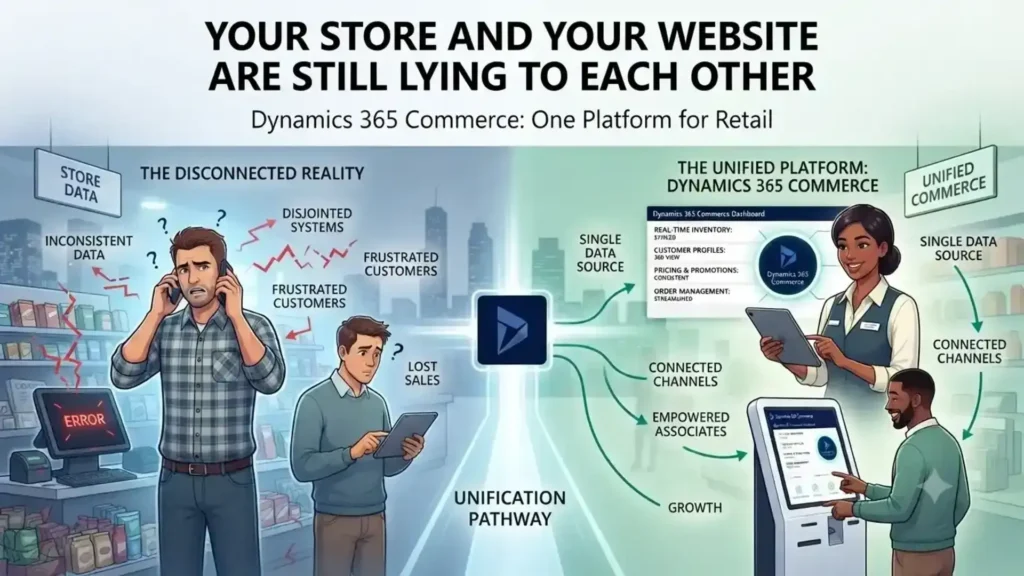
[vc_row][vc_column][vc_column_text]Over the last decade, the retail sector has experienced enormous change and transition. Many have suggested that conventional brick and mortar retail is dying and that for the everyday needs, consumers switch entirely to online platforms. However, this is not the case. As per a survey from the National Retail Federation, since 2010 retail storefronts in the US have continued to expand at approximately 4 percent annually along with the consistent double-digit growth of online shopping. Almost all of the top 50 online retailers have brick and mortar stores, as well. Although progress in e-commerce tends to outpace physical stores, the rate of progress in physical retail outlets is still much higher. E-commerce is also not a stand-alone medium in most cases but used in combination with conventional and new platforms to meet consumer needs such as buying online pick up in-store or Click and Collect. Physical outlets are still a big part of consumer spending patterns, but with this, we also have seen that consumer priorities have changed around shopping. Trident is offering Retail ERP Software for an outstanding commerce experience that helps in gaining maximum profits. Gone are the days when store employees are the only experts in information about goods. Consumers already have greater access to product details, price clarity, and accessibility. This means that retailers have to look at customer engagement across all platforms to make sure that their enterprise is capable of delivering on these recent high requirements. E-commerce will no longer be a major differentiator for retailers in the next few years, but will instead allow integrated retail trade to compete in the ever more challenging customer needs worldwide. So Trident ( dynamics 365 partner) & solution dynamics 365 for marketing not confined to e-commerce, but aims to streamline the process of unifying consumer shopping experiences through an end-to-end business framework that puts together e-commerce, in-store, back office, and call centre. Let’s discuss furthermore how Dynamics 365 for marketing solution helps retailers meet those dominant business requirements. 1)- Grant Excellent and Customized Consumer Experience Consumer experience is not only one of the top growth factors in the retail sector, but according to the recent survey by Microsoft and Forbes, 33 percent of retail managers are also considered a great business priority. The main task is to identify what constitutes outstanding customer experience for each individual business, as expectations of customers differ by micro-vertical retail, product category, and consumers themselves. It is up to the retailers to better define how their marketing commitment aligns with the experience. When customer experience is established, retailers need to be able to deliver on this commitment by providing technology that allows customer engagement in the next generation and does not limit their ability to evolve and build differentiating consumer experience. As per the report by Microsoft and Forbes, providing customized shopping has become increasingly popular and over 49 percent of customers aged between 18 and 24 stating they are more likely to purchase from retailers offering custom shopping experiences. The aim of personalization is to form a bond between both the retailer and the consumer by delivering goods and/or services across all retail channels based on past interactions. It enhances the relationship to an encounter more similar to an interaction with a trustworthy friend or partner than a simple transaction. There is a significant technological dependence to reach this next stage of customization. Networked and real-time visibility into consumers and activities are needed by retailers. Dynamics 365 put together all facets of customer interaction through e-commerce, call centre and in-store as well as simple incorporation into new channels to enable retailers to gain a holistic customer perspective. Couple this with out-of-the-box integration with Dynamics 365 Consumer insights and retailers can not only deliver AI-driven suggestions based on customer shopping history, likes, and patterns but also provide store agents with tools for presenting the customer’s 360-degree view and facilitating rich interaction throughout the selling journey.  2) Omni Channel Experience    Nowadays Customers expect to be able to purchase anywhere they want, and by whatever platform. Retailers also acknowledge the importance of Omni channel as one of their top three priorities, with 47 percent of Microsoft and Forbes survey executives rating this. Most retailers are still struggling in having an Omni channel experience because of the complexity of internal infrastructure and disconnected or fragmented systems. Trident’s Dynamics 365 NAV makes it much easier to offer a native Omni channel solution for retailers, as it was built in the cloud. 3) Flexibility An integrated solution is important not just for customers to engage and shop in retail, but also for how a unified solution can allow first-line employees to take part better and make sure ideal operational efficiencies across your supply chain. Dynamics 365 for marketing offers retailers the ability to streamline their operations with enriched knowledge that characterizes their business. Employees at the store can gain greater information and insight into stock availability, cross-application support for task management, as well as trade analytics that enable managers to monitor performance and insights to help them make informed decisions.[/vc_column_text][/vc_column][/vc_row]

Redefining shopping excellence with an unified E-commerce solution Read More »

What Considerations Should be taken into Account when Implementing the New ERP for Food Manufacturing?

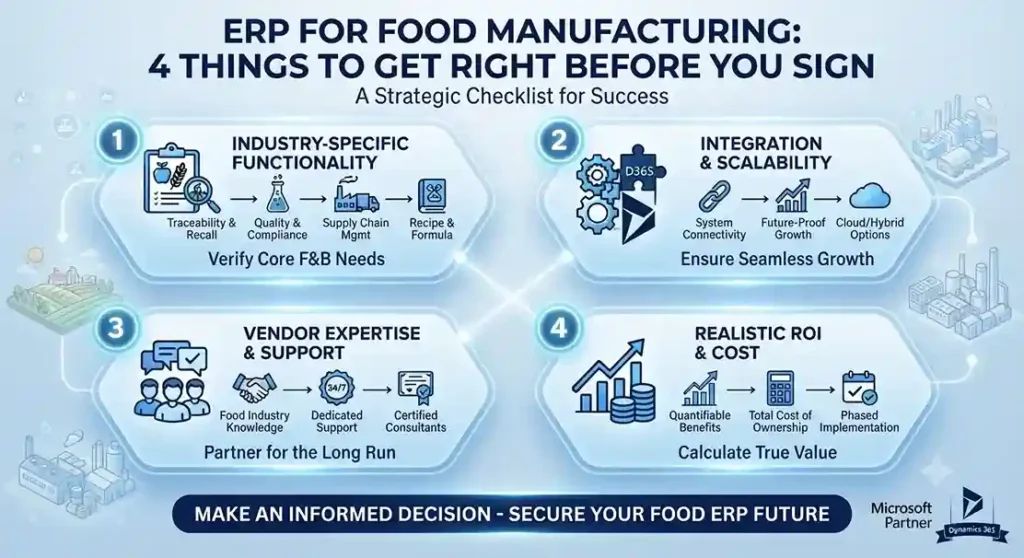
[vc_row][vc_column][vc_column_text]Usually, the decision-making process for ERP for Food Manufacturing is long and complex. From deciding which functionality is most vital to your business, to choosing a system that will make rapid and meaningful changes, it may seem daunting to decide on the appropriate ERP solution for your organization. But don’t worry, Microsoft gold partner Trident got you covered. As we have 20+ years’ experience and  implemented ERP food manufacturing various satisfied customers like Haldirams, Nik Bakers, etc. Through sharing tips on how to pick and incorporate the right food production ERP solution for your food company, we will make the decision-making process of implementing an appropriate ERP for food manufacturing a bit easier for your organization. 1) – Food Specific Approaches Tons of ERPs and business solutions are available to choose from. But as a food manufacturer or supplier, you should understand that it is complex to manage a food business effectively and comes with its own set of unique complexities. Many of the integrated software systems in the marketplace for small to medium-sized enterprises provide the functionality you would expect for sales, acquisitions, operations, accounting and inventory management only. But what about the extra features distinctive to food manufacturing? Once you settle on a standardized ERP solution, ask yourselves how much modification and flexibility a food-specific system will have to go into implementing the following characteristics: Food safety and compliance Manufacturing and quality Recipe development and management Food recall and trace-ability 2) – Functionality Recalling that not all food businesses run in the same manner is also relevant. A supermarket bakery operates much differently than a manufacturing frozen food, and a meat processor will have a completely different set of software specifications than a broad line dealer. So where are you going to start? Try to address the features and functions that your existing system currently lacks. Create a “wish list” of elements that would make operations run better if you had them in the spot. From there, you can filter a lot of ERP providers and can concentrate on only those solutions that are suitable for your organization. 3) –  Easy to Use Suppose: at your job you’re a warehouse worker or a machine technician. Now your management team has decided to introduce a new software platform throughout the organization, and you are responsible for learning it as soon as possible (and as precisely as possible). Too much load, right? Moving from manually managing stuff or from a legacy system to a fully integrated ERP solution can be terrifying for everyone in the company. The accounting department now needs to learn how to use a new system to enter figures and run calculations. The QA department now has a new way to set up quality controls and audits. If a new process is too complex, your staff might feel frustrated, disheartened, and underappreciated. Look for an ERP running on a system that is probably already familiar with most of your workforce (such as, for example, Microsoft Dynamics) 4) – Customer Support Working with a vendor of an ERP solution is so much more than just buying and using the product to run your business. The ERP solution is implemented, which usually takes five to nine months, and then continued support and facilities will proceed across your software’s life cycle. It is therefore essential to ensure that the ERP you choose is assisted by a team of people who are committed to ensuring that you are successful. This means for the food industry you need experts who are not only professionals in software but also food specialists. You wouldn’t recruit somebody to work in your warehouse that wasn’t a good choice, correct? Think the same way about the people who are working for your ERP provider. Because they are also responsible for your business ‘ success. It is easy to get confused as there are too many ERP for food manufacturing service providers, so remember to remain vigilant and consistent with what you want to get out of your solution. Selecting the right ERP means choosing software to help you enhance food security, simplify efficiency or productivity and handle the progress of the enterprise. If you still have any doubts left in your mind then you can contact to Trident’s ERP for food manufacturing providers on https://tridentinfo.com/contact/[/vc_column_text][/vc_column][/vc_row]

What Considerations Should be taken into Account when Implementing the New ERP for Food Manufacturing? Read More »

How to Transform Your Business Data Into Actionable Insights: A Complete BI and Analytics Guide

Your business is generating more data than ever before. The question is — are you doing anything useful with it? Most organizations today are data-rich but insight-poor. They collect vast amounts of operational, financial, and customer data across multiple systems — and then struggle to turn any of it into decisions that actually move the business forward. Reports are produced. Dashboards are built. And yet, leadership teams still find themselves making critical decisions based on gut instinct rather than verified, real-time intelligence. That is the problem that business intelligence and data analytics solutions are designed to solve. By connecting your data sources, structuring your information architecture, and surfacing insights through intuitive visualizations and predictive models, the right BI platform transforms raw data from a liability into your most powerful strategic asset. Trident’s Data Analytics Solutions — built on Microsoft Dynamics 365, Power BI, and leading cloud platforms — give organizations of every size the ability to move from basic reporting to real-time monitoring, predictive forecasting, and data-driven decision-making at every level of the business. Whether you are just beginning your analytics journey or looking to mature a complex enterprise BI environment, Trident has the expertise, tools, and methodology to take you there. Why Most Businesses Are Sitting on Data They Cannot Use The Gap Between Data Collection and Data-Driven Decision Making Data collection has never been easier. Every transaction, every customer interaction, every operational process generates a trail of structured and unstructured data. But collecting data and extracting value from it are two entirely different capabilities — and most businesses have invested heavily in the former while neglecting the latter. The result is data silos: marketing data locked in one platform, financial data in another, operational data in a legacy ERP that barely talks to anything else. Without a unified analytics layer connecting these sources, the data your business generates every day remains invisible to the people who need it most. What Actionable Business Intelligence Actually Looks Like Actionable business intelligence is not a dashboard full of numbers. It is the right insight, delivered to the right person, at the right moment — with enough context to drive a confident decision. It is a sales manager who can see which accounts are at risk of churning before they receive a cancellation notice. It is an operations director who can forecast supply chain disruption three weeks before it happens. It is a CFO who can model the financial impact of a strategic decision in real time, without waiting for the finance team to build a spreadsheet. That is what Trident’s Power BI and analytics solutions are built to deliver. Advance Your Analytics Journey With Trident Data Insights From Reporting to Monitoring: Accelerating Your Power BI Maturity Most organizations start their analytics journey at the same place — basic reporting. Someone needs a number, someone builds a report, and that report gets emailed as a PDF once a week. It works, barely, until the business grows to the point where weekly reports are too slow, too static, and too disconnected from the operational reality on the ground. Trident’s Data Analytics Solutions are designed to rapidly accelerate your organization from passive reporting to active monitoring — giving your teams live visibility into the metrics that matter, with the ability to drill down, explore trends, and act on what they find without waiting for the next report cycle. Connecting Microsoft Dynamics 365 and Legacy Systems to One Analytics Layer One of the most common Power BI challenges enterprises face is fragmented data across modern and legacy platforms. Trident’s Data Insights platform connects directly to your existing deployed applications — including Microsoft Dynamics 365 for Operations and legacy Dynamics AX 2012 — creating a single, unified source of truth for all your analytical data. Historical trending — understand how your business has performed over time Drill-down reporting — move from high-level KPIs to granular transaction-level detail in seconds Operational and financial insights — unified visibility across every function of the business Single source of truth — eliminate conflicting data versions across departments Our Business Intelligence and Analytics Service Offerings Trident offers a comprehensive suite of Power BI and data analytics services — from initial strategy and maturity assessment through to full platform implementation, visualization development, and ongoing analytics optimization. Business Strategy and Enterprise Metrics Before building any analytics platform, the right strategy must be in place. Trident’s business strategy services include: Enterprise information management strategy and roadmap development Business information health assessments to identify gaps and opportunities Business case development to justify BI investment to stakeholders Platform and tool evaluations to ensure the right technology fit Architecture definition and enterprise metrics management H3BI Capabilities: Rationalization, Consolidation and Cloud Reporting Many organizations have accumulated multiple overlapping Power BI tools over time — each serving a different team, none talking to each other. Trident’s Power BI rationalization service consolidates your analytics environment into a coherent, scalable platform that serves the entire organization: BI rationalization and consolidation across siloed tools and platforms Data visualization and analytic application development BI Centre of Excellence establishment for long-term analytics governance Cloud reporting capabilities for anywhere, anytime access to business insights Analytic Applications and Web Analytics Beyond standard business reporting, Trident builds purpose-built analytic applications tailored to your industry and business model — including enterprise analytics services, industry-specific solutions, and web analytics integration that connects your digital performance data to your broader business intelligence environment. Information Infrastructure and Data Governance Insights are only as reliable as the data behind them. Trident’s information infrastructure services ensure your data foundation is solid before any visualization or analytics layer is built on top of it: Data modelling, architecture design, and integration Centre of Excellence Master data management and metadata management Data quality management and governance frameworks Data warehouse performance improvement, design, and development Quality assurance, auditing, and regulatory compliance support Data Visualization: Turning Raw Numbers Into Business Decisions KPIs, Dashboards and Real-Time Metrics for CXOs and Managers Data only becomes valuable when it can

How to Transform Your Business Data Into Actionable Insights: A Complete BI and Analytics Guide Read More »