Welcome to Trident Information Systems!
Write us to - info@tridentinfo.com
Let's Socialize

Search Results for: NAV TO BUSINESS CENTRAL

Why it makes sense to move your retail management software to the cloud

As a successful retailer, chances are you are already running some of your IT functions in the cloud. That’s smart. The next logical step is to move your entire retail management system to the cloud, and go from the on-premises version to its software as a service (SaaS) one. But even if you know that the cloud is experiencing exponential growth, and that you will, one day, take the leap, you may be hesitant to do it now. Perhaps you are afraid you’re not ready for the change. Perhaps you have security concerns. Maybe you can’t clearly identify which practical, day-to-day benefits you’d get from moving to the cloud. Whichever your reasons, you want the best for your business, and you care about staying competitive. You want to make the right decision, and employ technology that will propel you forward today and tomorrow. While you are debating whether the cloud is for you, here are 8 good reasons why you should consider migrating your system. 1. Stay up to date, automatically With traditional on-premises software, businesses are responsible of keeping their hardware and software up to date. In order to stay current (and safe), they’d need to purchase new hardware every few years, and to update their software every few months. But in reality, retailers usually have more pressing concerns than keeping track of the latest software patch or upgrade. And if the company is using multiple software solutions and there are integrations in place, a system upgrade can become a costly and lengthy project. As a result, many companies end up with outdated IT environments that work, but don’t really support the business, and may even hinder it. In the worst cases, this old tech might reduce the company’s ability to grow and take on new projects, or stay on top of consumer demands. When you are using SaaS in the cloud, all these concerns belong to the past. You don’t need to worry about periodic maintenance, or to budget for expensive and complicated software upgrades. Instead, your supplier takes care of updating your software regularly. And if you have configured your add-ons correctly, you can maintain all your extensions, and even your configurations. SaaS software guarantees that you are always, automatically, on the latest version, and can use all the new functionality that comes with it. 2. Enhance productivity with intelligence One of the biggest advantages of the cloud is the advanced computational power it offers. Tasks that until yesterday were too complex for even the most powerful computer, for example predicting future sales patterns, are now within reach of any retailer. Businesses can run their data into Artificial Intelligence (AI) and machine learning (ML) powered tools available in the cloud, and without having to pay for extra servers or data scientists, they can get the answers they need, with minimal effort, very rapidly, and at a fraction of the cost than comparable on-prem technology. There is a wide variety of AI tools available in the cloud, giving businesses infinite possibilities to improve their effectiveness and productivity. AI can also help make smarter decisions, and deliver more personalized, to the point customer service. Would you like to send personalized promotions and special deals to your customers based on their shopping history and specific tastes? Are you thinking about adding a chatbot or virtual agent as a first-line customer support? Or perhaps you’d like to offer intelligent search on your e-commerce site? When you run your software in the cloud, all these initiatives are accessible to you, and can be started within a very short timeframe. But AI can do much more than help deliver bespoke customer experiences. You can use optimize your inventory with advanced forecasting that can factor seasonality, promotions, trends, and product substitutes and complements into your forecasts. You can refine your hiring practices with intelligent talent acquisition solutions. You can simplify searches across your catalog for both staff and customers using AI-powered accurate product tagging applied to images. When you infuse your business with intelligence, you also make it more proactive, agile, and profitable. 3. Guarantee business continuity with a reliable infrastructure With traditional in-house IT setups, businesses are at constant risk of downtimes and failures. On-site servers can’t usually guarantee a consistent performance, and if a key piece of your hardware breaks down, you may be left unable to serve customers or close sales – and could even risk losing your business data. As regards reliability, a traditional infrastructure usually necessitates a disaster recovery plan, requiring you to build redundancy, carefully monitor conditions, having dual firewalls and more – in short, you need to budget for time-consuming, expensive, complex monitoring. Switch to SaaS software, and you can step away from all of these problems. Even if you experience a hardware failure – say your computers or servers break down – you won’t lose your data, as it is safely stored in the cloud and can be accessed when and as you need to. The cloud also guarantees higher reliability. Large cloud services like Microsoft Azure, with expansive resources and entire dedicated teams, have already built in redundancy, from failover hardware to datacenters located across the world. As a result, Azure, the service where the cloud-based version of LS Central resides, can guarantee 99,995% uptime, and top security features. 4. Respond quickly to changing market conditions You know how important speed of action is in the retail industry. Yet, traditional IT environments are all but agile: even a project as simple as adding new servers or applications can be very time consuming. First, your IT staff needs time to procure the hardware or software that will fit within the current infrastructure. Then they have to set it up and test it, and finally, they’ll have to go through implementing it. In the past, this process was the only way to implement change. Today, this is an outdated and ineffective way of operating – especially when the businesses you are competing against are agile and unburdened by traditional infrastructure, such as e-commerce players. To stay

Why it makes sense to move your retail management software to the cloud Read More »
AI and AR retail technology helping customers visualize products and make confident purchasing decisions.

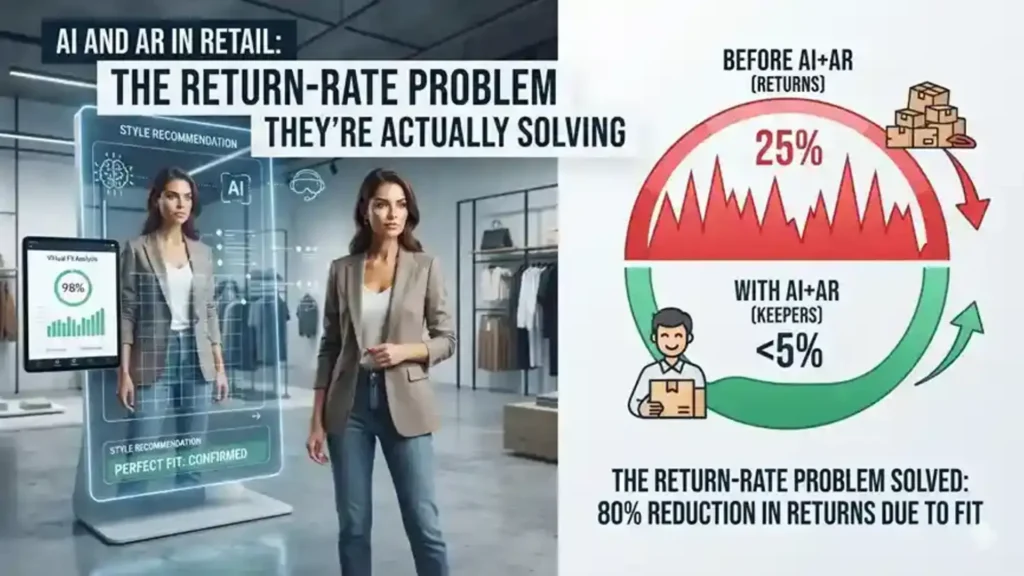
AI and AR in Retail: The Return-Rate Problem They’re Actually Solving

INTRODUCTION Each returned item represents a double cost for the retailer: once when shipping it and once when processing its return. AI and augmented reality (AR) in retail largely exist to avoid that round trip in the first place, helping the shopper choose the right product the first time. Virtual try-on technology alone has been shown to significantly increase conversion rates in e-commerce and reduce returns by over 8%; figures that explain why beauty, fashion and home goods retailers were the first to adopt it. Take the fitting room to the client’s living room Opticians were pioneers in this area for an obvious reason: glasses are a product that people do not buy without seeing how they look on their own face. The virtual try-on solved this problem entirely online, and some retailers have gone further by using AI to recommend frame shapes suitable for the customer’s face, rather than forcing them to guess which one will fit them. The same logic applies to any situation where excess options are the true barrier to purchase. A beauty catalog with hundreds of thousands of products is impossible for a human being to explore; However, an AI-based recommendation service can reduce that number to a few relevant options based on the user’s search and purchase history, transforming an overwhelming catalog into a short, personalized selection. Make the “infinite hallway” truly navigable A larger online catalog is only useful if customers can find what fits their tastes. Wayfair’s approach is a clear example: its search algorithm interprets style preferences from a customer’s search history to show furniture that is likely to fit their tastes; Additionally, a visual search feature allows the shopper to photograph an item they like and find matches among millions of products in inventory. Augmented reality expands this concept: it goes from “will I like it?” to “Will it fit in my space?” It allows the buyer to view a digitally recreated piece of furniture in their own room before purchasing it, which goes a long way to explaining why this category has seen measurable improvements in conversion and a reduction in returns. In the fashion sector, the question of sizes works in a similar way. Levi’s uses an AI chatbot that asks for fit, rise and stretch preferences—in addition to the size the customer wears in other brands—to recommend the right size, addressing the leading cause of fashion returns: a garment not fitting as expected. H2: 3. Turn purchasing behavior into better forecasts Turn Shopping Behavior Into Better Forecasts Every interaction with an AI-powered shopping tool—a search, a virtual product try-on, or a completed purchase—generates data that retailers didn’t previously have. Used correctly, this data refines inventory and demand forecasts far beyond what historical sales data alone allows, and facilitates truly relevant follow-up marketing: A shopper who has just purchased kitten supplies is an ideal candidate for a cat food subscription offer, not a mass generic newsletter. This same data allows retailers to target their promotions more precisely, tailoring the discount type and channel to what a specific customer actually responds to based on their history, rather than launching a one-size-fits-all promotion. Keep shelves stocked before customers notice they are empty AI-based forecasting is increasingly used to anticipate not only typical demand, but also disruptions to it; This involves recalculating replenishment quantities and adjusting supply in response to real changes, and not simply historical averages. Some retailers have piloted robots that scan shelves to automatically detect out-of-stocks; Likewise, real-time replenishment signaling systems in selected stores seek to solve a basic but persistent problem: the customer who comes expecting to find an item and finds an empty shelf. What does this mean for retailers who don’t have Wayfair’s budget? None of this requires developing AI and computer vision capabilities internally. ERP platforms for the retail sector increasingly integrate AI-based demand forecasting and customer data unification as standard functionality; This is what really puts personalization and smarter inventory management within reach of a mid-sized retailer, not a multimillion-dollar in-house AI team. Curious what AI-powered forecasting and personalization would look like on your retail platform? Contact Trident to request a demo of your retail ERP.

AI and AR in Retail: The Return-Rate Problem They’re Actually Solving Read More »

Cloud ERP dashboard helping SMBs manage finance, inventory, operations, and business performance.

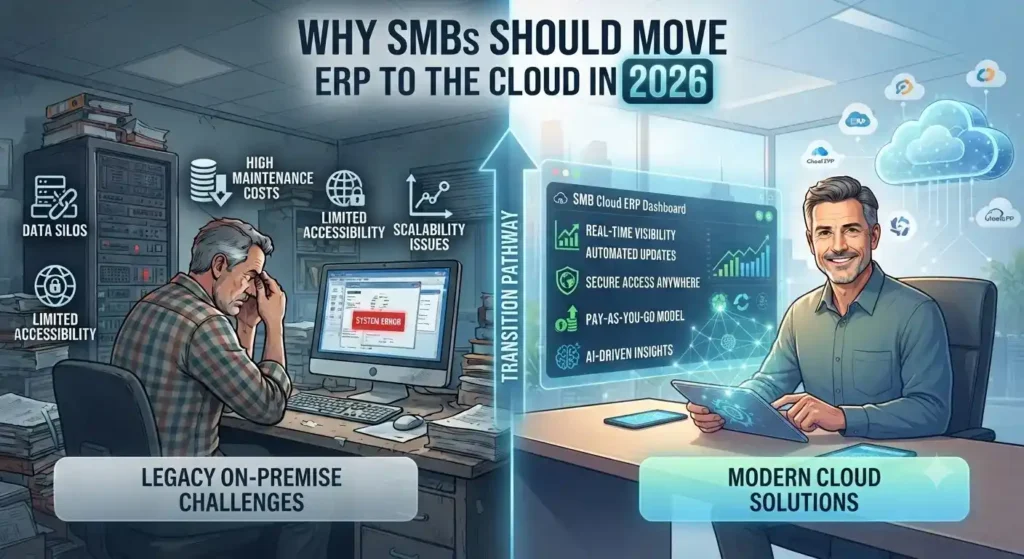
Why SMBs Should Move ERP to the Cloud in 2026

Why SMBs Should Move ERP to the Cloud in 2026 Roughly 44% of small businesses now run meaningful cloud infrastructure, and that number keeps climbing. But most of that adoption is email and productivity tools — not the ERP system running finance, inventory, and operations. That gap is where SMBs quietly lose money every year. The Real Cost of Staying on Legacy ERP Companies spent 40% of their IT budgets in 2025 just keeping legacy systems running — patching, maintaining, and working around software that was outdated the day it was installed. That’s not investment; it’s maintenance debt with no return. Every year an SMB delays ERP migration, that wasted spend tends to grow, not shrink, because the gap between legacy capability and modern cloud ERP keeps widening. Global public cloud spending is projected to hit $723.4 billion in 2025, up from $595.7 billion the year before — a jump driven largely by core workloads shifting into the cloud, not just email. ERP is where legacy costs compound fastest, which is exactly why it’s driving so much of that growth. Predictable Costs Instead of Capital Surprises The CapEx-to-OpEx shift is the change SMBs feel first. Instead of a large upfront hardware and licensing spend followed by unpredictable maintenance bills, cloud ERP runs on subscription pricing tied to actual usage. For Microsoft-centric SMBs, this gets stronger. Azure Hybrid Benefit lets businesses that already own Windows Server or SQL Server licenses apply them toward cloud costs, cutting Azure VM costs by up to 40-55% compared to standard pay-as-you-go pricing. If your SMB already runs Microsoft 365 or Windows Server, that discount alone changes the ROI math on a Dynamics 365 migration. Security Concerns Are Backwards Now The instinct to keep ERP on-premises for “control” doesn’t hold up anymore. Modern cloud platforms often deliver stronger security, better uptime, and greater scalability than most SMBs can achieve running their own infrastructure. Built-in compliance frameworks and dedicated provider security teams cover ground most SMB IT teams can’t staff for — a real constraint for a five-person IT department juggling help desk tickets and server patching at the same time. Scalability Without the Hardware Gamble Legacy ERP forces a bet: buy enough server capacity for growth you haven’t hit yet, or underprovision and hit a wall mid-quarter. Cloud ERP removes that bet. Resources scale with actual transaction volume, seasonal demand, or headcount growth, with no hardware refresh cycle every three to five years. What This Means for a Dynamics 365 Decision For SMBs already in the Microsoft ecosystem, this isn’t a “should we move to the cloud” question anymore — it’s a “why are we still running Dynamics NAV or an on-prem F&O instance in 2026” question. The path to Dynamics 365 Business Central or Finance & Operations keeps the interface logic staff already know, while shifting cost structure, security posture, and scalability all at once. Still running ERP on-premises or on an older Dynamics NAV instance? Talk to Trident’s Dynamics 365 team about what a cloud migration looks like for your cost structure and timeline. FAQ Q: Is cloud ERP more secure than on-premises ERP for SMBs?A: Often yes — cloud providers invest in dedicated security teams and compliance frameworks most SMB IT departments can’t match in-house. Q: How much can SMBs save moving ERP to Azure?A: Businesses with existing Windows Server or SQL Server licenses can save 40-55% on Azure costs through Azure Hybrid Benefit. Q: What’s the cost of staying on legacy ERP systems?A: Organizations spent roughly 40% of their 2025 IT budgets just maintaining legacy systems — spend that delivers no new capability, only upkeep.

Why SMBs Should Move ERP to the Cloud in 2026 Read More »

Modern restaurant POS system managing orders, billing, and kitchen operations efficiently.

How a Modern Restaurant POS System Boosts Productivity by Up to 40%

Nearly a quarter of restaurant owners who have not updated their POS system in the past year plan to do so in the next twelve months. If you are one of them, the question is not whether to upgrade — it is how to choose the right system and make the most of the investment. Your POS is the operational heartbeat of your restaurant. Every order, every payment, every table movement flows through it. When it works well, your team works well. When it is clunky, slow, or poorly configured, the entire service suffers — and often, you do not even realise how much productivity you are losing until you switch to something better. Research consistently shows that the right POS configuration can improve restaurant floor productivity by at least 20 to 40 percent. Here are four features that make that possible. Why Restaurants Stay Stuck on Outdated POS Systems It is easy to understand why so many restaurants keep running on ageing systems. Replacing a POS means disrupting the operation, retraining the team, and making a significant financial commitment — without always knowing what the return will be. It feels risky. So the outdated system stays, and the inefficiencies it creates become invisible because they are simply how things are done. But the hidden cost of an outdated POS compounds over time. Slower service leads to fewer table turns. Order errors frustrate customers and damage reviews. Manual processes consume staff time that should be spent on hospitality. And the data that a modern POS would generate — on sales patterns, peak times, menu performance — simply does not exist. The right modern POS does not just replace your old one. It fundamentally changes how your team works. 4 POS Features That Transform Restaurant Productivity 1. A POS That Mirrors Your Menu The biggest single productivity gain from a POS upgrade comes from one simple change: configuring the system to match how your team actually takes orders — not how the software developer imagined they would. When menu items, modifiers, and customisation options are arranged in the POS exactly as they appear on the menu — in the same order, using the same language — your staff can take orders conversationally without hunting through menus or navigating confusing interfaces. No mayo and extra sauce? Your team handles it in seconds. Dietary modifications? Captured instantly without slowing the order flow. One large restaurant chain we worked with saw floor efficiency improve by 40% after configuring their POS to mirror the menu. Staff moved faster, orders were more accurate, customers received better service, and table turns increased — all from a configuration change, not a workflow overhaul. The lesson: a well-configured POS is as important as the technology itself. 2. Colour-Coded Menu Sections Speed on the restaurant floor depends on how quickly staff can find what they need without thinking. Colour coding is a simple, powerful tool that makes this effortless. Assign a distinct colour to each menu category — starters, mains, desserts, beverages. Then break those categories down further with colour-coded sub-sections within each course. Staff can navigate the entire menu at a glance rather than reading through text-heavy lists. For accessibility, colour schemes can be configured in high-contrast or grayscale modes for team members with visual impairments — ensuring everyone benefits equally. The result is a POS that staff can navigate confidently from their first shift — reducing training time, reducing errors, and freeing attention for what actually matters: the customer experience. 3. Flexible Seating and Split Payment Modern restaurant service is rarely straightforward. Guests move tables. Groups merge. Bills get split in complex ways. Each of these situations, handled poorly, creates friction for staff and frustration for customers. A modern POS handles all of it smoothly. When a group arrives with an advance booking, staff can pull up their reservation instantly — including dietary requirements and allergy notes — and seat them within seconds. If they want to join colleagues at another table, the POS table management feature moves diners and updates the kitchen queue in real time without confusion. When it is time to pay, split billing is handled intuitively — dividing the bill by item, by person, or any combination — with automatic gratuity calculation and tax handling built in. No manual arithmetic. No errors. No awkward moments at the end of the meal. This flexibility does not just improve the customer experience. It significantly reduces the time staff spend on administrative tasks at the end of each table’s visit — freeing them for the next guests. 4. A Centralised System for the Whole Operation Individual POS terminals are useful. A centralised POS system that connects every terminal — and every department — is transformative. When all POS terminals draw from and contribute to the same central data source, the benefits multiply across the entire operation: When your entire team works from a single source of truth, communication improves, errors decrease, and management decisions are based on real data rather than approximation. The Real Cost of Staying on an Outdated POS Before evaluating what a new POS would cost, consider what your current system is costing you. Every order that takes an extra thirty seconds to enter. Every split bill that requires a manager’s intervention. Every table that turns slower than it should because the system cannot keep pace with the service. Every week that passes without useful sales data to inform menu and staffing decisions. These are real costs — distributed across every service, every shift, every week. Aggregated over a year, they significantly outweigh the investment in a modern system. Microsoft Dynamics 365 for Restaurant Management Microsoft Dynamics 365 — combined with LS Central for Restaurants — delivers all four capabilities above within a single, unified restaurant management platform. From POS configuration and table management through kitchen display integration, inventory tracking, and real-time analytics — it connects every aspect of your restaurant operation on one intelligent platform that scales from a single outlet to

How a Modern Restaurant POS System Boosts Productivity by Up to 40% Read More »

Retail POS system displaying sales, inventory management, payment processing, and troubleshooting alerts.

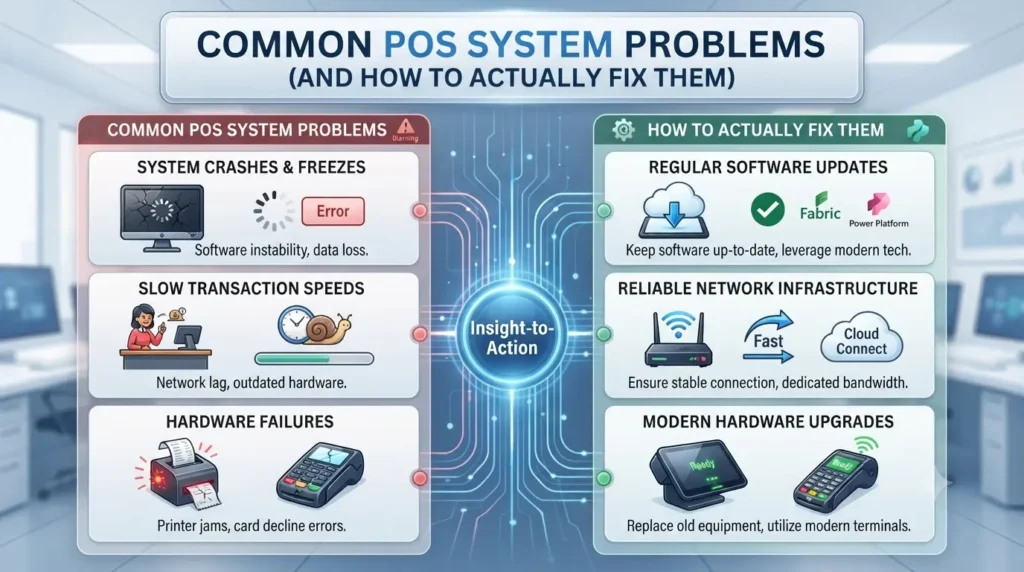
Common POS System Problems (And How to Actually Fix Them)

POS System Problems and Solutions for Retail A single unencrypted Wi-Fi network shared between your POS terminals and customer guest access is one of the most common ways retail payment data gets exposed — and it’s still standard setup in a lot of small and mid-size stores. Most POS problems aren’t software failures. They’re implementation gaps that show up months after go-live, when nobody’s watching for them anymore. Here are the five that come up most often, and what actually fixes each one. 1. Security Gaps That Go Unnoticed Until It’s Too Late A single data breach can undo years of customer trust — and PCI-DSS non-compliance carries real financial penalties on top of the reputational damage. The fix isn’t a single tool; it’s a checklist most retailers skip at implementation: A POS platform with built-in breach detection catches anomalies — like a terminal suddenly processing transactions outside normal hours — before they become a full incident. 2. Choosing a POS System That Can’t Scale With You Retailers often pick POS software based on sticker price alone, then discover it can’t handle multi-location reporting or real-time inventory sync once they open a second store. Reporting inaccuracy at that point isn’t a bug — it’s the system reaching its architectural limit. Treat POS selection as infrastructure, not a one-time purchase. A platform built to handle your business at 3x its current size costs more upfront but avoids a forced, disruptive migration in 18 months. 3. No Fallback When the Internet Drops If your POS is fully cloud-dependent and your internet connection fails, you can’t process a single transaction — not ideal during a Saturday afternoon rush. This is a design flaw many retailers only discover during their first outage. Two fixes, not mutually exclusive: a backup hotspot connection as a stopgap, and a POS platform with offline transaction mode that queues sales locally and syncs once connectivity returns. LS Central, built on Microsoft Dynamics 365 Business Central, supports offline resilience so a dropped connection doesn’t mean a dropped sale. 4. Paying for Features You Never Turn On Sales reporting, email marketing integration, e-commerce sync, employee management — most modern POS platforms include all of it, and most retailers use a fraction of it. That’s not a software problem; it’s an onboarding problem. Nobody walked the team through what the platform can actually do beyond ringing up sales. An implementation partner should include a features audit 60-90 days post go-live, not just at launch, since usage patterns and business needs shift once the system is live. 5. Staff Who Never Got Properly Trained A new POS rollout without structured training turns every shift into a slowdown — staff second-guessing screens, mis-keyed transactions, frustrated customers in line. High retail staff turnover makes this worse: every new hire restarts the same friction if training isn’t systematized. Platforms built on familiar Microsoft interface logic — Business Central, Windows, Office — cut this ramp-up time meaningfully, because staff already know the underlying navigation patterns. Pair that with a standard onboarding checklist your team follows for every new hire, not ad hoc shadowing. Choosing a Partner, Not Just a Platform A POS rollout isn’t a one-time transaction — it’s the start of a long-term relationship with whoever implements and supports it. Trident Information Systems is a Microsoft Solutions Partner delivering LS Central, an end-to-end retail solution built on Dynamics 365 Business Central covering POS, inventory, merchandising, demand planning, and back-office operations in a single platform — no stitching together separate systems for headquarters and store-level reporting. Facing one of these problems in your current POS setup? Talk to Trident’s retail solutions team about an LS Central assessment for your store or chain. FAQ Q: What are the most common POS system problems?A: Security gaps from shared Wi-Fi networks, systems that can’t scale to multiple locations, no offline fallback during outages, underused features, and insufficient staff training. Q: What happens if a POS system loses internet connection?A: Fully cloud-dependent systems can’t process transactions during an outage; platforms with offline mode queue sales locally and sync once connectivity returns. Q: Is LS Central suitable for multi-location retail chains?A: Yes — built on Dynamics 365 Business Central, it unifies POS, inventory, and back-office operations across store locations from a single platform.

Common POS System Problems (And How to Actually Fix Them) Read More »

Business leaders evaluating an ERP implementation partner for a successful ERP deployment.

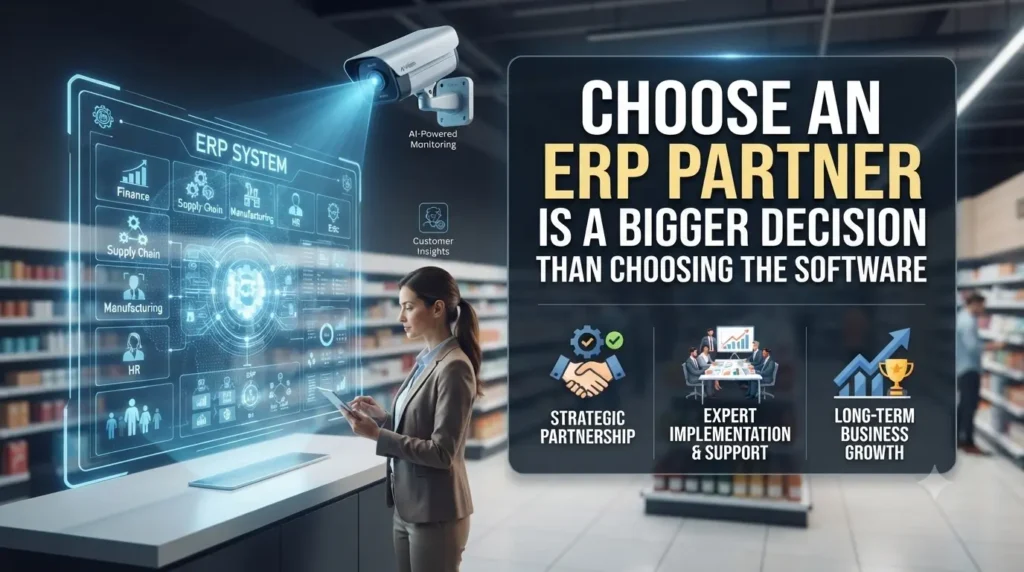
Choosing an ERP Partner Is a Bigger Decision Than Choosing the Software

INTRO Most ERP failures aren’t software failures. They’re implementation failures — a partner who didn’t know the industry, didn’t have the bench strength to staff the project, or disappeared after go-live. Before comparing Dynamics 365 versus Business Central versus F&O, it’s worth comparing partners, because the software rarely determines the outcome. The team implementing it does. Trident Information Systems is a Microsoft Solutions Partner delivering Dynamics 365 — F&O, Business Central, Finance, Supply Chain, Commerce, and LS Central — across India, UAE, and East Africa. Here’s what that actually means for a business evaluating who to trust with the rollout. A Track Record Across the Industries That Are Hardest to Get Wrong Generic ERP experience doesn’t transfer cleanly between industries — a retail rollout and a manufacturing rollout stress completely different parts of a system. Trident’s implementation history spans retail, hospitality, food service, manufacturing, supply chain, and automotive, which means the fit-gap analysis on a new project starts from pattern recognition, not a blank slate. 250+ Consultants Means Your Project Doesn’t Stall on Bench Depth A common failure point in ERP projects isn’t the plan — it’s running out of qualified people mid-implementation. Trident maintains 250+ technical and functional resources across offices in India, UAE, and East Africa, which means a project scales with certified consultants rather than waiting on hiring. That bench covers: Industry Fit Reduces Cost — Here’s Why That Matters The less a business has to reshape its existing processes to fit new software, the less expensive and disruptive the implementation becomes. That’s the practical case for working with a partner who’s already solved your industry’s specific problems: a food distributor’s batch-tracking and expiry requirements aren’t the same fit-gap exercise as a hospitality group’s multi-property inventory sync, and a partner who’s done both isn’t guessing at either. Microsoft-Recognized, Not Just Self-Described Trident holds Microsoft Gold and Silver competencies — designations Microsoft doesn’t award for volume of work, but for demonstrated technical capability and customer success across specific solution areas. For a buyer with no independent way to verify an ERP partner’s actual skill level before signing a contract, that’s an external checkpoint worth weighing, not a marketing line. Implementation That Adapts as Requirements Change Requirements shift mid-project more often than anyone plans for — a department’s actual workflow turns out to differ from what was scoped, or a business changes course based on something the first phase reveals. Trident runs implementations with an agile approach built to absorb that kind of change without treating it as scope creep, adjusting the plan as new information surfaces rather than forcing the original blueprint regardless of fit. Evaluating ERP Implementation Partner for an upcoming implementation? Talk to Trident about your project scope and timeline. FAQ Is Trident a certified Microsoft Dynamics 365 partner?Yes — Trident holds Microsoft Gold and Silver competencies and operates as a Microsoft Solutions Partner delivering Dynamics 365 F&O, Business Central, and related solutions. Which countries does Trident provide ERP implementation in?Trident delivers Dynamics 365 implementations across India, UAE, and East Africa, with consulting teams based in each region. What industries does Trident specialize in for ERP implementation?Trident has implementation experience across retail, hospitality, food service, manufacturing, supply chain, and automotive.

Choosing an ERP Partner Is a Bigger Decision Than Choosing the Software Read More »

Trident Microsoft Dynamics partner delivering ERP implementation, migration, customization, and support across India, UAE, and Africa.

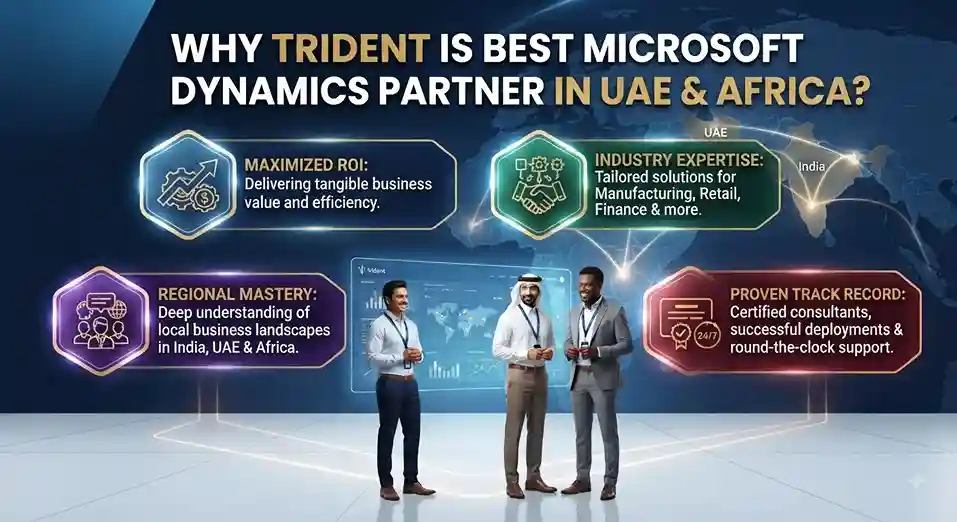
Why Trident is best Microsoft Dynamics Partner in India, UAE & Africa

Trident Information Systems is a Microsoft Solutions Partner with 25+ years of delivery experience and 250+ Dynamics 365 implementations across India, the UAE, Nigeria, Kenya, Ethiopia, and South Africa. We help mid-size and enterprise businesses in retail, manufacturing, hospitality, supply chain, and automotive move onto Dynamics 365 and get real, measurable value out of it — not just a go-live date. Whether you’re evaluating your first ERP, migrating off Dynamics NAV or AX, or looking for a Microsoft Dynamics 365 partner in Dubai, Nigeria, Kenya, or South Africa with people on the ground who understand your market, our teams across these regions support the full lifecycle: requirement discovery, implementation, data migration, integration, and ongoing support. Why businesses across India, UAE & Africa choose Trident Deep regional presence, not a fly-in consultancy. We operate with dedicated teams across India, the UAE, Nigeria, and East Africa — so when you need a Microsoft Dynamics partner in Kenya or a Microsoft ERP partner in Nigeria, you’re working with consultants who understand local tax, compliance, and business practice, not a generic offshore desk. A track record Microsoft itself has recognized. Trident has twice been named to the Microsoft Dynamics President’s Club — an honor reserved for the top 5% of Dynamics partners worldwide by customer success and growth. We’ve also been ranked among the top 5 strategic Microsoft partners for Dynamics AX in Retail in India, and we hold LS Central Diamond Partner status for retail and hospitality. Breadth across the Microsoft stack. As a Microsoft Solutions Partner, we implement and support: 190+ certified technical and functional resources, giving you the bench strength for implementation, staff augmentation, and 24/7 managed support — without the resourcing risk of a boutique shop. Industries we serve Our strongest domain expertise is in retail, e-commerce, food service and manufacturing, construction and real estate, logistics and transportation, hospitality, and automotive — verticals where off-the-shelf ERP configuration rarely fits and real industry knowledge shortens the path to go-live. Where we operate India — Headquartered in New Delhi, with the largest share of our certified Dynamics 365 and Business Central consulting bench. If you’re comparing Microsoft Dynamics 365 partners in India, we’re one of the longer-standing names in the market, going back over two decades. UAE — Active on-the-ground operations supporting Dubai, Abu Dhabi, and Sharjah, with Dynamics 365 configurations built around UAE VAT and Corporate Tax requirements. If you’re searching for a Microsoft Dynamics 365 partner in Dubai or UAE, our regional team handles implementation, NAV/AX migration, and managed support locally. Nigeria & East Africa — A growing focus area for Trident, supporting retail and e-commerce businesses across Nigeria (including Port Harcourt and Lagos), Kenya, and Ethiopia. If you’re looking for a Microsoft Dynamics partner in Nigeria or a Microsoft ERP partner in Kenya, our team works directly with local business and IT leadership — not through a remote-only model. South Africa & broader Africa — Delivery support for Dynamics 365 and Business Central implementations extending across the wider African market, complementing our Nigeria and East Africa presence. What working with Trident looks like Ready to talk to a Dynamics 365 partner who knows your market? Whether you’re in Delhi, Dubai, Lagos, Nairobi, or Johannesburg, Trident’s regional teams are ready to scope your Dynamics 365, Business Central, or CRM implementation. Contact Trident Information Systems.

Why Trident is best Microsoft Dynamics Partner in India, UAE & Africa Read More »

Customer using a retail mobile app for shopping, rewards, and personalized offers.

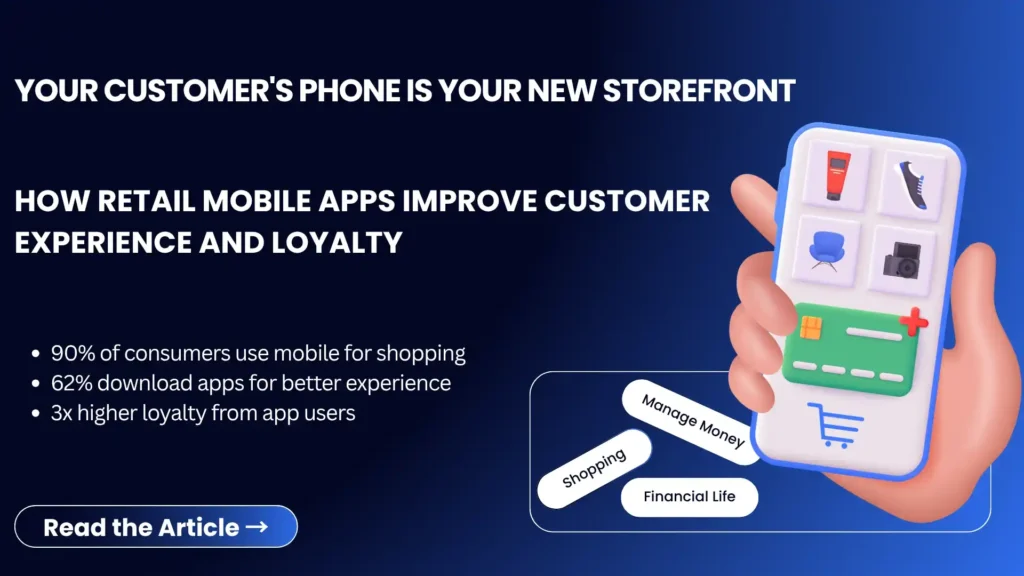
How Retail Mobile Apps Improve Customer Experience and Loyalty

In today’s digital-first world, customers expect convenience, speed, and personalized experiences whenever they shop. With smartphones becoming an essential part of everyday life, retailers are rapidly adopting mobile applications to stay connected with customers and meet their evolving expectations. Retail mobile apps are no longer just an additional sales channel—they have become a powerful tool for enhancing customer experience, increasing engagement, and building long-term customer loyalty. From personalized recommendations to seamless shopping journeys, mobile apps are transforming the way retailers interact with their customers. In this article, we’ll explore how retail mobile apps are reshaping customer experiences and why investing in a retail app can help businesses gain a competitive advantage. The Rise of Mobile Commerce in Retail Mobile commerce, often referred to as m-commerce, has witnessed tremendous growth over the last few years. Consumers increasingly rely on their smartphones to browse products, compare prices, read reviews, and make purchases. The convenience of shopping anytime and anywhere has made mobile devices the preferred shopping platform for millions of consumers worldwide. As mobile commerce continues to expand, retailers must embrace digital technologies that simplify shopping experiences and create stronger customer relationships. Retail mobile apps play a crucial role in this transformation by providing customers with quick access to products, services, offers, and loyalty rewards directly from their smartphones. Why Retail Mobile Apps Matter More Than Ever Modern customers demand seamless shopping experiences across both online and offline channels. They want personalized interactions, faster checkout processes, and instant access to information. A well-designed retail mobile app helps businesses meet these expectations by offering: By delivering convenience and value, retailers can encourage repeat purchases and strengthen customer loyalty. 1. Enhanced Customer Experience Through Personalization Personalization has become one of the most important factors influencing purchasing decisions. Customers are more likely to engage with brands that understand their preferences and provide relevant recommendations. Retail mobile apps collect valuable customer insights such as browsing history, purchase behavior, and shopping preferences. This information enables retailers to deliver personalized experiences that make customers feel valued. Examples of personalization include: When customers receive relevant content and offers, they are more likely to remain engaged with the brand and make repeat purchases. 2. Loyalty Programs Become More Effective Traditional loyalty cards are rapidly being replaced by digital loyalty programs integrated within mobile apps. Retail mobile apps make it easier for customers to: A digital loyalty program encourages customers to shop more frequently because rewards are always accessible through their smartphones. Retailers also gain valuable data that helps them understand customer behavior and improve future loyalty initiatives. 3. Improved Customer Engagement Customer engagement is critical for long-term business success. Retail mobile apps provide direct communication channels that keep customers connected with the brand. Features such as push notifications, in-app messages, and personalized alerts help businesses maintain regular interaction with their customers. Retailers can use mobile apps to notify customers about: Unlike email marketing, mobile notifications often achieve higher engagement rates because they reach customers instantly. 4. Faster and More Convenient Shopping Convenience is one of the biggest reasons customers prefer mobile shopping. Retail mobile apps simplify the purchasing process by offering: Customers can browse products, place orders, and make payments within minutes without visiting a physical store. This convenience significantly improves customer satisfaction and increases the likelihood of repeat purchases. 5. Omnichannel Shopping Experience Today’s consumers interact with brands through multiple touchpoints, including websites, social media platforms, physical stores, and mobile applications. Retail mobile apps help create a seamless omnichannel experience by connecting all customer interactions into a single ecosystem. Customers can: This consistency creates a more satisfying customer journey and strengthens brand loyalty. 6. Real-Time Customer Insights and Analytics One of the biggest advantages of retail mobile apps is access to real-time customer data. Retailers can track: These insights help businesses make data-driven decisions that improve customer experiences and maximize revenue opportunities. By understanding what customers want, retailers can continuously optimize their offerings and marketing strategies. 7. Competitive Advantage in a Digital Marketplace The retail industry is becoming increasingly competitive. Businesses that fail to embrace mobile technology risk losing customers to competitors who offer more convenient shopping experiences. A feature-rich retail mobile app allows businesses to differentiate themselves by providing: Investing in retail app development helps businesses stay relevant and meet the expectations of today’s digitally empowered consumers. Key Features Every Retail Mobile App Should Include To maximize customer engagement and loyalty, retailers should consider incorporating the following features: User-Friendly Interface A simple and intuitive design ensures customers can easily navigate the app. Personalized Recommendations AI-driven recommendations improve customer satisfaction and increase sales. Digital Loyalty Programs Integrated rewards systems encourage repeat purchases. Secure Mobile Payments Multiple payment options improve convenience and trust. Push Notifications Real-time updates keep customers informed and engaged. Order Tracking Customers appreciate transparency throughout the purchasing journey. Customer Support Integration Instant assistance enhances the overall customer experience. Future Trends in Retail Mobile Apps As technology continues to evolve, retail mobile apps are becoming smarter and more sophisticated. Emerging trends include: Retailers that embrace these innovations will be better positioned to meet future customer expectations and drive long-term growth. Conclusion Retail mobile apps have become an essential tool for businesses seeking to improve customer experience, strengthen customer loyalty, and increase sales. By providing personalized experiences, convenient shopping journeys, and effective loyalty programs, mobile apps help retailers build stronger relationships with their customers. As mobile commerce continues to grow, businesses that invest in retail app development will gain a significant competitive advantage. Whether your goal is to improve customer engagement, increase retention, or drive revenue growth, a well-designed retail mobile app can play a vital role in achieving success. At Trident Information Systems, we help retailers leverage innovative technology solutions to create powerful mobile applications that enhance customer experiences and support long-term business growth. Want to build a customer-focused retail mobile app? Speak with Trident’s retail technology experts and discover how mobile commerce can increase loyalty, engagement, and revenue. For more insightful content and industry updates, follow

How Retail Mobile Apps Improve Customer Experience and Loyalty Read More »

LS Hospitality dashboard managing restaurant POS, kitchen operations, inventory, and guest services.

LS Hospitality: The Restaurant Management Software That Connects Your Entire Food Service Operation on Microsoft Dynamics 365

Running a restaurant has always been demanding. Running one in 2025 — where customers expect online ordering, mobile payments, personalized loyalty rewards, and flawless service simultaneously — demands technology that was simply not available to most operators a decade ago. The gap between what guests now expect and what most restaurant technology delivers is widening. Customers who order through an app on Tuesday expect the same loyalty points when they walk in on Friday. A table of four who order separately expect the split bill to process in seconds. A kitchen managing 200 covers on a Saturday night cannot afford miscommunication between the floor and the pass. LS Hospitality — the restaurant and food service management solution built on Microsoft Dynamics 365 Business Central — is designed for exactly this operational environment. It connects your POS terminals, kitchen management, table service, menu configuration, loyalty programs, online ordering, and head office operations on a single unified platform — giving every member of your team the real-time information they need to deliver outstanding hospitality, every service. Whether you operate a single fine dining restaurant, a chain of quick-service outlets, a café group, or a multi-concept hospitality business, LS Hospitality delivers the operational intelligence, service speed, and customer engagement tools that modern food service demands. Trident Information Systems is a certified LS Hospitality and Microsoft Dynamics 365 implementation partner — helping restaurants and hospitality businesses across India implement and maximize the value of this industry-leading platform. Why the Restaurant and Food Service Industry Needs Smarter Technology Now The Five Forces Reshaping How Restaurants Operate in 2026 The restaurant industry is navigating a convergence of five simultaneous shifts — any one of which would require a technology response on its own. Together, they are making the case for a unified, modern hospitality management platform more urgent than ever: 1. The omnichannel expectation — online ordering, mobile payment, in-app loyalty, table ordering via QR code, and dine-in service are no longer separate experiences. Guests expect them to work together seamlessly — with their preferences, history, and rewards recognized across every format. 2. The experience standard — in hospitality, the product is the experience. Operators who deliver consistently high-quality, frictionless service build the loyalty and word-of-mouth that sustains a restaurant long-term. Operators who do not — regardless of food quality — lose customers to those who do. 3. The pace of change — consumer preferences, dietary requirements, delivery platforms, payment methods, and social media dynamics change faster than ever before. Restaurant operators need a technology platform that evolves continuously — not one that requires expensive custom development every time the market shifts. 4. The social dining phenomenon — from food photography on Instagram to review platforms like Google, TripAdvisor, and Zomato, dining has become a social experience that extends far beyond the restaurant walls. Operators who manage their digital presence actively and use data to improve the experience will consistently outperform those who do not. 5. The analytics imperative — the restaurants making the best decisions about menu engineering, staff scheduling, promotional pricing, and customer retention are the ones with access to real-time, accurate data about their operation. Analytics is no longer a back-office function — it is a frontline competitive tool. The Real Cost of Running a Restaurant on Disconnected Systems Most restaurant operations have grown their technology stack organically — a standalone POS here, a reservation system there, a separate loyalty app, an accounting system that receives a manual export at the end of the week. This fragmentation has hidden costs that compound over time: A unified hospitality management platform eliminates every one of these costs. What Is LS Hospitality? Restaurant Management Software Built for Every Format LS Hospitality is an end-to-end restaurant and food service management solution — connecting POS, kitchen management, table service, menu management, loyalty, online ordering, and head office operations within a single unified application built on Microsoft Dynamics 365 Business Central. From Fine Dining to Quick Service: One Platform for Every Hospitality Setup LS Hospitality is designed to serve the full spectrum of food service formats — with configurable workflows that adapt to the operational requirements of each format without requiring separate systems: LS Hospitality on Microsoft Dynamics 365 Business Central LS Hospitality is built on and powered by Microsoft Dynamics 365 Business Central — giving hospitality operators the combined benefit of deep restaurant-specific functionality and enterprise-grade financial management, supply chain, and analytics capabilities. This means your restaurant operation runs on a platform that: Point of Service — Not Just Point of Sale The POS in a restaurant is fundamentally different from a retail POS. It is not just a payment terminal — it is the primary communication hub between the guest, the floor team, and the kitchen. LS Hospitality is built with this reality at its core. A POS That Informs, Orders, Pays, and Manages — All at Once The LS Hospitality POS is designed as a complete point of service — not simply a point of sale. From a single interface, your floor staff can: Superior Customer Service From Every Corner of the Restaurant LS Hospitality’s mobile POS capability means the point of service moves with your staff — not the other way around. Orders can be taken tableside on a handheld device, payments processed at the table without the guest leaving their seat, and loyalty enrollments completed during the dining experience rather than as an afterthought at checkout. This mobility transforms the service dynamic — reducing the friction between guest request and staff response, eliminating the queues at fixed POS terminals, and giving your team the tools to deliver genuinely attentive hospitality rather than transaction-focused service. Table and Guest Management: Maximize Covers, Minimize Wait Times Effective table management is the operational foundation of a profitable restaurant. Every table turn represents revenue. Every guest left waiting represents a potential lost visit. LS Hospitality gives your front-of-house team the visual tools and real-time information to optimize seating, service, and turnover across every service. Graphic Table Management for

LS Hospitality: The Restaurant Management Software That Connects Your Entire Food Service Operation on Microsoft Dynamics 365 Read More »

Microsoft Dynamics 365 Finance and Operations dashboard managing finance, supply chain, and enterprise operations.

Microsoft Dynamics 365 Finance and Operations: Elevate Financial Performance, Streamline Operations, and Scale With Confidence

For enterprises still running financial and operational management on legacy ERP systems, the question is no longer whether to modernize — it is how quickly they can afford not to. Disconnected financial systems, manual reporting processes, siloed supply chain data, and compliance frameworks built for a pre-digital regulatory environment are not just inefficient. They are competitive liabilities. Every month a CFO waits days for month-end close, every time an operations director cannot see real-time production capacity, and every time a procurement team manually reconciles purchase orders against invoices — value is being destroyed that a modern ERP platform would have preserved. Microsoft Dynamics 365 Finance and Operations is the evolution of Microsoft Dynamics AX — rebranded, rebuilt for the cloud, and extended with artificial intelligence, embedded analytics, and no-code configurability that legacy AX simply cannot match. It gives finance, operations, manufacturing, supply chain, and procurement teams a single, unified intelligent platform — with the real-time visibility, automation depth, and global compliance capability that modern enterprises require. Whether your organization is evaluating its first enterprise ERP investment, planning an upgrade from Dynamics AX 2012, or looking to consolidate a fragmented mix of financial and operational systems onto a single platform — this guide covers everything you need to know about Microsoft Dynamics 365 Finance and Operations. Why Enterprises Are Upgrading From Dynamics AX to Dynamics 365 What Changed: From On-Premises ERP to Intelligent Cloud Finance Microsoft Dynamics AX was one of the most capable on-premises ERP platforms available for mid-to-large enterprises — particularly in manufacturing and distribution. But the world it was built for no longer exists. Today’s enterprise finance and operations environment demands: Microsoft Dynamics 365 Finance and Operations delivers all of these capabilities natively — on the Microsoft Azure cloud platform, with continuous updates, embedded Microsoft Copilot AI, and deep integration across the Microsoft 365 and Power Platform ecosystems. The Risk of Staying on Legacy Dynamics AX — What You Need to Know Microsoft ended mainstream support for Dynamics AX 2012 in 2021 and extended support in January 2023. Organizations still running AX 2012 are now operating on an unsupported platform — with no security patches, no regulatory updates, and no new feature development. The risks compound over time: The migration path from Dynamics AX to Dynamics 365 Finance and Operations is well-documented — and Trident has guided multiple enterprises through it successfully, preserving existing data, configurations, and business process knowledge while unlocking the full capability of the modern platform. 1. Elevate Your Financial Performance With Dynamics 365 The financial management capabilities of Microsoft Dynamics 365 Finance and Operations are built for the complexity and pace of modern enterprise finance — with real-time intelligence, automated processes, and global compliance tools that enable finance teams to move faster, report more accurately, and contribute more strategically. Increase Profitability With Real-Time Financial Intelligence Profitability management in complex enterprises requires more than periodic financial reporting — it requires continuous, real-time visibility into margin performance across products, customers, geographies, and business units. Microsoft Dynamics 365 Finance delivers: When financial intelligence is available in real time — not compiled once a month — the decisions that protect and grow profitability can be made faster and with greater confidence. Optimize Workforce Productivity Through Role-Based Automation Finance and operations teams lose significant productive capacity to manual, repetitive tasks that intelligent automation can handle faster and more accurately. Dynamics 365 Finance and Operations eliminates this waste through: Reduce Operational Expense Across Every Business Geography For enterprises operating across multiple countries and regions, financial process inconsistency is a hidden cost driver. Different teams using different processes, different tools, and different approval workflows create both inefficiency and compliance risk. Dynamics 365 Finance addresses this through: Adapt Quickly to Changing Financial and Regulatory Requirements The regulatory environment for global enterprises has never been more complex or more rapidly changing — VAT reforms, IFRS updates, digital invoicing mandates, transfer pricing requirements, and ESG reporting obligations are creating continuous compliance pressure that legacy systems were never designed to handle. Microsoft Dynamics 365 Finance is built for this reality: Streamline Asset Management From Acquisition Through Disposal Fixed asset management is one of the most error-prone areas in enterprise finance — particularly when asset registers are maintained in spreadsheets or legacy systems disconnected from the main ERP. Dynamics 365 Finance delivers: 2. Run Smarter Manufacturing Operations With Dynamics 365 Microsoft Dynamics 365 Finance and Operations extends beyond the finance function to deliver deep manufacturing operations capabilities — connecting production planning, scheduling, resource management, and cost control in a single unified system. Select the Best-Fit Manufacturing Process for Every Product Line Modern manufacturing organizations rarely operate on a single production model. A company might run make-to-stock for high-volume standard products, make-to-order for customized variants, and engineer-to-order for complex customer-specific configurations — simultaneously, within the same facility. Dynamics 365 Finance and Operations supports the complete range of manufacturing models in a single unified solution: Improve Operational Procedures With Advanced Production Planning Manufacturing competitiveness is built on the ability to optimize production parameters for every product and every scenario — adjusting quickly to demand changes, supply constraints, and capacity limitations without losing efficiency: Simplify Resource Management With Real-Time Scheduling Visibility Resource scheduling in complex manufacturing environments — balancing machine capacity, labor availability, tooling requirements, and material flow across multiple production lines — is one of the most operationally demanding challenges in enterprise management. Dynamics 365 Finance and Operations simplifies this through: Accelerate Product Delivery Through Advanced Warehouse Management The connection between manufacturing and warehouse management is where delivery performance is won or lost. Dynamics 365 Finance and Operations integrates advanced warehouse management directly with production planning: 3. Automate and Modernize Your Supply Chain A modern, connected supply chain is one of the most significant sources of competitive advantage available to manufacturing and distribution enterprises. Microsoft Dynamics 365 Finance and Operations delivers the tools to transform a fragmented, reactive supply chain into a unified, predictive, cost-optimized operation. Modernize Business Logistics Across Sites, Warehouses, and Transport Modes Supply chain

Microsoft Dynamics 365 Finance and Operations: Elevate Financial Performance, Streamline Operations, and Scale With Confidence Read More »