Welcome to Trident Information Systems!
Write us to - info@tridentinfo.com
Let's Socialize

Search Results for: Supply chain

ERP software dashboard managing food manufacturing production, inventory, and compliance.

ERP for Food Manufacturing: Why Intelligent Software Is No Longer Optional in 2026

Food manufacturing is one of the most operationally demanding industries on the planet — and one of the least forgiving when things go wrong. A batch produced with the wrong ingredient ratio. A shelf-life date miscalculated by a day. A supplier delivering substandard raw materials that are not caught until they are already in production. A demand forecast that is off by 20 percent — leaving you either short of product during peak season or sitting on months of unsold inventory. In most industries, operational errors are expensive. In food manufacturing, they can also be dangerous — to consumers, to your brand, and to your regulatory standing. A single food safety incident that reaches consumers can damage years of brand equity overnight. This is why ERP for food manufacturing is no longer a technology investment that forward-thinking companies make to gain competitive advantage. It is a baseline operational requirement for any food manufacturer serious about quality, compliance, efficiency, and growth. An intelligent ERP system — purpose-built or deeply configured for the specific requirements of food and beverage production — connects every function of your manufacturing operation on a single platform: from raw material procurement and recipe management through production scheduling, quality control, traceability, warehouse management, and financial reporting. It replaces the patchwork of spreadsheets, paper records, and disconnected systems that most food manufacturers have accumulated over years — and gives every team in your operation the real-time information they need to make better decisions, faster. This guide covers the key challenges driving food manufacturers toward ERP adoption, the six core ways ERP transforms operations, the critical features to look for, and what Microsoft Dynamics 365 delivers for food and beverage manufacturers. The Unique Challenges Facing Food Manufacturers in 2026 The food manufacturing industry faces a confluence of pressures that are making intelligent ERP software not just beneficial but operationally essential. Understanding these challenges is the starting point for understanding what ERP needs to solve. Regulatory Compliance and Food Safety Pressure Food safety regulations are tightening globally — and in India specifically, FSSAI compliance requirements are expanding in scope and enforcement intensity. For manufacturers supplying export markets, compliance with FDA, EU food safety regulations, HACCP requirements, and retailer-specific food safety standards adds further complexity. Meeting these requirements without an integrated system that maintains complete, auditable records throughout production is becoming increasingly difficult — and the consequences of non-compliance range from product recalls and production shutdowns to significant financial penalties and reputational damage. Supply Chain Volatility and Raw Material Costs Food raw material costs are notoriously volatile — subject to seasonal variation, weather events, geopolitical disruption, and commodity market fluctuations that can dramatically change the economics of production within a single quarter. Managing ingredient sourcing, supplier relationships, and procurement timing without real-time visibility into costs and availability means making buying decisions that may look sensible today but prove expensive in three months. Consumer Demand for Transparency and Traceability Today’s consumers — and the retailers and food service operators who serve them — increasingly demand transparency about where food comes from, what ingredients it contains, and how it was produced. This is driven by a combination of food safety awareness, dietary preference and allergy concerns, sustainability requirements, and supply chain ethics expectations. Meeting this demand requires the ability to trace every product back through every stage of production to its source ingredients — a capability that is simply not achievable without a system that tracks batch and lot numbers throughout the entire production and distribution process. Shelf Life, Waste, and Margin Pressure Food manufacturing margins are thin — and food waste is one of the largest controllable cost variables. Overproduction, poor shelf-life management, inaccurate demand forecasting, and sub-optimal raw material usage all contribute to waste that erodes profitability directly. In an industry where competition on price is intense and input costs are rising, reducing waste through better planning, better inventory management, and better production efficiency is not an optional improvement — it is a margin imperative. Why Food Manufacturing Needs a Specialized ERP — Not a Generic One What Generic ERP Systems Miss in Food Production A generic ERP system can manage financial accounts, purchase orders, and inventory records. What it typically cannot handle natively — without expensive customization — are the specific operational requirements that define food manufacturing: A food manufacturing ERP that does not handle these requirements natively forces manufacturers to either build expensive custom solutions or work around them with manual processes — undermining the efficiency gains that ERP is supposed to deliver. What Intelligent Food Manufacturing ERP Actually Delivers An intelligent food manufacturing ERP — like Microsoft Dynamics 365 Supply Chain Management or Business Central with food industry extensions — delivers all of the above natively, within a unified platform that connects production with procurement, quality, warehouse, finance, and sales. The result is a manufacturing operation that is: 6 Ways ERP Transforms Food Manufacturing Operations 1. Single Integrated System: One Source of Truth Across Every Function Let us start with the most fundamental transformation — because everything else flows from this. Most food manufacturers have accumulated technology over the years in the same way most people accumulate tools: buying something for a specific purpose when the need arose, without a clear plan for how everything would eventually work together. The result is a production system talking to a separate quality system, a warehouse system that does not connect to the ERP, a finance system receiving manual exports from production, and a sales system that does not have real-time visibility into manufacturing capacity. Every connection between these systems is a potential point of failure — a data lag, an import error, a version mismatch, or simply a piece of information that never arrives because someone forgot to run the export. An integrated ERP for food manufacturing replaces this patchwork with a single platform where every function — procurement, production, quality, warehousing, finance, and sales — operates from the same real-time data: This real-time, enterprise-wide integration is the foundation from

ERP for Food Manufacturing: Why Intelligent Software Is No Longer Optional in 2026 Read More »
Microsoft Azure security dashboard monitoring cyber threats, cloud protection, and data backup.

Microsoft Azure Enterprise Security: How to Protect Your Business Data Against Cyber Threats, Outages, and Data Loss

Here is a question that should make every IT leader uncomfortable: if your organization suffered a significant cyberattack at 9am tomorrow morning, how confident are you — genuinely confident — in your ability to recover? Not hopeful. Not fairly confident. Genuinely, documentably confident — because you have tested your recovery plan, you know your Recovery Time Objective, and you know that your backup data is clean, current, and accessible even if your primary environment is completely compromised. If that confidence is not there, you are not alone. And the stakes have never been higher. Ransomware attacks on enterprise systems are increasing in frequency, sophistication, and financial impact. Data breaches are exposing sensitive customer and commercial information at a scale that would have seemed extraordinary just five years ago. And regulatory consequences — financial penalties, reputational damage, and operational disruption — are following those incidents with increasing severity. Microsoft Azure enterprise security is the answer to this challenge — providing an integrated, multi-layered security, backup, and disaster recovery architecture that gives organizations the genuine confidence that their data is protected, their systems can recover, and their business can keep running through whatever the threat landscape throws at them. Azure is not simply a cloud platform with security features added. It is a platform that was engineered with security as a foundational design principle — built on customized hardware with security controls embedded at every layer, defended by 8,500 dedicated security professionals globally, and continuously updated by AI systems analyzing trillions of security signals every single day. This guide covers every dimension of Microsoft Azure’s enterprise security capability — backup, disaster recovery, threat protection, identity management, compliance, and the AI-powered intelligence that makes Azure one of the most secure enterprise cloud environments available in 2025. Why Enterprise Data Security Has Never Been More Critical The Evolving Cyber Threat Landscape in 2026 The cybersecurity threat environment that enterprise IT teams face in 2026 is qualitatively different from what it was even three years ago. The combination of increasingly sophisticated threat actors, AI-powered attack tools, and an expanding attack surface — created by hybrid work, IoT proliferation, and multi-cloud environments — means that traditional perimeter-based security is no longer sufficient. The numbers make the challenge concrete: For Indian enterprises specifically, the implementation of the Digital Personal Data Protection (DPDP) Act 2023 adds a regulatory dimension to data security — with penalties for inadequate data protection that create financial risk alongside the operational risk of a breach. The Three Questions Every IT Leader Must Be Able to Answer In a security incident, there are three questions that separate organizations that recover quickly from those that do not: 1. “Is our data safe and intact?” This requires confidence in your backup strategy — that every critical system is backed up, that backups are tested and restorable, and that backup data is isolated from the primary environment so that an attack cannot encrypt both simultaneously. 2. “How long will it take to recover?” This requires a defined, tested Recovery Time Objective (RTO) — the maximum acceptable time between an incident and the restoration of normal operations. Organizations without a tested DR plan frequently discover that their actual recovery time is orders of magnitude longer than their assumed one. 3. “What did we lose?” This requires a defined Recovery Point Objective (RPO) — the maximum acceptable amount of data loss measured in time. An RPO of four hours means you can afford to lose up to four hours of transaction data. An RPO of zero means you need real-time replication to a secondary environment. Microsoft Azure provides the infrastructure, services, and tools to answer all three questions confidently — with documented SLAs backing every commitment. Microsoft Azure: The Enterprise Cloud Security Platform Microsoft Azure is the world’s second-largest cloud platform — serving hundreds of thousands of enterprise organizations globally, including many of the world’s most security-sensitive institutions: government agencies, financial services organizations, healthcare systems, and defense contractors. This trust has been earned through a security architecture that is genuinely different from what most organizations can build independently. How Azure’s Security Architecture Is Different Azure’s security architecture is built on a principle that Microsoft calls assume breach — designing every system on the assumption that a breach may occur, and engineering to minimize the impact, detect it quickly, and recover rapidly. This principle drives every layer of Azure’s security design: Azure’s Global Security Infrastructure: Scale and Expertise The security investment Microsoft makes in Azure is simply not replicable by most organizations building their own security capability: Azure Backup: Never Lose Critical Business Data Again Data loss is one of the most devastating events an organization can experience — and in 2025, it is also one of the most preventable. Azure Backup provides enterprise-grade data protection for on-premises workloads, cloud-based applications, and Azure virtual machines — with the automation, scalability, and reliability that enterprise backup requires. What Azure Backup Protects Azure Backup provides comprehensive protection for virtually every workload in your enterprise environment: Key Azure Backup Capabilities Offload on-premises backup infrastructure Azure Backup eliminates the need for on-premises backup hardware, software, and the ongoing management overhead that comes with it. Your backups go directly to Azure’s cloud storage — with Microsoft managing the infrastructure, the replication, and the retention — while you retain full control over backup policies and recovery operations. For organizations still running tape-based or legacy backup solutions, Azure Backup represents a fundamental simplification — lower cost, lower management overhead, and dramatically better reliability. Automated backup management Configure backup policies once — frequency, retention period, consistency requirements — and Azure Backup executes them automatically. No backup job monitoring, no failed job alerts going to an already-overloaded IT team. Backups happen on schedule, and exceptions are flagged automatically. Pay-as-you-use storage model Azure Backup uses a consumption-based pricing model — you pay for the backup storage you actually consume, not a fixed capacity you have to provision upfront. As your data volumes grow, backup storage scales automatically — with

Microsoft Azure Enterprise Security: How to Protect Your Business Data Against Cyber Threats, Outages, and Data Loss Read More »

Microsoft Dynamics 365 dashboard managing manufacturing operations, production, and supply chain performance.

Microsoft Dynamics 365 for Manufacturing: How It Transforms Operations and Drives Profitability

Every manufacturer faces the same pressure: produce more, faster, at lower cost — without compromising quality. Meeting that demand with disconnected systems, manual processes, and limited supply chain visibility is not just difficult. It is becoming impossible. The manufacturers pulling ahead in 2025 are those who have replaced fragmented tools with a single, intelligent ERP platform that connects every function of their operation. Microsoft Dynamics 365 for manufacturing is that platform. Built for the complexity of modern manufacturing — from production planning and supply chain management to asset monitoring, quality control, and financial reporting — Dynamics 365 gives manufacturers the real-time visibility, automation depth, and data-driven intelligence to operate at their best. Here are five ways it makes that happen. Why Manufacturing Businesses Need a Modern ERP in 2026 The Real Cost of Outdated Manufacturing Systems Running a manufacturing business on legacy ERP systems — or worse, on spreadsheets and disconnected tools — creates hidden costs that compound over time. Production schedules that do not reflect real material availability. Supply chain decisions made without current data. Asset failures that were not predicted. Quality issues caught too late. Financial reports that take days to compile. Each of these is a cost. Together, they represent the difference between a manufacturing operation that competes effectively and one that is perpetually behind. Microsoft Dynamics 365 addresses all of them — in a single, cloud-native platform that connects every function of the manufacturing business from one unified data model. 5 Ways Microsoft Dynamics 365 Transforms Manufacturing 1. Smarter Supply Chain Operations Supply chain complexity is the defining operational challenge for most manufacturers. Sales data, supplier performance, order fulfilment status, product quality metrics, and logistics information all need to be visible simultaneously — and acted on in real time. Dynamics 365 brings all of this together on one platform. By connecting your business data, supply chain data, and external inputs like demand signals and logistics tracking through built-in artificial intelligence and machine learning, it enables manufacturers to: The result is a supply chain that is proactive rather than reactive — and that is a fundamental competitive shift. 2. Intelligent Asset Management Unplanned equipment downtime is one of the most expensive events in any manufacturing operation. When a critical machine fails without warning, the cost is not just the repair — it is the lost production, the missed delivery commitments, and the knock-on disruption to every downstream process. Dynamics 365 enables manufacturers to move from reactive maintenance to predictive maintenance. By combining the ERP with IoT-connected sensors on production equipment, you can: The business impact is direct: more uptime, lower maintenance costs, and longer asset lifespans. 3. Faster Innovation and Shorter Time to Market In manufacturing, speed to market is a competitive weapon. The faster you can develop a new product, refine a production process, or respond to changing customer requirements — the more market share you can capture before competitors catch up. Dynamics 365 gives product development and operations teams the real-time data visibility they need to innovate faster: Shorter development cycles. Faster process refinement. Quicker response to market changes. These are tangible competitive advantages — and they are built on data visibility that Dynamics 365 makes possible. 4. Turn Business Data Into Competitive Advantage Modern manufacturing generates enormous volumes of data — from production equipment, quality systems, supply chain transactions, and customer interactions. Most of this data is either underused or completely ignored. Dynamics 365 changes that. Its built-in AI and analytics capabilities — powered by Azure Machine Learning and Microsoft Power BI — transform operational data into actionable business intelligence: Manufacturers who use their data effectively make better decisions, faster. Dynamics 365 is the platform that makes this possible — without requiring a dedicated data science team. 5. Increase Profitability Across the Operation Every improvement above contributes to the same outcome: higher profitability. Less downtime means more productive hours. Better supply chain management means lower procurement costs. Faster time to market means more revenue captured. Better quality control means fewer returns and less rework. Smarter use of data means fewer costly mistakes. Dynamics 365 equips manufacturers with the tools to eliminate waste, reduce errors, serve customers better, and operate more efficiently — all of which flow directly to the bottom line. Key Features of Dynamics 365 for Manufacturing Feature What It Delivers MRP and production planning Align materials, capacity, and schedules in real time IoT asset monitoring Predictive maintenance and real-time equipment visibility Quality management In-process checks, batch traceability, compliance documentation Warehouse management Optimised storage, directed picking, real-time inventory Demand forecasting AI-powered planning that anticipates market changes Financial management Real-time cost visibility across every production process Power BI dashboards Live KPI reporting for every level of the organisation Real Results: What Manufacturers Achieve With Dynamics 365 Manufacturers implementing Microsoft Dynamics 365 through Trident consistently report measurable improvements: Why Trident Is India’s Trusted Dynamics 365 Manufacturing Partner As a certified Microsoft Dynamics 365 implementation partner, Trident Information Systems has helped manufacturers across India — spanning discrete manufacturing, process manufacturing, and mixed-mode operations — implement ERP solutions that deliver real, measurable outcomes. Our manufacturing implementations cover everything from production planning and supply chain integration to IoT asset management, quality control, and Power BI analytics — configured for the specific requirements of your operation, not a generic template. Ready to transform your manufacturing operation with Microsoft Dynamics 365? Book a free manufacturing ERP assessment with Trident today — and discover exactly where connected intelligence can deliver the most immediate value for your business. For more insightful content and industry updates, follow our LinkedIn page.

Microsoft Dynamics 365 for Manufacturing: How It Transforms Operations and Drives Profitability Read More »

Business leaders evaluating an ERP implementation partner for a successful ERP deployment.

Choosing an ERP Partner Is a Bigger Decision Than Choosing the Software

INTRO Most ERP failures aren’t software failures. They’re implementation failures — a partner who didn’t know the industry, didn’t have the bench strength to staff the project, or disappeared after go-live. Before comparing Dynamics 365 versus Business Central versus F&O, it’s worth comparing partners, because the software rarely determines the outcome. The team implementing it does. Trident Information Systems is a Microsoft Solutions Partner delivering Dynamics 365 — F&O, Business Central, Finance, Supply Chain, Commerce, and LS Central — across India, UAE, and East Africa. Here’s what that actually means for a business evaluating who to trust with the rollout. A Track Record Across the Industries That Are Hardest to Get Wrong Generic ERP experience doesn’t transfer cleanly between industries — a retail rollout and a manufacturing rollout stress completely different parts of a system. Trident’s implementation history spans retail, hospitality, food service, manufacturing, supply chain, and automotive, which means the fit-gap analysis on a new project starts from pattern recognition, not a blank slate. 250+ Consultants Means Your Project Doesn’t Stall on Bench Depth A common failure point in ERP projects isn’t the plan — it’s running out of qualified people mid-implementation. Trident maintains 250+ technical and functional resources across offices in India, UAE, and East Africa, which means a project scales with certified consultants rather than waiting on hiring. That bench covers: Industry Fit Reduces Cost — Here’s Why That Matters The less a business has to reshape its existing processes to fit new software, the less expensive and disruptive the implementation becomes. That’s the practical case for working with a partner who’s already solved your industry’s specific problems: a food distributor’s batch-tracking and expiry requirements aren’t the same fit-gap exercise as a hospitality group’s multi-property inventory sync, and a partner who’s done both isn’t guessing at either. Microsoft-Recognized, Not Just Self-Described Trident holds Microsoft Gold and Silver competencies — designations Microsoft doesn’t award for volume of work, but for demonstrated technical capability and customer success across specific solution areas. For a buyer with no independent way to verify an ERP partner’s actual skill level before signing a contract, that’s an external checkpoint worth weighing, not a marketing line. Implementation That Adapts as Requirements Change Requirements shift mid-project more often than anyone plans for — a department’s actual workflow turns out to differ from what was scoped, or a business changes course based on something the first phase reveals. Trident runs implementations with an agile approach built to absorb that kind of change without treating it as scope creep, adjusting the plan as new information surfaces rather than forcing the original blueprint regardless of fit. Evaluating ERP Implementation Partner for an upcoming implementation? Talk to Trident about your project scope and timeline. FAQ Is Trident a certified Microsoft Dynamics 365 partner?Yes — Trident holds Microsoft Gold and Silver competencies and operates as a Microsoft Solutions Partner delivering Dynamics 365 F&O, Business Central, and related solutions. Which countries does Trident provide ERP implementation in?Trident delivers Dynamics 365 implementations across India, UAE, and East Africa, with consulting teams based in each region. What industries does Trident specialize in for ERP implementation?Trident has implementation experience across retail, hospitality, food service, manufacturing, supply chain, and automotive.

Choosing an ERP Partner Is a Bigger Decision Than Choosing the Software Read More »

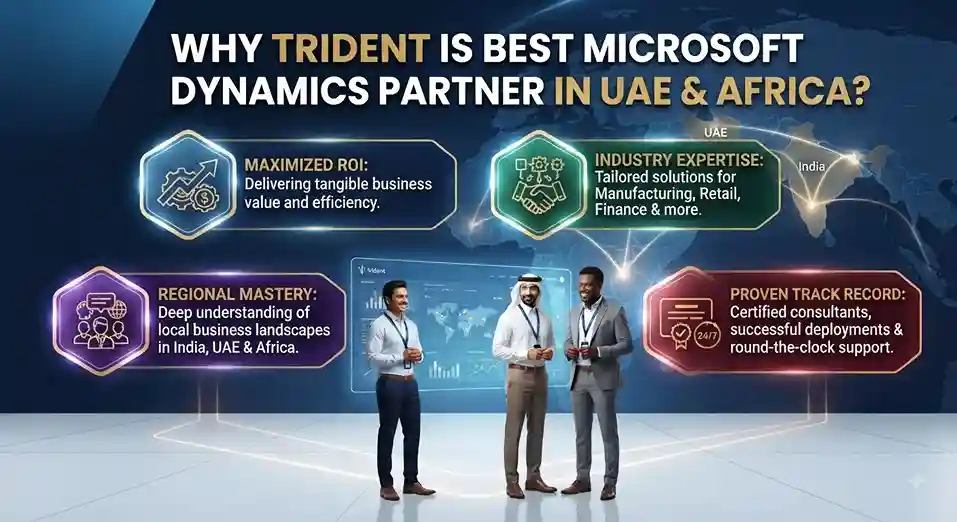
Trident Microsoft Dynamics partner delivering ERP implementation, migration, customization, and support across India, UAE, and Africa.

Why Trident is best Microsoft Dynamics Partner in India, UAE & Africa

Trident Information Systems is a Microsoft Solutions Partner with 25+ years of delivery experience and 250+ Dynamics 365 implementations across India, the UAE, Nigeria, Kenya, Ethiopia, and South Africa. We help mid-size and enterprise businesses in retail, manufacturing, hospitality, supply chain, and automotive move onto Dynamics 365 and get real, measurable value out of it — not just a go-live date. Whether you’re evaluating your first ERP, migrating off Dynamics NAV or AX, or looking for a Microsoft Dynamics 365 partner in Dubai, Nigeria, Kenya, or South Africa with people on the ground who understand your market, our teams across these regions support the full lifecycle: requirement discovery, implementation, data migration, integration, and ongoing support. Why businesses across India, UAE & Africa choose Trident Deep regional presence, not a fly-in consultancy. We operate with dedicated teams across India, the UAE, Nigeria, and East Africa — so when you need a Microsoft Dynamics partner in Kenya or a Microsoft ERP partner in Nigeria, you’re working with consultants who understand local tax, compliance, and business practice, not a generic offshore desk. A track record Microsoft itself has recognized. Trident has twice been named to the Microsoft Dynamics President’s Club — an honor reserved for the top 5% of Dynamics partners worldwide by customer success and growth. We’ve also been ranked among the top 5 strategic Microsoft partners for Dynamics AX in Retail in India, and we hold LS Central Diamond Partner status for retail and hospitality. Breadth across the Microsoft stack. As a Microsoft Solutions Partner, we implement and support: 190+ certified technical and functional resources, giving you the bench strength for implementation, staff augmentation, and 24/7 managed support — without the resourcing risk of a boutique shop. Industries we serve Our strongest domain expertise is in retail, e-commerce, food service and manufacturing, construction and real estate, logistics and transportation, hospitality, and automotive — verticals where off-the-shelf ERP configuration rarely fits and real industry knowledge shortens the path to go-live. Where we operate India — Headquartered in New Delhi, with the largest share of our certified Dynamics 365 and Business Central consulting bench. If you’re comparing Microsoft Dynamics 365 partners in India, we’re one of the longer-standing names in the market, going back over two decades. UAE — Active on-the-ground operations supporting Dubai, Abu Dhabi, and Sharjah, with Dynamics 365 configurations built around UAE VAT and Corporate Tax requirements. If you’re searching for a Microsoft Dynamics 365 partner in Dubai or UAE, our regional team handles implementation, NAV/AX migration, and managed support locally. Nigeria & East Africa — A growing focus area for Trident, supporting retail and e-commerce businesses across Nigeria (including Port Harcourt and Lagos), Kenya, and Ethiopia. If you’re looking for a Microsoft Dynamics partner in Nigeria or a Microsoft ERP partner in Kenya, our team works directly with local business and IT leadership — not through a remote-only model. South Africa & broader Africa — Delivery support for Dynamics 365 and Business Central implementations extending across the wider African market, complementing our Nigeria and East Africa presence. What working with Trident looks like Ready to talk to a Dynamics 365 partner who knows your market? Whether you’re in Delhi, Dubai, Lagos, Nairobi, or Johannesburg, Trident’s regional teams are ready to scope your Dynamics 365, Business Central, or CRM implementation. Contact Trident Information Systems.

Why Trident is best Microsoft Dynamics Partner in India, UAE & Africa Read More »

IoT dashboard monitoring connected devices, real-time analytics, and business operations.

IoT Applications for Business: How the Internet of Things Is Transforming Operations Across Every Industry

Every physical object in your business — every machine, vehicle, sensor, package, and piece of equipment — is generating data. The question is whether your organization is capturing it, analyzing it, and acting on it. The Internet of Things (IoT) is the technology infrastructure that makes this possible. By embedding sensors, connectivity, and software into physical devices and environments, IoT creates a continuous stream of real-world data that organizations can use to operate more efficiently, respond faster to problems, serve customers better, and make decisions based on what is actually happening — not what someone reported happening yesterday. The business case for IoT is no longer theoretical. Organizations across agriculture, e-commerce, healthcare, manufacturing, transportation, and enterprise operations are deploying IoT applications to solve specific operational problems — and achieving measurable, documented results. Farmers are optimizing water usage through soil moisture sensors. Manufacturers are predicting equipment failures before they happen. Transport operators are tracking goods in real time across global supply chains. This guide covers the practical reality of IoT applications for business — what IoT is, how it works, where it is delivering the most significant value across six major industries, and how Microsoft Azure IoT provides the enterprise-grade platform that makes business IoT scalable and secure. What Is IoT and Why Does It Matter for Business? The Internet of Things refers to the network of physical devices — machines, vehicles, sensors, appliances, wearables, and infrastructure — that are embedded with software, sensors, and connectivity to collect and exchange data over the internet or a private network. In practical terms, IoT is about closing the gap between the physical world and the digital world. In a traditional business environment, data about physical operations — machine performance, vehicle location, inventory levels, environmental conditions — had to be collected manually, which meant it was always delayed, often inaccurate, and expensive to gather at scale. IoT eliminates this gap by making physical assets continuously self-reporting — feeding real-time operational data into business systems automatically, without human intervention. The Core Components of an IoT System Every IoT deployment, regardless of industry or application, consists of four fundamental components: 1. Devices and sensors — the physical layer that collects data from the real world. Temperature sensors, motion detectors, GPS trackers, RFID readers, smart meters, industrial monitoring equipment, and thousands of other device types. 2. Connectivity — the communication layer that transmits data from devices to processing systems. Wi-Fi, cellular (4G/5G), Bluetooth, LoRaWAN, Zigbee, and satellite connectivity are all used depending on the application’s range, power, and bandwidth requirements. 3. Data processing and analytics — the intelligence layer that receives raw sensor data, processes it, applies business rules and analytical models, and generates actionable insights. Cloud platforms like Microsoft Azure IoT Hub provide this capability at enterprise scale. 4. Applications and interfaces — the user layer where insights and controls are made accessible to the people and systems that need them. Mobile applications, dashboards, automated alerts, and integration with ERP and CRM systems like Microsoft Dynamics 365 all operate at this layer. How IoT Creates Competitive Advantage for Organizations Organizations that deploy IoT effectively gain advantages that compound over time — because the data generated by IoT systems becomes progressively more valuable as it accumulates and as analytical models are refined: IoT Business Applications Across 6 Major Industries 1. IoT in Agriculture: Precision Farming and Resource Optimization Agriculture is one of the sectors most profoundly transformed by IoT — moving from experience-based farming practices to data-driven precision agriculture that optimizes every input for maximum yield and minimum waste. Key IoT applications in agriculture: For a sector historically characterized by low technology adoption, IoT is delivering some of the most dramatic productivity and sustainability gains of any industry — with direct implications for food security at a global scale. 2. IoT in E-Commerce: Smarter Inventory, Logistics, and Customer Insights E-commerce businesses compete on speed, accuracy, and the quality of the customer experience — and IoT is a critical enabler of all three at scale. Key IoT applications in e-commerce: 3. IoT in Healthcare: Remote Patient Monitoring and Equipment Management Healthcare is one of the highest-impact domains for IoT — where connected devices can directly improve patient outcomes, reduce the cost of care, and enable healthcare delivery models that were previously impossible. Key IoT applications in healthcare: The growing market for IoT-based healthcare applications reflects both the scale of the opportunity and the maturity of the technology — with remote patient monitoring alone projected to be one of the fastest-growing segments of digital health investment globally. 4. IoT in Enterprise Operations: Connected Workforce and Process Intelligence For enterprises across every sector, IoT provides the visibility and automation capability to optimize operations, reduce costs, and improve employee productivity through connected workplace technologies. Key IoT applications in enterprise operations: 5. IoT in Transportation and Logistics: Real-Time Tracking and Fleet Management Transportation and logistics is one of the earliest and most mature IoT application domains — with GPS tracking and telematics predating the broader IoT movement. Modern IoT capabilities have dramatically extended what is possible. Key IoT applications in transportation and logistics: 6. IoT in Manufacturing: Industry 4.0, AI, and Machine Learning Manufacturing is the industry where IoT delivers the most direct and measurable ROI — and where the convergence of IoT with artificial intelligence and machine learning is creating the most transformative operational improvements. Key IoT applications in manufacturing: IoT and Mobile Applications: How They Work Together The relationship between IoT and mobile applications is increasingly central to how both technologies deliver value — particularly in enterprise and field service contexts. Mobile as the Interface for IoT Data and Control For many IoT deployments, the mobile application is the primary user interface — the means by which workers, managers, and customers interact with the data and control capabilities that IoT sensors and systems generate: Enterprise Mobile IoT Applications in Practice The convergence of IoT and mobile is particularly powerful in enterprise environments where workers are mobile and operations are

IoT Applications for Business: How the Internet of Things Is Transforming Operations Across Every Industry Read More »

AI-powered visual inspection system detecting product defects on a manufacturing production line.

Visual Quality Inspection Systems for Manufacturing: How AI-Powered Vision Intelligence Is Eliminating Defects at Scale

In manufacturing, quality is not just a standard — it is a commercial obligation. A defective product that reaches the customer costs far more than the product itself: warranty claims, returns, reputation damage, regulatory penalties, and in industries like pharmaceuticals and automotive, potential safety liability. For decades, quality control in manufacturing depended almost entirely on human visual inspection — trained inspectors examining products at the end of the production line, relying on their eyes, experience, and concentration to detect defects before they reached the customer. The problem is that human inspection has fundamental, irreducible limitations. Attention lapses. Fatigue accumulates. Lighting conditions vary. And no matter how experienced the inspector, the error rate in human visual inspection means that some proportion of defective products will always pass through. Visual quality inspection systems — powered by digital imaging, optical sensors, AI, and machine learning — eliminate these limitations entirely. By replacing or augmenting human inspection with automated machine vision, manufacturers across automotive, pharmaceutical, FMCG, tobacco, and consumer goods industries are achieving inspection accuracy and throughput levels that human-only quality control simply cannot match. Trident’s Vision Intelligence System (VIS) platform brings industry-specific visual inspection solutions to manufacturers across India — with dedicated configurations for automotive, pharma, retail and FMCG, tobacco manufacturing, and safety compliance applications including face mask detection. This guide covers everything you need to know about visual quality inspection systems — how they work, what they deliver, and how Trident’s VIS platform addresses the specific inspection requirements of your industry. Why Manual Quality Inspection Is No Longer Enough The Real Cost of Human Error in Manufacturing Quality Control Manual visual inspection has served manufacturing quality control for generations — but its limitations have always been present. The critical question is not whether human inspectors make errors — they do, consistently and predictably — but whether those errors are acceptable given the commercial and safety stakes involved. In most modern manufacturing environments, they are not: What Modern Visual Quality Inspection Systems Replace Visual quality inspection systems do not just make existing inspection processes faster — they replace the fundamental dependency on human judgment for defect detection with objective, measurable, consistently applied machine vision criteria. The result is a quality control function that operates at production speed, maintains consistent accuracy across every shift and every unit, generates quantitative defect data for process improvement, and enables real-time corrective action before defective products progress further down the production line. What Is a Visual Quality Inspection System and How Does It Work? A visual quality inspection system is an automated quality control solution that uses digital cameras, optical sensors, and computer vision software to capture images of products during or after production — and then analyzes those images against defined quality parameters to accept or reject each unit. The Core Components of a Machine Vision Inspection System Every visual quality inspection system — regardless of industry application — consists of four fundamental components working together: 1. Imaging hardware — high-resolution digital cameras, line scan cameras, or 3D imaging systems capture images of every product as it moves through the production or inspection station. The choice of imaging hardware depends on the product type, production speed, and the nature of the defects being detected. Lighting systems — LED ring lights, backlit panels, structured light projectors — are configured to maximize defect visibility for the specific inspection application. 2. Sensor integration — RFID tags, QR codes, barcode readers, and proximity sensors provide product identification and triggering signals — ensuring the imaging system captures each unit at precisely the right moment and associates inspection results with specific product batches and serial numbers. 3. Image processing and AI analysis — captured images are processed in real time by computer vision algorithms — including deep learning models trained on examples of acceptable and defective products. The system measures specific characteristics: dimensions, surface finish, color consistency, label placement, fill levels, seal integrity, and hundreds of other parameters depending on the application. AI-powered systems continuously improve their detection accuracy as they accumulate inspection data. 4. Decision and action layer — based on the analysis results, the system makes an accept or reject decision for each unit — and triggers appropriate actions: pass-through for accepted units, diversion or rejection for non-conforming units, and alert generation for systematic defect patterns that indicate a production process issue requiring investigation. How Visual Inspection Systems Make Decisions Modern visual quality inspection systems make inspection decisions through a combination of traditional machine vision techniques and AI-powered deep learning: 5 Key Benefits of Visual Quality Inspection in Manufacturing 1. Faster Inspection Without Sacrificing Accuracy The most immediate and measurable benefit of automated visual inspection is the combination of inspection speed and accuracy that no human inspection process can match. A machine vision system can inspect hundreds or thousands of units per minute — at full production line speed — without the accuracy degradation that accompanies high-speed human inspection. For high-volume manufacturers, this means quality control no longer constrains production throughput — the inspection system keeps pace with production, not the other way around. The time savings extend beyond the inspection process itself. Automated inspection systems generate instant, quantitative results — eliminating the documentation, reporting, and data compilation time associated with manual inspection processes. 2. Elimination of Human Error From Quality Control Human inspection error is not a management or training problem — it is a physiological reality. The human visual system has limitations in resolution, consistency, and sustained attention that cannot be overcome through training or motivation. Visual quality inspection systems have no such limitations: The practical result is a dramatically lower defect escape rate — the proportion of defective products that pass inspection and reach the customer or the next production stage. 3. Adaptable to Every Production Process and Use Case One of the most commercially significant characteristics of modern visual quality inspection systems is their adaptability. When production parameters change — new product variants, modified specifications, updated packaging, new defect types — the inspection system can be

Visual Quality Inspection Systems for Manufacturing: How AI-Powered Vision Intelligence Is Eliminating Defects at Scale Read More »

Smart factory using IoT devices and automation for real-time manufacturing monitoring.

How Smart Manufacturing and IoT Are Transforming the Factory Floor

Introduction Every unplanned machine breakdown costs a manufacturer time, money, and customer trust. Every quality defect that slips through costs even more. The hard truth is that most of these losses are preventable — if you have the right data at the right time. That is exactly what Smart Manufacturing and the Industrial Internet of Things (IIoT) are built to deliver. When machines, sensors, and systems are connected and sharing data in real time, manufacturers stop reacting to problems and start preventing them. Production lines run leaner. Quality becomes consistent. And the gap between what the factory floor produces and what management can actually see shrinks to almost nothing. This article breaks down how that works in practice — and why manufacturers who are not already investing in connected systems are falling behind those who are. What Is Smart Manufacturing? (And Why the Definition Matters) The term “IoT” was coined by Peter T. Lewis to describe “the integration of people, processes, and technology with connectable devices and sensors to enable remote monitoring, real-time control, and data-driven decision-making.” But here is the part most explainers skip: smart manufacturing is not about adding technology for its own sake. It is about closing the gap between what is happening on the shop floor and what decision-makers know about it. In a traditional factory, that gap is wide. A machine can be underperforming for weeks before a supervisor notices. A quality issue can affect hundreds of units before it is caught. A maintenance window gets scheduled on gut instinct, not data. In a smart factory, that gap is nearly zero. The Core Engine: Sensors, Connectivity, and Real-Time Data Smart manufacturing is built on three layers that work together: 1. Sensors — the factory’s nervous system Sensors attached to machines, conveyor belts, assembly stations, and environmental systems continuously collect data — temperature, vibration, pressure, speed, output rate, energy consumption, and dozens of other variables. They do this 24/7, without human involvement. The moment a reading drifts outside a set parameter, the system knows. Even if no one is watching. 2. Connectivity — getting data where it needs to go Raw sensor data is useless if it stays on the machine. Connectivity — whether via Wi-Fi, MQTT protocols, edge gateways, or cloud pipelines — moves data from individual devices to a central system where it can be processed and analysed. Every connected device on the floor contributes to a shared, factory-wide picture. Every disconnected device is a blind spot. For manufacturers managing sensitive production data, this also raises a critical question: where does the data live? On-premises, in a private cloud, or a hybrid setup? The answer depends on your security requirements, your IT infrastructure, and how quickly you need to act on the data. There is no universal right answer — but there is definitely a wrong one, which is not thinking about it at all. 3. Data analysis — where the value actually lives Collected data means nothing without interpretation. Modern smart manufacturing platforms apply analytics — and increasingly, machine learning — to turn streams of sensor readings into actionable intelligence: This is the shift from descriptive reporting (“here is what happened”) to predictive and prescriptive intelligence (“here is what will happen, and here is what to do about it”). Key Benefits of Smart Manufacturing — What Manufacturers Actually Gain Predictive maintenance that prevents unplanned downtime Unplanned downtime is one of the most expensive problems in manufacturing. Industry estimates put the average cost at thousands of dollars per hour — and in some sectors, far more. Smart manufacturing flips the model. Instead of waiting for a machine to break and then fixing it (reactive), or scheduling maintenance on a fixed calendar (preventive), predictive maintenance uses real-time sensor data to detect the early warning signs of failure — unusual vibration patterns, rising temperatures, changes in motor current — and flags them before they cause a breakdown. The result: maintenance teams intervene exactly when they need to, not before (wasted resource) and not after (costly downtime). Consistent quality and fewer defects Every production process has variables. Raw material variations, temperature fluctuations, operator differences, tool wear — any of these can push output outside acceptable tolerances. In a smart factory, quality monitoring happens continuously, at every stage of production. Statistical process control systems track output quality in real time and alert operators the moment a process starts drifting. Defects get caught at the source, not at final inspection — or worse, at the customer. For manufacturers in precision-sensitive sectors like automotive components, medical devices, or electronics, this is not a nice-to-have. It is a competitive requirement. End-to-end production visibility Smart manufacturing gives plant managers, production supervisors, and customers something that has historically been surprisingly difficult to obtain: an accurate, real-time picture of what is actually happening. When this information is available instantly — on a dashboard, on a mobile device, from anywhere — decision-making speeds up dramatically. Problems get escalated in minutes, not hours. Smart Manufacturing in Automotive Component Manufacturing Automotive component manufacturing deserves specific attention. It is one of the largest and most demanding sectors in global manufacturing, and it illustrates the value of smart manufacturing particularly well. Automotive components are complex, high-precision, and produced at scale. Tolerances are tight. Quality requirements are strict. And the supply chain consequences of a defect reaching an OEM can be severe. Smart manufacturing addresses this in two directions: For the manufacturer: Connected sensors and real-time analytics ensure maximum process consistency. Predictive maintenance reduces the risk of unplanned stoppages mid-production run. Data on machine performance, cycle times, and output quality gives plant managers the visibility to optimise continuously rather than periodically. For the customer: Real-time production data means customers are no longer in the dark about order status. Production milestones, completion estimates, and quality sign-offs can be communicated proactively, not reactively. That visibility strengthens the commercial relationship. What Needs to Be in Place Before You Connect the Factory Smart manufacturing does not require ripping out existing infrastructure and starting

How Smart Manufacturing and IoT Are Transforming the Factory Floor Read More »

Microsoft Dynamics 365 Business Central dashboard managing finance, inventory, and business operations.

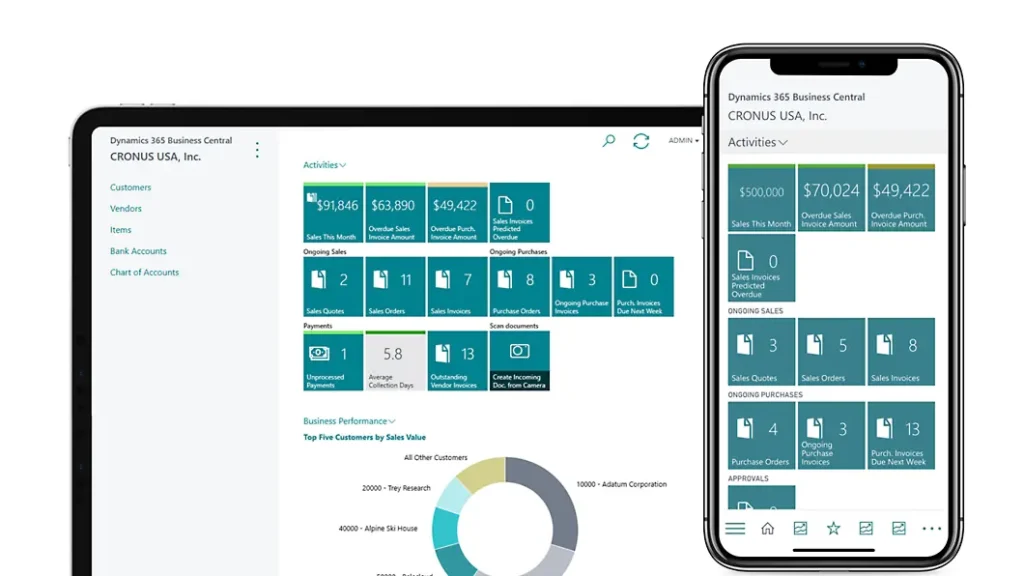
Microsoft Dynamics 365 Business Central: The All-in-One ERP Solution for Growing Businesses

Growing businesses reach a point where spreadsheets, disconnected accounting software, and manual processes stop being inconveniences and start being strategic risks. Inventory decisions made without real-time stock data. Financial close processes that take weeks instead of days. Sales teams working from customer records that do not reflect the latest service interactions. Supply chain planning that cannot see production capacity in real time. These are not just operational frustrations — they are competitive vulnerabilities in a market where speed and accuracy determine which businesses grow and which ones stall. Microsoft Dynamics 365 Business Central is built for exactly this inflection point. It is an all-in-one business management solution that connects finance, sales, supply chain, manufacturing, project management, and service operations on a single, intelligent platform — giving growing businesses the end-to-end visibility, automation depth, and real-time intelligence they need to make better decisions and accelerate growth. As the evolution of Microsoft Dynamics NAV — one of the world’s most widely deployed mid-market ERP platforms — Business Central combines the deep functional capability that NAV users trusted with the cloud-native architecture, embedded Power BI analytics, and Microsoft 365 integration that modern businesses require. Trident Information Systems is a certified Microsoft Dynamics 365 Business Central implementation partner — helping businesses across manufacturing, retail, professional services, and distribution implement, configure, and maximize the value of Business Central across India. This guide covers every major capability of Dynamics 365 Business Central — what it does, how it works, and what it delivers for growing businesses. What Is Microsoft Dynamics 365 Business Central? Microsoft Dynamics 365 Business Central is an all-in-one cloud ERP solution designed for small and mid-size businesses that need a single, integrated platform to manage their entire operation — without the complexity and cost of enterprise-grade ERP systems like Dynamics 365 Finance and Operations. The Evolution of Dynamics NAV: Built for Modern Business Business Central is the direct successor to Microsoft Dynamics NAV — one of the most successful mid-market ERP platforms in the world, with hundreds of thousands of deployments across more than 170 countries. If your organization is currently running Dynamics NAV, Business Central is your natural upgrade path — preserving the functional depth and business logic you depend on while adding cloud delivery, embedded AI, real-time analytics, and modern Microsoft 365 integration. For new implementations, Business Central offers the fastest path to a fully integrated business management platform — with preconfigured industry templates, rapid deployment methodology, and no-code customization tools that allow businesses to adapt the system to their specific processes without expensive custom development. Who Is Dynamics 365 Business Central Designed For? Business Central is designed for: Financial Management: Real-Time Intelligence Across Every Account Financial management is the operational core of Business Central — built to give finance teams the real-time visibility, automation, and control they need to close faster, report more accurately, and forecast with confidence. Make Informed Decisions With End-to-End Financial Visibility Business Central connects data across accounting, sales, purchasing, inventory, and customer interactions — creating a single, continuously updated financial picture of your business. Built-in Power BI dashboards display financial performance in real time, with drill-down capability from summary KPIs to individual transaction level: Accelerate Financial Close and Reporting Manual financial close processes consume weeks of finance team capacity every period — reconciling accounts, chasing documentation, and correcting errors that automated systems would have caught immediately. Business Central streamlines the entire close cycle: Improve Forecast Accuracy With Multi-Dimensional Analysis Business Central’s forecasting capabilities give finance and leadership teams the tools to model future performance with confidence: Core Financial Capabilities: GL, Fixed Assets, Receivables, and More Business Central’s financial module covers every dimension of business accounting: Customer Relationship Management: Deliver Value at Every Touchpoint Business Central includes integrated CRM capabilities — giving sales teams the customer intelligence, opportunity management tools, and productivity features they need to close more deals and build stronger relationships. Prioritize Leads, Track Interactions, and Close More Deals Boost Sales Productivity From Within Microsoft Outlook One of Business Central’s most practically impactful capabilities is its deep integration with Microsoft Outlook — the tool most sales professionals already spend the majority of their working day in: Dynamics 365 Business Central and Dynamics 365 Sales Integration For organizations that require deeper CRM functionality than Business Central’s native capabilities provide, Dynamics 365 for Sales integration is available natively — synchronizing sales orders, item availability, units of measure, and currencies between the two platforms in a few straightforward steps. Supply Chain Management: Automate, Optimize, and Protect Margins Business Central’s supply chain capabilities give purchasing, inventory, and operations teams the intelligence and automation to maintain optimal stock levels, avoid costly shortages, and protect margins through smarter procurement. Optimize Inventory Levels With Built-In Intelligence Avoid Stockouts and Lost Sales With Automated Replenishment Stockouts are one of the most costly and preventable operational failures in any product-based business. Business Central eliminates them through: Purchase and Sales Order Management Warehouse Management: Basic and Advanced Business Central’s warehouse management can be configured at different complexity levels — from basic order-by-order processing for simpler operations to advanced multi-order consolidation for high-volume distribution environments: Manufacturing: From Planning to Production to Delivery Business Central provides integrated manufacturing capabilities for companies that produce goods — from simple assembly operations through complex multi-level production with subcontracting. Production Planning and Capacity Optimization Subcontracting and Assembly Management Service Order Management: From After-Sales to Contract Management Business Central provides a complete service management framework — giving service operations teams the tools to manage service requests, service contracts, field technician dispatch, and pricing across the full service lifecycle: Project Management: Stay on Budget, Deliver on Time Business Central’s project management capabilities give professional services organizations and project-based businesses the tools to plan, track, and deliver customer projects profitably: Job Costing, Timesheets, and Resource Planning Analyze Project Profitability in Real Time Human Resources and Expense Management Business Central includes foundational human resources and expense management capabilities — giving HR and finance teams a single system for employee data and expense processing: Power

Microsoft Dynamics 365 Business Central: The All-in-One ERP Solution for Growing Businesses Read More »

Microsoft Dynamics 365 Integration Services connecting business applications, data, and workflows.

Microsoft Dynamics 365 Integration Services: Connect Your Applications, Data, and Processes — Seamlessly

Every enterprise runs on more applications than it can easily count. A CRM here. An ERP there. A website that does not talk to either. A mobile app that syncs to a database once a night. A marketing platform that receives a weekly export. A finance system that requires manual reconciliation with the sales data that should be feeding it automatically. This is not a technology problem. It is a strategy problem — and it compounds with every new system your business adds. Microsoft Dynamics 365 integration services solve this at the architectural level. By connecting your Dynamics 365 environment — and every other application, data source, and process in your business ecosystem — through Microsoft Azure, Power Automate, and Microsoft Dataverse, Trident enables your organization to operate with the speed, accuracy, and agility that modern business demands. Whether you are implementing Dynamics 365 for the first time, upgrading from a legacy ERP, or trying to rationalize a complex multi-system environment that has grown organically over years — Trident’s integration consultants will architect a solution that ensures your data flows where it needs to, when it needs to, without manual intervention, without data loss, and without the security risks that come from poorly designed integration architectures. This is not about connecting systems. It is about connecting your business. Why Seamless Integration Is Now a Business Imperative The Hidden Cost of Disconnected Systems and Data Silos Most businesses underestimate the cost of their disconnected systems — because the cost is distributed across dozens of daily processes that have been manual for so long, nobody questions them anymore. The sales team copies data from the CRM into a spreadsheet to send to operations. The finance team waits for the month-end export from the sales system to reconcile revenue. The warehouse team checks inventory in one system and updates orders in another. The marketing team sends campaigns to a list that was last synchronized three days ago. Each of these manual steps is a cost: time spent, errors introduced, decisions delayed, and opportunities missed. At enterprise scale, the aggregate cost of data silos is enormous — and entirely preventable with the right integration architecture. What True Integration Looks Like in a Modern Business True integration is not connecting two systems with a point-to-point API that breaks every time either system updates. It is a resilient, scalable integration architecture that: This is the integration architecture that Trident designs, builds, and maintains for organizations running Microsoft Dynamics 365 across India. Trident’s Microsoft Dynamics 365 Integration Approach Right Data, Right Place, Right Time — Every Time The success of any ERP or CRM implementation depends fundamentally on data quality and data availability. A Dynamics 365 deployment that does not receive accurate, timely data from every connected system is a Dynamics 365 deployment that is not delivering its full value. Trident’s integration philosophy is built around a simple principle: the right data, in the right place, at the right time. Our integration consultants work with your team to understand every data flow your business depends on — and architect an integration solution that makes those flows automatic, reliable, and auditable. Our most common integration scenarios include: On-Premises, Cloud, and Hybrid Integration Capabilities Not every business is ready to move everything to the cloud simultaneously — and not every system can be. Trident’s integration capabilities cover the full deployment spectrum: Microsoft Azure: The Integration Foundation Azure Integration Services: Power, Security, and Global Scale Microsoft Azure is the cloud platform that powers Trident’s integration solutions — providing the security, scalability, and global infrastructure that enterprise integration requires. Azure’s integration services give organizations access to: Hybrid Cloud Connectivity: Maximize Value From Existing Investments One of the most compelling capabilities of Azure’s integration platform is its hybrid connectivity — allowing organizations to connect on-premises systems to cloud services without replacing existing infrastructure. The Azure On-Premises Data Gateway enables secure, encrypted connectivity between cloud-based Power Automate workflows and on-premises data sources — including databases, file systems, and legacy applications — without opening inbound firewall ports or compromising on-premises security posture. For organizations managing a mixed environment of legacy on-premises systems and modern cloud applications during a digital transformation journey, this hybrid connectivity is the bridge that makes a phased approach viable. Microsoft Power Automate: Automate Workflows Without Code Microsoft Power Automate (formerly Microsoft Flow) is the workflow automation layer that connects everyday business applications and automates repetitive processes — without requiring any code. For business users who need to automate a specific process and for IT teams building enterprise integration workflows, Power Automate provides a no-code interface for creating automated workflows between hundreds of supported applications and services. Multi-Step Workflows and Conditional Logic Power Automate’s workflow engine goes far beyond simple “if this then that” automation. Enterprise-grade workflows can include: Practical examples of Power Automate integration for Dynamics 365: Secure Data Management and Loss Prevention Data security is not an afterthought in Power Automate — it is built into the architecture: On-Premises Data Gateway: Connect Legacy Systems to the Cloud The On-Premises Data Gateway for Power Automate enables secure connectivity to on-premises data sources — including SQL Server, Oracle, SharePoint on-premises, and file system sources — without exposing those systems directly to the internet. This capability is critical for organizations in the middle of a digital transformation journey — where some systems have moved to the cloud but others remain on-premises for operational, compliance, or cost reasons. The gateway acts as a secure bridge — enabling cloud-based workflows to access on-premises data as if it were a cloud service. Microsoft Dataverse: The Single Source of Truth for Your Business Data Microsoft Dataverse (formerly Common Data Service) is the unified data platform at the heart of the Microsoft Dynamics 365 and Power Platform ecosystem — providing a standardized, secure, and governed data layer that every connected application can use as a shared source of truth. A Unified Data Layer Across Every Business Application Rather than each application maintaining its own separate database

Microsoft Dynamics 365 Integration Services: Connect Your Applications, Data, and Processes — Seamlessly Read More »